Appendix F Reviews of practices and self-tests
Come back to the analysis after your own attempt. For observations, evaluate the clarity of the recording and the distinction between inference and assumption. For calculations, check the original rules and intermediate steps. Research continuations allow for several informed decisions. The self-test retains questions from the chapter; here are the answers.
Chapter 1 Analysis of practice
There is no single list of sensations here. The work is done if the external fact, description and explanation can be distinguished from the record. The greater number of details in the second attempt does not yet establish the enrichment of the experience itself: attention, memory and vocabulary could change. A good remaining question is naming the alternatives and the next comparison.
Self-test answers
1. The phrase reports a change in sensation and explains it by a physical change in the object. Reasons are needed for both the heating claim and the causal connection. One experienced change allows for several explanations.
2. Yes, if we are talking about how a specific episode was experienced. This message must be distinguished from a stable preference or general judgment about the quality of a thing. The decision is determined by the meaning of the statement.
3. Differences between records have been established. It may reflect changes in experience, attention, memory, or language. Further comparisons will be required to infer the cause. The sheer number of details is not a measure of the amount of consciousness.
Chapter 2 Analysis of practice
The correspondence of the map to the original relationships is checked. If the numbers were given only the order, there is no need to require an exact coincidence of all distances. An unstable answer cannot be silently corrected for the sake of beautiful geometry. In the exploratory continuation, the usefulness of the model is assessed based on new, pre-predicted relationships.
Self-test answers
1. The name can unite cases by material, purpose or familiar category. Descriptions of experiences and pairwise comparisons define other relationships. It is necessary to clarify on what basis the grouping is made.
2. Its meaning depends on the instructions. It can only indicate a place in the ranking order. A statement about an exact ratio of quantities, such as “twice as strong,” requires a separate basis.
3. You should determine in advance which relationships or new cases the model will predict better. Then use the data that was not involved in the selection of coordinates. Improving the drawing on the same four points does not yet show the ability to explain something new.
Chapter 3 Analysis of practice
The immobility of the hand does not negate the ownership, and the control of the pointer does not make it part of the body. The past authorship of a note is not identical to the current action. It is not necessary to have the same experiences in different people; it is required to maintain the differences between the issues and not to deduce the internal attitude solely from the external event.
Self-test answers
1. Control refers to the connection between the command and the outcome. Belonging refers to whether an object is given as part of one's own body. These relationships can be combined, but one does not determine the other.
2. The actual authorship is determined by the causal chain of events. The sense of authorship is studied as an experienced attitude towards action and through corresponding reports. They may diverge, and this discrepancy itself requires explanation.
3. A name is an element of self-description. It does not explain spatial perspective, bodily identity, experienced action, or the testing of one's own judgments. A utility model must indicate which of these problems it solves and by what mechanism.
Chapter 4 Analysis of practice
Answers: erasers; the presence of a large green card is not necessary; Peter came last. In the second case, all the green ones can be small round ones, and the big round ones can have a different color. This is a counterexample that satisfies the conditions and refutes the necessity of the conclusion. The task shows the relationship between a prediction and a subsequent test, rather than measuring the general level of self-awareness.
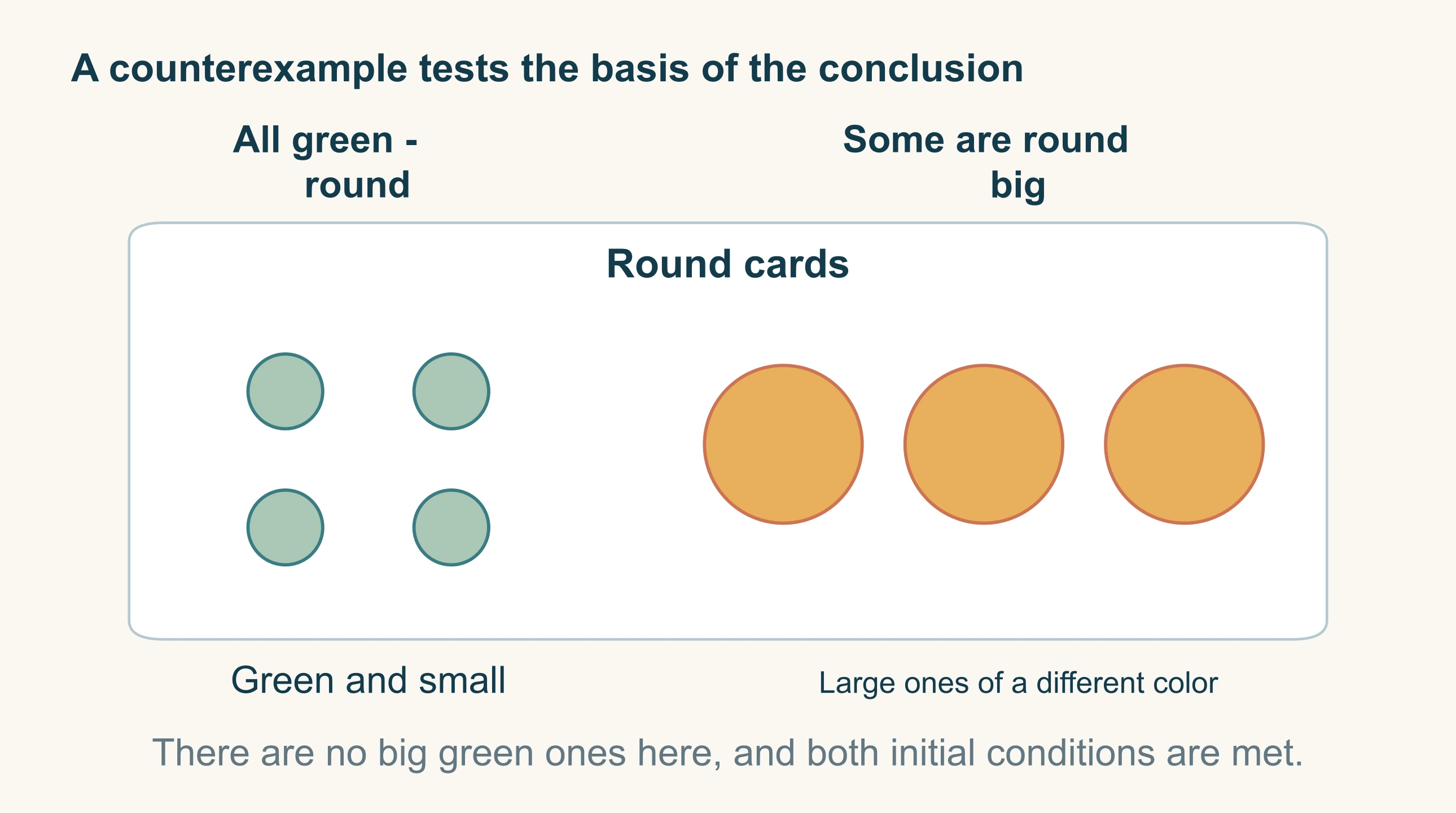
Figure 9. Checking logical inference with a counterexample. All the green cards in the diagram are round, and some of the round cards are large. However, there are no big green ones: the initial conditions do not guarantee such a conclusion, and the counterexample shows a specific gap in the reasoning.
Self-test answers
1. Feedback adds information and allows the construction of a new way of explaining. It is necessary to distinguish between initially noticed steps, later memory and reconstruction taking into account the correct answer.
2. Yes. One can attribute equal confidence to almost all answers. Overall success and the ability to direct the check to probable errors will then be different characteristics.
3. State the type of task, the observed error, and the intended process, then suggest a specific change to the procedure. After this, compare the results on new comparable tasks, taking into account possible alternative reasons for the improvement.
Chapter 5 Analysis of practice
Comparing the diary with an equal pause begins to separate the proposed versions. It still requires measurement, comparable tasks and order control. If the chosen metric only reflects an increase in description length, the conclusion about improved discrimination is not yet assured. Good work preserves this limitation and offers the following comparison.
Self-test answers
1. A mechanism shows how the parts interact to produce an outcome, including the conditions and sequence of changes. The parts list does not explain how they work together.
2. A metric can affect, depend on, or change with a report due to another process. Discrimination requires additional data and appropriate interventions.
3. What is needed is a well-founded bridge between the realized function and the experience: a theory of correspondence, its scope, and tests of alternatives. Success in recognition itself establishes the completion of the task, and further inference requires an additional argument.
Chapter 6 Analysis of practice
Checking an item determines its external properties. The original report refers to its procedure and is not rewritten by later knowledge. A specification is useful if another person can repeat the instructions and determine exactly when the information became available. Consensus across multiple indicators requires testing common causes rather than counting votes.
Self-test answers
1. Lack of recall may occur after an episode or reflect the difficulty of the issue. It is necessary to distinguish between experiencing, storing information and the ability to communicate it at the moment.
2. It shows the successful use of information in a specific task. Conclusions about clarity, completeness of experience and other properties require additional data and a reasonable connection with them.
3. All three indicators may depend on the overall process, such as response preparation. Consensus becomes more meaningful when such common causes are tested and it is shown which alternative explanations are ruled out by a combination of methods.
Chapter 7 Analysis of practice
The long entry may be due to dictionary, format training, and timing. To draw a conclusion about discrimination, a corresponding new result is needed. The four distributions help to separate the material, order and method of work. If all outcomes are declared as confirmation, the hypothesis does not yet specify a testable difference.
Self-test answers
1. In one condition, a person can read all the time, and in another, spend part of the time on the diagram. The comparison makes some sense given the overall budget, but the internal operations remain different.
2. It breaks the systematic choice of condition based on the known characteristics of the participants and sets the distribution procedure. However, in a small group, the composition of conditions may accidentally be different.
3. A new hypothesis arose taking into account the patterns already seen. For independent verification, new data or a previously separated part of data that was not used in its formulation is needed.
Chapter 8 Analysis of practice
In the fourth repetition, the difference is minus twenty points, in the sixth, plus twenty. According to the conditions of the educational generator, the modes are the same, but individual assessments fluctuate. Inaccuracy may require new independent data; precise exclusion of an important effect limits the hypothesis; The dependence on the material requires a new check of the conditions. The number of rows does not replace the number of independent study units.
Self-test answers
1. Percentage points are the difference between the shares themselves. Relative growth is calculated relative to the baseline: ten divided by seventy, resulting in approximately fourteen percent.
2. The responses of the general model depend on certain parameters and training history. They help evaluate its behavior, but do not replace information about variability between independently created systems.
3. Yes, if the measurement is sufficiently accurate to exclude a priori significant improvement under specified conditions. With a wide range of compatible effects, the result remains uncertain, and the absence of a convincing signal does not prove the absence of an effect.
Chapter 9 Analysis of practice
For A, the impulse appears at the third step. B does not reach the threshold; the final state is approximately 0.921754. When storing zero, each non-zero input gives only 0.6, so there are no pulses in both sequences. What is explained is the dynamics of the chosen mechanism, not a universal property of neurons or consciousness.
Self-test answers
1. The rule uses not only the current input, but also the saved state. Different stories change the distance to the threshold.
2. The state describes the current dynamics under these rules. Learning changes the very parameters of these rules and thereby the behavior in future sequences.
3. It distinguishes between an explanation in terms of a total sum and an explanation in terms of temporary accumulation with leakage. The difference in outputs supports the role of the temporary structure in a given model.
Chapter 10 Analysis of practice
The direct rule and reprocessing may produce the same category. Coincidence itself does not select the mechanism. Two identical cards with different hidden labels show information ambiguity. Additional inference requires certain rules, equal available information, and a condition under which the answers diverge.
Self-test answers
1. The report depends on the question format, memory, timing and message sequence. To draw conclusions about experience, a reasonable connection with these processes is needed.
2. Context can be used by different architectures. One needs to compare models with comparable inputs and resources under conditions where their predictions differ.
3. To whom or what exactly is information available, for what operation and at what moment. The ability to categorize, report, remember, and check an answer cannot automatically be considered the same ability.
Chapter 11 Analysis of practice
History allows you to compare the effect with the previous command. For the selected delayed series, the connection is restored with a lag of two. If two mechanisms produce the same observations in all steps taken, there is no current data to choose from. The hidden column is needed by the evaluator, but should not participate in the calculations of the model under study.
Self-test answers
1. A common cause may be signals from external objects. Bodily belonging requires additional relations to the representation of the body and data about the corresponding experience.
2. New interventions on commands and impact comparisons. If the observations in two versions are the same, passive coincidence alone is not enough to confidently distinguish them.
3. The improvement may be due to overall memory capacity. To distinguish an organization by sources, you need to compare it with suitable alternatives and check the transfer to new conditions.
Chapter 12 Analysis of practice
Primary forecasts are approximately 0.500; 0.667; 0.750; 0.600; 0.667; 0.571. Their mean square error is about 0.309, for the constant model 0.250. This is the outcome of one short episode. When continuing, you need to start with the saved counters, and not repeat the original smoothing. It is the quality of the forecast that is tested, not the depth of the confidence experienced.
Self-test answers
1. It uses information that was previously missing. The forecast being tested must be fixed before feedback, otherwise a hint from the future arises.
2. Individual tasks may vary in difficulty and features available. The general history estimates the average reliability of the selected class, and the specific case requires additional information.
3. The update follows the specified rule. Explicit reflection considers the basis, applicability or limitations of this rule and may lead to the proposal and testing of another way of assessing.
Chapter 13 Analysis of practice
The complete system gives 10 out of 10 for both indicators. Without return, recognition and memory give 7 out of 10. Without transmission, recognition stores 10 out of 10, memory gives 4 out of 10; when both indicators are disabled, 7 and 4, respectively. A direct competitor gives 10 out of 10. These numbers come from the device and are not derived from a human study.
Reproduction: python teaching_lab.py --chapter 13
Self-test answers
1. Why aren't global propagation and recurrence strictly opposed?
Recurrence describes the return of influence, and globality describes the accessibility of content to different processes. The general exchange system can use feedback links. It is necessary to distinguish between supposed sufficient conditions and functions of specific interactions.
2. Does the disappearance of the report after the intervention prove the disappearance of the experience?
It doesn't prove it in itself. The intervention may have impaired memory, response selection, or instruction following. The conclusion is strengthened by independent indicators and monitoring of the preservation of these capabilities, although the problem of measurement does not completely disappear.
3. Why compare mechanisms with the same computing budget?
Otherwise, the advantage may be mistakenly attributed to a specific architecture, although one system simply received more processing steps. Control helps to determine whether the organization of interactions is necessary for the observed result.
Chapter 14 Analysis of practice
Success here means sharing responsibilities, not picking a winner. The specification should allow you to agree with the device and separately argue about the connection with the experience. Given the same predictions, there is not enough data to make a choice; in the absence of the necessary formalism, one cannot pass off an approximate scheme as a calculation of the criterion of the theory.
Self-test answers
1. Why is a high correlation between parts not sufficient to infer their mutual causal influence?
Both parts may depend on a third source. Causal inference requires additional premises, interventions, or a specifically justified dependency model.
2. Is reflection equal to any higher order representation?
No. Expanded reflection includes examining one's own reasons, comparing explanations and revising strategies. Representing the reliability of a current signal can serve a much narrower function.
3. Can a theory be mathematically precise and empirically controversial?
Yes. Precision allows consequences to be rigorously deduced from assumptions. Confirming that these assumptions and implications describe consciousness requires independent evidence and comparison with alternative explanations.
Chapter 15 Analysis of practice
For the signal on the right, the new probability is about 0.857. For the signal on the left, it is equal to 0.12 from the sum of 0.12 and 0.32, approximately 0.273. With direct communication, the command coincides with the side of the target, with reverse communication, it is the opposite. The mere coincidence of expectations does not prove experienced authorship; a computable causal model is tested here.
Reproduction: python teaching_lab.py --chapter 15
Self-test answers
1. Is every prediction a conscious expectation?
No. A prediction is a calculated distribution of possible signals. The presence of such a calculation does not in itself establish its experience.
2. How does a model of action differ from a model of the world?
The first describes the connection of one’s own commands with the consequences, the second describes the state and changes in the surrounding situation. Their mistakes require different corrections, even if outwardly both lead to unsuccessful action.
3. Why should the absence of a signal be distinguished from a negative signal?
A non-functioning sensor does not indicate that a target is missing. This confusion creates unfounded confidence. It is necessary to explicitly model the omission of an observation and the possible change in the world during the omission.
Chapter 16 Analysis of practice
The correct specification may contain unknown fields. By canceling a report, one cannot automatically conclude that all related processes are absent. Decoding shows the information available for analysis; necessity and sufficiency require other grounds. If the following prediction is common to two theories, it is useful for the mechanism, but does not yet choose between the theories.
Self-test answers
1. Why shouldn't a major study finally settle the theory debate?
Its scale increases the information content of certain measurements, but does not automatically expand the scope of verified statements. The chosen predictions, objectives, metrics, and sensitivity of the analysis matter.
2. Is the no-report condition a direct measurement of experience?
No. It reduces some of the response requirements, but requires justification for how perception is determined. Indirect indicators also have prerequisites and limitations.
3. What changes confidence in a model more—the expected outcome or the discriminative prediction?
Particularly informative is the result, which is probable with one model and unlikely with a serious competitor. Concordance with a general expectation is useful, but less helpful in selecting an explanation.
Chapter 17 Analysis of practice
Complete trajectory in steps 0–4: 0; 0.4; 0.6; 0.6; 0.6. Without maintenance after 0.6, the results are 0.3 and 0.15. Without the first input, we get 0; 0; 0.4; 0.2; 0.1. The status read mark does not change the dynamics unless specifically included in the rule. All numbers refer to the learning mechanism.
Self-test answers
1. Why is dynamic emergence not the same as evolutionary origin?
The first describes state transitions of a running system. The second concerns the history of the appearance and changes in its mechanisms between generations. They require different data and explain different time scales.
2. Does sustained activity prove the presence of a conscious episode?
No. Stability explains the persistence of a state. It is necessary to further explain the content, its causal role and the basis of the connection with the experience.
3. What does the discrepancy between neural and behavioral indicators mean?
It limits the simple identification of indicators and requires testing of several explanations: the sensitivity of the measurement, the role of the process in the problem, and the possibility of compensation. The discrepancy itself is useful data.
Chapter 18 Analysis of practice
For example, failure to touch a mark may depend on an unnoticed detail or on the difficulty of the corresponding movement. Prominence and action controls separate these versions. Requesting help also requires social accessibility of help. The conclusion of each achievement is not the same as dating the emergence of all forms of consciousness.
Self-test answers
1. Why can’t the age of successful self-recognition be considered the age of the emergence of consciousness?
Self-recognition requires a certain set of visual, motor and cognitive capabilities. Conscious experience and other forms of self-reference are not identical to the performance of this particular task.
2. How does asking for help differ from explicit reflection?
The query can be governed by uncertainty assessment without verbal analysis. Explicit reflection presupposes that a person makes his own reasons the subject of consideration, compares them and is able to purposefully revise them.
3. What does the absence of the expected indicator for the younger group mean?
It allows for several explanations: lack of function, different implementation, additional difficulty of the task, or insufficient measurement sensitivity. Control tasks and observation of changes over time help to choose an explanation.
Chapter 19 Analysis of practice
Both learning stories are compatible with the given leaves. The benefits of memory are relative to variability and costs. Even a confident reconstruction of the origin of M does not establish experience without a valid connection between M and experience. A good map stores all these dependencies and indicates what data is needed next.
Self-test answers
1. Does the adaptive benefit of a mechanism prove the presence of experience?
No. It explains under what conditions the mechanism could be maintained by selection. The connection of this mechanism with experience requires a separate justification.
2. Why don't closely related species provide completely independent evidence?
Their common features can be traced back to a single historical event. The comparative analysis must take into account the overall history, otherwise the amount of independent information will be overstated.
3. Why save multiple origin stories?
Given incomplete data, they may equally explain the observed distribution of traits. The apparent alternatives show which additional observations will truly differentiate the reconstructions and which conclusions are still premature.
Chapter 20 Analysis of practice
You cannot demand that a small project immediately solve all questions of consciousness. But its output must correspond exactly to the work performed. A strong principle takes on more obligations than the prediction of a report; it must be justified consistently, without arbitrarily excluding inconvenient implementations.
Self-test answers
1. Why might an explanation of color discrimination fail to address the question of experience?
It shows how the system classifies and matches signals. The claim that these processes are experiential requires a separate connection between computational organization and phenomenal property.
2. Is it necessary to introduce an additional entity to explain the experience?
No. A strategy of physical identity is possible. But she must justify which process is identical to experience and why, and not simply declare the two descriptions to be identical.
3. What is considered progress if there is no definitive explanation yet?
A new discriminating prediction, the elimination of a serious alternative, a more precise correspondence between the structure of the mechanism and the structure of experience, and a clear narrowing of the remaining assumptions. These results can be verified independently of the claim to solve the whole question.
Chapter 21 Analysis of practice
To study memory, we can conclude that there is a certain dependence of choice on available information under given conditions. For damage research, exposure registration, avoidance, and perceived negative experiences remain at different levels. The closest alternative must be specified by a rule or mechanism, and not by the word “instinct.”
Self-test answers
1. Why does recognizing possible pain not mean recognizing explicit reflection?
Negative experience, control of the state of the body and consideration of one’s own reasons are different properties. Data about the first does not automatically become evidence of the others.
2. Is it possible to extend the result of one species to all its relatives?
Only with additional justification, taking into account the mechanisms, relationships and conditions of the task. The proximity of species helps to build a hypothesis, but does not replace testing its boundaries.
3. What to do with an explanation through a simple rule?
You need to write it down accurately and check it against the same data and new conditions. If the rule explains the outcome, the more complex inference is weakened; if it is systematically wrong, there are grounds for a richer model.
Chapter 22 Analysis of practice
Until the new B, the reactions are the same. On B they are equal to 1 and 0.32768, so observation separates the rules. After five pause steps, the answer to A in a specific model is about 0.779695, the resource has about 0.758219. These differences are consequences of a given calculation and do not establish qualia for the system.
Reproduction: python teaching_lab.py --chapter 22
Self-test answers
1. Can functional memory exist without a nervous system?
Yes, the state of a system can retain the influence of past influences and change future responses. This is a broad functional sense of memory, which should be distinguished from experienced memory.
2. Why doesn't a decrease in response prove learning?
It can be caused by exhaustion, corruption, changes in input availability, or other processes. Control conditions, tests of recovery, specificity, and a more accurate model of alternatives are needed.
3. Does the absence of neurons make the question of qualia meaningless?
No. It changes the range of possible mechanisms and the requirements for evidence. A theory that allows for a different medium must specify a sufficient organization and method of verification, and not be limited by the overall complexity of the system.
Chapter 23 Analysis of practice
Changing an independent template can change the text without changing the calculations. A target change in the used state can change actions, but its role must be checked against the rules of a particular implementation. The diagram supports questions about architecture and access; in itself it does not justify the experienced confusion or other quality.
Self-test answers
1. Why is successful conversation about experiences not sufficient to draw conclusions about them?
Text can be generated by a mechanism unrelated to the internal states it describes. We must investigate how the response arises, what information is accessible, and what causal role the hypothesized self-control plays.
2. Does a biological bearer guarantee consciousness?
No. The material does not automatically determine the organization required by the theory under consideration. It is necessary to study a specific system, its connections and interaction with external control.
3. Why is a candidate’s profile better than the number of characteristics completed?
It preserves the dependence of the conclusion on the theory and distinguishes between necessary, sufficient and concomitant. A simple amount can hide the absence of a critical condition and create unreasonable precision in the estimate.
Chapter 24 Analysis of practice
A separate history may be useful, but a match with a common tracker will limit the output to the identity mechanism. The lack of discriminative conditions makes even a large sample uninformative regarding this issue. The finished specification should show what data and what computable rules are needed next.
Self-test answers
1. History can be used by a general mechanism for learning and tracking objects. For a special output you need a corresponding competitor.
2. This comparison confuses the structure of the model with the advantage of available information; the contribution of the mechanism itself has not yet been identified.
3. Otherwise, the hypothesis begins to serve as its own proof. The division shows what the model must already take into account and what remains to be verified.
Chapter 25 Analysis of practice
M0 gives 0.75; 0.25; 0.75; 0.75. M1 gives 0.75; 0.4375; approximately 0.710526; approximately 0.858108. M2 and the general tracker give 0.75; 0.25; 0.875; 0.5625. When holding zero, all updates start from 0.5. Simultaneously renaming sources changes the designations of the records, but not the numerical relationships.
Reproduction: python teaching_lab.py --chapter 25
Self-test answers
1. It returns to the history of A, keeping its confirmation separate from B's contradiction.
2. In this implementation, M1 and M2 will coincide, so the value of individual stories cannot be verified.
3. The answer also depends on the scale and how it is used. The connection between the calculation and the report of the experience cannot be considered as given by the name of the variable itself.
Chapter 26 Analysis of practice
Independent recording may reproduce the usual trajectory and may not preserve targeted responses to interventions. The one-way controller requires a separate missing direction test. A simple regulator cannot be ruled out by the mere impression of simplicity: the substantive conditions of the definition must be checked. None of these tests by itself proves that the organization is sufficient for the experience.
Reproduction: python teaching_lab.py --chapter 26
Self-test answers
1. It asserts the sufficiency of a particular organization for the existence of experience; predictive reports establish a more limited relationship.
2. What is important in the hypothesis are the relationships and transitions preserved by such renaming.
3. No. The assembly checks the implementation of the conditions. Sufficiency, boundaries of implementation and transfer to a phenomenal conclusion require their own justification.
Chapter 27 Analysis of practice
M0 uses the current window, M1 the general history, M2 the history of the recognized source. If the general tracker matches M2, winning over M1 supports individual histories but does not highlight a special bodily organization. The phenomenal implications of the principle require independent verification of qualitative relationships and do not follow from functional comparison alone.
Self-test answers
1. No. Need different models or other comparison item.
2. It shows the role of current causation relative to weak control, but does not exclude full-fledged alternative mechanisms.
3. Describe it as discovered in the analysis, derive a new prediction, and test it on independent data.
Chapter 28 Analysis of practice
The basic full mode has a success rate of about 0.8794 and a utility of 0.8619 per step. The fixed model has an average success of about 0.4997, hiding 0.8780 before and 0.1213 after the inversion. The difference supports the functional benefit of the management update in a given environment. Utility and accuracy vary due to observational costs.
Self-test answers
1. We disable one specific mechanism. Removing all memory at once would change several reasons for the outcome.
2. The average combines almost correct control and almost systematic error after switching.
3. The forecast would cease to measure uncertainty before the outcome. There would be a leakage of the answer into the metric being assessed.
Chapter 29 Analysis of practice
Rotation and translation preserve distances with numerical precision; stretching usually changes them. Recurrent steps and the same unfolded layers coincide. In the delivery problem, full selection and direct access give 100 percent: this shows the work of the channel, and not its exceptional need or phenomenality.
Self-test answers
1. The selected transformation preserves the geometry of the given model. The presence of experience does not follow from this.
2. Specific final calculations have been verified. A theory may make additional commitments about time, state, or physical implementation that require separate testing.
3. For this task, the required information can be used in at least two ways. The contribution of the limited general space has not yet been identified.
Chapter 30 Analysis of practice
M2 matches the general tracker according to the given rules. Direct internal sensor has access by design. An adaptive strategy changes actions based on past mistakes. The accelerated revision of the base composite candidate has zero inclusions. These are different outcomes requiring different next steps; they cannot be combined to prove the experience of one system.
Self-test answers
1. It shows that minimal calculations do not yet distinguish between special self-reference and general accounting of source history.
2. Operation of a given access channel and measurement verification. Stronger conclusions require additional support.
3. No. The mechanism was not activated in the baseline scenario; it needs a predetermined experiment that will test its predicted role.
Chapter 31 Analysis of practice
The training table retains the original IDs and explicit exceptions. The actual structure of the downloaded file is not replaced by a brief description of the repository. Added STTC can improve or worsen the error; valid output is specific to the selected procedure and this set. Testing by batches is stricter than testing by organoids regarding batch transfer, but also does not eliminate all dependencies and does not establish experience.
Reproduction: python teaching_lab.py --chapter 31
Self-test answers
1. The result can be jointly provided by the tissue, the input transformation, the feedback algorithm, and the readout.
2. The first evaluates the temporal transfer within a sample, the second evaluates the transfer between samples.
3. No. It establishes a certain functional result; the phenomenal inference requires an additional argument about the mechanism and the correspondence principle.
Chapter 32 Analysis of practice
The profile must distinguish between implemented and verified, implemented without a verified role, and unknown. The absence of a shutdown effect requires checking activation, task sensitivity, and compensation. Even a complete functional profile does not independently confirm the sufficiency of its own theoretical requirements.
Self-test answers
1. No. It is necessary to check activation, information dependencies and impact on the decision.
2. The first shows the possibilities of external analysis, the second shows the use of information by the system itself.
3. The implementation tests the candidate design, and sufficiency is a separate theoretical hypothesis and needs independent reasons.
Chapter 33 Analysis of practice
Recovery does not have to be error-free. The result includes the generation rule, comparison criterion, all selection outcomes and uncertainty. The same type of additional events does not eliminate structural non-identification. Winning among bad models can be combined with a poor absolute forecast.
Reproduction: python teaching_lab.py --chapter 33
In the attached run, 30 sequences of 120 events are built for each generator. The selection is made based on the smallest Brier error of the observation forecast; the candidate parameters are fixed here. The row of the matrix shows the given generator, the column shows the selected candidate. This is a diagnostic teaching experiment, not a comparison based on unknown human nature.
Generator | Selected M0 | Selected M1 | Selected M2 |
M0 | 25 | 1 | 4 |
M1 | 3 | 24 | 3 |
M2 | 3 | 5 | 22 |
On the selected grid, the smallest Brier error 0.231314 was given by a pair of parameters: history preservation 0.80, observation reliability 0.75. In this run, it coincided with the pair assigned to the generator. One such result is not an estimate of the accuracy of restoration in all conditions.
Self-test answers
1. The sign is noisy and can occur for various hidden reasons; We need a forecast for both possibilities.
2. No. It tests the analysis in a known artificial situation.
3. The rule specifies causal dynamics and new predictions. Subtle substitution makes it difficult to assess what was actually tested.
Chapter 34 Analysis of practice
The protocol must contain specific data, the order of calculations, the main result and conditions of the solution. The reference point 0.01 is a selected educational criterion, and not a universal scientific norm. Stopping after the first successful distinction without a predetermined sequential procedure changes the meaning of the test.
Reproduction: python teaching_lab.py --chapter 34
For 100 independent sequences with two sources, the average pairwise error difference M1 minus M2 is equal to 0.016965; percentile interval 95 percent with 4000 repeated samples of whole pairs: [0.013687; 0.020376]. The pre-selected training threshold is 0.01. The interval refers to the generator and procedure of this experiment. The protocol is saved until the result is calculated; This is a local record and not a public record of independent research.
Self-test answers
1. No. This analysis must be distinguished from a pre-planned inspection.
2. Otherwise, the answer being tested itself may be included in the forecast.
3. No. This is the selected scope of the case study; for a specific study, the volume is justified by the required accuracy and the difference in models.
Chapter 35 Analysis of practice
The average 0.008 in the educational illustration does not in itself answer the question about the practically interesting advantage of 0.01. Version matching with zero inclusions of a component does not check its operation in active mode. The choice of a strong next experiment is the meaningful result of the analysis.
Self-test answers
1. The completed task did not check the consequences of running this module; to evaluate its contribution, discriminating conditions are needed.
2. The same result can be given by the general memory of the identity of the sources M1I, which coincides with M2 according to the rules.
3. The revision specifies an explicit new rule and consequences for the independent conditions; adjustment may be limited to improving the result already seen.
Chapter 36 Analysis of practice
A full-fledged work allows you to repeat the path from inputs to output and does not require agreement with the phenomenal hypothesis to verify the calculations. Independent contribution begins with a new discernible consequence. If the proposed principle of sufficiency is not yet justified, this is clearly indicated and linked to a specific next study.
Self-test answers
1. He established the consequences of the chosen separate memory mechanism and its coincidence with the general object tracker.
2. The working hypothesis requires mutual causal influence; general activity or signal transmission alone does not establish it.
3. Yes. It must clearly define the test performed, preserve the research objective, and suggest the next discriminating step.