Perception and Global Access
Agent success alone did not explain what relationships the representation preserves or why certain treatments help. The three papers in this chapter will break down the problem: the geometry of differences, mixing noisy channels, and delivering content. Each has its own control and its own outcome. After each experiment, we will dwell on what has been established before moving the conclusion to the scientific theory of consciousness.
What exactly should the system represent?
In the previous chapter, the agent distinguished between two sides. Now we are interested in the presentation device: which states the system considers similar, how it changes them during repeated processing, and which modules they become available to. These questions refer to different properties. Convenient geometry does not guarantee accessibility for planning, and wide transfer of information does not explain why one shade is perceived as similar to another.
Let's start with five points on the plane. Each point will represent some object, and the distance between the points will represent the selected difference model. The numbers here are specified by the constructor; they are not measurements of human sensations. Their advantage is transparency: we can specify exactly which relationships are preserved after transformation and which ones change. After this, it will become easier to evaluate more complex models of quality organization.
Complete the second lab. All additional work is in the mechanisms_lab.py file; next to it should be agent_lab.py, which is used by the composite prototype. The result is saved in JSON, suitable for viewing with a regular text editor.
python3 mechanisms_lab.py --lab 2 --json geometry.json
The program rotates the original points by an angle 0.73 radian and transfers them to the same vector. It then separately stretches one coordinate by half. The distances of each pair before and after the transformation are compared. The slight difference in the last digits when rotated is due to the representation of real numbers in the computer. In a basic run the maximum difference is approximately 0.00000000000000044.
Why invariants are more important than names
An invariant is a property that is preserved under a specified transformation. If the model uses only pairwise Euclidean distances, overall rotation and translation should not change its similarity predictions. The names of the coordinates may become completely different. The statement “this coordinate is redness” does not stand up to such scrutiny without additional explanation of why this particular recording method was chosen.
Stretching one axis usually changes the distance relationships. This means that it is essential for a model based on these distances. However, the output depends on the selected indicator. A model that uses only the order of objects in the first coordinate can preserve some responses after positive stretching. Before the experiment, you should name what is considered significant: absolute distance, neighborhood order, direction, distance ratio, or the ability to distinguish categories.
Educational geometry does not provide a ready-made map of qualia. Such a map would require data on discrimination or similarity, decisions on the scale of measurement, and testing on new combinations. It is also important to distinguish the distance between stimuli from the relationship between the reported experiences. The same physical step in terms of a parameter does not have to mean the same subjective step. The formulation of the research question precedes the beautiful picture.
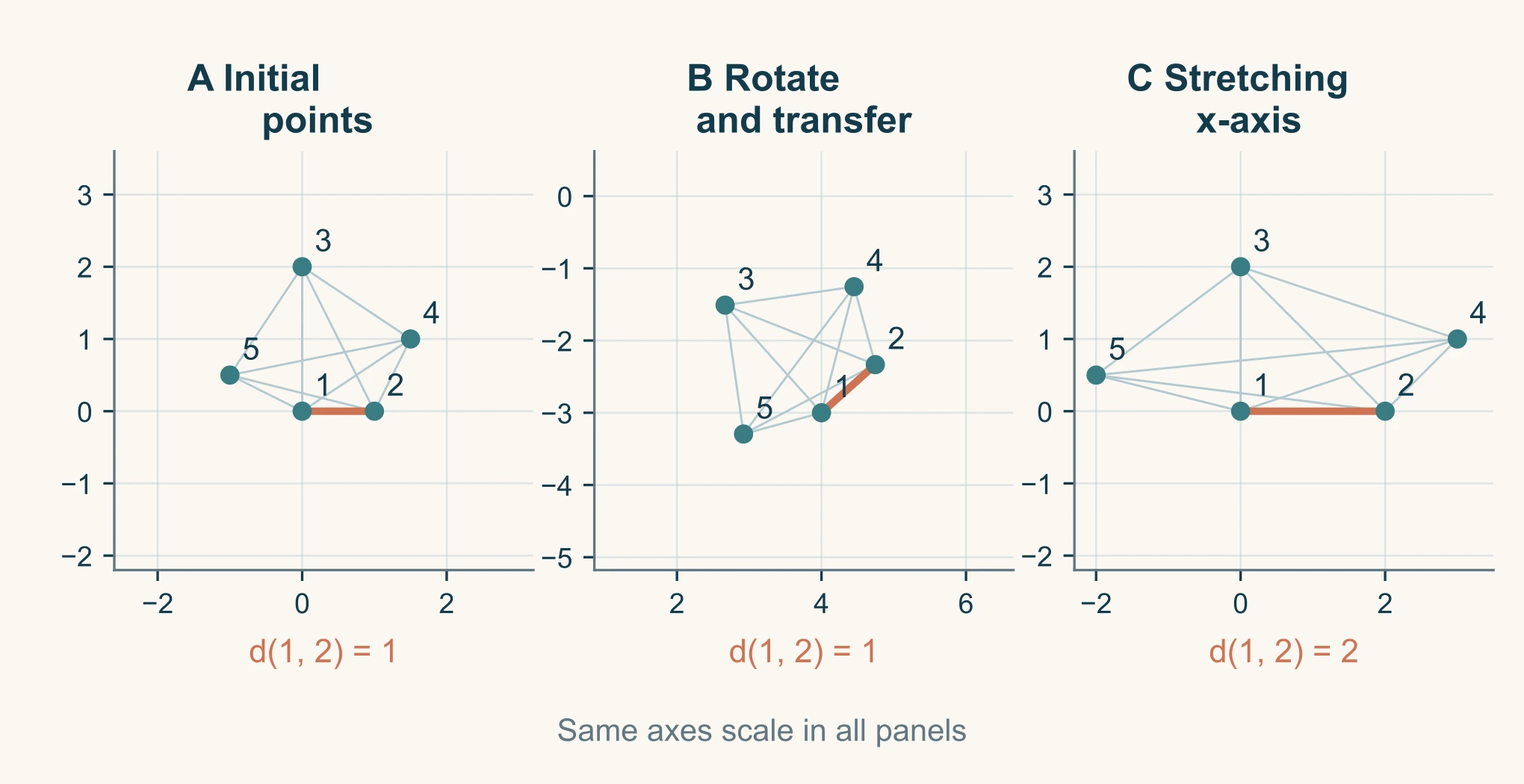
Figure 66. What is preserved when a view is transformed. Educational geometry of the second work. Rotation by 0.73 radian and translation by (4; −3) preserves all ten pairwise distances with machine error; stretching x changes some of the distances. One pair is selected, and the calculation checks all pairs. The numbers represent points, not types of experience. The initial coordinates are specified in mechanisms_lab.py.
Reprocessing with a simple mechanism
In the third work, three channels receive noisy values from a single hidden signal. The true value is equal to minus one or one, noise is added to each observation. One version immediately uses the first channel. The other mixes the channel values four times: half of the new state retains the previous value of a given channel, and a quarter each comes from two neighbors. The first channel is read for the result.
Repeated processing gradually makes the channels similar. This can be understood without a formula. If one channel is accidentally overestimated and the others are closer to the target, the exchange reduces the single deviation. But such an exchange will not correct the common mistake of all channels. It redistributes information already available; a new independent sensor does not appear after each iteration.
python3 mechanisms_lab.py --lab 3 --json recurrence.json
An important control is four sequentially deployed layers. Each one performs the same operation as one iteration of the recurrent circuit. With the same input, the result coincides exactly. In the first case, the program repeats one step in a loop; in the second, it explicitly records four nested calls. Changing the notation form does not create a new computational property.
Option in 2000 training tests | Mean square error |
One channel without mixing | 1.892736 |
Four recurrent steps | 0.632419 |
Four unfolded layers | 0.632419 |
Direct average of three channels | 0.632465 |
The numbers were obtained by the program launched with seed 1729. They are relevant to this task. Direct Average is another useful alternative that uses all inputs without the four mixing steps. Its computational cost is different, so it is not a control with an equal number of operations. The almost equal result shows that there may be a significantly simpler processing method for the selected task.
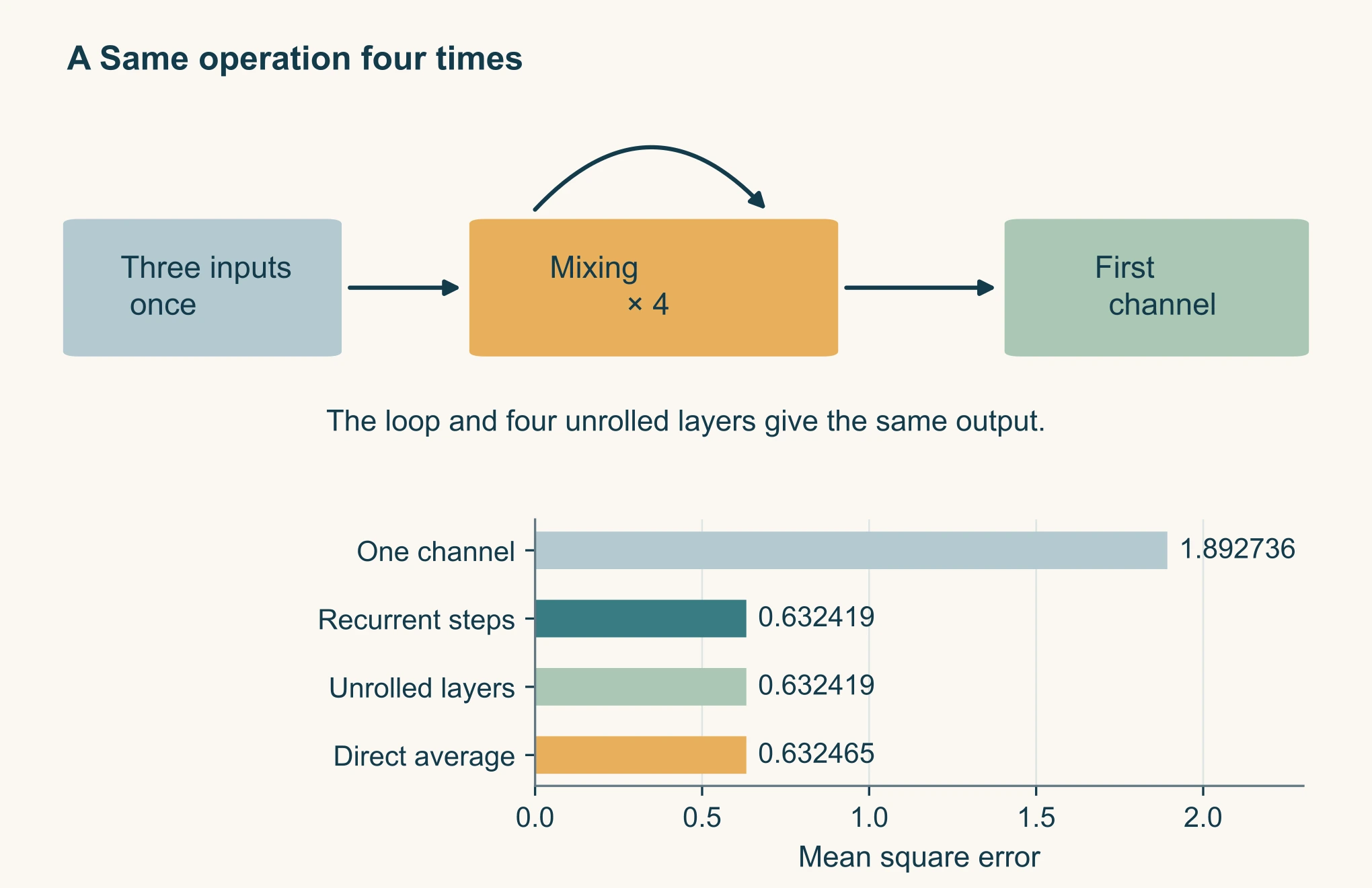
Figure 67. Recurrence and comparable alternatives. Training scheme and results of the third work: 2000 tests, seed 1729. When mixed, a channel retains half its value and receives a quarter each from the other two. The recurrent and unrolled implementations perform the same operations and match exactly. Direct average serves as an additional alternative with different computational costs. Data: mechanisms_results.json, work 3.
Designing a Stronger Test of Recurrence
The final sequence of calculations can often be represented by an expanded diagram. Therefore, the question “is there a loop in the code” is too crude to investigate. It is necessary to clarify which property of the loop is supposed to be essential: reuse of parameters, processing duration, state maintenance, interaction with changing input, or physical mutual causation of elements.
If the hypothesis concerns a computational function, the equality of the final realizations becomes an important constraint. If it refers to a physical organization, the program text does not yet fully describe how the processes are implemented in the device. These differences were introduced in the theoretical part; here we get the opportunity to test at least the computational statement before a stronger conclusion.
To expand the work, you can pre-select a task with different presentation times or with the arrival of new observations between iterations. Then it is necessary to give the competitor the same information and comparable resources. Otherwise, the gain of the recurrent system can be explained by longer observation. A meaningful experiment occurs when we understand exactly how much architecture difference remains after equalizing the conditions.
Workspace as content transfer
The fourth work uses three messages: color, shape, and distractor. Color and shape take values from zero to two. The correct answer is determined by the sum of color and shape modulo three. The rule is known to the program in advance. We don't need to train a classifier because it learns how to communicate the required information.
The workspace in this model accommodates two messages. The full version selects the color and shape and passes them to the response module. If there is no transmission, it receives an empty representation and uses zero values. With random selection, part of the space is taken up by a distracting message. The additional competitor has direct access to all inputs.
python3 mechanisms_lab.py --lab 4 --json workspace.json
In three thousand trials, full selection and direct access yield one hundred percent correct answers. Without transfer, the success rate is 34.40 percent, with random selection - 55.83 percent. These results are expected from the task device. The relevant channels are named by the constructor and the response rule is specified. The program did not independently discover what was considered important.
This experiment confirms the operation of the transmission channel. It also shows that this workspace is not the only way to solve the problem: direct access gives the same result. If we want to explore the benefit of limited exchange between specialized modules, a more complex set of tasks and meaningful comparisons with other modes of coordination will be required.
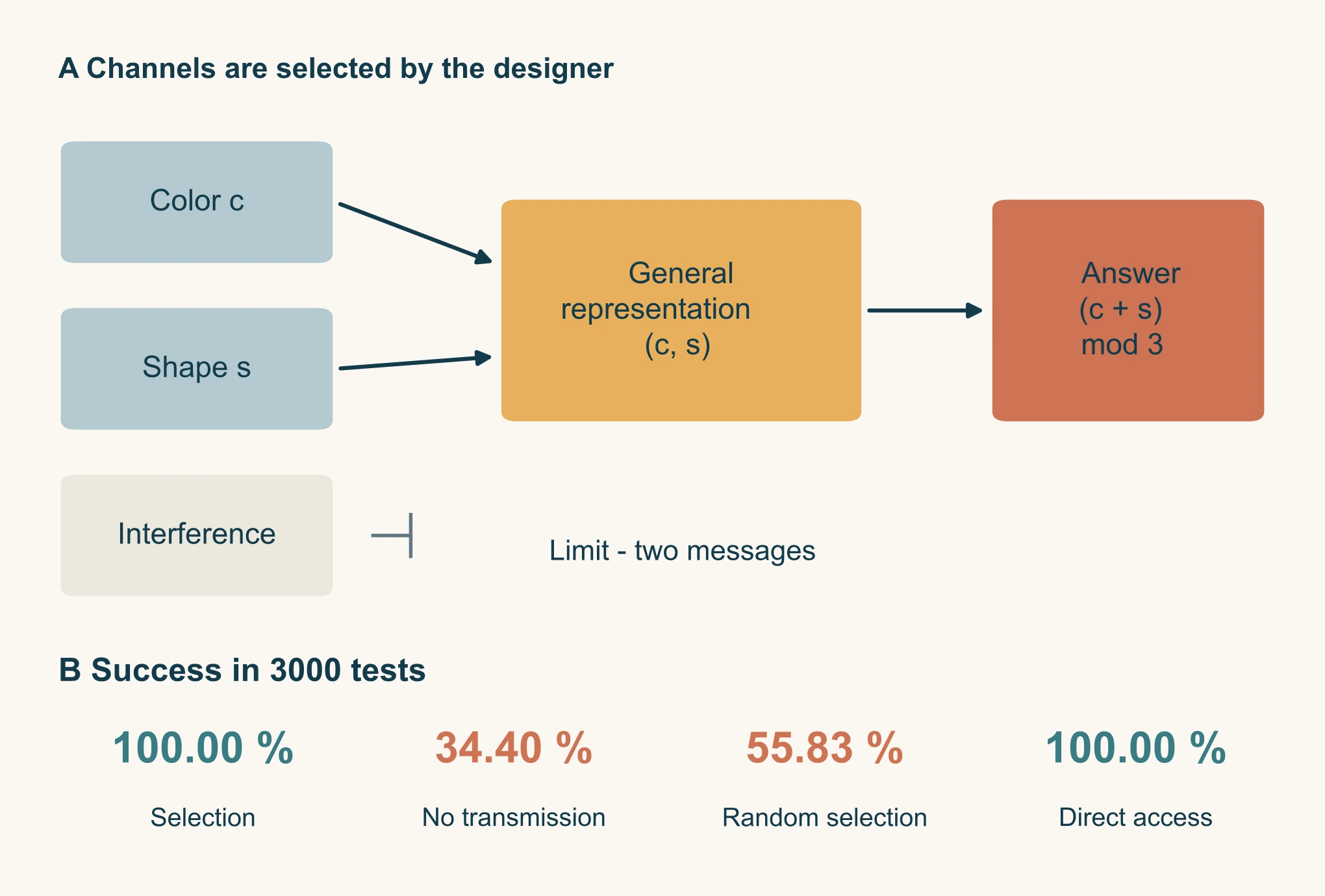
Figure 68. Content delivery and direct access control. Training scheme and results of the fourth work. Color and shape have the values 0, 1 or 2; the response rule is predetermined. The full version conveys the two required messages. A competitor with direct access solves the problem just as successfully. Here the delivery of information to a given rule is checked. Data: mechanisms_results.json, work 4.
From transfer to flexible use
Imagine the continuation of the experience: after perception, a new instruction comes. In one case you need to compare the color, in another you need to use the shape, in the third you need to remember the object for the next step. The system should preserve content that is useful to different consumers. This brings up the issue of flexibility of use rather than just delivering two numbers to a fixed rule.
However, new instructions must also be given to the competitor. If only the workspace receives task information, the benefit will be trivial. A useful design prefixes the amount of memory, the number of messages to be transmitted, the processing time, and the set of possible instructions. You can test transfer to new combinations without changing the selection rule after each unsuccessful result.
The next step is to disable content distribution itself, while maintaining local processing. Then compare this intervention with turning off an equally costly but insignificant channel. Such controls help figure out which change is important. Degradation when a large part of information is removed in itself says little about the special organization of consciousness.
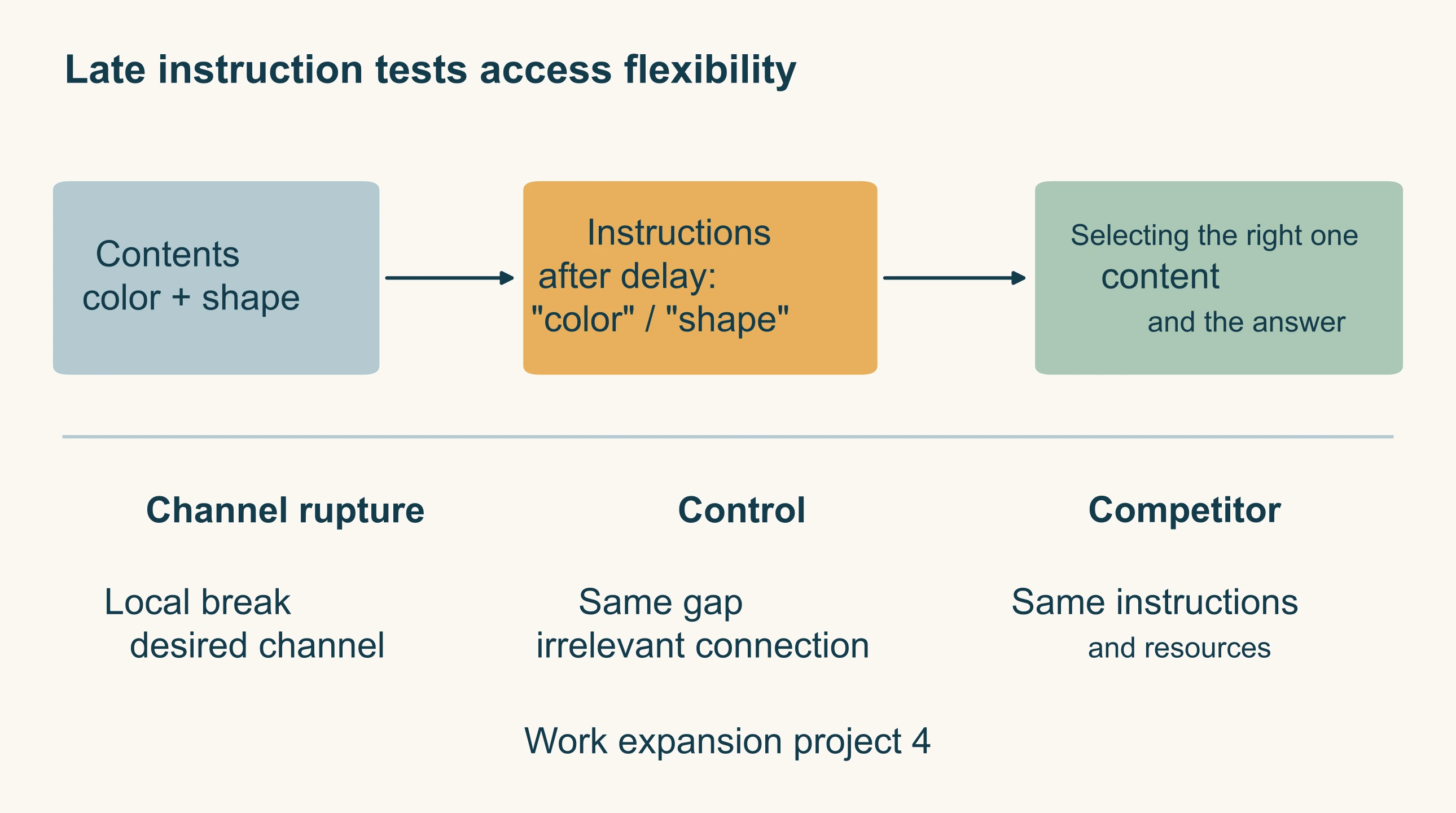
Figure 69. Access check after late instruction. In the proposed experiment, the system recognizes the desired task after presenting the content. The selective intervention is compared with an irrelevant gap and a competitor with the same resources; this design tests more than the delivery of two numbers in a fixed task.
Why Equal Outputs Limit Architectural Inferences
The four recurrent mixing steps can be written as four sequentially unwrapped layers with the same rule. If the input is the same, the calculated result will be the same. This means that a specific gain over one noisy channel cannot be explained by the mere fact of the presence of a loop in the source code. It is necessary to clarify what is assumed to be significant: the number of available inputs, time, reuse of parameters, a changing signal, or the physical organization of the execution. A useful control preserves the remaining differences and checks the selected ones.
What has now been established
Geometry, processing and transmission describe different properties. One lucky number does not replace three checks. Now let's choose one work and bring its argument to the end.
Practice 29 Make two discriminating experiments
Why do it: Test one architectural statement against a strong control case.
What you will need: Invariant from chapter 2; feedback and comparable resources; local state and shared access. Work runs 2–4 are independent and do not require changing all mechanisms at once.
Time guide: 30–45 minutes for one job. Can be done intermittently; This is not a speed standard.
1. To work with 2, select the invariance indicator in advance: a complete list of pairwise distances. Run python mechanisms_lab.py --lab 2 --json geometry.json and compare rotation with stretch.
2. To work 3, first predict the difference of one channel, blend, unwrapped layers and direct average. Perform a separate run --lab 3.
3. To work 4, write down which messages actually reach the response rule. Compare full selection, no transfer, random selection and direct access via --lab 4.
4. Choose one of the three experiments and state its immediate result, a strong competitor, and the next differentiating question.
What to save: One saved experiment with verified controls; the rest of the work can be completed in separate sessions.
Hint: The coincidence of one pair of distances does not establish the invariance of all relations. Winning over a version without the required inputs does not establish the uniqueness of the architecture.
Research continuation: For mixing, add a common noise component to all channels and save the independent one separately. For transfer, design a late instruction with equal inputs and competitor resources.
Analysis and answers - Appendix F, chapter 29, p. 294
Self-test
1. What does the persistence of distances show after rotating the view?
2. Why does the coincidence of the recurrent and expanded versions not solve the question of all theories of recurrence?
3. Which conclusion is supported by the equal success of workspace and direct access in the fourth work?
Individual functions received their own controls. The next chapter will add source history, internal access, and strategy revision, and then test their implementation together.
Chapter 30