What counts as an explanation?
In the previous chapter, it was possible to improve the solution, for example, start looking for a counterexample. But the improvement still leaves the question of the reason: did a new technique, extra time, or familiarity with the task help? Now let's learn how to construct an explanation so that it can be compared with another version. This will prepare both the experimental part and later models of consciousness.
From title to research question
The man reread the sentence several times and finally understood it. Why did this happen? The answer “understanding turned on” repeats the name of the result. The answer “the brain processed the information” adds to the overall process, but does not yet show what changed between the unsuccessful and successful reading. A good beginning of an explanation clarifies the problem: what connection was made, what information was previously available, and what operations could lead to a new result.
The description tells what happened. For example: “On the second reading, the participant correctly ordered three events in time.” The explanation seeks to show how this result was achieved. A prediction indicates what to expect under certain conditions. These tasks are related, but not identical. It is possible to accurately predict the output of a device from a table of past occurrences, without knowing almost anything about the internals. It is possible to propose a plausible mechanism that does not yet predict real data well.
For research on experience, it is also important to clarify the result itself. Are we explaining a correct answer, a message of clarity, the ability to use information in a new task, or an experienced understanding? One experiment may contain all of these data, but moving from one to the other requires an argument. Otherwise, the theory quietly explains a convenient indicator instead of the original phenomenon.
What do we call a mechanism?
Let's imagine an automatic lamp. The sensor measures the illumination, the program compares the number with the threshold, the switch supplies power. When it gets darker, the lamp turns on. The parts, their interactions and the sequence of changes are named here. If the sensor is covered, the result will change in a predictable way. This is a simple mechanistic explanation that can be tested by intervention.
Peter Machamer, Lindley Darden and Carl Craver proposed to analyze mechanisms through organized entities and activities that produce change. The research process itself is useful for our work: listing the components is not enough, we need to show their organization and operation. Their article presents a philosophical analysis of explanation rather than an experimental theory of consciousness. [7]
Let's take a reading approach. Components of the model may be word representations, a previous sentence store, and a temporal relation matching rule. The words “storage” and “rule” are still relative. It is necessary to clarify what is stored, for how long, how it is used and under what conditions it is lost. Only then will it become clear why the model copes with one text and makes mistakes in another.
The mechanism can be described at different levels. The electrical circuit explains the switching of the lamp through current, and the program through the condition and command. If both descriptions are correct, they may refer to the same system and answer different questions. The mere diversity of levels does not require the existence of several independent causal worlds.
Correlation and Intervention
Let's say that in a training observation, people who looked at the image longer were more likely to say that they understood it well. Several explanations are possible. The extra time helped me figure it out. Complex images both made people look longer and elicited a more cautious response. Or interested participants both looked longer and reported greater clarity. The relationship between two indicators does not yet determine the direction of the causal influence.
The intervention changes the condition according to the research rule. For example, the show time is set in advance and does not depend on the participant’s interest. If other significant differences are taken into account, the comparison becomes more informative about the effect of time. However, the intervention also needs to be dismantled. Longer exposure may simultaneously alter the number of eye movements, rereading ability, and fatigue. These are parts of a possible causal chain or concomitant changes, not automatically resolved issues.
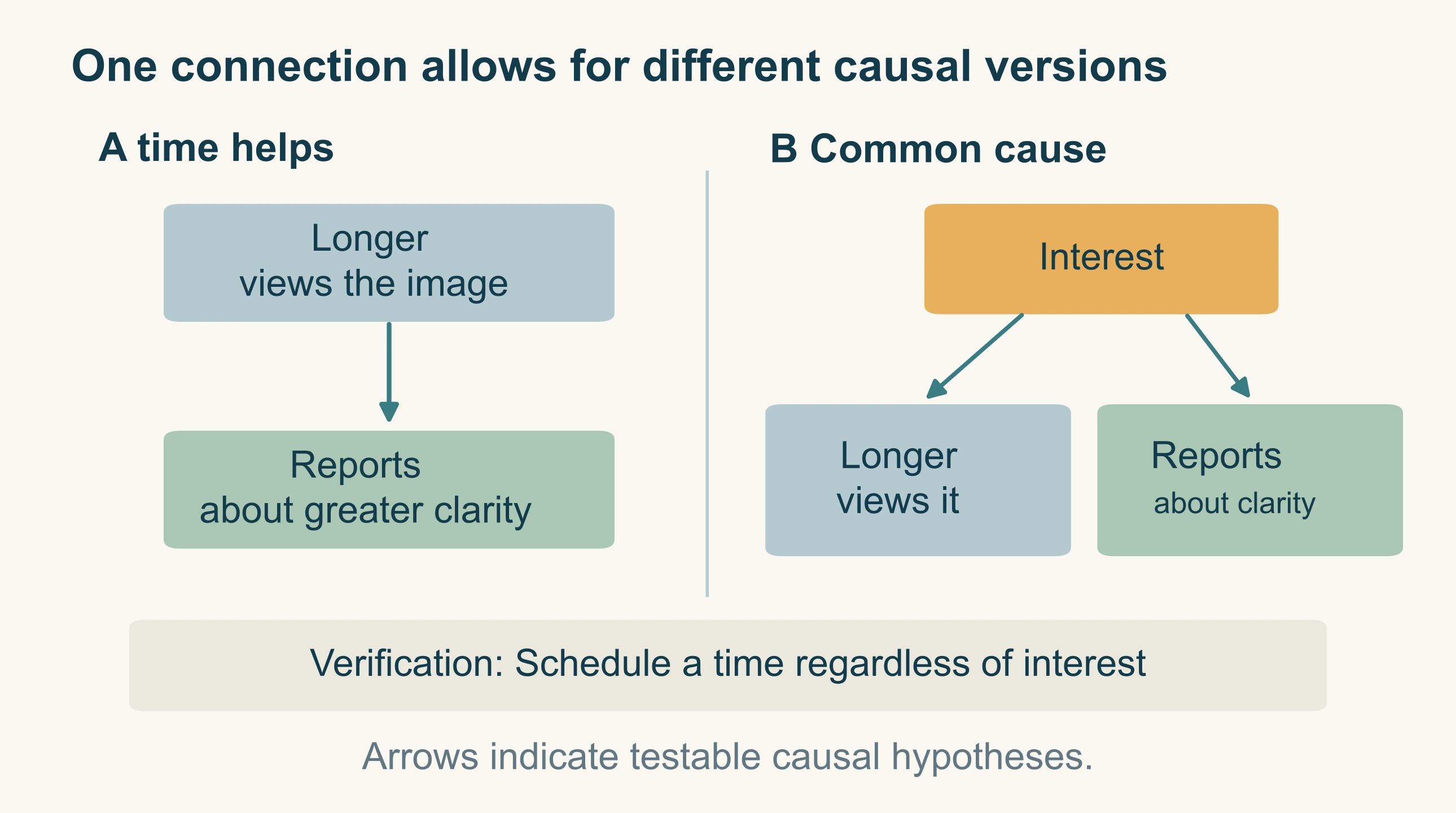
Figure 10. Causal influence and common cause. The relationship between viewing duration and clarity messages suggests different mechanisms: the effect of time or the effect of interest on both indicators. Assigning time according to the research rule helps to distinguish between these versions if other essential conditions are taken into account.
It is useful to distinguish between the cause of an event of interest and an indicator of that cause. The thermometer reports the temperature, but changing the number on the drawn thermometer will not warm the room. Likewise, the neural measure associated with a report may be a cause, an effect, or a contributing process. To choose an explanation requires conditions under which these options make different predictions.
Necessity Sufficiency and the Scope of a Claim
If a property is required for some result, without it the result does not occur in the specified condition area. If the property is sufficient, its presence ensures the result under specified conditions. These relationships cannot be reversed. A working power source is necessary for our lamp to operate, but power alone is not enough: the lamp may be turned off by software or have a faulty switch.
When discussing consciousness, the domain of conditions is especially important. The phrase “process P is necessary for experience” sounds universal. Data from a single visual task in adults support a narrower claim. Generalization to other types of experience, organisms or artificial systems will require additional justification. Refining the scope does not weaken a good theory: it makes visible the boundary between the work already done and the next study.
We must also distinguish causal provision from presumptive identity. A theory can claim that a certain organization of a process is an experience. Then the author proposes a relationship between two ways of describing one phenomenon. Observing co-occurrence does not by itself establish such an identity. The correspondences, limits, and advantages of this view over alternatives will need to be explained.
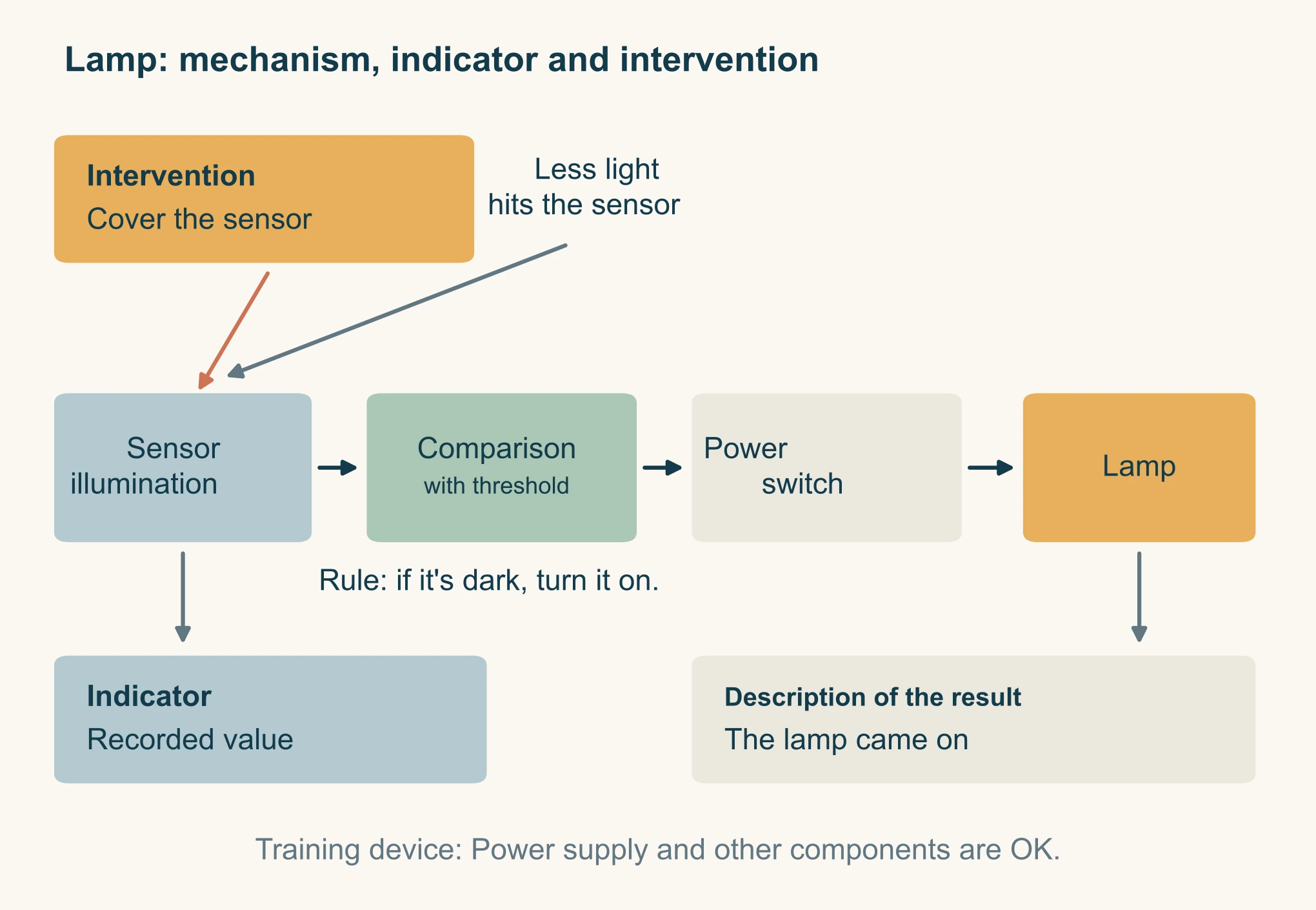
Figure 11. Three research roles in the lamp design. The middle row shows the transmission of measurement, command and power in the training automatic lamp. Closing the sensor is an intervention; the number in the record is an indicator; turning on the lamp - the described result. The forecast depends on the agreed serviceability of the remaining components.
A Worked Argument about Recurrent Processing
Consider the fictional reasoning: “After repeated viewing, people become better at recognizing an image. This means that repeated processing creates consciousness. Let’s add feedback to the program and get an experience.” The first step is an empirical statement about the success of the task. The second connects success with consciousness. The third transfers the proposed mechanism between different systems. Each step adds premises that are not present in the original observation.
Let's restructure the argument. First, we define the indicator: the proportion of correctly recognized images and a separate assessment of visual clarity. Then we propose a mechanism: the first pass selects the features, the subsequent ones refine them taking into account neighboring elements. The next prediction is that reprocessing should be particularly helpful in conditions where local cues are ambiguous and context is informative.
Now a competitor appears: the improvement simply provides additional computational time, regardless of feedback. Comparison requires models with comparable resources and a task on which their predictions diverge. If the feedback model wins, we will have reason to prefer this mechanism for the chosen outcome. Further treatment of the experience will depend on the individual theory and other tests.
Such an analysis does not close the question of creating a possible subject. It makes the project sequential: first figure out which organization explains what, then formulate a reasoned transition to the properties of experience. Engineering success becomes part of the argument rather than a silent substitute for it.
Designing a Discriminating Comparison between Two Accounts
Let's consider the benefits of a diary. Version one: the saved text holds the details and allows them to be compared. Version two: the pause itself for careful consideration helps. The diary comparison with the absence of any stop is compatible with both versions. A more meaningful comparison gives the same time, but in one condition it saves the record for later use, and in the other it leaves only a pause. Now, the difference in results may limit the explanation. However, we still need to choose a measure of understanding: the length of the story and the accuracy of the new discrimination are not the same result.
What has now been established
The explanation became more definitive as parts, interactions, and various predictions emerged. These requirements do not make the idea true in advance. They allow you to understand what results will really change your attitude towards it.
Practice 5 Restore missing transitions
Why do it: Convert a general statement about the benefits of journaling into a testable pair of mechanisms.
What you will need: The concepts of event, indicator and preliminary forecast. We will distinguish between what is being measured and what mechanism is being proposed to explain it.
Time reference: 25–35 minutes. Can be done intermittently; This is not a speed standard.
1. Select one outcome: for example, correctly distinguishing two previously described types of episodes using new examples.
2. Record two versions: saving the available recording and the extra pause effect. For each, specify the input, action, and expected change.
3. Make a comparison using the same time and material. Describe exactly how the conditions differ.
4. Formulate three outcomes in advance: recording advantage, agreement, and disadvantage. For each, write down the valid output and the remaining alternative.
What to keep: One page with the indicator, two mechanisms, conditions being compared, and interpretation rules.
Hint: If either outcome supports your favorite explanation, clarify the mechanism's promise. The absence of difference due to inaccurate measurement does not yet establish equality.
Research continuation: Add interference to access to stored text after recording. Explain what new conclusion it will allow and what collateral changes will need to be taken into account.
Analysis and answers - Appendix F, chapter 5, p. 281
Self-test questions
1. How does describing a mechanism differ from listing the parts of a system?
2. Why does the joint change in the neural indicator and the report not yet determine the causal direction?
3. What is missing in the transition from a successful recognition program to a statement of created experience?
The next chapter will look at how a selected phenomenon becomes data. For each button, verbal scale, and physiological signal, you will need to explain the relationship to the question under study.
Chapter 6