What It Means to Experience Oneself
We have learned to compare the qualities of experiences. However, two similar impressions may relate differently to the experiencer: the movement of the hand and the movement of the pointer are both visible, but the hand is felt to be part of the body, and the pointer usually remains an external object. To further explore this, let us separate perspective, bodily identity, authorship of action, and self-image over time. This separation will be needed later when building event source models.
Multiple meanings of one word
You reach out to the pencil and say, “I took it.” A short phrase combines several relationships. The pencil was visible from a certain place. The hand felt like part of your body. The movement was perceived as your action. Do you remember why you needed a pencil? This is enough in everyday conversation. To investigate, we have to ask what kind of relationships we want to explain and whether they always necessarily occur together.
Let's start with perspective. The table is visible from here: one side is closer, the other is partially closed. The sound comes from the left of your position. Perspective is the organization of content relative to some point or frame of reference. It is different from biographical knowledge about oneself. To see the edge of the table on the right, you do not need to mentally say your name or remember your profession. However, the presence of coordinates calculated relative to the robot's camera does not in itself establish the experience of perspective. In describing a system, it is necessary to distinguish between the coordinate structure and how the situation is experienced.
The second question concerns the ownership of the body. The feeling “this is my hand” is not the same as a judgment of legal ownership. We are talking about how a part of the body is given in experience. The third question concerns the authorship of the action: “I produce this movement.” The fourth is the image of myself in time: what kind of person I consider myself to be, what I remember about my past, what intentions I associate with the future. These four questions provide a useful work map, although they do not exhaust all uses of the word “I.”
Ownership of the body and authorship of the action
Let's look at a common difference. You deliberately raise your hand, then calmly place it on the table. In the second case, the hand does not cease to be yours due to lack of movement. Ownership of a body cannot be defined as continuous voluntary control over it. Now you move the mouse: the movement of the pointer on the screen is felt as a result of your action, although the pointer itself is usually not felt as part of the body. Control of an object and body ownership also do not coincide.
In a study by Andreas Kalckert and Henrik Ehrsson, participants observed the movements of an artificial hand in relation to the movements of their own. The authors changed the consistency and nature of the movement, as well as the position of the model. The result was conditions in which assessments of ownership and authorship diverged. The work supports research separation of these components of bodily self-perception; it does not turn each of them into an independent subject. [4]
Another distinction is useful here. A sense of authorship is a characteristic of an experience or an account of it. Actual causal involvement is a characteristic of events. It is possible to press a key, not notice the effect, and still cause a causal effect on the program. You can expect that the movement was performed by you, although at that moment the recording played it. To test causal participation, we need information about the structure of the situation, and to study experienced authorship, we also need data from the participant. One question does not replace another.
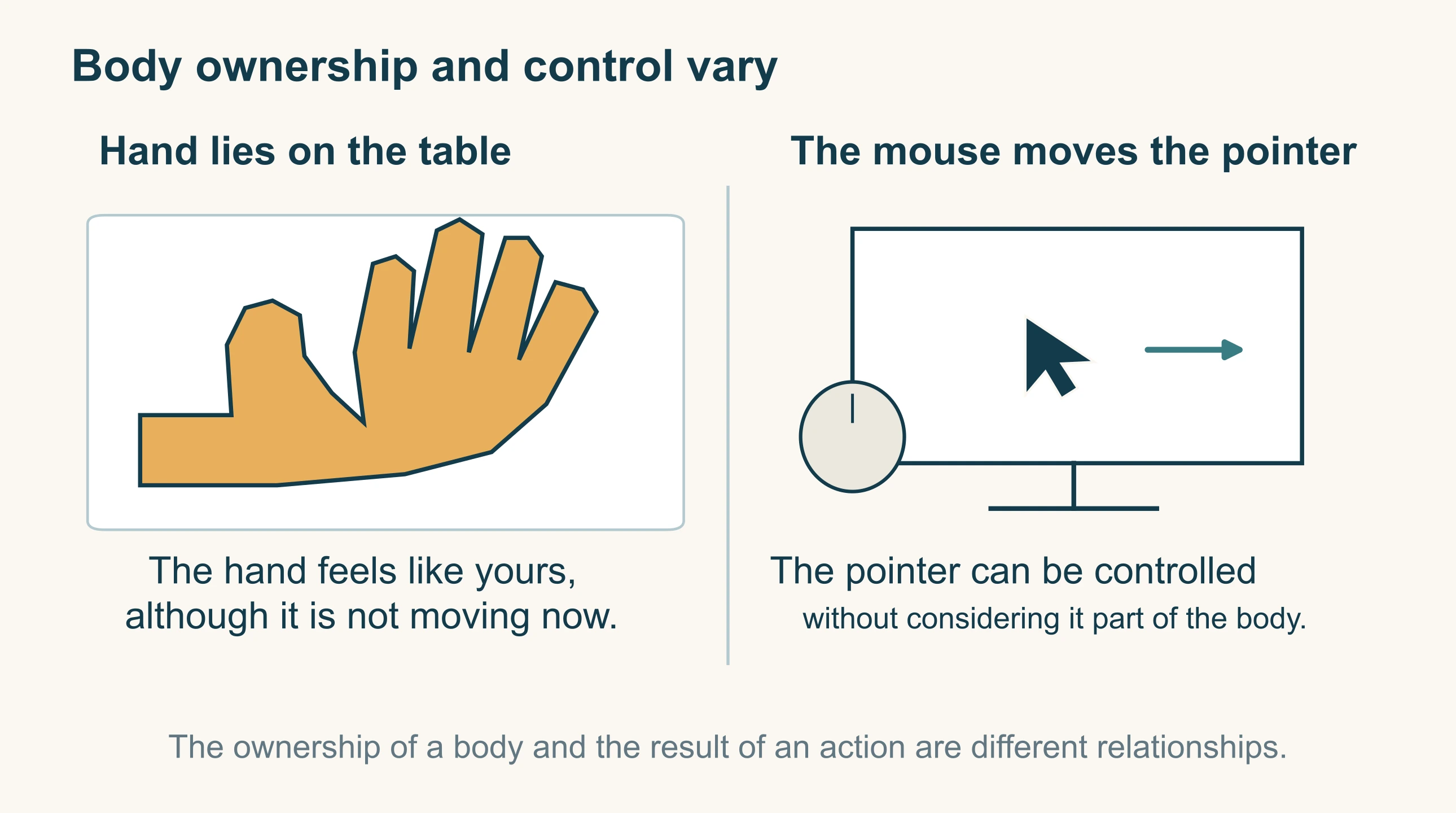
Figure 6. Belonging without movement and controlling an external object. The immobile hand may continue to feel like part of your own body. Pointer control refers to the relationship of action to result, not automatically to the physicality of the pointer.
How the body becomes accessible without looking
Try to describe the position of your hand lying on the table without looking at it specifically. Finger flexion, surface pressure, and approximate elbow position may be available. Information about the position and movement of body parts is called proprioceptive. It participates in bodily orientation along with vision, touch and other sources. The term denotes a specific type of information and sensitivity, rather than a separate small consciousness within the body.
Consistency of sources is important for the researcher. If you see a hand where you expect to feel it, one group of explanations links the information to a single bodily object. If the information differs, the question arises as to what the system gives more weight to and why. For now, this is an outline of the research problem. In chapter 11 we will turn it into a computable model and formulate predictions for different conditions.
Body ownership cannot be reduced in advance to a single signal match. Two lights can flash at the same time without becoming parts of your body. The model must explain which sources are compared, how the shape and position of the object, the history of interactions and possible alternatives are taken into account. It is precisely such clarifications that turn the expressive metaphor “the brain assembles me” into a concrete task.
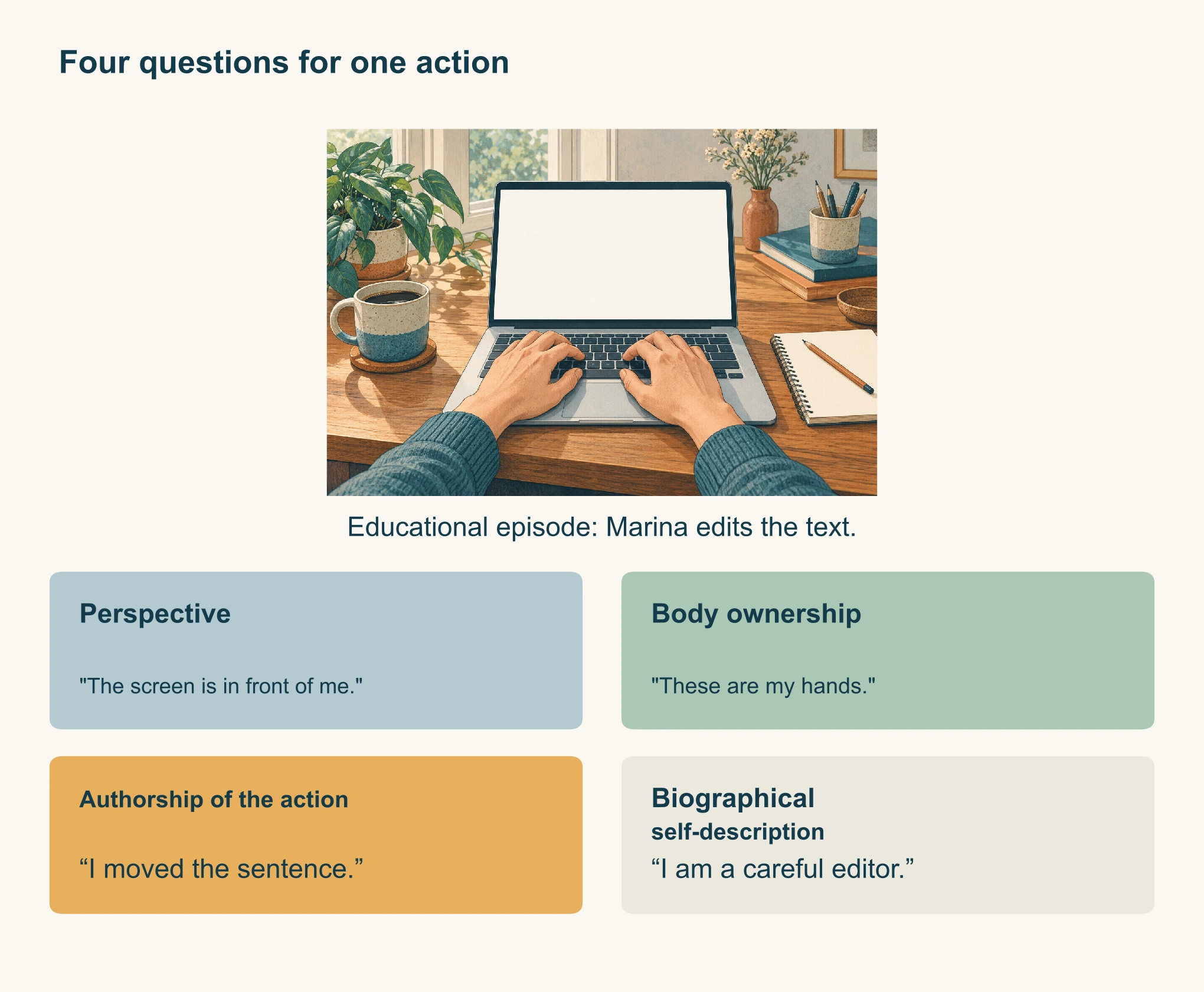
Figure 7. Four attitudes towards yourself in one episode. Perspective, bodily identity, authorship, and biographical self-description are highlighted separately. Clarifying whether a person or a program corrected a gap refers to the authorship of a particular change, and does not automatically apply to all other relationships.
An example with a text editor
Let's imagine a training episode. Marina transfers the sentence in the document. She moves the mouse, sees the highlighted text, and intends to move it to the beginning of the paragraph. After releasing the button, the program automatically corrects the space. Marina says: “I moved the sentence and corrected the format.” Let us consider this phrase without assuming that it necessarily accurately describes all events.
Moving the sentence was Marina's intention and action. Correcting the space could be an automatic operation of the program. The final result is visible to her: she can check the arrangement of words. But access to a result does not mean access to all the reasons for its occurrence. In the research record, it would be worthwhile to separately indicate the movement of the mouse, the change in the document, Marina’s message, and the automatic correction rule known to the researcher.
Let’s say that after viewing the history of changes, Marina clarifies: “The program corrected the gap.” This is a revision of the judgment of authorship. It does not follow from this that the original sense of control was invented. It could arise from the connection between intention, action and overall result. The research challenge is to explain this relationship, including when it leads to overly broad self-attribution of the outcome.
The biographical self-description appears on another level: “I am a careful editor.” Autospace alone is not sufficient to verify this statement. It generalizes to many situations and depends on the criterion of attentiveness. If the levels are mixed, a small error in determining the cause becomes an unwarranted inference about the individual. When recording separately, there remains a specific question that can be checked.
Is an internal observer necessary?
Self-awareness is sometimes thought of as a spectator looking at an internal screen. This picture is convenient until it becomes an explanation. If the viewer must recognize the image, remember the past and understand that it relates to him, a smaller copy of it has appeared inside the original task. It will be necessary to explain the abilities of this viewer.
A more productive initial question is what information is associated with the system and how this connection is used. For example, a program can store its own identifier, distinguish its commands from incoming messages, and evaluate the reliability of its response. These are different functionalities. They can be implemented and tested individually. The presence of an identifier does not prove an experienced self, but it does provide a clear object for the study of self-reference.
Explicit reflection adds another layer: the system or person views its own judgment as subject to verification. The phrase “I can see the edge of the table” and the question “Why am I sure that I can see it accurately” serve different purposes. When constructing hypotheses about a minimal subject, one cannot imperceptibly make complex verbal reflection a mandatory condition of any experience. Such a condition would require a separate justification.
Why Control Doesn't Equal Ownership
In the first episode, the hand rests calmly on the table. There is no action now, but her position and touch can be experienced as relating to her own body. In the second episode, you move your mouse and see a pointer. Its movement depends on the command, but this does not imply a physical identity. In the third, you read yesterday's note: its creation relates to your history, although the current reading is not the experience of the current writing. These cases show why separate description columns are needed. One general answer, “It’s me,” would hide the differences.
What has now been established
Four questions refer to different relationships within the same episode. There is no need to attribute independence to them in all situations. First, it is enough to learn to notice what answers are available and what attitude is being explored.
Practice 3 Four questions for three episodes
Why do it: Develop several meanings of self-reference in three ordinary episodes.
What you will need: Distinguishing between an event and a report from chapter 1. Remember that actual causal involvement and sense of authorship answer different questions.
Time reference: 20–25 minutes. Can be done intermittently; This is not a speed standard.
1. Describe three cases: a stationary hand on a table, controlling a pointer, and reading one's own previous text.
2. For each, separately indicate the perspective, the experienced ownership of the body, the authorship of the current action, and information about yourself in the past.
3. Choose one causal claim that can be independently verified: what exactly caused the movement or when the text was created.
4. Match this check with the first description. Save the discrepancy if there is one; do not turn it into a general assessment of personality.
What to Keep: Three descriptions with four separate questions and one independently verified relationship.
Hint: The absence of words does not prove the absence of a component. You can write down exactly which question remains unclear and what clarification would help answer.
Exploratory follow-up: Suggest a change to the situation that could separate authorship and ownership. Formulate a separate forecast for each indicator and explain what external events need to be controlled.
Analysis and answers - Appendix F, chapter 3, p. 280
Self-test questions
1. Why doesn't controlling a pointer on a screen prove the experience of the pointer as a part of the body?
2. How does actual authorship of an action differ from the feeling of authorship?
3. Why is knowledge of one's own name not sufficient for a complete model of the experienced self?
Having distinguished attitudes towards ourselves, let’s move on to assessing our own thinking. The next chapter will ask how much the feeling of understanding allows us to judge the correctness of a decision and how to check this connection.
Chapter 4