How we notice our own thinking
The sense of self includes the ability to notice one's own decision, but the noticed decision still needs to be evaluated. The familiar feeling of “everything is clear” sometimes precedes the check. In this chapter we will distinguish between the correctness of the answer, confidence before feedback, and subsequent explanation. Maintaining their order will allow you to see what exactly has changed after the check, and turn reflection into the basis of a new action.
Thought and knowledge about thought
Read the phrase: “The box contains fewer pencils than pens, but more pencils than erasers.” You can feel that everything is clear and immediately move on. You can also stop and ask which items are in abundance. In the second case, the initial impression is verified by action. If you have to read the condition again to answer, this does not necessarily mean a lack of understanding. However, it becomes clear that the feeling of understanding and the willingness to complete a certain task are different data.
In this book, we refer to introspection as referring to one's own current or recently experienced state. Reflection means considering one's own thinking, action or judgment as a subject for analysis and possible revision. Metacognition is a broader family of processes for assessing and regulating cognition. For example, the choice to retest a difficult answer may depend on an assessment of its reliability. These operational definitions help to ask different questions; in scientific literature, the boundaries of terms may be drawn differently.
Having a thought does not guarantee detailed knowledge of how it came about. Let's say you quickly recognized a familiar word. The recognition result is available to you, but you may not know the sequence of letter processing. The story “I looked at each letter first” then requires verification. It may be a description of actually noticed steps or a plausible reconstruction after recognition.
Why Sincerity Doesn't Bring Accuracy
A self-report may be completely sincere and yet inaccurate. The reason is not necessarily a bad memory: sometimes it is not clear what differences should be noticed and what words to express them. The question “was the thought verbal” requires distinguishing the spoken internal phrase from knowledge of its meaning and from the phrase that appeared during the answer itself.
Eric Schwitzgebel, in a philosophical article on the unreliability of naive introspection, examines the reasons to doubt the infallible knowledge of one's own current experience. His examples concern, among other things, visual clarity, emotions, and thinking patterns. This is an argument against the automatic infallibility of self-reporting, not a measurement of the error rate of any individual, nor a reason to reject self-reporting. [5]
For practice, a modest but effective rule follows from this: separate the moment of experience, the moment of the first message and the moment of subsequent explanation. If, when solving a problem, the answer appeared first, and the verbal justification appeared later, write it down. There is no need to fill the gap with supposed mental steps. A gap in the record is more useful than fictional continuity.
Confidence must relate to a specific issue
The phrase “I am eighty percent sure” becomes research useful after clarifying what exactly the certainty is. Is the answer correct? Exactly memories? The ability to repeat the explanation tomorrow? These are different events, and the way they are verified is different. A number without specifying an event creates the appearance of precision.
In problems with a verifiable answer, it can be agreed that confidence refers to the probability of the correctness of a given answer. If a person chooses the 80 percent level many times, it is desirable that approximately eight out of ten such answers turn out to be correct. This is the idea of calibration. One correct or incorrect answer does not allow us to evaluate it: the probabilistic expectation is checked against a series of comparable cases.
Stephen Fleming and Hakwan Lau distinguish between the tendency to give high confidence, the ability to confidently separate correct answers from incorrect ones, and the effectiveness of such assessment in relation to the success of the main task. These are different measurement questions. High average confidence by itself does not show good discrimination of one's own errors. [6]
Save the task, the answer, the confidence before the test and the result of the test. A complex calculation will not restore the lost original forecast: the confidence recorded after reviewing the solution answers a different question.
An example of two readers
Let's present the training data created for this chapter. Anton and Vera solved four identical problems each. Both performed the first and third correctly, but made mistakes in the second and fourth. Their success in this small series is the same. Confidence was recorded before feedback was received.
Quest | Correctness | Anton's confidence | Vera's Confidence |
First | That's right | 90 percent | 90 percent |
Second | Error | 90 percent | 40 percent |
Third | That's right | 90 percent | 80 percent |
Fourth | Error | 90 percent | 30 percent |
Anton assigns the same confidence to every answer. In this series, Vera places less trust precisely in the answers that turned out to be wrong. Equal numbers of correct answers therefore do not imply equal quality of self-checking. If only two tasks may be checked again, Vera's ratings help direct effort where it is needed most. This is one possible practical function of assessing one's own thinking.
The four tasks do not establish a stable property of a person: random coincidence and different understanding of the scale are possible. To check, additional tasks and the same instructions are required. The table describes the quality of the response assessment and does not allow Vera to be declared “more conscious”.
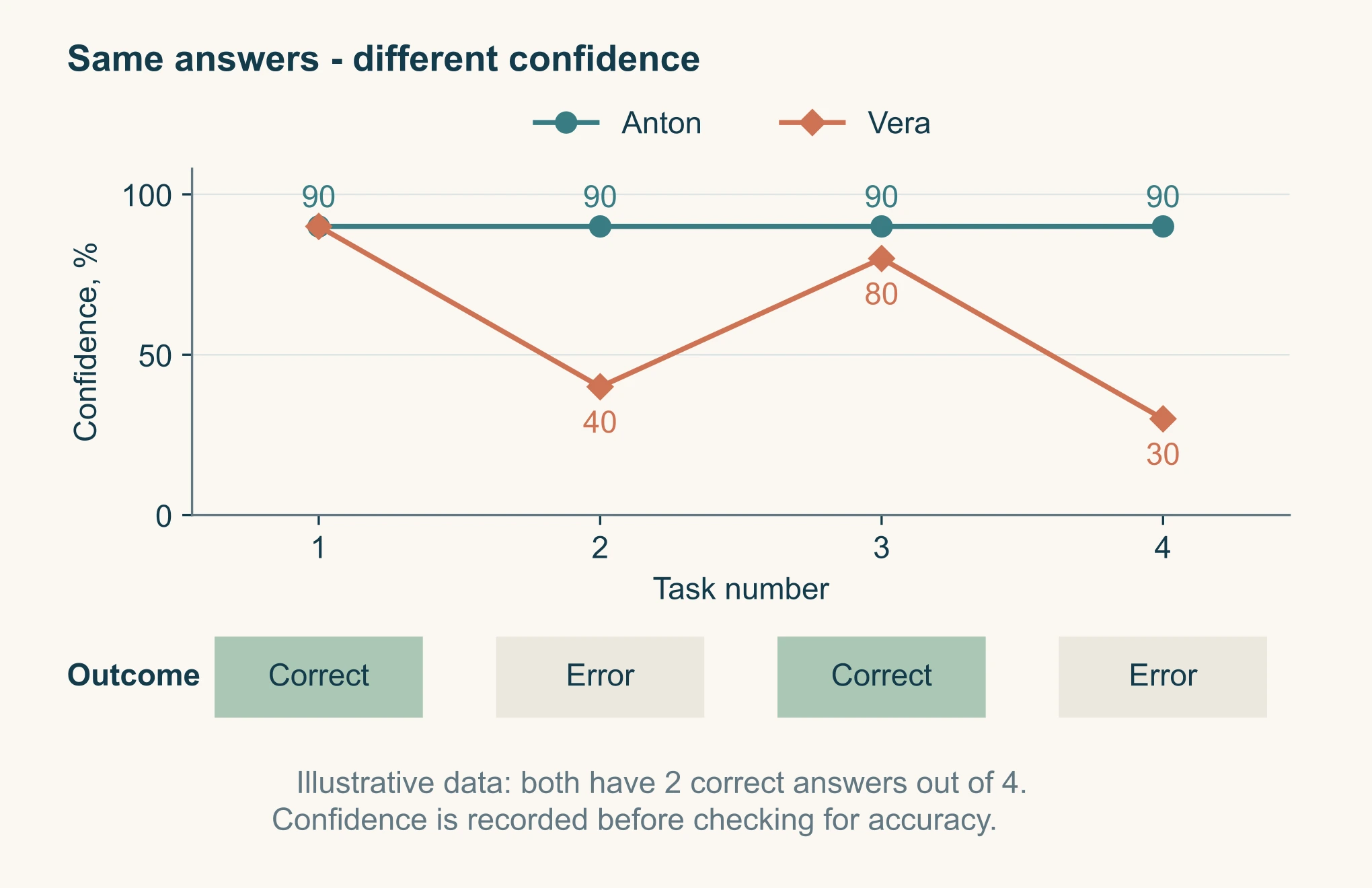
Figure 8. Confidence with equal success. In the educational series, Anton and Vera correctly answer tasks 1 and 3. Anton attributes 90 percent to all answers, and Vera attributes 90, 40, 80 and 30 percent. On these four occasions, Vera's assessments highlight future errors; new data are needed to draw conclusions about sustainable capacity.
From self-observation to changing the way of solving
Reflection produces results when it changes the testable decision about the next step. Suppose you notice, “When reading comparisons, I often keep the first pair of objects and lose the third.” From observation, a proposal arises to write down relationships with arrows. You can then check whether errors have decreased on new tasks of the same type. This creates a small research chain: difficulty, suspected cause, change in procedure, new results.
However, successful change does not prove the whole story about the cause. The arrows could help simply by increasing the operating time. To distinguish the explanations, you will need a condition with the same time, but without the arrows. We will examine this issue in detail in the chapters on verification. What is important now is to see how reflection moves from a general “we need to be more careful” to a specific change for which competing explanations are possible.
Self-control can occur without extensive introspection. The person notices the uncertainty and rereads the line without constructing a theory of his reading. Explicit reflection begins where the basis of an assessment, a method of action, or the boundaries of a conclusion are considered. It is useful to consider automatic error correction and verbal investigation of the cause separately.
How to keep knowledge in order
Let the participant write down the answer and confidence of 90 percent, then see the error and say that he doubted it from the very beginning. The last message may be sincere, but it comes after new information. Both records are kept for the study: the initial prediction and the subsequent interpretation. If you replace the first recording with a second one, the ability to assess the initial accuracy of self-control will disappear. Therefore, in the exercise below, the answers are separated from the conditions and placed in a discussion at the end of the book.
What has now been established
We do not require infallible introspection. It is enough to make the moment and the subject of confidence explicit. The subsequent error becomes material for changing the procedure if the original record remains available.
Practice 4 Forecast before inspection
Why do it: Compare preliminary confidence with the outcome and choose a specific method for the next test.
What you will need: Distinguish between the moment of experience, the first recording and the later explanation. Paper is enough for the exercise; knowledge of formal logic is not required.
Time reference: 15–20 minutes. Can be done intermittently; This is not a speed standard.
1. Without opening the analysis, solve three tasks. There are fewer pencils in a box than pens, but more than erasers: what is the least of? All green cards are round, some round ones are large: should there be a large green one? Nina arrived before Oleg, Oleg before Peter: who is last?
2. For each answer, write down the confidence from 0 to 100 percent and one phrase about the observed progress of the solution.
3. After all three entries, open the practice analysis 4. Separately note the correctness and what has changed in understanding.
4. For one difficulty, choose the following technique, for example, finding a counterexample. Don't assess sustainable ability across three tasks.
What to keep: Three pre-confidence answers, test outcomes, and one specific rule for next action.
Hint: The word “some” refers to some of the round cards. Try to imagine several acceptable layouts without revealing the analysis yet.
Exploratory continuation: Test the chosen technique on new similar problems without changing the initial confidence. Compare the accuracy of answers and the ability to separate doubtful cases.
Analysis and answers - Appendix F, chapter 4, p. 280
Self-test questions
1. Why shouldn't explaining a solution after viewing an answer automatically be considered a record of original thinking?
2. Can a person often answer correctly and have poor confidence in recognizing his own mistakes?
3. How can you turn “I don’t read carefully” into the beginning of a research paper?
Now we have an example of a useful revision. To explain why it helps, we need to distinguish the name of the result from the mechanism at work. This is what the next chapter will deal with.
Part 2