How to Explore the Evolution of Experience
The development of one individual and the history of the origin of the species require different evidence. Let us now consider how comparisons of function, design, and relatedness limit the story of the evolution of mechanisms. The usefulness of memory depends on the environment, and a similar ability may have a different history. Therefore, we will not build a single ladder of consciousness. The purpose of the chapter is to explicitly examine the transitions from observed feature to historical hypothesis and from mechanism to putative experience.
History of the mechanism and history of the experience
The structure of a living organism has a history of origin. It is therefore natural to ask when the experience-related mechanisms arose and what tasks contributed to their maintenance. But reconstructing the history of a mechanism and establishing the presence of an experience are different research operations. One can explain well the benefits of memory and still argue about the organization of memory that is accompanied by conscious recollection.
The evolutionary question must be formulated narrowly. For example: under what conditions could selection support integrating multiple sources of information, controlling uncertainty, or distinguishing between one's own actions and external events? Such formulations specify functions that can be modeled and compared. The next question—whether these functions are conditions of experience—requires a separate theoretical connection. Confusing questions creates overly confident narratives about the origins of qualia.

Figure 41. The environment sets different behavioral tasks. Subject illustration of different living conditions near water and on land. The benefits of memory, retrieval, and action selection depend on the specific environment; The arrangement of organisms in the figure does not determine the order in which the experience occurs.
How explanation through advantage works
Let's consider our own model of two inherited strategies. The first one chooses an action every time based on the last signal. The second saves several recent observations. The world sometimes changes, and the sensor makes mistakes. In a stable world, memory can reduce the impact of random errors. In a rapidly changing world, the same memory can delay switching and make behavior worse. Therefore, the advantage of a mechanism depends on the environment and its parameters.
We will add the cost of storage and processing. If winnings are rare, even an accurate memory may not compensate for the costs. Selection in this training model depends on how we have specified the relationship between successful actions, costs and reproduction. Therefore, the phrases “more difficult means better” or “more memory means closer to consciousness” do not follow from the constructed task. We explore trade-offs between features rather than movement towards a pre-assigned apex.
Now let's supply the second strategy with a variable called "experience." If a variable does not participate in any way in the causal organization, adding it will not change anything in the selection model. This shows the limitation of a particular design. It does not follow from this that experience in nature is causally powerless. Perhaps it is identical to some active process; perhaps the supposed process connection requires a different explanation. The model must explicitly indicate the selected option.
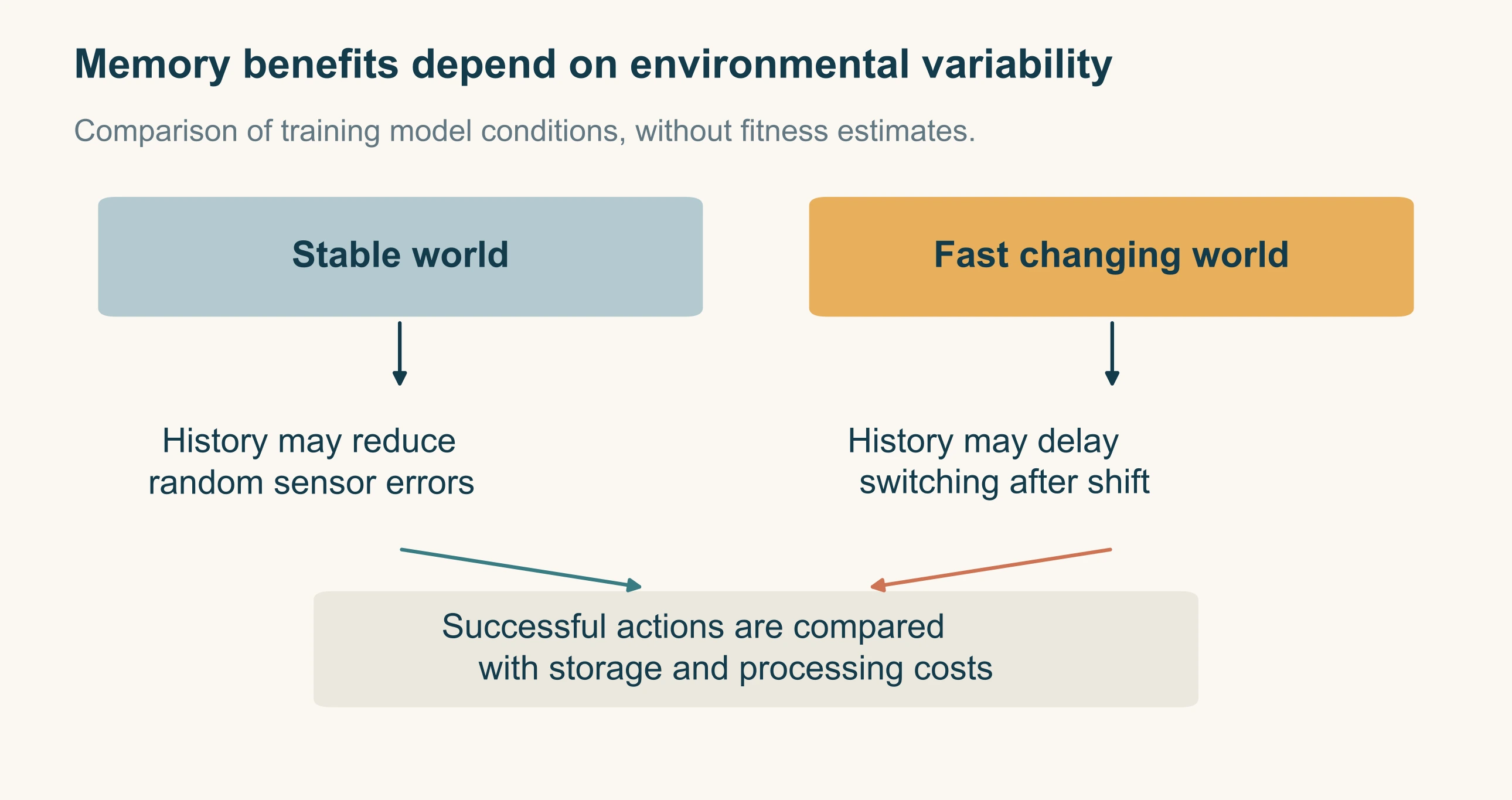
Figure 42. Memory trade-off instead of complexity ladder. In the chapter model, memory is able to smooth out noise when the target is stable and retain outdated information after it has changed. To draw a conclusion about an advantage, success and costs must be taken into account independently, and the connection with reproduction must be explicitly stated. This comparison of functions does not establish an evolutionary origin for the experience.
Similarities do not tell one story
If two species are found to have a similar ability, different historical explanations are possible. It could come from a common ancestor, be formed independently, or be based on a combination of common and new elements. In addition, the same result of a task can be achieved by different mechanisms. Therefore, comparison requires a joint analysis of behavior, design, and origin, rather than counting similar responses.
Felsenstein showed why species cannot be statistically treated as completely independent observations: their characters are linked by a common history of origin. His methodological work suggests taking kinship into account in comparative analyses. For the study of consciousness, this principle means that ten closely related species with one trait are not equivalent to ten independent cases of its occurrence. [31]
Let's build a fictional tree with four finite branches. Two close branches have the M mechanism, the other two do not demonstrate it. One explanation suggests the emergence of M in the common ancestor of the first pair. The other is an earlier appearance followed by loss in the second pair. Based on the distribution of one attribute, the story may remain ambiguous. Additional information can distinguish between versions, but omissions in observations cannot automatically be considered a loss.
When an experience is studied, uncertainty increases. Even the presence of M is not always established with equal reliability, and the connection of M with experience may depend on the theory. Therefore, historical reconstruction must preserve both uncertainties. It is incorrect to first declare a controversial indicator to be an exact criterion of consciousness, and then present the confidence of the constructed tree as an independent confirmation of the criterion.
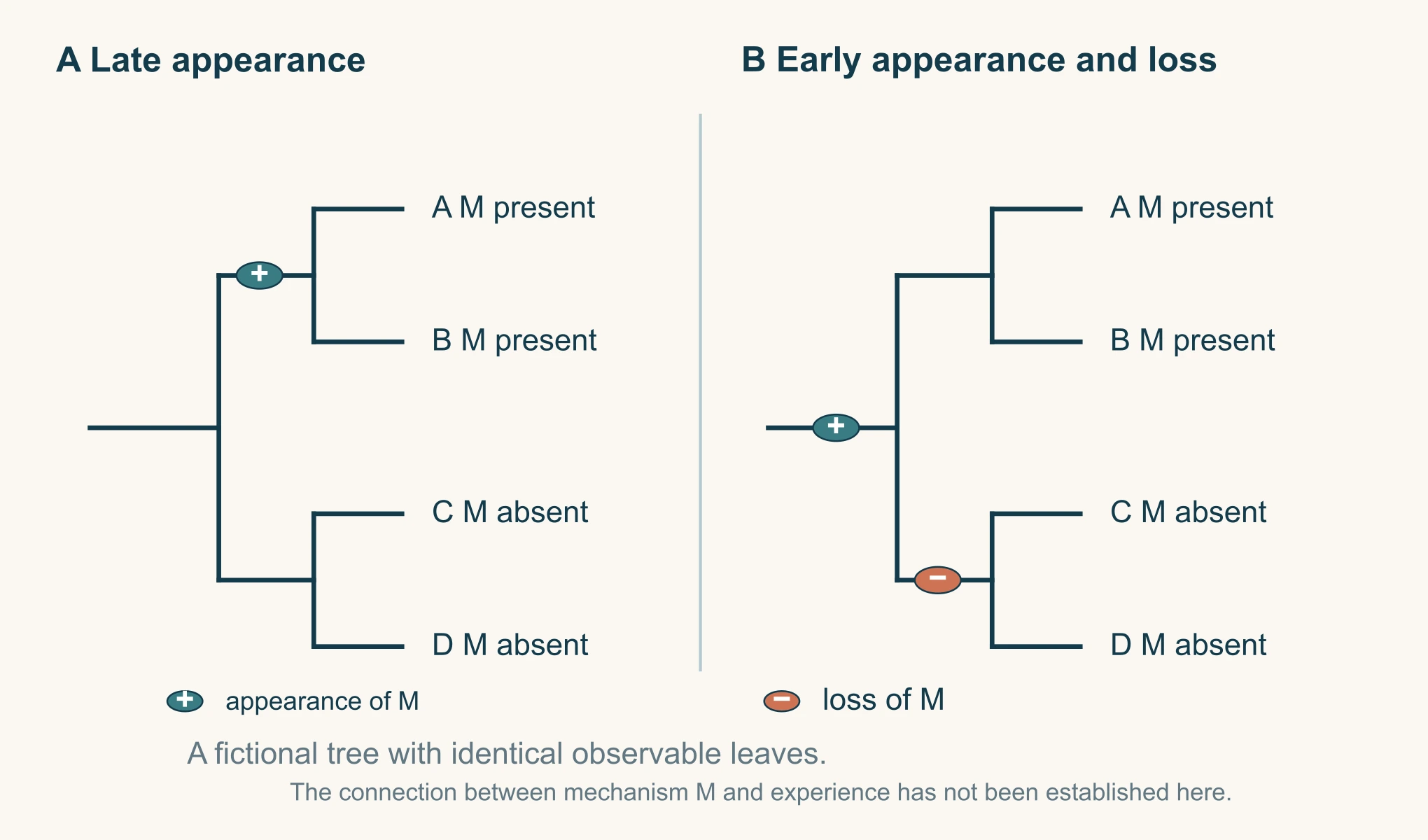
Figure 43. Two histories of the same trait distribution. In the teaching tree, mechanism M is present in species A and B and absent in C and D. This is compatible either with M first appearing in the common ancestor of the first pair, or with M arising earlier and later being lost in the second pair. The tree does not reconstruct the origin of consciousness; the relationship between M and experience remains a separate question.
Comparing Function and Organization
Barron and Klein proposed an argument about the possible experience of insects that relies on functional analogies between the behavioral control systems of insects and vertebrates. This is a primary theoretical work, not a direct observation of qualia and does not date their origin. Its research value lies in the explicit connection between the assumed organization and the inference about the experience; the transition itself remains subject to scrutiny and debate. [32]
You can start your own comparative project with a much more modest question: does the system integrate information about space, available actions, and internal state when making choices? To answer, you will need to show that changes in these factors interact and do not cause three independent reactions. For example, the availability of a resource should change the choice of route depending on the cost of movement, and new information should be transferred to a previously unseen combination of conditions.
Such a result would support the hypothesis of a specific management organization. Causal mechanisms should then be sought and simpler explanations tested. The transition to consciousness will depend on why this particular organization is considered essential. This is where the material in chapters 13–16 becomes useful: different theories guide comparative research towards different attributes and interventions.
Why does a universal ladder get in the way?
One scale forces disparate abilities to be combined. A species may be good at a spatial task but poor at a task that requires an unfamiliar sensory channel. Another system may accurately estimate the uncertainty of one action, but not transfer the estimate to a new area. These profiles do not have to be ordered in one line.
A map of functions is more useful for analysis: available types of information, time horizon, transfer flexibility, bodily organization, error control. If phenomenal experience is of interest, a separate column of arguments about it is placed next to it. If explicit reflection is of interest, another set of tasks is required. This idea prevents the subtle conclusion that “better in one test means more conscientious in everything.”
One should also not turn the modern look into a living step of the past. It has its own history of changes. Comparison helps to reconstruct certain ancestral traits, but does not make the observed animal an exact copy of a distant ancestral state. Therefore, one's own origin scenarios need to be presented as models with explicitly stated assumptions.
It is useful to check the script for a circular explanation. Let's imagine the reasoning: the mechanism was preserved because it was useful; its usefulness is established by its survival. Here one statement supports itself. To break the cycle, one must independently measure the perceived benefit, the cost, and the conditions under which the benefit disappears. Then the model may be wrong in terms of content.
In the memory example, the condition being tested would be a sudden change in the environment. If the model predicts a loss of benefit, but it persists across all parameters, the implementation and costing should be examined. Perhaps the comparison is designed so that one strategy always receives extraneous information. A technical error like this can produce a compelling but false adaptation story.
Identical tree leaves allow two stories
On the training tree, species A and B found mechanism M, while C and D did not. One story suggests the appearance of M in the common ancestor of A and B. Another allows for an earlier appearance and subsequent loss in another branch. The observed ends of the tree are the same, the historical changes vary. To make a choice, you need additional information about relatives, device and likely transitions. If the connection of M with experience itself remains a hypothesis, confidence in historical reconstruction does not turn it into independent evidence of consciousness.
What has now been established
The history of the mechanism and the history of the experience did not merge into one conclusion. It is possible to explain the advantages of a specific memory and at the same time keep open the question of in what organization it has an experienced side.
Practice 19 Map of the Evolutionary Argument
Why do it: Construct an evolutionary argument with explicit assumptions at each transition.
What you will need: Distinguish between development, evolutionary origin and the presence of experience. The mechanism, the observed trait, and the putative ancestor are different elements of the argument.
Time reference: 25–35 minutes. Can be done intermittently; This is not a speed standard.
1. Use the tutorial drawing tree 43. Write your observations on leaves separate from the two versions of the story.
2. For each option, name the expected appearances and losses of the mechanism. Do not pass off any variant as a direct observation of an ancestor.
3. Describe an environment in which multiple-signal memory can help and an environment where it delays switching. Please also include storage and handling costs.
4. Add a separate sentence about the relationship between mechanism and experience and label it as a theoretical hypothesis. Provide information that would change each conclusion.
What to keep: Map from observation, historical explanation, advantage model, and single phenomenal proposition.
Hint: Similar behavior does not guarantee a common device. A common molecule does not guarantee the same function of the entire system.
Research Continuation: Select a published comparative argument for the chapter. Check what information relates to function, structure, and relationship, and offer an observation that distinguishes nearby historical versions.
Analysis and answers - Appendix F, chapter 19, p. 289
Self-test questions
1. Does the adaptive benefit of a mechanism prove the presence of experience?
2. Why don't closely related species provide completely independent evidence?
3. Why save multiple origin stories?
We separated episode dynamics, development and evolution. The next chapter will highlight the remaining question: why a certain physical organization can have an experiential side at all.
Chapter 20