Body and action in self-reference
Context helps to interpret the sign, but in action it is also necessary to evaluate the source of the change. Did the movement coincide with the command by chance or did the command actually control it? There will be two related tasks in this chapter: integrating sensory causes and distinguishing self-effects. Before the numerical example, we will analyze probabilistic updating as a rule of version change, maintaining its difference from the experienced bodily belonging.
When several signals refer to one event
You raise your hand and at the same time see its movement, feel the change in position and get new sensations from the clothes. To describe this episode, it is not enough to say that many signals were received. It is necessary to explain why they are associated with one part of the body and one action. A similar movement on a nearby screen may remain an external event, although it also occurs before the eyes.
One approach views the problem as inferring sources. The system must evaluate whether visual, bodily, and motor information are related to a common cause or arose independently. Such an assessment may take into account temporal coherence, spatial coherence, and past reliability of sources. The word "output" here does not require an internal phrase or conscious reasoning: it denotes the operation of a model that distinguishes between possible explanations for the input.
Majed Samad, Albert Jin Chung, and Ladan Shams applied the Bayesian causal inference model to the perception of body ownership. They compared the model's predictions with experiments on the illusion of an artificial hand. The work shows how the assumption of the unification of sensory causes can be made computable and testable with data; it does not establish that any combination of signals is already an experience of one's own body. [15]

Figure 23. Hand tool and observed result. A detailed illustration of an action through an instrument: the movement of the hand is accompanied by a change in the pattern on the screen. To study authorship and self-attribution, it is necessary to clarify what information the system associates with one cause and how it verifies this connection.
A Common Cause Does Not Yet Establish Body Ownership
The sound of the impact and the movement of a falling book may also have a common cause. Therefore, the source pooling model solves a more general problem than bodily identity. To move to the body, you need to clarify which signals relate to it, how its position is represented, and what relationships connect events with the actions of the system.
Let's return to the distinction of chapter 3. Belonging answers the question whether an object is given as part of its own body. Authorship refers to the experienced or appreciated connection of an action with its outcome. The system can control an external tool and maintain a distinction between the tool and the body. It can receive information about the position of a stationary limb without performing any voluntary movement at this moment.
The work of Kalckert and Ehrsson, discussed earlier, provides experimental grounds for studying these components separately. [4] Our model will therefore have separate variables for combining sensory sources and assessing the causal contribution of the command. Even if in ordinary episodes they often change together, their separation allows the formulation of new testable conditions.
Why does evidence change the weight of a version?
Let's first distinguish between two questions. How likely is version C before the new observation? How probable is the observation itself if C is true? The first quantity is the preliminary probability of the version. The second is called the likelihood of observation under this version. They are related by calculation, but are not interchangeable.
Let sixty out of one hundred conditional cases have a right goal. The gauge is correct eighty percent of the time, regardless of the side. Then, among sixty right targets, forty-eight signals from the right are expected, and among forty left targets, eight such signals are expected. If we received a signal from the right, we consider these fifty-six cases. In forty-eight of them the target is actually to the right. The new share is equal to 48/56. The numbers here describe the selected training probability model, not a survey of people.
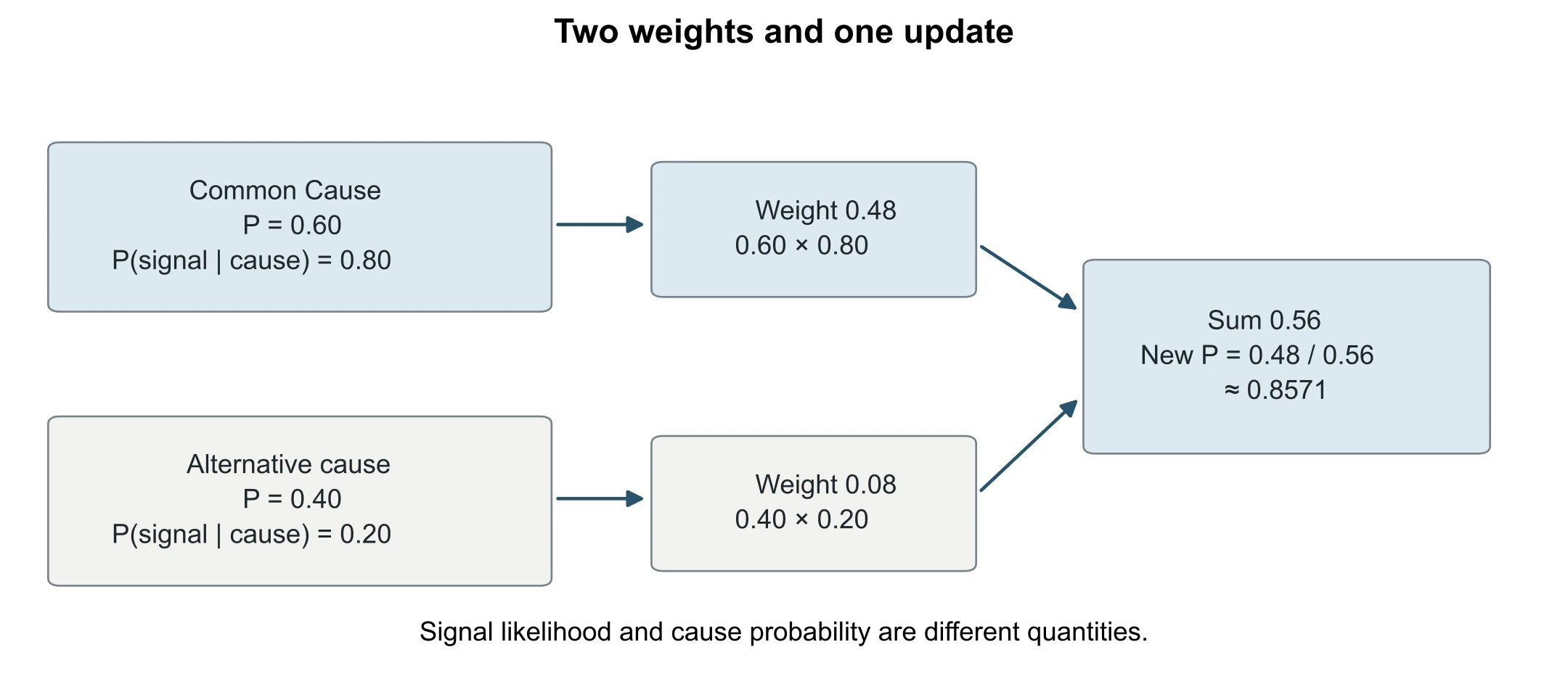
Figure 24. Consistent updating of causal versions. Training calculation with preliminary probability 0.60 and symmetric reliability 0.80. First, the unnormalized weights 0.48 and 0.08 are constructed, then normalization is performed. Numbers provide a model, not a measurement, of experience.
The same calculation can be written down for two arbitrary versions. First, we multiply the preliminary probability of each by the likelihood of the data obtained. We get two unnormalized weights. Then divide the required weight by the sum of both. Division returns the probabilities to a total of one. If the sum is zero, the data is not possible under both versions; this requires model revision or input testing rather than an arbitrary response.
The odds ratio allows you to perform the same operation compactly. The odds of C versus P are P(C)/P(P). The new feature multiplies them by the likelihood ratio P(sign|C)/P(sign|P). With initial odds of one to one, a feature that is three times more likely at C gives three to one, that is, probability C 3/4.
The following testimony should not automatically be considered a new independent voice. If one gauge simply copied another, identical numbers do not produce double the base. For sequential multiplication, the likelihood of a new feature is used, taking into account already known ones; conditional independence is a simplification that does not change this likelihood. Now the numerical example can be read as a specific mechanism and at the same time see its premises.
Worked example of two versions
Let's build our own educational model. Version C assumes that visual and bodily signals refer to the same object. Version P assumes different sources. Until a new observation, we will give the versions equal weights. Then we get a sign: the changes occurred almost simultaneously. For the exercise, let's say that such a coincidence is three times more likely with version C than with version P.
After taking into account the sign, the ratio of the weights will become three to one. Of the total sum of four shares, three fall on C: its model probability is equal to 75 percent. This is not a measured probability of hand ownership, nor is it an estimate of a real person. The numbers are chosen to show an update of two competing explanations.
Now comes the second sign: the positions of the objects diverge greatly. Let us agree that it is four times less probable at C than at P. The previous ratio of three to one is multiplied by one quarter and becomes 0.75 to one. Probability C is now approximately 43 percent. New information has changed the model's preference, although the first feature continues to be taken into account.
The calculation can be written briefly. odds means the ratio of probability C to probability P. ratio indicates how many times the next attribute is more likely at C. The last line converts the ratio into a fraction of the total amount.
odds = 1.0
for ratio in [3.0, 0.25]:
odds = odds * ratio
probability_common = odds / (1.0 + odds)
print(round(probability_common, 3))
We received 0.75 and approximately 0.429. In this simplified model, the characteristics are considered independent when the version of the cause is fixed. If temporal and spatial coincidence are interrelated, they cannot be multiplied as independent evidence without verification: some of the information may be counted twice. A more accurate model should specify a joint dependence or evaluate the second characteristic taking into account the first.
What One's Own Action Adds
The passive match of signals and the result of the command create different verification possibilities. Let's say the program sends a left command and expects the pointer to move to the left. It compares the expectation to the actual change. But a coincidental result alone is not enough to establish causal control: the external recording could have accidentally performed the same movement.
Now the program changes the commands according to the new sequence. If the pointer continues to match them, the control version gains more support. If the old recording is played back regardless of the new commands, a discrepancy appears. Intervention in the sequence of actions helps to distinguish between causes that, when passively observed, might look the same.
An action model must store at a minimum a command, an expected consequence, and an observed result. It is also important to indicate the time: a late consequence may relate to a previous command. If you compare it only with the current one, the system will mistakenly attribute failure or external interference to itself. History is needed to establish relationships between events, and not simply to increase memory capacity.
At the same time, the functional assessment “this command caused the event” remains separate from the experienced sense of authorship. For human research, model estimates can be compared with reports. For an artificial system, the source discrimination itself and its use in behavior are first tested.
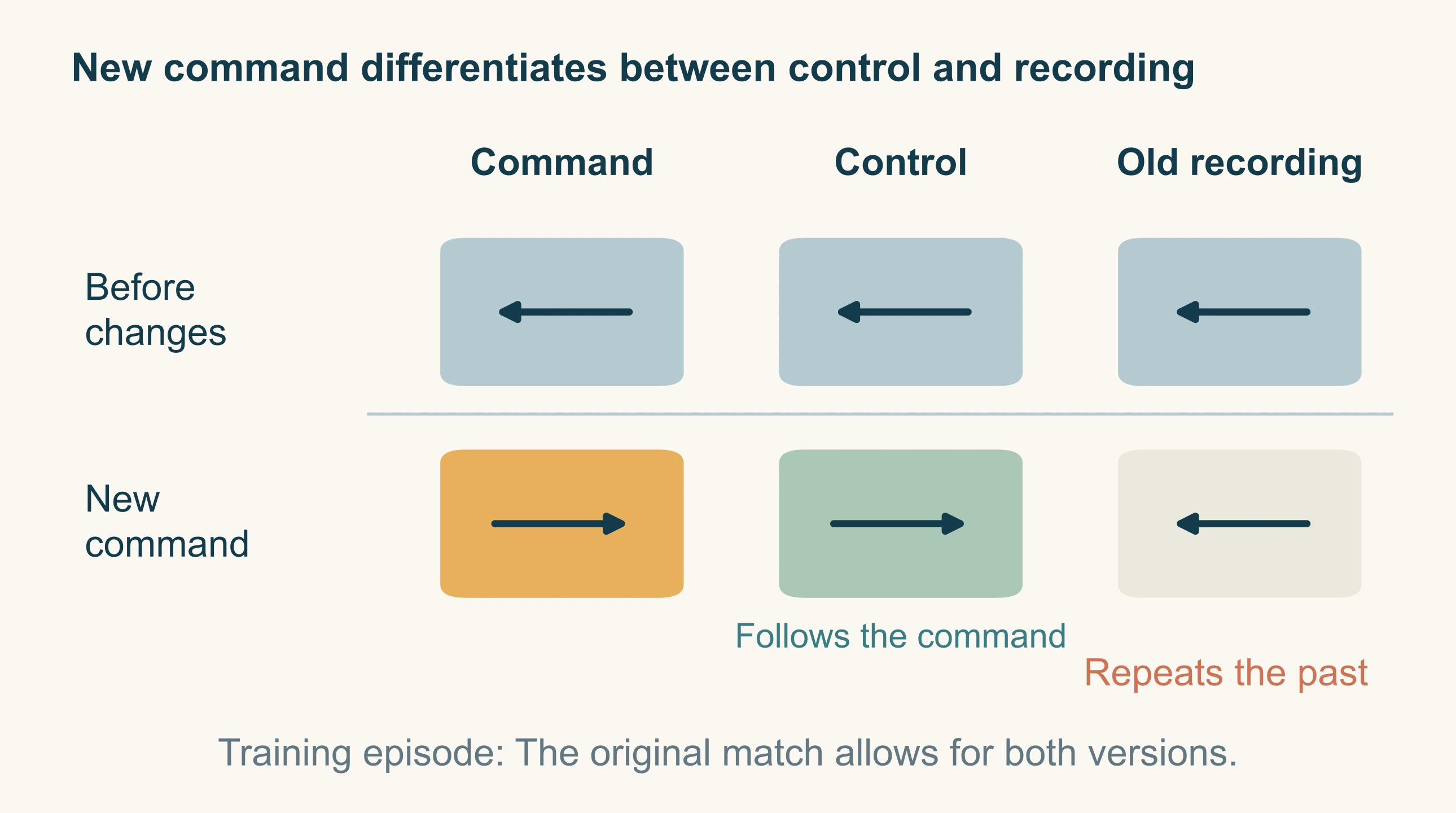
Figure 25. Distinguishing causes by changing the command. With the initial command to the left, the movement of the pointer can coincide with both the control and the external record. In the fictional sequel, a new command to the right makes different predictions: the controlled pointer changes direction, but the entry repeats the previous movement to the left.
Compare models of memory and self-reference
Let's imagine three versions of the program. The first looks only at the current match of signals. The second additionally takes into account the overall reliability history, but does not distinguish between sources. The third stores history separately for its own commands, external events and each observation channel. These models answer different questions about what information is needed for robust causal discrimination.
The third program does not gain an advantage automatically from the word "own." We must test exactly what information this label contains and how it affects prediction. If the program was simply given the correct answers, its success explains nothing. If it stores more data, it should be compared with a general memory model of comparable capacity. Otherwise, the contribution of organization becomes confounded with an advantage in resources.
A meaningful hypothesis might sound like this: separate history of sources helps to transfer the assessment of authorship to new combinations of delay and interference. The check should use combinations that were not encountered during setup. The result then shows the ability to apply the intended relation, and not just remember familiar sequences.
How a delay changes the meaning of a coincidence
At moment 1 a command was sent to the right, at moment 2 to the left. The visible result to the right occurs only at moment 3. Comparing only the current command and the current effect may mistakenly consider the result to be external. The story allows for a connection to an earlier command. But if an external recording reproduces the same series, passive observation is not enough. A new pre-selected sequence of commands allows you to check whether the result follows the current control or the old record. This control distinguishes between causal accounts and does not itself measure the sense of authorship.
What has now been established
The general cause of signals, causal control and bodily belonging did not become one indicator. We now have ways to test the first two relationships and can separately ask how their estimates relate to human reports.
Practice 11 Paper Source Researcher
Why do it: Construct a transparent analysis of the source of the event without revealing the correct reasons to the model.
What you will need: Concepts of observation, latent state, and internal evaluation. The probabilistic transition in this chapter explains the necessary calculations; There is no need to derive Bayes' rule yourself before reading the chapter.
Time reference: 30–40 minutes. Can be done intermittently; This is not a speed standard.
1. Set commands in steps: right, left, left, right. For the control version, the effect appears in two steps. For external recording, take a cyclic sequence of right, right, left, left, repeating in the same order regardless of the commands.
2. Make two observation tables and keep the true reason separately. For the first available events, write down the delay versions zero and two steps.
3. Continue the commands with a new row to the left, to the right. Before discovering new effects, write down what the control predicts and what the external recording predicts.
4. Highlight cases where there is not enough data yet, and explain which new command will actually distinguish the remaining explanations.
What to keep: Tables of commands and effects, two causal versions and a preliminary forecast of a discriminating continuation.
Hint: The first two steps of the delayed channel may not yet correspond to a command within the observed window. Don't fill them with a fictitious connection.
Exploratory continuation: Add noise and uncertain source recognition. Compare shared memory and separate histories with the same inputs and comparable capacity.
Analysis and answers - Appendix F, chapter 11, p. 284
Self-test questions
1. Why is the inference of common cause not the same as bodily belonging?
2. What makes it possible to distinguish between one's own control and a random coincidence with an external recording?
3. Why doesn't more stored data prove the benefit of self-reference?
History has been helpful in distinguishing causes. The next chapter will add another question: how reliable is your own answer and how to evaluate this before getting the result.
Chapter 12