Workspace and recurrent processing
In previous chapters, we separately examined state, feedback, content use, and response evaluation. These concepts will now allow us to compare two theoretical ideas: refinement within sensory processing and dissemination of the result to different consumers. Let us first trace their functions in a fully specified device. Then we return to the stronger claims of the theories of conscious access and experience. The coincidence of functions does not make two theories identical.
From name to device
Let's imagine that you are reading a message and a cup falls nearby. The sound interrupts the reading; you turn, assess the danger and change your action. In explaining such an episode, it is easy to combine several different issues. How was the sound recognized? Why did it get the advantage? How did information become available to movement, memory, and reasoning? Why was the event experienced? The theories discussed in this chapter offer different ways to connect these issues. Comparing them requires first understanding the proposed mechanisms and then separately assessing the transition from mechanism to consciousness.
It is convenient to think of a workspace as an organization of exchange between specialized processes. Recurrent processing means that the result of processing returns and changes the further operation of elements that have already participated. These are different characteristics of the device: the breadth of availability and the presence of reverse interaction. They can be combined. Therefore, the debate between approaches cannot be reduced to a choice between a “connected” brain and an “unconnected” brain.
The Central Claim of Global Workspace Theory
In the global neural workspace model of Stanislas Dehaene, Michel Kerszberg and Jean Pierre Changeux, specialized processes interact with a distributed system capable of maintaining and disseminating selected information. The computer implementation of 1998 linked its participation with mastering the task, requiring effortful execution and error handling. This is a specific proposal about the organization of cognitive work, not the discovery of a separate brain "screen". [16]
Let's look at our own teaching example. The device has four modules: object recognition, risk assessment, movement selection and event memory. As long as the recognizer sees the cup, only it stores the corresponding record. After selection, the “cup falls” message receives a common event identifier and is transmitted to other modules. The risk assessment associates it with a possible burn, the movement chooses to retreat, the memory retains the incident. The architecture explains the coordinated use of the same content by multiple processes.
Now let's clarify the statement being verified. If a common channel is needed to transfer new information between modules, its temporary shutdown should disrupt the transfer. Recognition of a cup may persist, but the use of the recognized one in a new task may disappear. If the shutdown simultaneously impairs sensory input and movement, the results are mixed. We will not know which of the damaged processes was responsible for the change in behavior.
The strong version of the conscious access explanation attributes a special role to the transition to sustained widespread availability of content. It is the responsibility of the researcher to indicate what is considered sufficiently widespread, what process supports the content, and what data would distinguish such a transition from normal signal amplification. The expression “information has become global” without these clarifications remains the name of the result.
The Central Claim of Recurrent Processing Theory
In Victor Lamme's approach, the initial forward propagation of the visual signal is separated from subsequent feedback interactions. Local recurrent processing is considered a candidate mechanism for visual experience, while broader interactions are associated with access and report. A strong thesis is the possibility of an experience that has not yet received all the possibilities of subsequent use. This is a theoretical interpretation that requires independent verification. [17]
Let's build another learning mechanism. The first module highlights short lines, the second assumes the outline of an object. The assumption goes back to the first and changes the weight of the ambiguous lines. After several exchanges, the system selects the agreed form. Here the feedback makes clear the dependence of recognition of the part on the whole. However, the presence of a cycle does not yet explain why processing should be accompanied by the visibility of the form. A fan with a temperature controller also forms a control loop; its structure differs significantly from the described visual interaction.
Therefore, the recurrent hypothesis must be written with restrictions. What elements are exchanged between? What is sent back? How long is the interaction? How to distinguish meaningful feedback from general modulation of excitability? What operations should be preserved if it is violated? The more detailed the answer, the less opportunity there is to declare any cycle found as a confirmation.
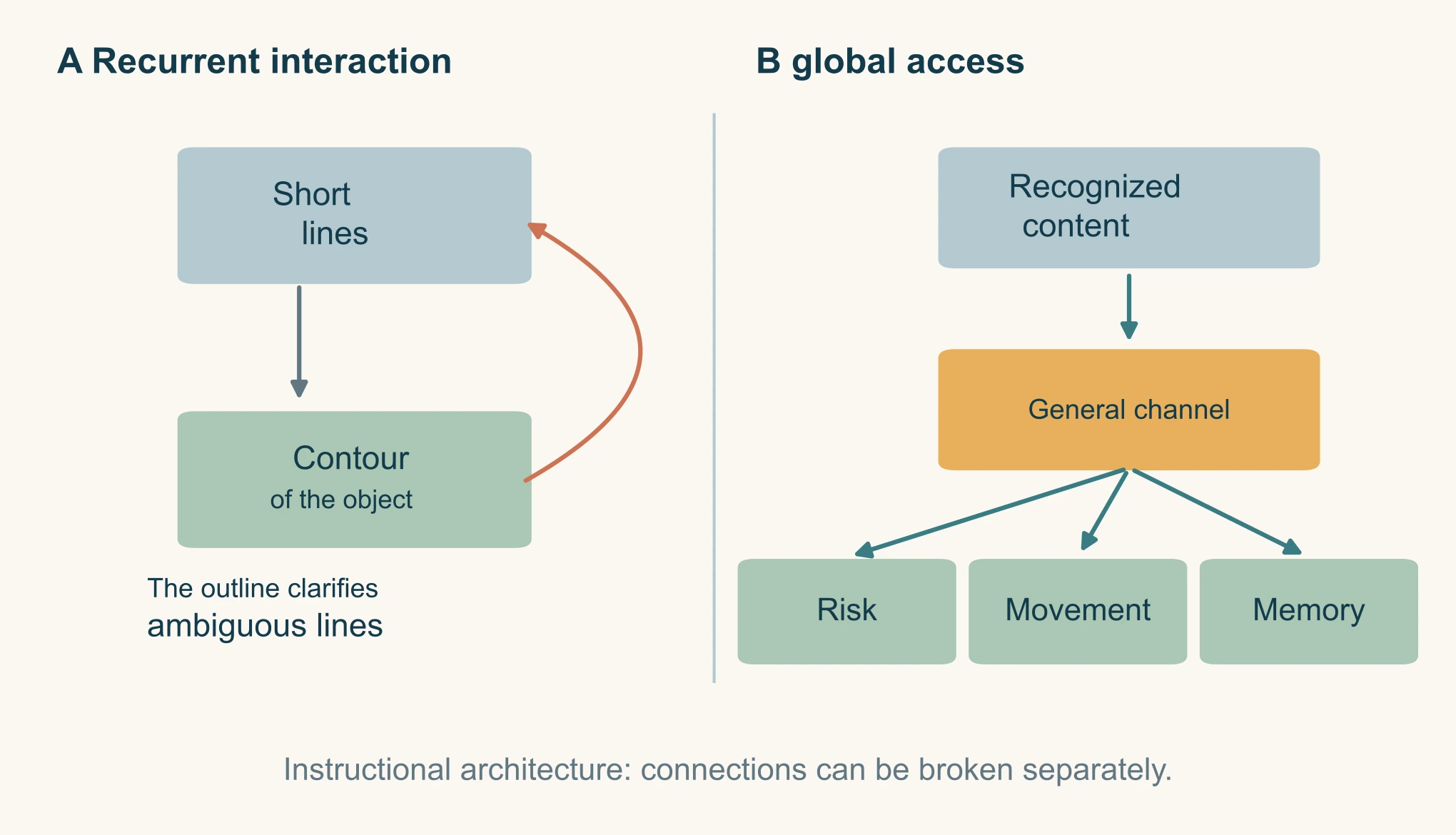
Figure 28. Recurrence and shared access. Two aspects of one educational device. Returning from the contour to the features helps to coordinate recognition; a shared channel allows multiple processes to use selected content. These connections can be changed separately. The diagram is not a test for the presence of consciousness.
In the study by Fahrenfort, Scholte, and Lamme, visual masking was combined with preservation of early processing and disruption of later signals interpreted as recurrent. The work supported the distinction between processing stages. It does not establish that any late response is sufficient for the experience, nor does it exclude all additional conditions of conscious perception. [18]
From a Diagram to a Theory's Commitments
It is useful to go through one case twice. First explain the processing: local features provide several possible objects, the context limits the choice, the result becomes available for further action. Then ask about the conscious status of each stage. The first pass sets the mechanism; the second shows what additional point of the theory connects the stage with the experience.
For the workspace approach, what is essential is not the arbitrary copying of a number, but a certain selection, maintenance and widespread use of content. You need to list the consumers, the new uses, and the consequences of selectively limiting access. Therefore, simply passing to one preconfigured output is a preliminary example, not the whole theory.
For the recurrent processing approach, it is important to clarify which feedback interactions are assumed to be sufficient for visual experience and how they differ from the subsequent report. The final sequence of repeated calculations can be expanded into a direct circuit. This forces a distinction between computational function and physical organization if the theory gives importance to the latter.
A good comparison selects one divergent forecast. Let's say that local content is preserved, but has become inaccessible to an arbitrary response. The dispute then concerns what basis allows us to consider a persisting process to be an experience and what independent indicator confirms this. The dispute cannot be resolved by simply renaming the process unconscious or conscious. The version being reviewed, the measurement, and the revision condition must be agreed upon.
The training system before practice is intentionally simpler. Its task is to provide experience in disabling functions separately. Once completed, we can return to the scientific debate with a precise understanding of which parts of the argument have been verified by such a calculation and which require additional data.
Where is the real disagreement?
Let us imagine content that is stably represented in the visual system, but is not used for voluntary response. One researcher will say: the experience is already there, access is limited. Another will answer: processing that precedes conscious access has been found. The disagreement concerns which device is considered sufficient and how to establish the presence of the sought-after phenomenon, regardless of the accepted theory.
This difficulty does not make the study pointless. Narrower predictions can be compared. For example, one model requires a long exchange between two sensory areas; the other requires connecting an additional system during a certain period. An experiment that selectively changes one interaction while maintaining the other is then useful. If an intervention is indiscriminate, it does not discriminate patterns well even when the behavioral effect is strong.
In our training device, you can independently turn off the return from the loop to the lines and the general channel of the event. The first time you disable it, form coordination will suffer; the second time, its use by different tasks will suffer. These differing consequences indicate that the two mechanisms serve different functions. To move to a claim about consciousness requires additional argumentation. The device is currently giving us an experiment with information processing.
You should not expect in advance that one process will replace all others. A mechanism may be necessary in one environment and make do with another mechanism after training. The detection threshold depends on the strength of the signal, and the willingness to respond depends on the instructions and the cost of the error. Therefore, the change in outcome must be decomposed into changes in sensitivity, strategy, response time, and subjective assessment.
Let's add a second source to the training system - a message about a moving person. Now the general channel must choose between two contents. If the cup always gains an advantage, the device will cope with one example, but will not show flexible selection. Let's change the task: sometimes you need to remember a person, sometimes you need to prevent a collision with a cup. Before checking, we will specify how the instruction affects the priority. Then we'll see if the recognition of the losing content persists and can later be accessed by other modules.
This complication no longer checks the presence of a communication line, but the rules of its use. It helps separate a rigid command sequence from an architecture that can convey different content depending on the new purpose. Both devices can perform the initial test successfully, but their differences will become apparent when transferred to an unfamiliar combination of requirements.
One sample with clarification and transfer
In the new training system, the local attribute is equal to 0, 1 or a question mark. The context contains 0 or 1. If the feature is defined, the recognizer saves it. If it is undefined, initially writes 0; enabled context return replaces this entry with the context value. The general channel copies the final content into memory. Without transfer, the memory remains 0. In the sample (?, 1), the full system first receives the local 0, then refines it to 1 and transfers 1 to memory. Disabling the return leaves 0; disabling transmission retains recognition of 1, but the memory remains 0.
The correct label for a specific input is equal to that input for an undefined context. The appraiser needs it. Here we examine the operation of predefined rules. A competitor with direct access to all inputs can solve the same problem, so the success of the demonstration does not establish the uniqueness of the workspace or the adequacy of the return for the experience.
What has now been established
We obtained two independently variable relationships: clarification of content and transfer of it to memory. Now the four modes can be compared in terms of two results, without calling the loss of one of them the disappearance of consciousness.
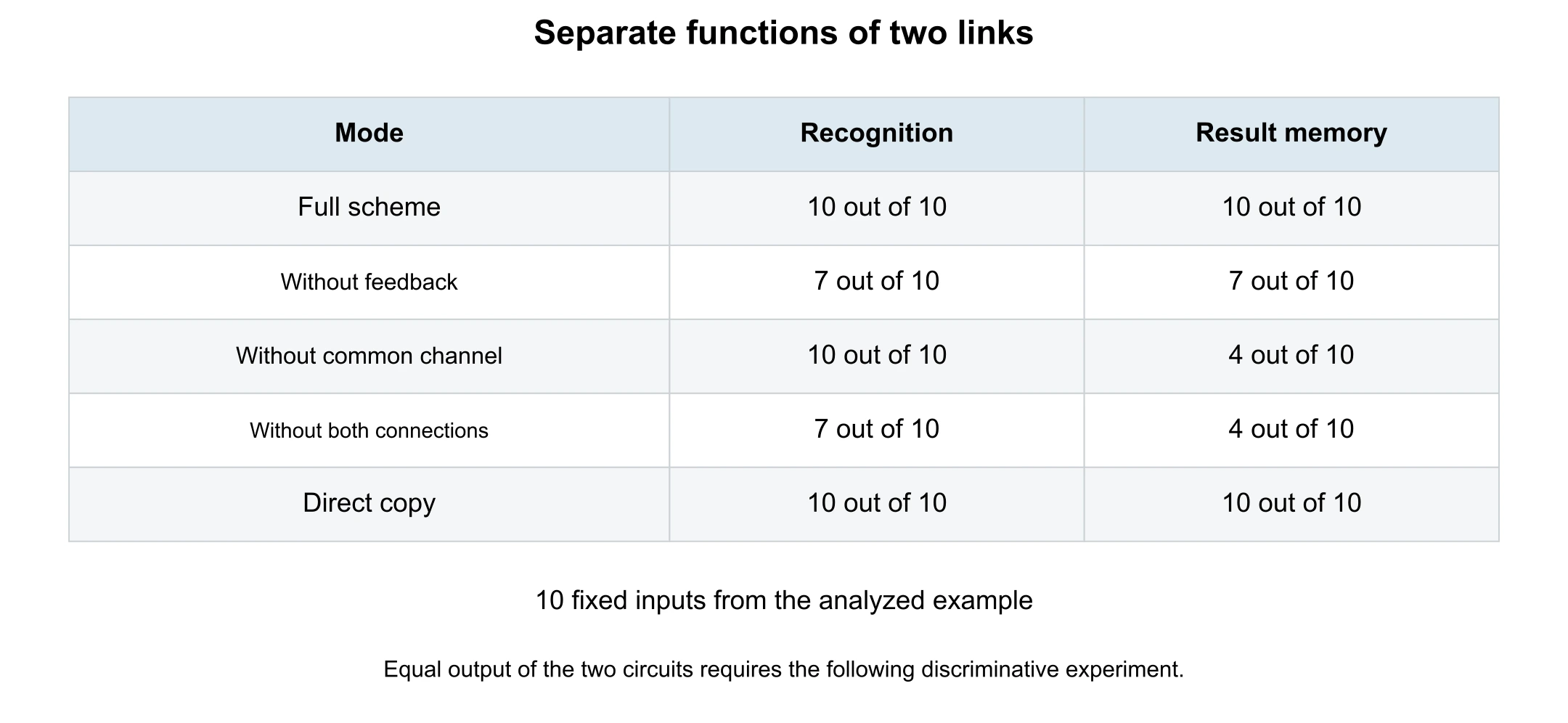
Figure 29. Independent shutdown of two mechanisms. The result of ten fully specified training trials; reproduced teaching_lab.py --chapter 13. The return clarifies the ambiguous sign, the common channel transmits the memory response. Direct copying is a strong functional control. The table does not measure consciousness and does not represent a comparison of complete scientific theories.
Practice 13 Translation of theory into prediction
Why do it: Test separately the contribution of refinement and transfer on identical ten samples.
What you will need: Input, status and output; difference between local representation and its use. Before practice, all the rules of the training system and ten inputs are given.
Time reference: 35–45 minutes. Can be done intermittently; This is not a speed standard.
1. Take pairs of local attribute and context: (0,0), (1,0), (0,1), (1,1), (1,0), (?,1), (?,0), (?,1), (?,0), (?,1). For each, calculate the correct label using the rule above.
2. For a complete system, fill in the columns: initial recognition, final recognition, memory content. After each trial, the memory begins with 0.
3. Repeat the same ten entries without return, without transmission and without both mechanisms. Calculate the accuracy of recognition and memory separately.
4. Check the table with the command python teaching_lab.py --chapter 13. Then add a direct competitor that sees both inputs and refine the limits of inference.
What to Keep: Four modes, two results for each, and an explanation for one specific discrepancy.
Hint: Disabling transmission does not change the recognition rule. If both indicators change, check to see if you have turned off multiple functions at the same time.
Exploratory continuation: Change the task: after a delay, a new instruction arrives to one of several consumers. Determine the memory, budget and inputs of a strong competitor in advance. Print the result where the mechanisms actually diverge.
Analysis and answers - Appendix F, chapter 13, p. 285
Self-test questions
1. Why aren't global propagation and recurrence strictly opposed?
2. Does the disappearance of the report after the intervention prove the disappearance of the experience?
3. Why compare mechanisms with the same computing budget?
The difference in functions became obvious. The next chapter will add two other topics of theory: internal causal organization and the system's representation of its own state.
Chapter 14