What exactly are we experiencing?
Let's start with a small skill that will be needed throughout the book: distinguishing between the event itself, the description of the experience, and the explanation of its cause. To do this, you don’t need to look for unusual conditions. One touch is enough. We are not yet building a theory of consciousness; we are preparing material about which a future theory will have to explain something. By the end of the chapter, you will have your first record and understand which parts of it require different methods of verification.
Start of research
There is a mug on the table. You can name its material, approximate volume, and price. Now take it in your hand. Other descriptions become possible: the handle feels cool, the rim seems smooth, and a bright reflection is visible on the surface. The object remains part of the same situation, but the question has changed. We are interested in what encountering it feels like.
Thus begins the study of qualia. The first work will not require an unusual condition or a rare experience. Something that is already happening when you look at a page, hear a sound, or feel a touch will do. Our task is to turn a familiar, usually quickly passing event into material about which we can talk accurately. By the end of the chapter, you will have your first observation record and several questions to test later.
What does the word qualia mean?
In this book, qualia refers to the qualitative characteristics of subjective experience: the way something is felt or perceived. Coolness is different from roughness, and a sharp sound is different from a dull sound. The difference exists for the experiencing person, even if he has not yet found the appropriate words. We choose a broad working meaning of the term in order to first learn to identify the subject of research.
The word "subjective" here indicates the presence of the experiencer's perspective. It does not mean "arbitrary" or "necessarily erroneous." You can report fairly confidently that the touch felt cool and be mistaken about the temperature of the object. These statements refer to different properties of the situation. The temperature can be compared using the readings of the device; the feeling of coolness describes what happened in your experience.
Qualia are not limited to emotions. Emotional tone can be part of an experience, as can color, sound, or bodily sensation. At the same time, there is no need to turn every thought into a set of imaginary pictures in advance. If, while solving a problem, you notice words, a vague feeling of difficulty, or an expectation of an answer, describe exactly this. The content of the observation is more important than conformity to someone else's model.
In philosophy, stronger meanings of the term are also used. Daniel Dennett has criticized the idea of qualia as special properties that are attributed, in particular, to ineffability and unmistakable accessibility to the person himself. His argument is directed at a particular conception of these properties. In our work, the presence of a verbal description will neither be a refutation of the experience nor a guarantee of complete accuracy of its understanding. [1]
Event, experience and recording
Consider the phrase: “I touched the handle, felt the coolness and realized that the mug was standing near the open window.” In one sentence there was a report of an action, a description of an experience, and an assumption of a antecedent cause. If left merged, it is easy to mistake the entire sentence for direct observation.
Separation helps you see what exactly needs checking. The touch can be recorded on video. Coolness is available in the person's report. An open window is a separate version of the origin of temperature, for which other information may be needed. Even a plausible explanation remains an explanation; it does not become part of what is seen just because it arose quickly.
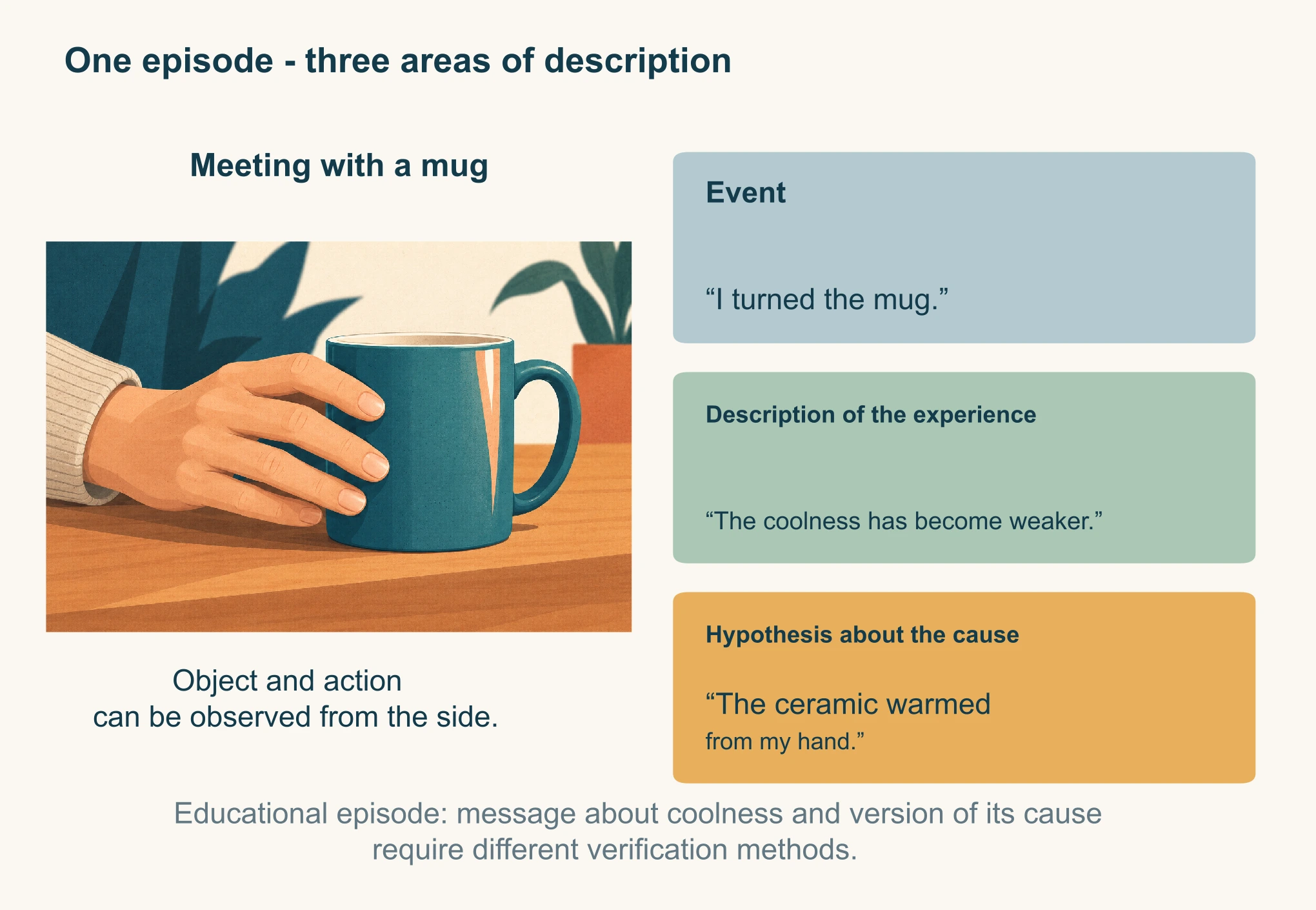
Figure 1. Three areas of description of one episode. The event, the description of the experience, and the hypothesis about the cause refer to the same situation but answer different questions. On the right are teaching statements; the image itself does not establish the feeling of coolness or its physical cause.
Statement | What does it say? |
I turned the mug | Action in a situation |
The highlight has shifted to the right and become brighter | Description of visual change |
The mug is well made | Judgment about an object |
The coolness weakened because the handle got hot | Description of change and causal hypothesis |
The words “pleasant” and “unpleasant” are not automatically distributed across this table. “The touch felt good” can inform the emotional tone of the episode. “This is a nice mug” may express a habitual preference or a general impression. You need to clarify the meaning: what happened now, what you usually prefer and what conclusion you draw about the thing.
Why is a detailed report not everything?
Suppose you first wrote down: “The mug is cool.” Then it turned out: “At the point of contact there was a feeling of coolness, which became less noticeable towards the end.” The second recording more accurately localizes the sensation and highlights its change. This is an improvement in the way of description. However, the number of words does not indicate how rich the original experience was.
There are several possible paths to a longer entry. You could take a closer look at the subject, find the right word, remember a detail, or include an assumption in the text that was not there before. Therefore, it is useful to save an early recording. It allows you to compare not only the conclusions, but also how they came together. Clearly corrected text often hides the origins of the confidence.
Time also matters. Recording during an event, immediately after it, and in the evening from memory are different research situations. In all three cases, the person can provide valuable information. But in the latter case, he describes the past through a present memory. A simple note “recorded in about a minute” makes the material clearer to the future reader and yourself.
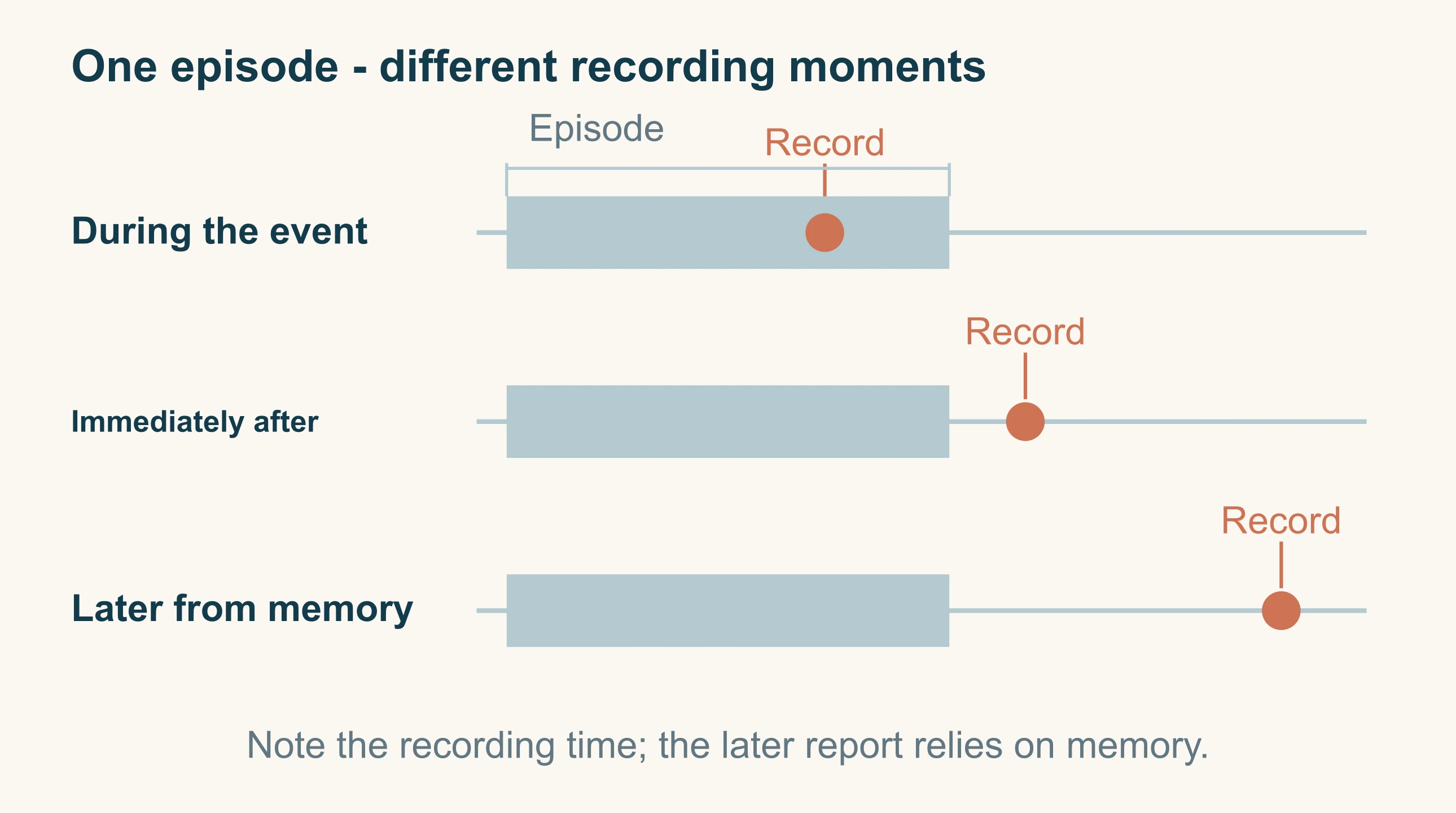
Figure 2. Recording time as part of observation. Descriptions during the event, immediately after it, and later from memory are collected in different conditions. Indicating the moment of recording allows you to distinguish the current report from the memory and subsequent explanation.
Where Do Consciousness and Reflection Fit?
The word "consciousness" refers to several related issues. Does the system have any subjective experience at all? What information is available to it to respond and act on? Can it evaluate its own decision? What happens when it begins to consider the basis of its thoughts? At the beginning of the course we will distinguish between these questions in order to gradually clarify the relationship between them.
David Chalmers suggested that there should be a separate discussion of the explanation of functions—for example, stimulus discrimination and state reporting—and the explanation of why what happens is experienced. This is an influential philosophical proposition, not a pre-established prohibition against explaining experience in terms of physical mechanisms. For our route, it is useful because it requires us to name exactly what the next model explained. [2]
Reflection begins with consideration of one’s own experience, judgments or actions, allowing for their revision. You note: “I considered the weakening of the coolness to be evidence of heating, although I did not measure the temperature.” Now we can ask what other changes have occurred. The analysis continues with observation: hold the position of the hand, clarify the time, compare conditions. This is how reflection becomes part of the research.
Worked example
Here is a teaching note, not the result of a published experiment: “Touched a pen. I felt coolness in my fingers. Later it became weaker. The touch felt slightly pleasant. The handle probably got hot from your hand. I don’t remember at what point I noticed the change.”
The first sentence sets the action. The next three describe the experience. The fifth offers a reason. The latter marks the limitation of recollection. None of this needs to be thrown away: research needs the conditions of the episode, the description, and the ideas that arise. You just need to maintain the differences between them.
The next step is to clarify the word “weaker.” Has the coolness become less intense or have you noticed it less often when looking at the glare? These versions are not yet identified causes. They indicate which additional issues to focus on for the next observation. A good clarification narrows down uncertainty, rather than simply adding a fancy term.
How to parse one recording without losing the experience
Let’s take four sentences: “I touched the handle of the cup. There was a feeling of coolness in my fingers. This cup is comfortable. It probably cooled off by the window.” The first reports the action, the second describes the quality of the experience, the third expresses an overall assessment, and the fourth offers a reason. We do not choose one correct sentence: each can be useful if its role is preserved.
Now let’s add: “The coolness was pleasant.” Here, pleasantness may denote a directly experienced tone rather than an assessment of the merits of the cup. Therefore, the marks refer to the meaning of the phrase and not to individual words. If in doubt, clarify: are we talking about a current touch or a stable relationship to the object? This is the first example of a research question arising from careful description.
What has now been established
We now have three different items to test: the event, the experienced quality, and the presumed cause. The ability to distinguish between them is more useful than a long list of impressions. Now apply this distinction to our own short record.
Practice 1 First record of experience
Why do it: Learn to keep a description of an experience separate from an assessment of a thing and a version of the cause.
What you will need: No special training required. All you need is an ordinary object at room temperature, a sheet of paper and a few quiet minutes.
Time reference: 15–20 minutes. Can be done intermittently; This is not a speed standard.
1. Look at the object or touch it for about a minute. Immediately after this, write down five sentences. Indicate when the recording was made.
2. Label the descriptions of the experience O, general assessments C, hypotheses about the cause D. Write down actions and external conditions separately. If the sentence is mixed, split it.
3. Choose one vague phrase. Specify location, time, or quality, adding only what you can actually communicate.
4. Repeat the observation. Save both entries and name one difference between them and one question that has not yet been resolved from these entries.
What to Keep: Two dated notes with notes and one specific question for the next observation.
Hint: If you can't select a mark, don't guess. Write down two possible meanings of the sentence. The inability to clarify the content also limits future inference.
Exploratory continuation: Test one version of sensation change, changing only the selected condition. For example, keep the method of touching, but change the order of observations. Before repeating, write down the expected difference.
Analysis and answers - Appendix F, chapter 1, p. 279
Self-test questions
1. Why does the phrase “the object became hot, so the coolness disappears” contain more than a description of an experience?
2. Can pleasantness be considered a characteristic of experience?
3. What is established if the second record contains twice as many details?
Use these notes as a guide in the next chapter. We will move from one episode to several and try to describe the similarity relationships that the future model should preserve.
Chapter 2