Prediction and self-models
The representation of one's own state becomes more meaningful when one knows how it is formed and used. The predictive approach proposes to build versions of hidden causes, compare expected signals with received ones, and update the assessment. Let's look at the world and the consequences of the command separately. Their confusion is especially noticeable after a change in control: the system can clearly see the target and at the same time make mistakes in action.
Why observation requires an assumption
You hear a short sound from behind the door. It could be an object falling, a lock tripping, or a switch being flipped. There is one signal available, but there are several possible causes. To choose an action, you need to take into account not only the signal, but also the context: who is behind the door, what happened before, how well the room can be heard. This example shows the main task of inference: to evaluate hidden causes from incomplete observation.
Prediction in a scientific model does not necessarily mean verbally expecting the future. It could be a calculated guess about what signal should appear given a certain state of the world. Comparing what is expected and what is received helps change the assumption. Rao and Ballard's model used this hierarchical organization to explain some properties of visual neurons: the upper level predicts the activity of the lower one, and the discrepancy is involved in the refinement of the representation. This is a model of processing, not independent evidence of the occurrence of experience. [21]
A simple hidden cause model
Let's look at our own computable example. The target is on the left or right. Before observation, the probability of the right side is estimated at sixty percent. The sensor correctly shows the side in eight cases out of ten. The signal "to the right" appears. How much should the estimate be changed?
Mentally consider one hundred identical situations. At sixty the target is on the right; in about forty-eight of them the sensor will show the right side. At forty the target is on the left; at about eight it will erroneously show the right side. Among the fifty-six right readings, forty-eight correspond to the right target. The updated probability is approximately eighty-six percent. This is a consequence of given numbers and assumptions about sensor reliability, rather than an experimental measurement of human perception.
The example shows why to separate three values: the assumption before the observation, the diagnosticity of the observation and the final assessment. A strong signal may do little to change a belief if the sensor is unreliable. Lack of observation does not equal observation of lack of purpose. If the sensor did not work, the system should maintain uncertainty, taking into account possible changes in the world, and not invent a confirmation of the previous version.
Now let's allow the target to move sometimes. Memory can no longer be understood as the immovable storage of the last answer. The old belief must be changed even before a new observation: the longer the break and the higher the mobility of the goal, the less reason for the previous confidence. This function makes memory part of the current output. In chapter 28, a similar mechanism will be available in a running agent.
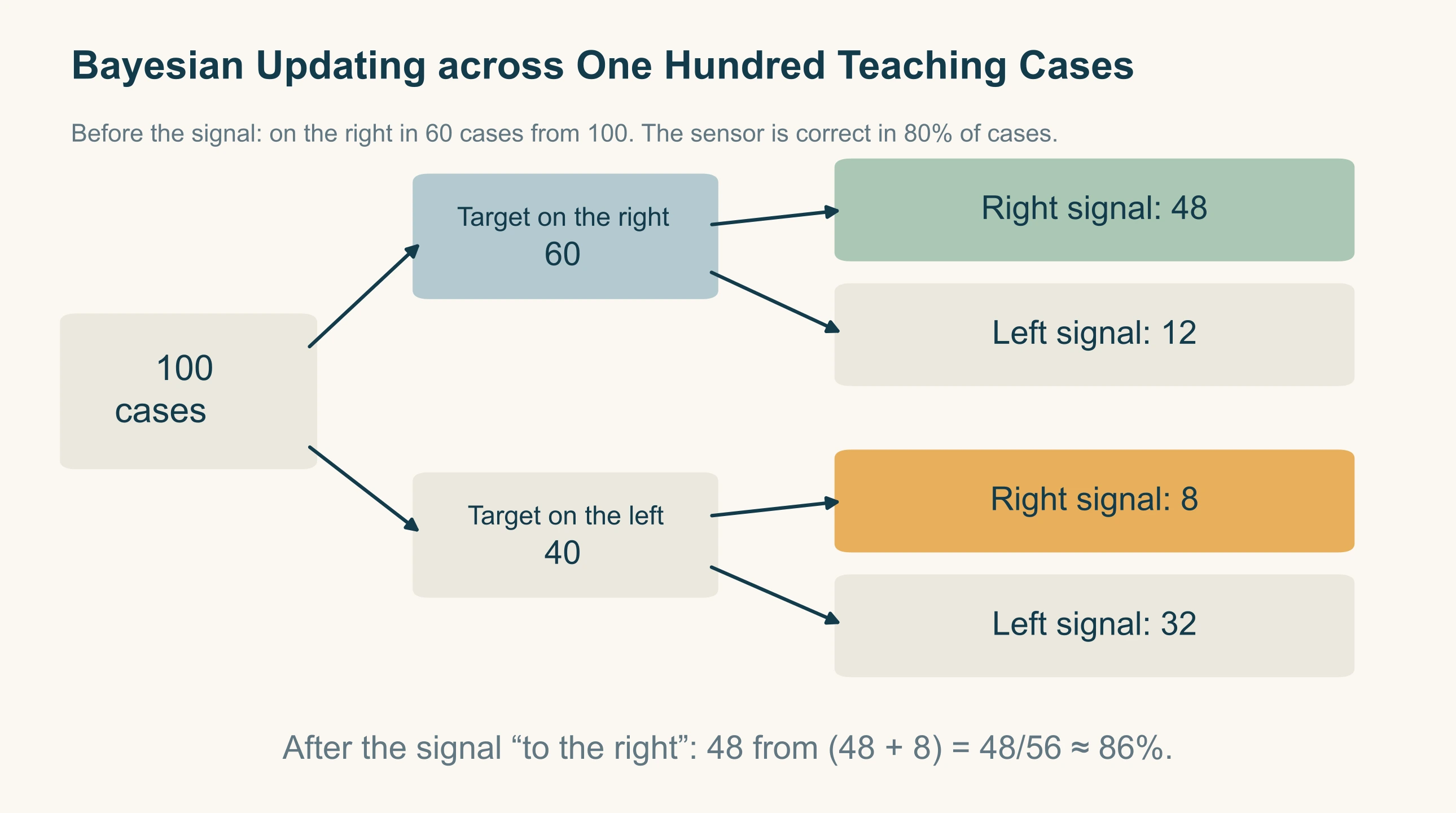
Figure 32. From preliminary estimate to updated probability. The tree uses exactly the numbers of the chapter's case study: the prior probability 0.6 and the symmetric sensor reliability 0.8. With a signal “on the right”, 56 cases remain, of which 48 have a right target. This is a calculation under given premises, and not the observed frequencies of human perception.
From a model of the world to a model of action
Let the device be able to send two commands. As long as the "right" command moves the pointer to the right, knowledge of the target is sufficient for selection. Then the connection changes imperceptibly: the right command gives the left effect. If the device only stores a model of the world, it will continue to know where the target is and at the same time act incorrectly. This means that it is necessary to separately represent the relationship between one’s own commands and the observed consequences.
In such a device, a functional model of one’s own ability to act appears. Its content is specific: which command is likely to produce which effect. To call this full-fledged human self-awareness would be premature. But it is possible to show exactly what problem a self-referred variable solves: it allows one to distinguish an error in knowledge about the world from an error in controlling an action.
Imagine that the action was unsuccessful. The system must consider at least three reasons: the goal was incorrectly defined, the correspondence between the command and the effect has changed, and the performer accidentally refused. If all errors are automatically attributed to the sensor, learning will spoil good perception. If everyone is assigned to an action, the device will change control endlessly. A good model requires observations that distinguish between causes of error.
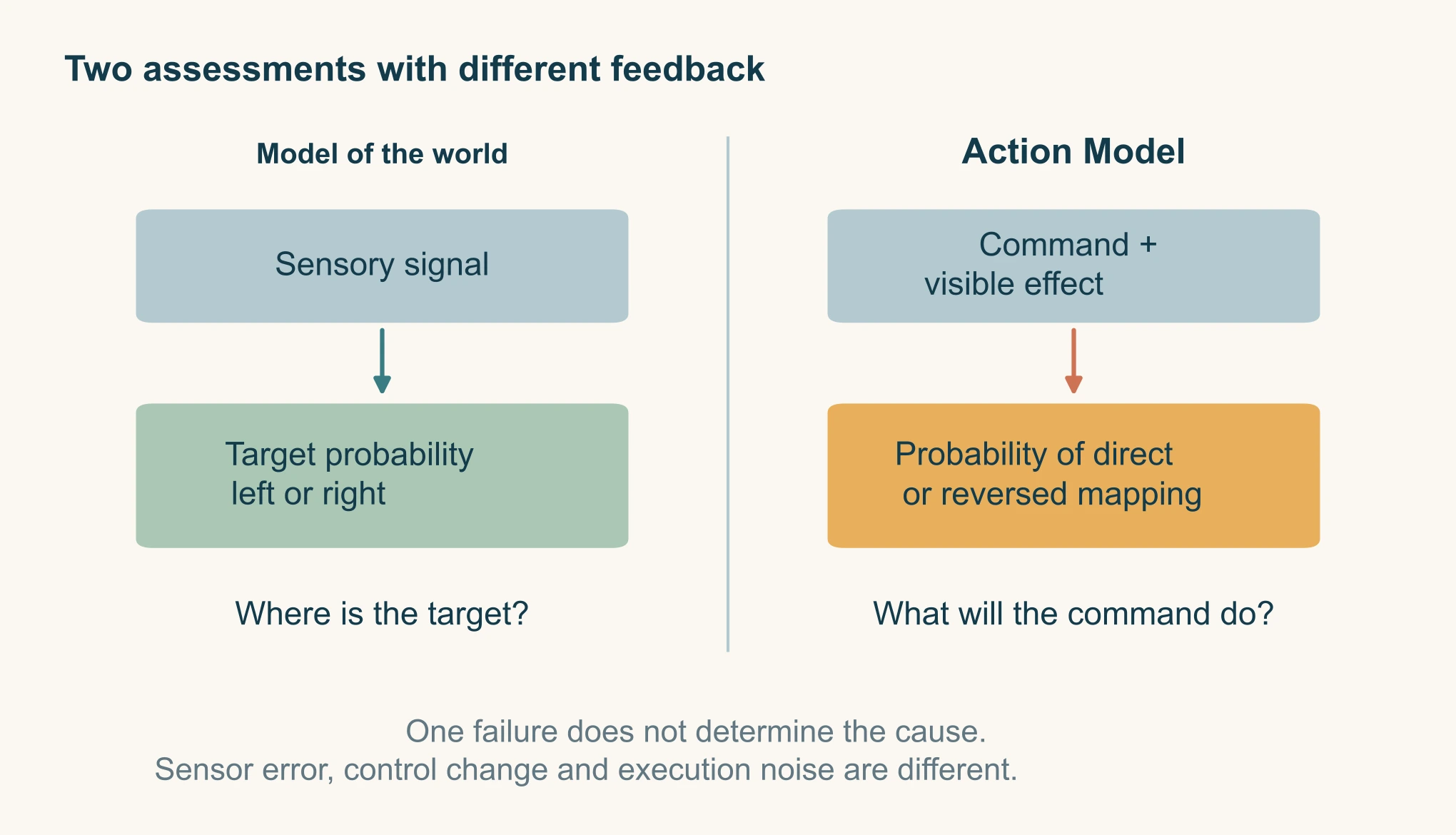
Figure 33. Separate models of the world and actions. The training device stores separate beliefs about the location of the target and the correspondence of the command to the visible effect. Different observations update different estimates. One failure cannot clearly establish a perception error, a change in control, or an accidental failure of execution.
The body as a common cause of signals
In the Bayesian model of Samad, Chung, and Shams, visible hand ownership was associated with common cause inference for visual, tactile, and proprioceptive signals. Consistency in time and space changes the plausibility of their association. This work suggests a mechanism for certain bodily effects; it does not derive from it all forms of self-awareness and biographical self. [15]
Using your own example, you can understand the meaning of the common cause. You move your finger, see the movement, and receive associated bodily signals. One hypothesis combines them as consequences of one-arm movement. The other involves several independent events. With stable matching, the first model turns out to be more economical in terms of the number of independent matches. However, the conclusion depends on what alternatives are presented at all and what matches the system has learned to expect.
Bodily identity and authorship of an action also do not have to change together. In the experiment of Kalckert and Ehrsson, the conditions of movement of the rubber hand made it possible to distinguish between subjective control of the hand and the feeling of control over its movement. This is an argument against reducing the two assessments to one indicator. It does not mean that in ordinary life they exist in isolation. [4]
Prediction of internal states
Anil Seth proposed to consider emotional states and bodily self-awareness through inference about the causes of signals from within the body. The approach connects prediction with the regulation of bodily state. It is a theoretical program: its usefulness is determined by what specific differences in sensations and behavior it explains and predicts. [22]
To develop your own model, this raises a useful question. The same change in input signal may indicate danger, physical stress, or measurement error. How does the system differentiate between these reasons? In the training device, you can specify the internal resource consumed by the action and the sensor with noise. Then its assessment of its own state will be checked against the forecast of future availability of actions. We will receive a model of resource regulation, without a basis for attributing fatigue to the device as an experience.
The general limit of predictive explanations is the breadth of their application. Many processes can be described with the words "wait" and "error". What creates scientific value is the precise distinction between models: what causes are allowed, how confidence changes, what counts as error, and what action reduces it. If these rules are adjusted anew for each outcome, the explanation becomes too flexible.
Another check concerns the dependence of observations. Let's say two sensors simultaneously show the right side. If they are independently wrong, the coincidence can greatly enhance belief. If the second one simply copies the first one, there is no new information. A model that considers the copy to be independent confirmation will become overconfident. In a more complex case, both sensors may be affected by a common interference that the device is not yet aware of.
Therefore, confidence control requires a model of the sources of error, not just an update formula. For a practice test, you can compare two identical series of readings: one obtained by independent measurements, the other created by copying. The correct estimate must depend on which procedure generated the series. This example helps to understand why multiple consistent inputs do not guarantee reliable knowledge about the world or one's own state.
One observation and two different uncertainties
Before the signal, the probability of the target on the right is 0.6. The sensor reports the correct side with probability 0.8 and is symmetrically wrong. After the signal on the right, the weight of the right target version is equal to 0.6 multiplied by 0.8, that is, 0.48. The weight of the left version is equal to 0.4 multiplied by 0.2, that is, 0.08. Normalization gives 0.48 out of 0.56, approximately 0.857. This updates the target's position. To select a command, you also need to know whether the right command causes the right effect. If the link is inverted, the more likely right target requires a left command. Refining the sensor does not correct the faulty control model.
What has now been established
World, control, and sensory reliability can be different sources of error. Successful learning requires information that separates these versions. Now let's see what data allows us to update each part.
Practice 15 Distinguishing three errors
Why do it: Separate the assessment of the target's position from the assessment of the command's relationship to the effect.
What you will need: Probabilistic chapter transition 11. Before the action, observation and history are available; the true goal and actual outcome are related to the environment and the evaluator.
Time reference: 30–40 minutes. Can be done intermittently; This is not a speed standard.
1. Repeat the calculation of the right target for the initial probability 0.6 and the sensor accuracy 0.8. Then get a forecast for the signal on the left.
2. For four cases, the target is on the left or right and the connection is direct or reverse, write out a command that will reach the target without motor noise.
3. In each case, indicate what is learned from sensory observation and what is learned from comparing the command to the visible effect.
4. Open the prepared example python teaching_lab.py --chapter 15. He shows a decision table; hide the true target and relationship columns from the model in question.
What to keep: Two probability updates, four solutions, and a map of feedback sources.
Hint: The likelihood of a signal under a hypothesis and the likelihood of a hypothesis after a signal occupy different places in the calculation.
Exploratory continuation: Conduct a paper experiment of twenty trials with a partner or a closed column of the environment. Specify the change of control in advance and do not inform the selector of the commands. Before the result, write down the forecast, after it, update only those states for which information was received.
Analysis and answers - Appendix F, chapter 15, p. 286
Self-test questions
1. Is every prediction a conscious expectation?
2. How does a model of action differ from a model of the world?
3. Why should the absence of a signal be distinguished from a negative signal?
Predictive mechanisms have become more defined. Now let's return to actual research and ask what data actually differentiate between theoretical explanations.
Chapter 16