Signal processing and access to their content
The drive showed how history changes the answer. This is not enough for perception: it is necessary to distinguish between the content, the method of interpretation and access to the result. The same oval can be used as a letter or number depending on its neighbors. In this case, we will analyze direct and repeated processing. When comparing them, we will make sure that the architecture does not gain an advantage only due to additional inputs or time.
One image and several research questions
You look at the page and look for the section number you need. It simultaneously contains letters, margins, punctuation marks and a small signature. Having all these elements in front of your eyes does not mean that each of them has the same impact on the current task or is equally available for subsequent description. To explore the situation, you need to separate several concepts.
Information processing means changing system states depending on input and internal rules. Attention in an operational functional sense refers to the selective allocation of processing: certain sources or cues are favored over others. Access means the ability to use content in specific actions, reasoning, or responses. A report is a specific action of a message. Experience refers to how a situation is subjectively given.
These concepts may relate to the same episode, but are measured differently. We can check if the answer to the section number has changed after the hint. We can ask what was clearly visible. We can find out if the location of the signature has been saved for the next task. If all the results are combined with the word “awareness,” it becomes difficult to understand what process the model explains.
Why does the length of the report depend on the procedure?
George Sperling examined brief presentations of character arrays, comparing the full report with the report of the portion specified after presentation. The partial report advantage and its dependence on pointing delay indicated that the availability of information after a brief presentation cannot be assessed solely by the number of sequentially named symbols. The experiment raises the question of storage and communication limits; by itself it does not conclude the debate about the full scope of phenomenal experience. [13]
The general lesson can be understood by a common example. You notice several objects on the table, then begin to describe the first one in detail. During the story, information about others may become less accessible. The short final list then depends not only on the initial processing, but also on timing, message order, and detail requirements. In a specific study, the contributions of these processes should be separated.
The opposite situation is also possible: the correct answer may be based on information that a person finds difficult to describe in words. Therefore, the question “how much was told” is useful for studying the report, but requires additional justification as a measure of all available content. It is better to clarify for which operation the information was available and at what moment.
Attention changes the task
Daniel Simons and Christopher Chabris examined noticing an unexpected event while observing a dynamic scene in an attention task. The probability of its detection depended on the design of the main task and the properties of the unexpected object. The work demonstrates the limitations of the observation under a particular load; the absence of a subsequent message should not be made into a universal criterion for the absence of any processing. [14]
Attention is conveniently understood by asking what information the system prefers to use now. When searching for a section number, the shape of the numbers may be more useful than the content of the adjacent paragraph. When checking typos, the priority changes. The same external elements are involved in different computational tasks depending on the purpose.
However, attention and consciousness do not become synonymous just because they are closely related. First you need to select an attention indicator, an experience indicator and the conditions for comparing them. If attention is defined through search success, and experience through the clarity report, the relationship between these indicators is examined. A substantive theory should explain their similarities and possible discrepancies, and not eliminate the difference by renaming.
An example of an ambiguous sign
Imagine a drawn oval, which can represent the letter O or the number 0. The drawing itself is the same in the two training cards. On the first there are K and T around him, on the second - 1 and 4. In the first environment, the letter version is natural, in the second - the numbers. Context adds information about what role the sign is likely to play in the record.
Let's build a simple model. The first stage evaluates only the central sign and stores two options. The second one considers the neighbors. If both neighbors are letters, the letter version takes precedence; if both digits are digital. The third displays the selected category. Here you can indicate what information was received at each stage and why the result differs with one central figure.
This is the author's teaching example, and not a reproduction of a specific experiment. It shows how context can be involved in the interpretation of input. Whether the subjective vision of the form has changed or only its designation has changed requires a separate question to the observer. The same response “letter” can be accompanied by different descriptions of experience, and the category model does not yet explain these differences.
One pass and re-refinement
In direct processing, information goes through a sequence of transformations to an answer. With recurrent processing, results can come back and change the operation of previously participating components. The word "recurrent" here means the presence of such a return. For example, a previously recognized context may influence further evaluation of the local shape.
In our problem, we can build a recurrent version: first store the ambiguous state of the central sign, then obtain information about the neighbors and update the previous state. But you can also create a model that immediately receives the entire card and selects a category with one rule. In the two examples described, their answers will be the same. Therefore, coincidence with people's answers does not yet determine the internal organization.
For a meaningful comparison of architectures, the amount of available information and computing resources must be taken into account. If one model was shown the entire card, and the other only an oval, the advantage of the first is explained by the difference in inputs. If the reprocessing was given more time, it is necessary to find out whether it was feedback or additional calculations that provided the gain. A good problem allows these explanations to diverge.
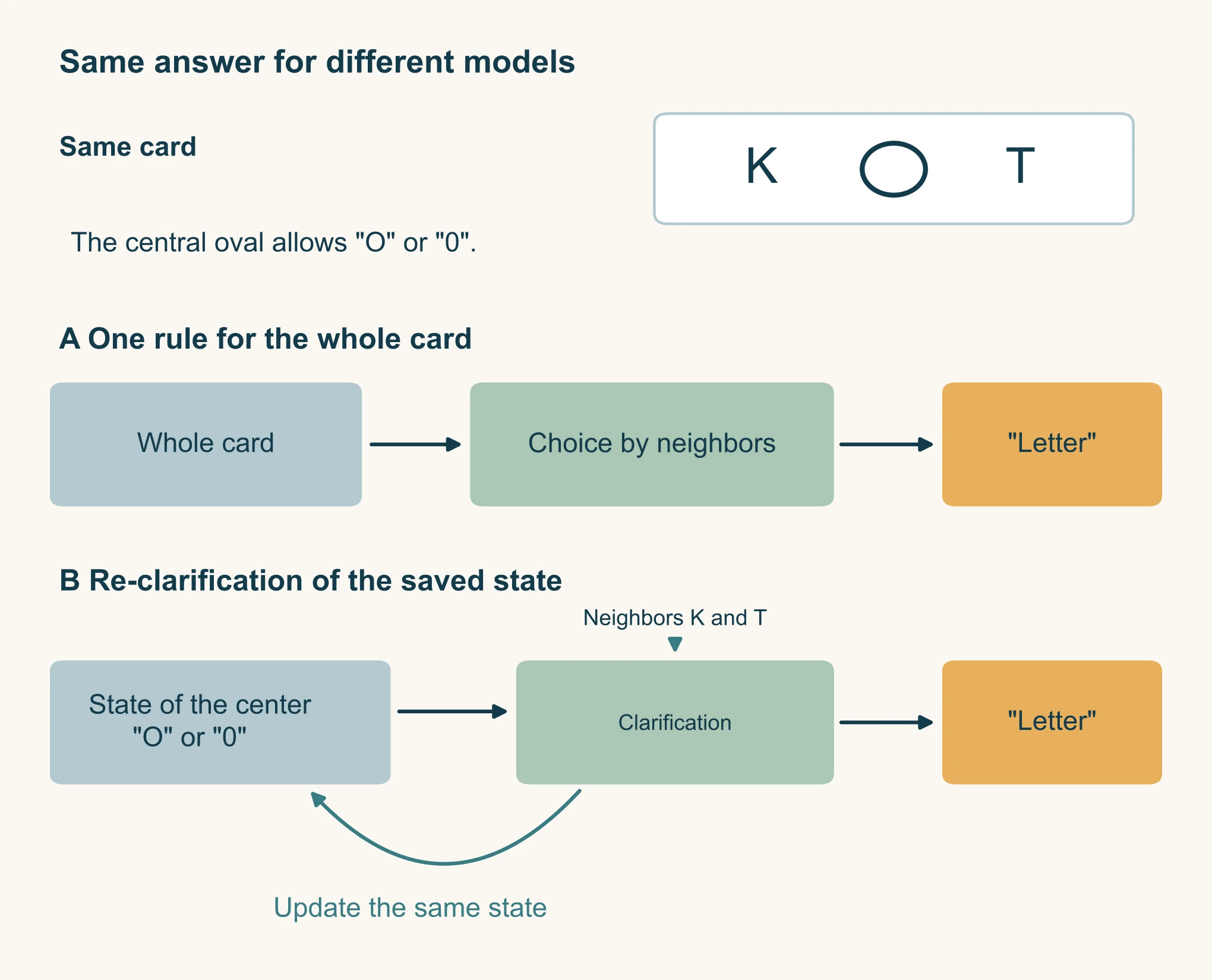
Figure 21. Two ways to use context. Both training models call the central oval a letter with neighbors K and T. The first uses the entire card with one rule. The second preserves the ambiguous state of the center, receives context and refines the previous state; the return arrow indicates this update. The equality of answers in the example does not determine the internal organization and does not prove the presence of experience.
From internal state to use
Let's say the selected category is saved within the program. One output might print the word “letter,” another might select a dictionary to continue writing to, and a third might decide whether additional checking is needed. These capabilities show different forms of access to the same processing result. The presence of an internal number does not mean that it is actually used by all components.
To test the role of a state, it can be changed or temporarily made unavailable to a specific output. If the response seal was broken, but the continuation choice was preserved, a functional discrepancy arose. In research, it is important to describe it literally. You cannot declare a system completely devoid of information just because one communication channel is broken.
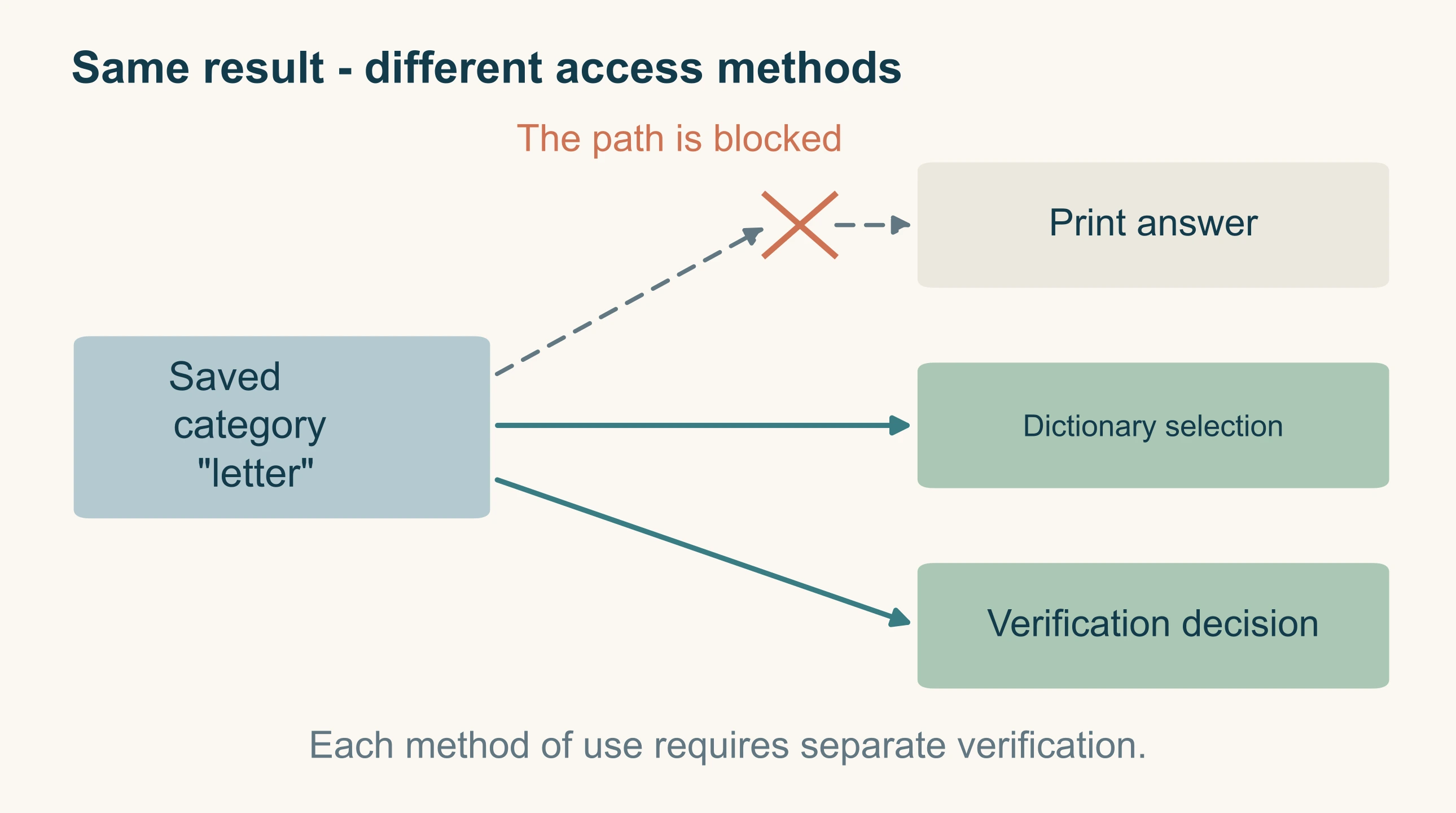
Figure 22. Selective channel disruption. In the learning architecture, the selected category is available for printing, vocabulary selection, and review decisions. Only the print path is blocked; the integrity of other uses is checked separately and is not inferred from a single missing message.
Such an analysis prepares the design of candidates for the subject. We will be able to ask what information is combined, what actions depend on it, and how the system evaluates its own decision. The relationship of this organization to experience will then become a separate testable part of the theory.
Why a hidden correct mark is not always recoverable
The same oval and digital neighbors are drawn on two cards. The author in one case conceived a number, in another a letter. If the device only sees the image, observations do not distinguish between these designs. An error regarding a hidden label here does not necessarily mean poor processing. To explore the usefulness of context, one must make an early choice between evaluating the most reasonable interpretation from the available evidence or guessing an inaccessible intention. This distinction will be useful when later auditing agent logins.
What has now been established
The correct name of the sign, the experienced form and the availability of the content for different actions are different results. Now let's compare the explanations on one explicitly given set of cards.
Practice 10 Compare three explanations
Why do it: Separate the role of context from the advantage of information and from the inaccessible environmental label.
What you will need: Entry, status and exit from chapter 9. Distinguish between an observed design and a hidden artist's mark that the device may not know.
Time reference: 25–35 minutes. Can be done intermittently; This is not a speed standard.
1. Make six cards with the same central oval: two with neighbors K and T, two with 1 and 4, two more repeat these images, but have opposite hidden author’s marks.
2. For each, write down the visible information and a separate hidden label. Set a basic rule: letter neighbors lead to the letters category, digital neighbors lead to the numbers category.
3. Compare a device that sees the entire card at once and a device that first receives the center, then its neighbors. Point out the moment when they have the same information.
4. Explain what can be determined from matching responses and what additional conditions are needed to distinguish the mechanism of re-specification.
What to keep: Six cards, two device rules, and an explicit list of available time information.
Hint: A different order of inputs is already a difference in conditions. To validate the architecture, you need to provide a competitor with comparable memory and compute.
Research continuation: Let the neighbors disappear before the center appears. Set the memory of each version and get a prediction before trying. Compare with the direct model, which is allowed the same external memory.
Analysis and answers - Appendix F, chapter 10, p. 284
Self-test questions
1. Why is the number of parts named not an automatic measure of the total initial experience?
2. Why doesn't the success of the context model prove the need for recurrent processing?
3. What needs to be clarified in the statement “information is available to the system”?
We have separated observation from hidden agenda. Now let's apply this discipline to event sourcing: how a system can evaluate whether an observed change is due to its own command.
Chapter 11