Verification of the designed system
Digital and biological material require different tools, but have the same need for precise testing. The presence of a component, its functional contribution, internal access, and hypothesized experience are different statements. In this chapter, we will create a profile of the system so that each statement has its basis. You can start with one fully traceable episode; there is no need to test all of the agent's intelligence at once.
Definition of the subject of inspection
You have assembled an agent with memory, an action model, and a self-assessment module. It solves the problem and communicates when in doubt. Now you need to set the status of the result. Program review, functional ability assessment, and experiential exploration are related but require different evidence. If you combine them into one overall score, it becomes unclear what exactly changed after the next improvement.
Start by describing the system as an operating whole. What processes are performed in one solution? What is stored between solutions? What data is available to each component? Is external language service enabled? Does the report derive information directly from the agent's state or only retell the history of actions? The boundaries of the object being tested determine the meaning of all subsequent results.
Map the existing connections
For each component, write down the input, state, output, and destination of the output. Then follow one specific episode. For example, the uncertainty of the action model has increased; the monitor noticed a decrease in expected success; policy requested additional monitoring; a new observation changed the decision. If additional observation concerns only the target, it may not resolve control uncertainty. The map should show such limitations of the mechanism.
The name of the module does not confirm its role. A component can exist in the code, but never turn on in the selected sequence. Its condition may change, but not affect the decision. Or the influence is completely duplicated in another way. It is therefore useful to distinguish between the availability of a computation, its actual activation, and its causal contribution to the outcome.
Check the measuring system separately. The true state of the environment and intervention flags must be available to the evaluator, but not bypassing the agent. If the self-assessment module reads a ready-made correct answer, the high accuracy of its messages indicates the quality of the transmission of this information. It does not install independent monitoring of its own solution.
Test the feature under new conditions
Memory requires tasks where the story actually changes the correct action. For the control model, conditions where the connection between command and effect changes. To assess uncertainty—situations where certainty may be wrong. One convenient demonstration does not test all of these abilities at once.
It is useful to separate familiarity from transference. In a familiar problem, the agent could learn a simple rule sufficient for success. The new combination of features will indicate whether it uses the intended structure. But a new condition should not imperceptibly change everything at once. If the noise, the goal, and the available actions change simultaneously, it is difficult to attribute failure to a specific mechanism.
Select a primary result for each feature. The number of requests in itself is not a quality of self-control: you can ask endlessly. The probabilistic prediction is evaluated against the subsequent outcome, and the verification policy is evaluated against benefits and costs. The content of a single confident sentence does not replace the distribution of errors over many episodes.
Prepare a causal test
Let's imagine two educational systems with equally convincing reports. The first forms a message from the source’s own assessment. The second chooses a phrase based on recent public actions. As long as the events are common, the difference may not be noticeable. Let's change the internal assessment of the source while maintaining the external story. If the first system actually uses this estimate, its message should change predictably.
However, interference may create an external sign: an unusual delay, a special token, a different response format. Then the second system also recognizes the condition. Therefore, control must preserve accessible external signs. A dummy intervention and a suitable nonspecific change are also needed to distinguish content recognition from a response to a general failure.
In a research report also posted as a preprint, Jack Lindsay examined the relationship between language model messages and interventions in their internal representations. The acquired abilities turned out to be limited and dependent on conditions. What is important for us is the transition to causal verification of internal access; it does not automatically infer subjective experience. [49]
Distinguish reading state from using it
An external classifier can be trained to determine the content of a latent vector. This will show that it contains information available to the selected analysis. But the agent may not use it either for reporting or for action. Therefore, external decoding and internal access should have different lines in the research description.
The next question is whether access affects control. Disable the monitor's association with the policy, leaving the monitor itself intact. If the estimates remain correct, but the decisions no longer take uncertainty into account, the contribution of this connection is highlighted. If the behavior does not change, the mechanism may be inactive, duplicative, or a task where it is not needed. You cannot choose a convenient explanation without checking.
Finally, strategy revision requires its own outcome. The agent must change a certain assumption and use the change in new decisions. Explanatory text after an error can be a useful interface, but its presence does not confirm such a causal chain. Comparison with a version that speaks the same text without revision helps highlight the mechanism at work.
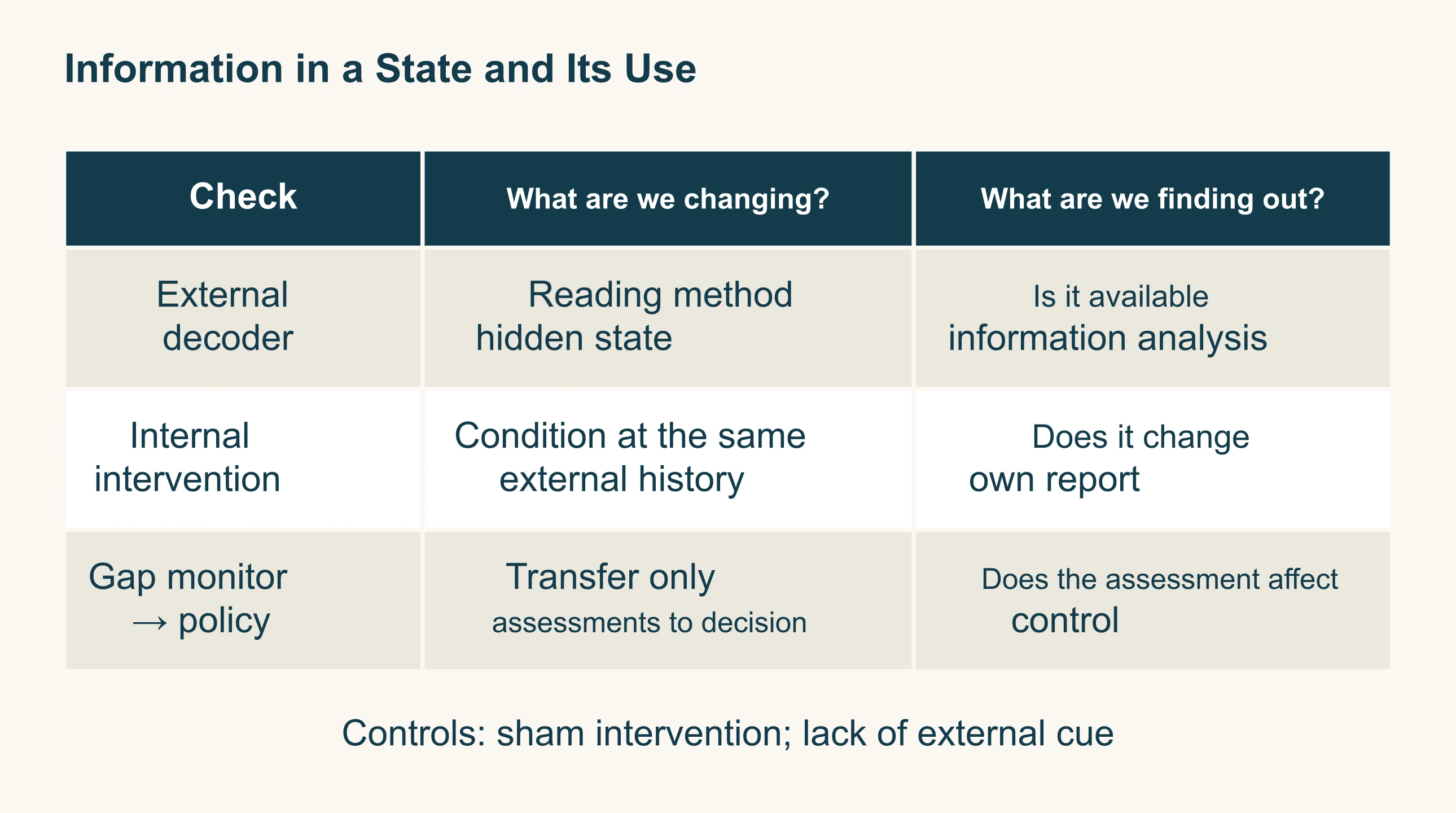
Figure 80. Three different questions about the internal state. External decoding, causal change in self-report, and monitor policy influence require different tests. The internal intervention must preserve external history and have fictitious control, otherwise the system may recognize a secondary indication of the influence.
Build a candidate profile
The theoretical profile begins with a selected position, rather than with a general list of spectacular properties. If the role of public access is being explored, the appropriate organization of distribution and use of content needs to be examined. If physical causal structure is significant, implementation data is required. If the chapter principle 26 is selected, the mutual determination of the distinctions and their role in alternative transformations are checked.
The indicator method of Butlin and colleagues suggests linking system assessment to the requirements of theories. It does not provide a universal scale on which the number of items completed turns into percentage of consciousness. In our work, the theoretical profile preserves the basis and uncertainty of each individual conclusion. [42]
For each requirement, use three descriptive states: implemented and verified; implemented, but the role has not been verified; not implemented or unknown. Then write down which observation can change the status. Such a record is more useful than the total number, because it shows where work with the code is needed, where a new experiment is needed, and where clarification of the theory itself is needed.
From a Profile to a Claim about Experience
A successful functional profile does not complete the argument. It is necessary to justify why the selected properties relate to the presence or quality of the experience. The results of the chapters on natural experience and the principle of correspondence formulated in the research section are used here. It is important not to consider the fact that one’s own requirements have been met as independent confirmation of their sufficiency.
Let us assume that the system satisfies our working organization of mutual distinctions. Then we can assert that a certain realization of the supposed sufficient condition has been created. The next question concerns the condition itself: does it explain independent data, withstand counterexamples and carryover between implementations? These reasons must be presented separately from the technical report.
If a theory allows for experience without explicit self-report, the absence of persuasive speech does not automatically disprove it. If a theory requires a certain access, good speech without the necessary causal organization does not support it. The test should follow the content of the theory, and not the impression of communicating with the system.
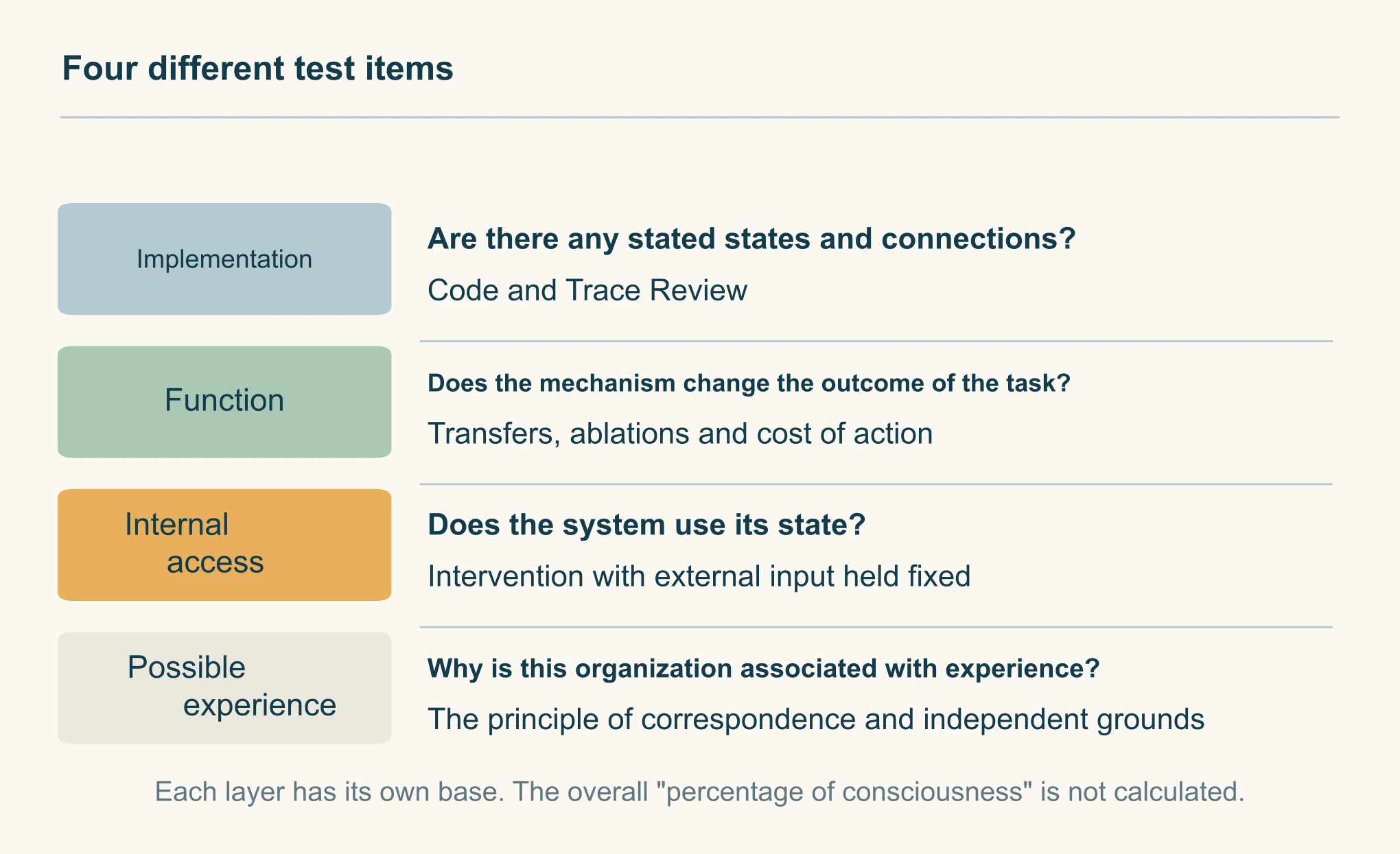
Figure 81. Candidate Screening Profile. The methodological table distinguishes between the presence of a software implementation, its functional contribution, the internal use of information and the argument about possible experience. Evidence from one layer does not replace evidence from another; the external state decoder does not itself establish internal access, and the sum of the requirements fulfilled is not a percentage of consciousness.
Interpreting a Result That Does Not Distinguish Models
Imagine that the full version and the version without the strategy revision gave the same result. First of all, check whether the conditions for triggering the review have occurred. If at no time, the experiment did not exploit the differences between the versions. The statement “reflection is not needed” is too strong, as is the statement “reflection works because the module is written.”
Then find the problem where the rules actually diverge and print the expected difference before running. If the results are the same again, investigate possible duplication and measurement accuracy. The need for a component is established relative to a specific implementation and task. Another system may provide the same result in a different way.
Such analysis has direct value for designing experience candidates. It prevents the accumulation of decorative components and helps to select mechanisms with a proven functional contribution. The phenomenal hypothesis receives a more precise subject, even if the final answer about the presence of experience has not yet been found.
Four questions for one status record
In the M2 model, record A actually exists: this is verified by the program state. Its influence on repeated A is checked by comparison with the remote history at the previous input. Recording access on a separate monitor will require checking the read channel; The presence of a record in itself does not create it. Finally, if the model gives the required numbers, it is still necessary to explain why this organization relates to the experienced content. Thus, one log can support several different checks, but each transition requires its own monitoring.
What has now been established
A profile helps avoid summarizing disparate attributes. The unknown property status indicates a specific next job instead of a general impression of awareness.
Practice 32 Perform an audit of one episode
Why do it: Parse one episode of implementation into four independent statements.
What you will need: Causal map, ablation as disabling a specific component, difference between decoding and using state. Keep the same available information across the versions you compare.
Time reference: 30–40 minutes. Can be done intermittently; This is not a speed standard.
1. Select repeated A in the source model or one agent step. Write down the input, old state, change, output, and output recipient.
2. State the connection to be disabled and the expected result before testing. Make sure it's the one that turns off.
3. Create four profile lines: implementation, function, internal access, possible experience. For each, indicate whether it was verified or unknown.
4. Offer one task where the feature is truly needed, and control that preserves comparable information and resources.
What to save: Single episode map, causal test and profile with separate statuses.
Tip: An external classifier may extract content that the agent does not use. For internal access, a recipient of information is needed inside the circuit under study.
Research continuation: Check the text report when the internal state and external history change independently. Compare with an explanation formed only from public actions.
Analysis and answers - Appendix F, chapter 32, p. 295
Self-test
1. Does the presence of the Monitor class in a program prove working self-monitoring?
2. How is external state decoding different from internal access?
3. Why doesn't meeting all self-selected requirements prove that those requirements are sufficient for the experience?
We have learned to check a specific implementation. Now let's clarify the rules of formalization and find out whether the selected analysis is even capable of distinguishing between the mechanisms that we want to compare.
Part 9