How self-awareness develops
The episode occurs in a short time, and the ability to recognize oneself or ask for help develops on a different time scale. Therefore, the question of the age of emergence of consciousness must be divided into specific achievements. We will look at sensory content, visual self-recognition, uncertainty management, and biographical self-description. This separation will prevent the failure of one test from being considered the failure of all other capabilities.
Development of multiple capabilities
The question “when does a child become aware of himself” seems like a request to name his age. But first you need to decide what kind of ability we are talking about. Distinguishing between one's own movement and an external event, recognizing one's body, appreciating one's mistake, using the word "I" and reflecting on one's own reasons are different achievements. They may have common premises, but one indicator does not automatically measure all the others.
In this chapter, development means the change in the organization and capabilities of one person over time. It involves the acquisition of new ways of interacting, changes in memory, learning and control. We do not presuppose in advance a single point up to which there is no experience, and after which all forms of self-consciousness simultaneously appear. The goal of the study is to determine what exactly is changing and what observations make it possible to distinguish it.
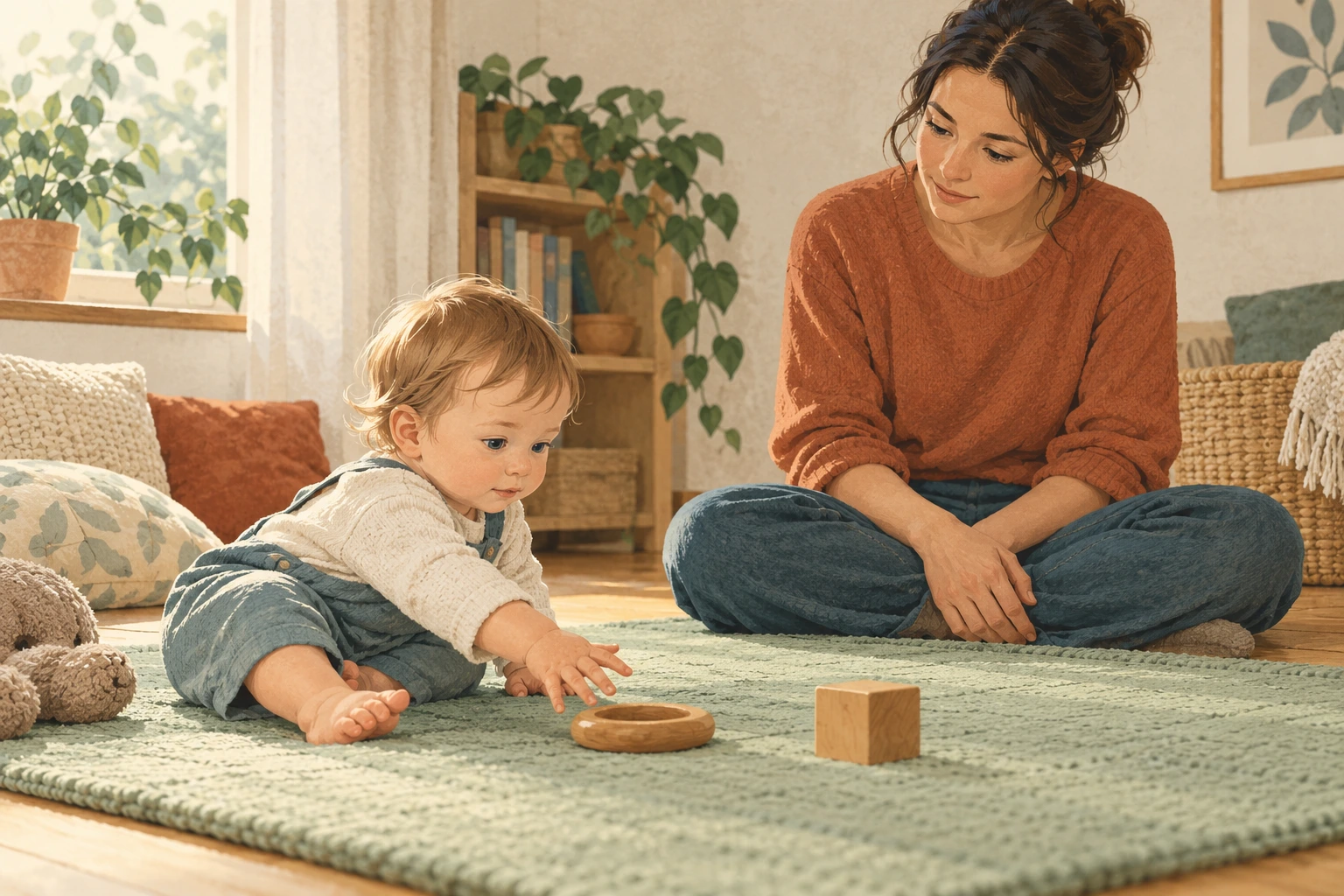
Figure 38. Development in everyday interactions. Object illustration of early interaction with an object. Directed movement, discernment of the consequences of an action, and subsequent self-narration require different observations; the image does not set the age threshold for the appearance of consciousness.
Experience and ability to communicate
Kouider and colleagues examined brain responses to masked faces in infants of five, twelve, and fifteen months. In all age groups, a late nonlinear response was found, which was interpreted by analogy with the indicator of conscious access in adults; among the younger ones it was weaker and slower. The work provides a neural argument for an early capacity for conscious perception, but does not establish the age of the very first experience or measure extensive reflection. [28]
The logic of such a transfer requires careful attention. If an indicator is associated with experience in adults, its presence in another group supports some commonality of mechanisms. But the researcher must check whether the signal performs the same function. The absence of an adult pattern is also ambiguous: the system may solve a similar problem in a different way, or the measurement may not be sensitive enough to its organization.
This applies to more than neural data. A verbal question adds requirements for understanding words, retaining instructions, and choosing an answer. A child may fail a verbal task for reasons unrelated to the absence of the state under investigation. Conversely, a correct answer learned as a stock phrase can overstate the sophistication of the child's understanding. It is therefore useful to compare several tasks with different additional requirements.
What does recognition in the mirror show?
Beulah Amsterdam's classic study observed age differences in children's responses to reflection; By the end of the second year, some children showed signs of self-recognition. Even within the group studied, the results were not the same. These data relate to a specific situation of visual self-recognition, and not to a universal calendar of the emergence of consciousness. [29]
Let's break down the problem into our own training scheme. You need to detect an unusual reflection detail, associate the image with the body, find the corresponding place on the body and perform the action. Failure can occur at any level. For example, it is difficult for a person to move his hand, a detail does not seem interesting, or the image is perceived in an unusual way. In order to interpret the result, control observations about each additional requirement are required.
Success also allows for several levels of explanation. It can rely on a strong connection between movement and image. A stronger statement concerns presenting oneself as the same person outside of the current interaction. Even more powerful is the ability to reason about oneself as an object of someone else’s assessment. Moving on to each next statement requires additional tasks, not expanding the meaning of one successful movement.
Let's imagine an adult program that detects a mark on the camera image and touches the corresponding part of the body. It can be specially taught such a connection. This engineering example itself shows why the behavioral criterion needs to be decomposed into mechanisms. It does not prove that the child performs the task in the same way, nor does it negate the importance of self-recognition in developmental research.
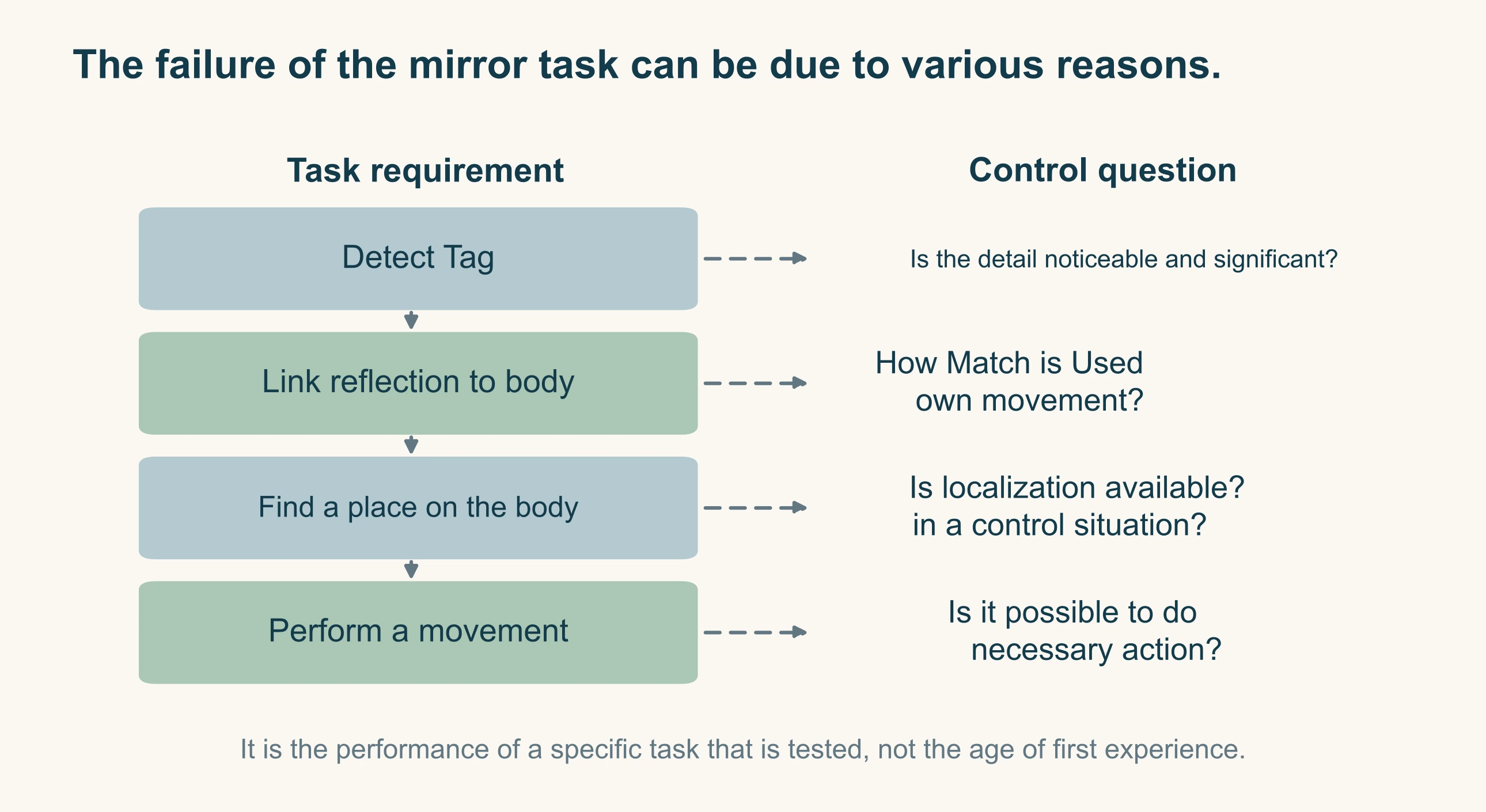
Figure 39. Decomposition of the visual self-recognition task. Touching a mark depends on several conditions: its detection, the connection of the reflection with the body, localization and the possibility of movement. Control questions help to isolate these reasons for failure, but do not themselves constitute a complete experimental protocol. One unsuccessful test cannot establish the absence of experience or other forms of self-reference.
Monitoring What One Does Not Know
In a study by Goupil, Roman Monnier, and Kuidera, twenty-month-old children were given the opportunity to request help on a memory task. Using assistance was subject to uncertainty and improved performance compared to always having to choose on one's own. The authors interpreted this as early nonverbal control of one's own knowledge. The result does not imply that the child has an adult concept of knowledge or is able to explicitly explain the reasons for the decision. [30]
To understand the mechanism, we distinguish between an assessment of the difficulty of the situation and an assessment of the quality of one’s own memory. In the first case, the child can learn the rule: after a long delay, ask for help. In the second, he uses information about how reliably he remembers a specific event. In a typical task, both strategies can coincide. A discriminative test must break this connection, for example comparing different opportunities to observe an event at the same delay.
The social side of the request is also important. For help to become a measurable action, you need to understand that the other person is able and willing to provide it. Therefore, rare calls may reflect the structure of the communication situation, and not just confidence. Such an analysis does not invalidate behavior, but rather shows which functions work together to make it possible.
From events to biographical self
Let's look at our own example of acquiring self-description. The student makes mistakes in mental calculation several times and concludes: “I don’t count well.” This phrase combines memory of events, generalization of results and application of characteristics to oneself. If the student then discovers that errors occurred only when in a hurry, the self-description may change: “When time is limited, I choose too early.” This is a more accurate model of your own work conditions.
This transition shows the research meaning of reflection. The object of change becomes the rule by which a person explains his results. One can study whether it distinguishes between permanent ability and temporary conditions, whether it seeks additional observation, or whether it transfers the refined rule to a new task. Age alone does not explain this: information about previous experience and available testing methods is needed.
Developmental research must also distinguish between comparisons of age groups and observations of the same group over time. The first shows the differences between the people examined. The second allows you to track individual changes, but repetition of the task itself can influence the result. Both strategies require control over how comparable the measurements are.
Let’s imagine that during a repeated examination the child is better at asking for help, but the rule for asking for help was specifically explained between meetings. Improvement confirms the change in execution; it does not by itself allow for the separation of rule learning and change in uncertainty control. This separation requires a new task with a different query method. If transference persists, the narrow explanation of a single learned gesture becomes less sufficient.
Such an analysis helps to avoid the opposite conclusion. Failure of transference may reflect a lack of understanding of the new communication situation. Therefore, it is useful to separately check whether a new response form is available before considering the changed result to be an indicator of the development or absence of an internal ability.
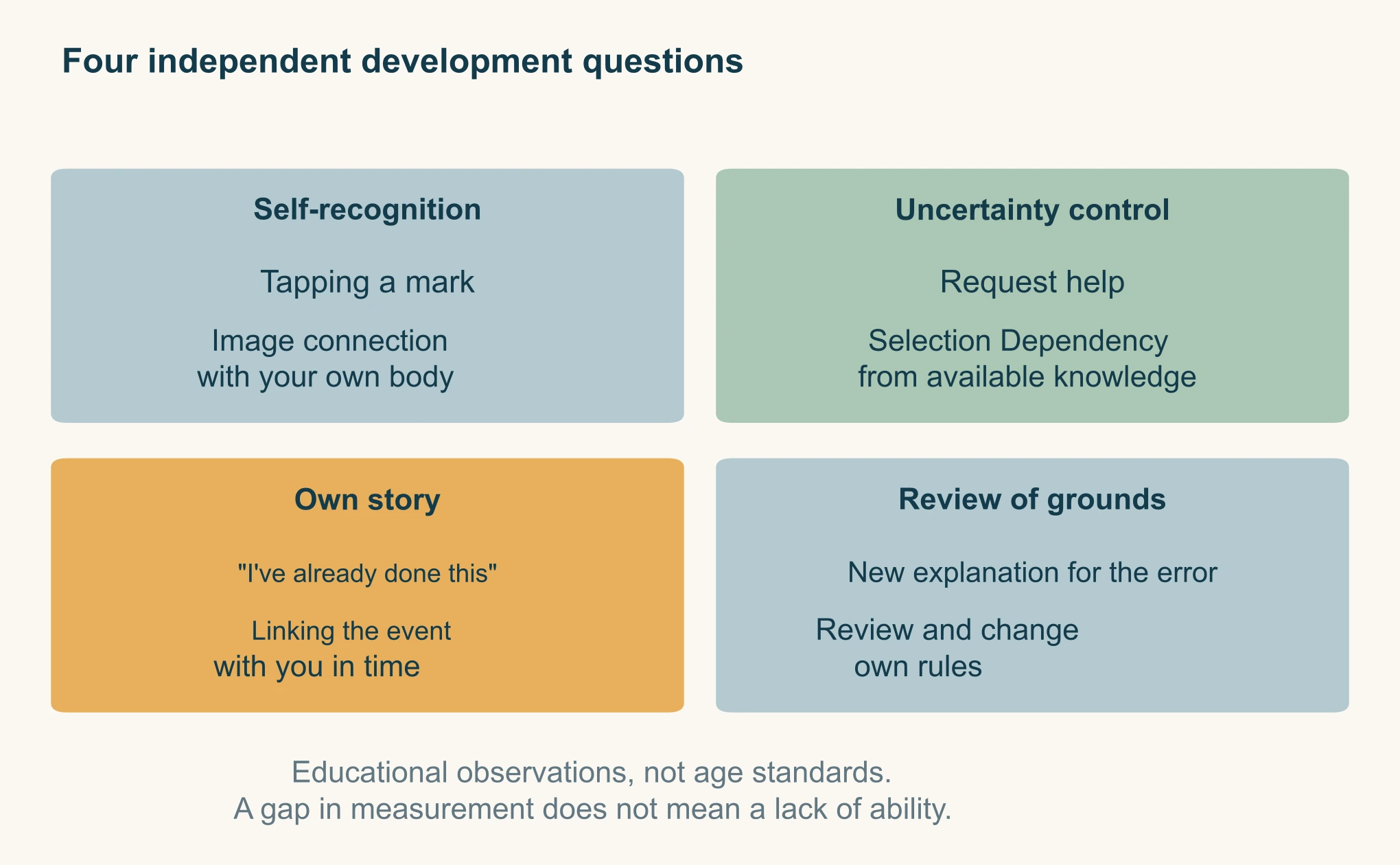
Figure 40. Development profile without a common ladder. The chapter's four fictitious case studies address different questions: self-recognition, managing uncertainty, relating events to the self, and reconsidering grounds. They should be measured separately. There are no age boundaries or a single scale of consciousness in the diagram.
How to decompose a mirror problem
To touch a mark detected through a reflection, you need to notice the mark itself, associate the reflection with the body, localize the corresponding location and perform the movement. Failure of any link can give the same external result. Therefore, the researcher first tests the availability of these activities in a control condition. Success also does not automatically transfer to adult reflection: it refers to a certain organization of visual self-recognition. Decomposing the problem does not invalidate the test; it makes the meaning of the result more precise.
What has now been established
A single calendar boundary does not replace a capability profile. One can examine the development of each relationship and then find out what background they have in common.
Practice 18 Four observations and some explanations
Why do it: Learn to distinguish between ability data and additional requirements of a specific task.
What you will need: Perspective, affiliation and authorship from chapter 3; the difference between success and self-control from chapter 4. Development here refers to changes in one organism over time.
Time reference: 25–35 minutes. Can be done intermittently; This is not a speed standard.
1. Create four lines: visual discrimination, recognition in the mirror, asking for help when uncertain, telling about your past.
2. For each, indicate the observed action and at least one additional requirement: speech, memory of instructions, movement, or understanding of the possibility of assistance.
3. For an unsuccessful result, offer two explanations and a control that can separate them.
4. Select one published chapter work and limit the summary to its task and age group, without assigning an age of first experience.
What to keep: A profile of four questions and one disassembled control of an alternative explanation.
Hint: There is no need to do home tests with your child for discussion. Use published description and case studies.
Exploratory follow-up: Suggest a transfer of ability to another form of response. First, separately make sure that the new form of action is clear to the participant, and then discuss the transfer of the internal mechanism.
Analysis and answers - Appendix F, chapter 18, p. 288
Self-test questions
1. Why can’t the age of successful self-recognition be considered the age of the emergence of consciousness?
2. How does asking for help differ from explicit reflection?
3. What does the absence of the expected indicator for the younger group mean?
The development of an individual has its own data and limitations. Now let's move on to another story: the origin of mechanisms in evolutionary lines.
Chapter 19