Integrated information and higher order theories
Workspace and recurrence can be compared as ways of organizing processing. However, theories of consciousness also ask what arrangement has meaning independent of the habitual external response and how the state is represented to the system itself. Consider causal structure and higher order representations. Our challenge is to accurately understand the underlying commitments of each theory; the computation of the full IIT formalism will not be silently replaced by the drawing of a few connected nodes.
Two directions of explanation
Imagine two systems that answer the question about the red circle in the same way. In the first, many parts mutually change each other’s state. The second has a table of answers to all resolved questions prepared in advance. Externally, they are difficult to distinguish if the questions are limited. Should what we attribute internally to these systems coincide? The answer depends on which properties the theory takes to be essential: causal organization, representation of one's own state, agency, or some combination of requirements.
In this chapter we will look at two areas. Integrated information theory begins with the assumed general properties of experience and looks for the corresponding physical organization. Higher-order theories relate the consciousness of a state to the way it is represented to the system itself. Both programs offer more than convenient behavior descriptions. That is why their underlying assumptions should be considered as carefully as mathematical models and experiments.
What does integrated information theory say?
In version 4.0, the theory of integrated information links experience to a certain indecomposable structure of cause and effect within a physical substrate. The authors proceed from the existence of experience and highlight its internal belonging, certainty, unity, concreteness and structure. Then they propose physical postulates and formalism. The identity of experience and the unfolded causal structure is the main explanatory claim of the theory. It is not transformed into an established empirical fact by a single mathematical notation. [19]
Let's look at the difference between registering a connection and checking the cause using our own example. Two indicators light up simultaneously every second. The observer notices a perfect match. However, the cause may be a shared timer; one indicator does not affect the other. If intervention in the first changes the future of the second, and intervention in the second changes the first, the device has a different causal organization. Identical observed sequences do not yet determine internal dependencies.
This example does not calculate integrated information. It teaches us to ask the question prior to computation: what states and interventions do we consider physically possible? Let's say our model has two elements with two states. It is necessary to set a rule for changing each element for all combinations of inputs. If some combinations are prohibited, you must explain why. If two elements actually indicate a common source, treating them separately may distort the analysis.
The next question concerns the system boundary. We can study one module, several interacting modules, or a device together with an external controller. The results of causal analysis may vary. Therefore, the choice of boundary cannot be justified by the desired answer “there must be consciousness here.” First, a selection rule is specified, then it is applied sequentially to the systems of interest and control.
The strength of this direction is the requirement to explain the unity and differences of possible states through the device. Its difficulty for the researcher is the transition from causal organization to the presence of experience. Even an error-free calculated characteristic confirms, first of all, the properties of the adopted model. The connection of these properties with experience must withstand separate comparison with data and alternatives.
What does higher order mean?
Higher-order theories propose to distinguish a state representing the world from a state representing the presence or character of the former state. In Haquan Lau's Bayesian model, conscious evaluation depends on decisions about one's own internal cues and their reliability. This is one specific implementation of a family of approaches, rather than a definition of all its variants. It can explore the discrepancy between task performance and subjective perceptual assessment. [20]
Let's build a training example with a sound recognizer. The first process chooses between two signals. The second receives characteristics of the first's performance: the magnitude of the difference between the alternatives, the consistency of several measurements, and information about recent errors. It evaluates how reliable the current choice is. The third process decides whether to respond now or request another observation. Such a device explains the confidence check if the second process actually uses information about the first.
Let's add an important difference. The variable “confidence equal to eighty percent” may be a simple recalculation of one sensory number. Then it does not indicate a rich model of one’s own capabilities. To show more meaningful control, it is useful to change the sensor robustness by maintaining separate input values. If the system takes into account error history and changes strategy, its score reflects more than the current signal strength.
But functional control of belief does not by itself resolve the issue of phenomenality. A strong theoretical claim must specify which representation of one's own state is sufficient for consciousness and why. It is not reasonable to automatically consider every numerical description of a process as awareness. In addition, conscious perception and detailed reflection are different: seeing color does not mean simultaneously reasoning about the reliability of one’s own color vision.
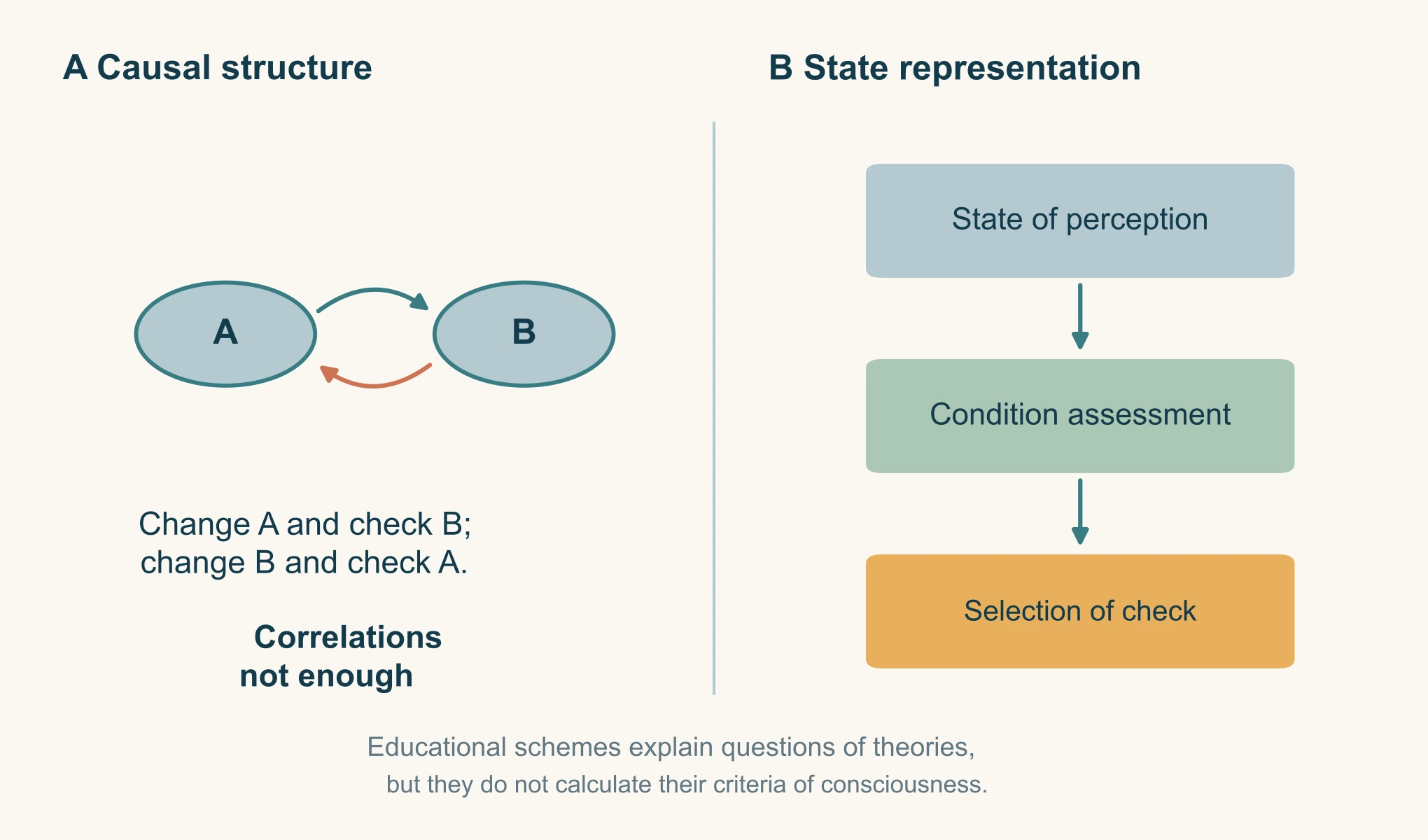
Figure 30. Two different objects of explanation. The left diagram directs attention to the mutual causal influences of the parts; the right one - on the system’s representation of its own state and its use. The diagrams explain various issues of IIT and higher order approaches, but do not replace the formalisms of these theories or assign a winner.
What you need to know about implementation
Two devices may have the same pattern of normal responses and different responses to internal interference. In one, the output depends on the interaction of the states now; another has a pre-recorded sequence. With a limited set of external issues, they may coincide. Therefore, the analysis of the causal device adds information that is not found in ordinary dialogue.
But any backward arrows are not yet a calculation of integrated information. For a specific version of the formalism, certain elements, states, transitions and a rule for choosing the system under consideration will be needed. The statement of correspondence to experience belongs to the theory itself and is evaluated together with its arguments. The teaching drawing explains the subject matter while maintaining this distinction.
A higher order representation requires a different specification. What is represented as the primary state? How does the second process get information about it? What information is relevant to the current decision itself, and what information is the general expectation of success? Who uses the assessment? These questions allow you to distinguish real monitoring from an external log or a pre-prepared phrase.
Finally, internal access does not have to give complete transparency to the system itself. A process can have privileged access to one signal and be mistaken about another. Therefore, we will check access to specific content, the moment of receipt and causal use, avoiding the general conclusion of perfect self-knowledge.
How to Compare Assumptions
Consider a fictional device with rich internal causal coherence that does not form a separate assessment of its own perceptions. Then imagine a device with detailed confidence control implemented by a different causal organization. Such cases force different approaches to clarify their boundaries. One explanation will ask primarily about physical structure, the other about the relationship between representations.
You cannot honestly resolve a dispute by simply choosing a more attractive example. It is required to indicate how we independently know about the consciousness of the compared systems. If there is no such knowledge, the thought experiment reveals the difference between theories, but does not determine the winner. Its usefulness is in developing testable consequences and revealing assumptions that were previously hidden.
It is useful to distinguish three types of statements. The definition states how the term is used. The formal theorem shows what follows from the rules of the model. An empirical statement tells how the world under study works. From a strict theorem it is impossible to obtain the truth of the initial premises. At the same time, a dispute about premises does not negate the value of formal analysis: it shows the exact cost of the accepted explanation.
For your own research, choose the narrowest conclusion. If the model correctly predicts the request for additional information, this is a result about behavioral regulation. If a causal characteristic distinguishes two networks, this is a result about their organization. The next step towards consciousness must have its own justification; it cannot be discreetly included in the name of the indicator.
It is also useful to check the dependence of the output on the observer. Let's imagine that the developer added a detailed log of internal states that is not readable by anyone inside the device. The researcher now knows more about the system, but its capabilities have not changed. Therefore, the information available to us about a process is different from the information that the process itself uses to control it. If the log is turned into a control module input, the organization actually changes and the consequences can be verified.
This distinction is especially important for self-description. Information recorded by an external experimenter in the first person does not become an internal model of the device. It is necessary to show who uses the recording, what actions depend on it, and what will happen if it is selectively distorted. Then the dispute about the representation of one's own state receives a concrete object.
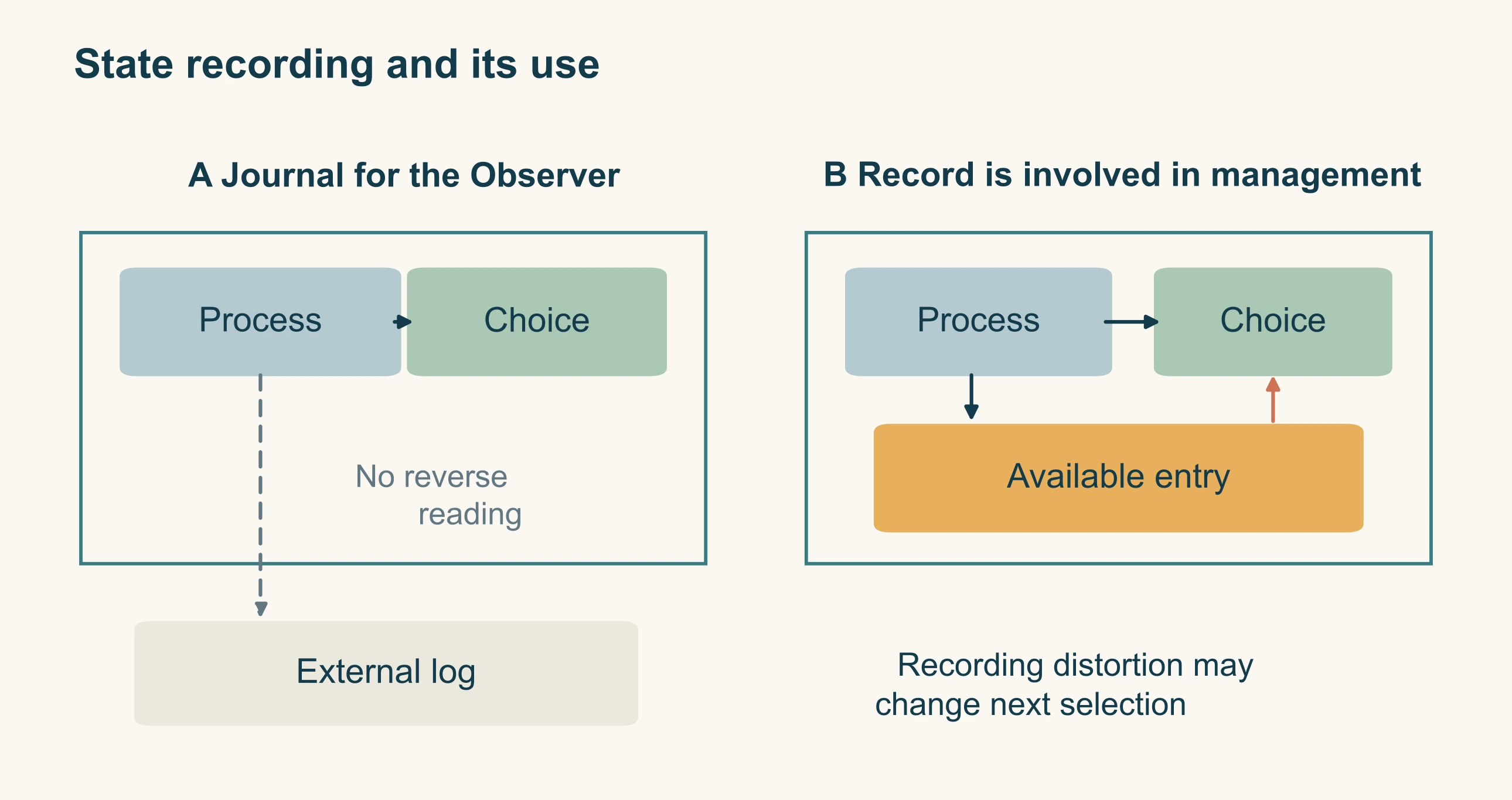
Figure 31. External log and internal use. In the left design, the researcher receives information about the process, but the device does not read the log. On the right, the record becomes a control input: its selective distortion makes it possible to test the causal role. Such testing concerns the use of information and does not yet establish a higher-order representation sufficient for consciousness.
How not to mix definition and strong assumption
The phrase “let’s call an internal assessment a forecast of one’s own error” sets a working definition. The statement “if a report reads this score, changing it can change the report” requires specific model connections. The phrase “appropriate internal evaluation makes a state conscious” already adds theoretical explanation. Finally, the observation of a relationship in a particular sample is related to the data. These sentences can participate in the same argument, but do not receive equal force due to proximity. It is especially important to maintain this analysis when comparing IIT and higher-order theories: they differ not only in metrics, but also in the initial objects of explanation.
What has now been established
General connectivity and the confidence number remain functional properties until a more precise theoretical requirement is formulated. Now let’s try to explicitly write down where the description of the device ends and the assumption about the experience begins.
Practice 14 Assumptions specification
Why do it: Create a specification of two explanations with distinguishable statuses of statements.
What you will need: Distinguish between a mechanism, its measurement, and a statement about its relationship to experience. Necessity and sufficiency are introduced in chapter 5.
Time reference: 30–40 minutes. Can be done intermittently; This is not a speed standard.
1. For a causal system, identify the two states that change and the direction of each influence. For a rating system, indicate the primary decision, the internal reliability indicator, and the recipient of the rating.
2. Write down four points for each approach: the phenomenon being explained, the proposed device, the basis for its significance, and the condition for revision.
3. Label each statement as a definition, assumption, consequence of a given model, or empirical statement. Separate mixed positions.
4. Select one intervention and a simpler mechanism that can produce the same response. If there is no discriminating result yet, save this as a summary.
What to keep: Two passports and one causal test with a clear boundary for phenomenal inference.
Hint: The mutual influence diagram is not an IIT calculation. An error prediction does not become a higher-order representation just by virtue of its name: its content, origin, and use are needed.
Exploratory follow-up: Take a specific version of one theory from the chapter's sources. Specify what its sufficient condition requires beyond the established educational system, and suggest a case where the conclusions of the theories diverge.
Analysis and answers - Appendix F, chapter 14, p. 286
Self-test questions
1. Why is a high correlation between parts not sufficient to infer their mutual causal influence?
2. Is reflection equal to any higher order representation?
3. Can a theory be mathematically precise and empirically controversial?
The next chapter will show a concrete way to calculate hidden causes and one's own reliability through prediction. This will help make some of the relationships discussed feasible.
Chapter 15