Competitors and risky predictions
A working hypothesis is useful when a possible outcome can change its content. Now let's prepare a distinguishing project. The first stage concerns the history of sources and projections of estimates; following mutual causal relationships and qualitative organization. Let us not demand that one comparison solve all the issues. For each stage, we will determine our own indicator, a strong opponent and a review condition.
Difference must be dangerous to the idea
Prediction is useful when a possible outcome can change our attitude towards the model. The statement “memory sometimes influences decisions” is easy to reconcile with almost any observation. The statement “when source A returns, a certain history will change the trajectory of the estimate more than the history of another source, given the same current signal” creates a risk. One might obtain a different trajectory, no transfer, or an effect entirely explained by general learning.
In this chapter, we will prepare an experimental design. It has not yet been carried out. His numerical examples refer to the training model, and future human responses remain unknown. This formulation allows you to make a forecast before the temptation arises to adjust the explanation to the result.
Start with matching models
M2 from chapter 25 stores separate histories of A and B. The general identification tracker M1 is capable of doing the same. If it receives the same features and uses the same rules, the two models are computationally the same. No sample size will differentiate between identical predictions. One must either accept that a general mechanism has been proposed, or define an additional substantive difference.
This is not a failure of the project. A general cause-tracking mechanism may be involved in bodily self-reference. It would be a mistake to declare it specifically corporeal just because the problem depicts a hand. The first stage of the study is entitled to answer a narrower question: is a separate source history required to explain the measured estimates?
For a strong hypothesis from chapter 26, the following step will be needed. What matters here is the participation of history in the general mutual dynamics of perception and choice of verification. Simply storing sources and including them in such a circuit are different organizations. They must be compared on the basis of their previously inferred consequences, maintaining the distinction between functional outcome and phenomenal inference.
Design four conditions
The proposed human experiment uses common visual and motor tasks with a virtual pointer or hand image. The study will require a professionally designed protocol and voluntary participation; This is where its logic is developed. The participant first interacts with source A when the signal connection is stable or variable. Then the same test sequence from the previous or new source B is presented.
Four combinations are obtained: stable history and former source; sustainable history and new source; changing history and former source; changing history and a new source. The total duration, number of events, and characteristics of the test sequence are compared. The source differs on a preselected observable attribute rather than on the participant's affiliation response.
It is important not to define sustainability solely by the number of matches. Two sequences can have the same number of confirmations and contradictions, but a different order. The model must receive the entire real sequences and produce a time forecast. If the original regimes differ in several characteristics, each of them is included in the list of possible explanations.
Measure several different results
The main result of the first stage will be the pre-selected dynamics of membership estimates. The manner in which scores are obtained should differ minimally between conditions. Additionally, current delay discrimination, source recognition, action attribution, and confidence can be measured. These indicators will help to understand what process has changed, but should not become unchecked into new key outcomes.
There is no external right number for a given person's experienced belonging. Therefore, the quality of sensory discrimination cannot be used as an automatic check of the truth of the report. It answers another question: how accessible is the physical difference that the model considers an input to the participant? Source recognition also helps verify that participants received the information required by the M2 mechanism.
Preserve the wording of the questions and the order of measurements. If control is assessed before ownership, the first rating may change how the second is made. This possibility within the design should be investigated in a pilot, rather than assumed to be absent. The pilot helps refine the procedure; the confirmatory test then follows a separately fixed plan.
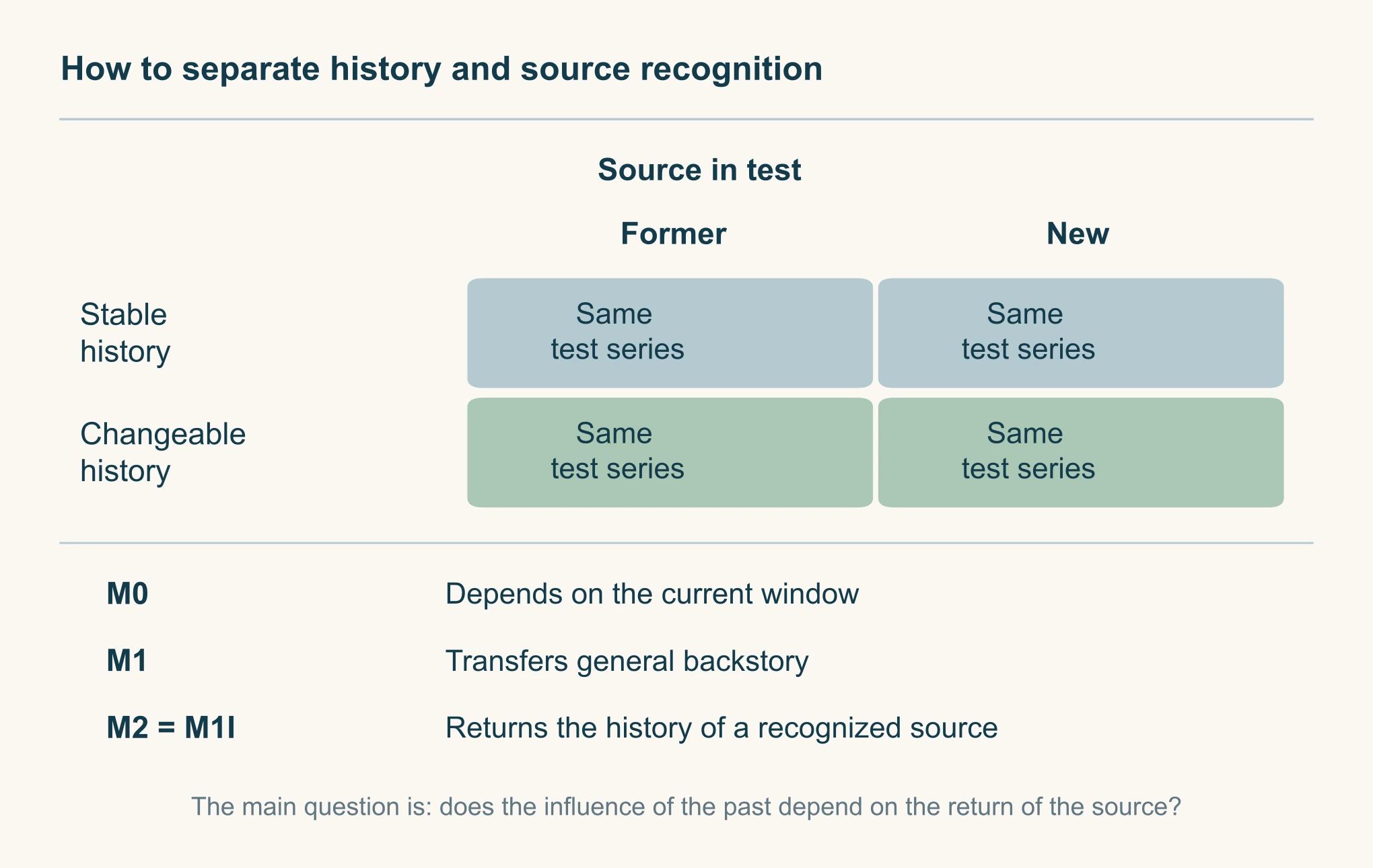
Figure 60. Four conditions of a discriminating design. The project has not yet been completed. Two factors - the nature of the background and the return of the previous or the emergence of a new source - are combined in four conditions with a comparable test series. Below are the qualitative differences of the rules, not the expected human averages. In the selected implementation, M2 and the general tracker M1 are the same; this design alone does not differentiate them.
Get specific forecasts
M0 predicts the same internal state given the same current window. M1 allows for the influence of backstory, but carries it over without separating the sources. M2 predicts the return of the corresponding individual story. Therefore, the main differentiating effect is the dependence of the influence of the past on whether the previous source has returned. Direction and magnitude must be calculated from fully defined rules.
The training sequence A is positive, B is negative, A positive gives M0 the last state 0.75, M1 approximately 0.7105, M2 - 0.875. These values are not expected human averages without additional assumptions. They show that differences between mechanisms can be obtained before the results are observed. The response pattern and individual parameters will require separate assessment.
The common tracker M1I in this sequence coincides with M2. Therefore, the gain over M0 and M1 will support the benefit of taking into account the history of the source in the explanation under consideration, but not yet the special physical nature of the mechanism. This conclusion requires transfer between the bodily task and the comparable task of tracking an external object.
Check mutual definition
For the next stage, we will create two software implementations. The first uses source estimation to select additional observations; the test result changes perception, history, and next choice. The second reproduces the usual outputs of the components, but breaks one of these feedback connections. In normal sequence, their behavior may appear similar.
The intervention must make the difference noticeable. For example, let’s change the reliability of one feature after generating the history of the source. The reciprocal system must rearrange its test choice according to its changed uncertainty. Playing back a recorded stream will not provide this. A comparison with a full-fledged alternative controller is also necessary so that defeating the record does not become the only achievement.
Such an experiment tests the presence of a certain causal organization. The structural part of the hypothesis of chapter 26 additionally requires predicting which relationships between experienced contents will change with the chosen intervention. Testing will require independent experiential data and a transference argument. From the mere sufficiency of the organization it does not follow that its rupture excludes any experience. Identical human texts at the output of the program do not provide a separate phenomenal basis.
Compare using new data
If the parameters are selected over the entire sequence, its successful description is not yet a successful prediction. Divide the data: estimate the parameters on one part, compare the predictions on the other. When there are multiple participants or biological samples, separation must take into account their structure. Random mixing of closely related events can make checking too easy.
Computational research also requires testing whether the chosen procedure can distinguish between models when the model that generated the data is known. Wilson and Collins view parameter and model recovery as important tests of computational analysis. In our project, such checks will be carried out on our own artificial sequences. [43]
It is advisable to look for a strong difference where rivals disagree, and not where everyone has an easy time. However, selecting conditions after reviewing the underlying human results should not be presented as a pre-determined success. This choice can become a useful research discovery and the basis for the next independent experiment.
Write down the terms of the revision
If M1 predicts new estimates just as well, a separate source history is not yet justified. If M2 wins, but M1I fully explains the advantage, the special body version is redundant. If the advantage occurs only after free reconfiguration of the response transformation in each condition, it is unclear whether the mechanism or flexibility of the measurement part explains it.
For a strong hypothesis, the absence of the phenomenal changes predicted by its structural component for a specific intervention would pose a distinct problem. We must determine whether the intervention succeeded and whether an alternative pathway was operating. Yet we cannot indefinitely dismiss every inconvenient result as an insufficiently genuine disruption. The criterion for a successful intervention must be fixed before testing.
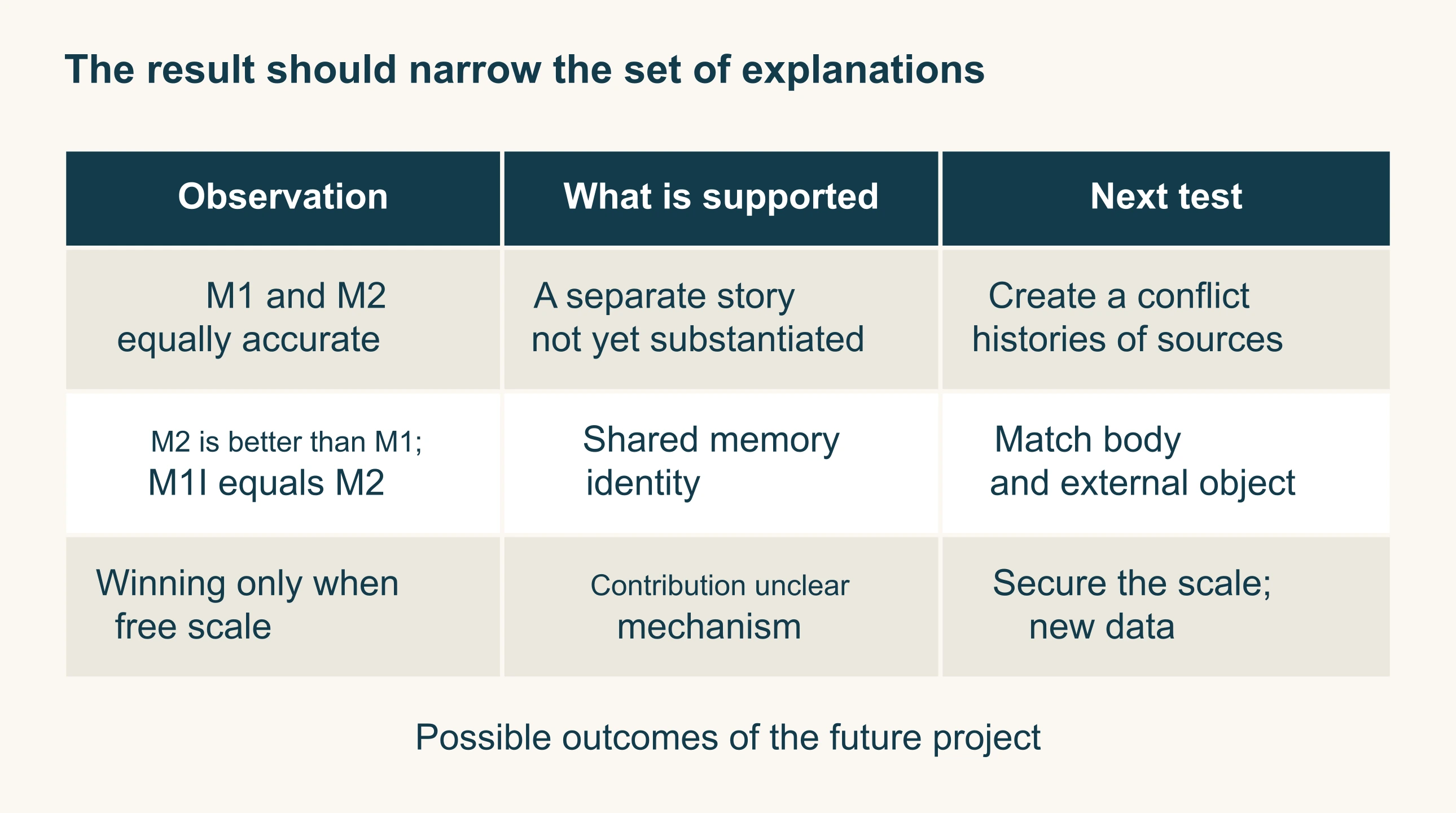
Figure 61. From possible outcome to discriminative test. The table specifies three possible outcomes of a future comparison and different decisions after them. The coincidence of M2 with the common tracker M1 leaves the question of special self-reference open, even if separate memory is useful.
Why won't more data distinguish the same rules?
M2 and the general tracker store separate histories and, in a minimal implementation, update them in the same way. If you give them the same observations and initial states, they will calculate the same predictions for any length of such experiment. Increasing the sample will reduce random bias in data estimates but will not introduce missing differences between models. Therefore, the first design might test the utility of a single story relative to general memory, but a specific bodily explanation would require an additional mechanism or other comparison.
What has now been established
The discriminative result is determined by the predictions, not by the name of the model. Now let’s write out the conditions and conclusions before the main data appears.
Practice 27 Make a differentiating project
Why do it: Prepare the four conditions of the first stage and separately identify the next causal test.
What you will need: M0, M1, M2 and a general tracker from chapters 24–25; the correspondence principle from Chapter 26. The human experiment here is designed, not considered already completed.
Time reference: 35–50 minutes. Can be done intermittently; This is not a speed standard.
1. Make four combinations: stable or changeable history and the same or new source in the test. Specify the available features and the same test sequence.
2. For each condition, write down which story M0, M1 and M2 are used. Keep the general tracker under your own control, even if it coincides with M2.
3. Name the main result and additional indicators: do not combine affiliation, source recognition, authorship and sensory discrimination with one number.
4. Set one targeted intervention for the next step and control for its side effects. Save the result and revise your preferred version.
What to keep: A design with four conditions, distinguishable predictions, and an explicit boundary to the first conclusion.
Hint: The numbers 0.75, 0.710526 and 0.875 from the calculation do not become human averages without a model for measuring and estimating the parameters.
Exploratory follow-up: Prepare two implementations with the same normal outputs but different directional influences. Compare also a full-fledged alternative controller and check the transfer to new scenarios.
Analysis and answers - Appendix F, chapter 27, p. 293
Self-test
1. Is it possible to increase the sample to distinguish between the computationally identical M2 and M1I?
2. Why is beating playback of recorded outputs a limited outcome?
3. What to do with an interesting effect noticed after analyzing the basic data?
The project specifies what needs to be checked. Now let's take an active agent, whose inputs, memory, prediction and action are visible, and reproduce functional checks in code.
Part 8