What an Explanation of Emergence Requires
Previous chapters explained how a process emerges over time and how its capabilities change. Now let us ask about the basis of the very presence of experience. A successful vision model can predict responses and errors, but its author must be explicit about what connection between computation and experience he is proposing. This requirement sets up the book's own hypothesis. It allows for strong assumptions to be made while preserving their commitments and possible objections.
Clarification of the remaining question
Let's assume we've built a detailed vision model. It explains recognition, memory, confidence, and response preparation. When changing parameters, errors similar to human ones occur. What else is required to call it an explanation of experience? The answer depends on what connection between the physical process and experience we accept and what data we justify this connection.
David Chalmers has formulated a distinction between explaining cognitive functions and asking why the performance of functions is accompanied by subjective experience. This argument poses a philosophical problem, not an experimental proof of a separate non-physical entity. One can not accept his further conclusions and still use the requirement to accurately designate the transition from mechanism to experience. [2]
In this chapter we are interested in the ontological meaning of emergence: why some process has an experiential side at all. Information about when the network turned on, when the child mastered the task, or when the mechanism appeared in the history of the species does not automatically answer this question. However, they limit the possible answers and help turn general ideas into research programs.
Explain the presence and explain the difference
Let's start with the difference between the two tasks. First: why is experience present in one state of the system and absent in another? Second: why does present experience have this particular quality? An explanation that predicts only the general possibility of consciousness does not yet explain the difference between sound, color and bodily sensation. Conversely, a color discrimination model can accurately describe the relationships between responses while leaving the question of experientiality open.
For our own example, let’s take a space of three sensations, designated by conventional letters. The participant considers the first to be closer to the second than to the third. The model reproduces this similarity structure. This is a meaningful achievement: it explains certain relationships in the data. But the coincidence of the three distances does not establish that the internal states of the model have the same qualities. It is necessary to understand what properties of space are being measured and why the chosen correspondence has explanatory power.
The next step is to predict changes. If an intervention changes one connection in a mechanism, should the similarity of the two sensations, their unification, or the accessibility of discrimination change? A prediction made before a measurement is stronger than simply choosing a pretty picture after the result. Selectivity is also important: changing one relationship should preserve others if the model asserts their independence.
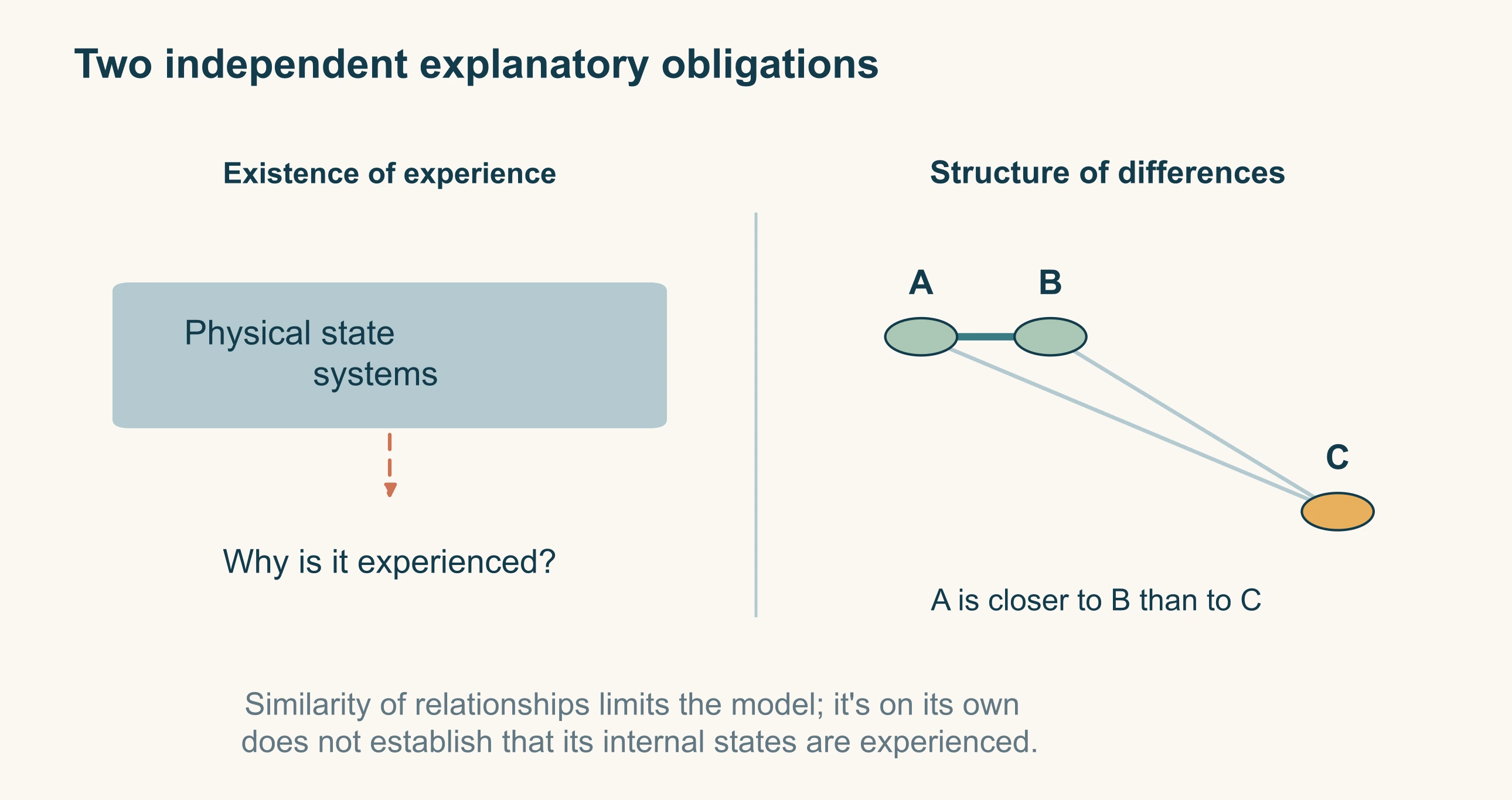
Figure 44. Explaining presence and explaining quality. On the left is the question about the presence of experience, on the right - about the structure of the differences between the three conventionally designated sensations. The geometry on the right shows only a given proximity relationship, without numerical distances or reference to modality. Reproducing such a relationship is a limitation for the model, but does not automatically solve the left problem.
Unity and belonging
Sound, visible movement, and bodily sensation may all be present together in one episode. The explanation should indicate why they are included in the same episode, as well as why some system processes are not included in it. A simple sum of records does not explain this: one must define the relationships through which changes in one part affect the rest and the accessible whole.
The identity of the experience also requires clarification. In a minimal sense, we are talking about the perspective in relation to which the content is organized. In a stronger sense, a person recognizes the state as his own. An even stronger version includes the concept of oneself as a participant in events that persists over time. If a theory assumes that an explicit concept of self is necessary for all sensation, it assumes an additional commitment that cannot be hidden within the definition of consciousness.
Let's check this with a mental example. The person is absorbed in the melody and does not analyze himself. Later he may describe the experience in the first person. Was the extended self-description part of the original episode or did it appear during the report? The story itself does not resolve the issue without additional clarification. But the example shows why the perceptual model, the belonging model, and the reflective model are useful to first distinguish and then explore their interaction.
What relationships are possible between process and experience?
One version of the explanation assumes identity: experience is a certain physical process described from the other side. Then it is necessary to justify the choice of process and show why its structure corresponds to the structure of experience. Simply changing the name is not enough. The success of such an explanation would depend on a consistent system of predictions, causal evidence, and the absence of arbitrary exceptions.
Another option introduces an additional principle of correspondence between physical organization and experience. Then you need to explicitly write down the principle and explain what cases it distinguishes. If it does not predict anything beyond already known behavior, the question arises of how to test it and prefer it to the competitive principle. This is not a ban on research, but a requirement to show the way to obtain new information.
The third option revises the original account of phenomenality: perhaps part of the apparent properties of experience are related to the way the system represents its own workings. Then it is not enough to declare difficulty an illusion. It is necessary to explain specific judgments about experience, their stability, errors and connection with other data. Here again, a strong answer should produce testable differences, rather than end up renaming the question.
These options are given as logical strategies. We do not consider them equally confirmed and do not choose a winner based on one mental case. It is more useful for a research textbook to learn to determine exactly what step each model takes and how much explanatory debt it has left.
How to formulate your own hypothesis
Consider a limited research hypothesis: the stable integration of visual and bodily content depends on whether the system derives them from a single, modifiable common cause. The hypothesis concerns a certain organization of the episode. It predicts that the violation of precisely this unification will change the joint belonging of contents while maintaining their separate distinction. This is our instructional formulation, not a statement of established universal law.
Testing will require identifying common cause in the model, finding independent evidence of separate discrimination, and selecting an intervention. Then compare the explanation with an alternative that attributes the outcome only to attention or memory. If all models produce the same expectations, the conditions should be changed. The mere presence of the words “common cause” does not make the hypothesis deeper than the existing descriptions.
Even a positive result would be supported primarily by the unification mechanism. To call it an explanation of the presence of experience, one must add and justify the corresponding principle. A possible scientific work therefore consists of several related achievements. To require that each small experiment solve the entire ontological question at once would be to lose useful intermediate constraints. Passing off restrictions as a final solution would be another mistake.
A good explanation should also indicate the scope of applicability. The visual unification hypothesis may say nothing about dreaming, bodily pain, or abstract thinking. This is acceptable if the restriction is written down in advance. Universality is not achieved by simply adding the word “every” to a successfully verified particular statement.
Expanding the field requires new connecting assumptions. It can be suggested that different types of content use the same organizing principle, but implement it with different elements. Then it is necessary to determine what exactly remains common and what change in each area is considered similar. If a match is chosen arbitrarily after the results, the program loses verifiability. If it is given in advance, a path arises from a particular mechanism to a more general theory of experience.
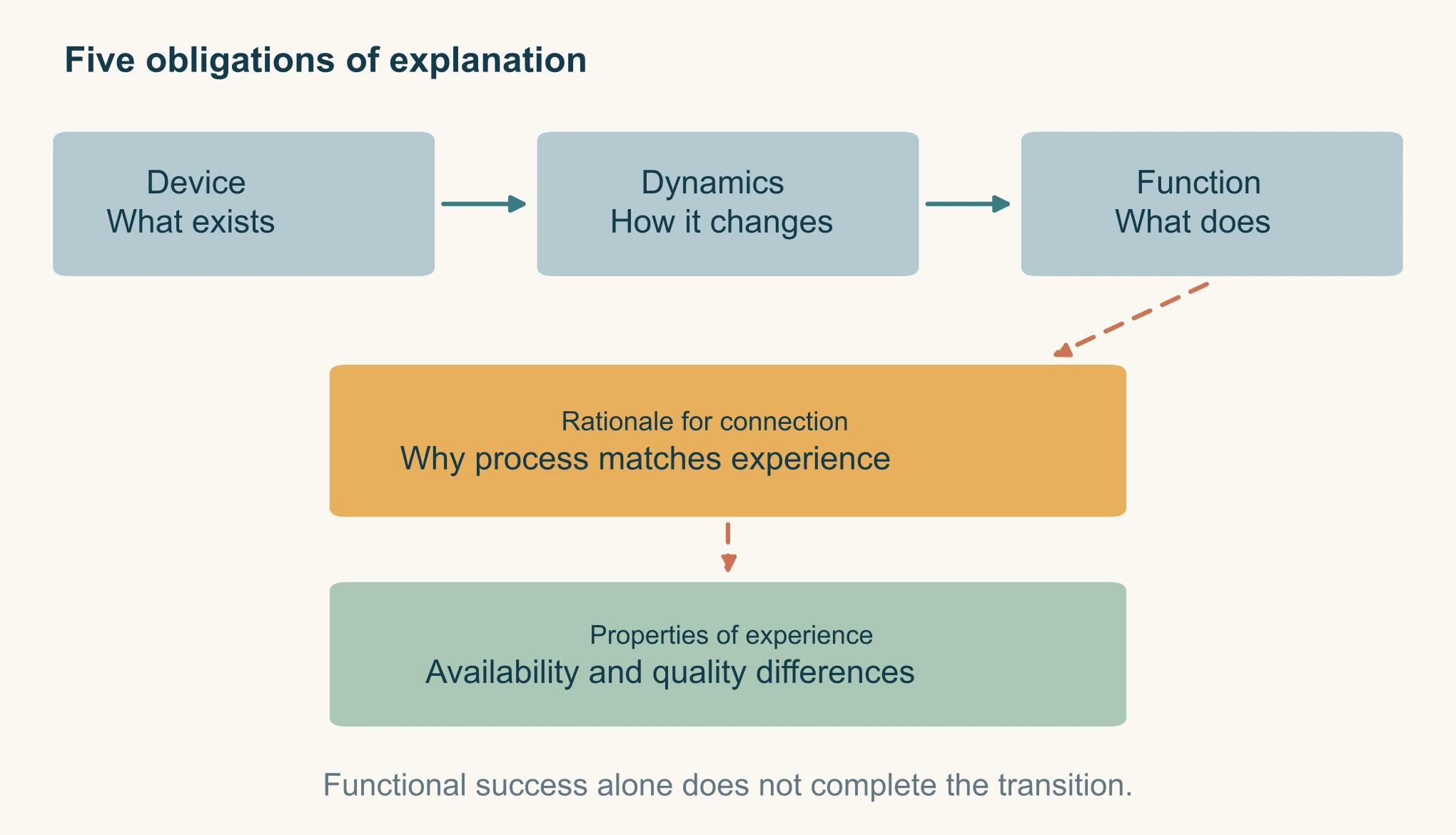
Figure 45. From device to explanation of experience. Five questions from the explanation audit: what exists, how it changes, what function it serves, what properties of experience are being explained, and why the process is associated with them. The dotted line marks a transition that requires its own justification. An explanation of a function does not automatically establish the presence of experience or its qualitative structure.
Five sentences do different explanatory work
The description of the associated elements answers what exists in the device. The rule for updating them shows the dynamics. Successful discrimination of objects describes a function. The relationship between the communicated qualities specifies a phenomenal requirement. The principle of relevance explains why the chosen organization is considered sufficient or essential for the experience. If we leave only the first three points and call the exit an experience, the last transition will not disappear. If we propose an explicit identity of process and experience, it receives substantive commitments: a structure of correspondences, boundaries of application and discriminating consequences.
What has now been established
We have identified what explanation is still missing after a good functional model. Now let's try to formulate this remainder precisely, without abandoning the result already obtained.
Practice 20 Audit explanations
Why do it: Break down one explanation for its individual obligations and find a strong competitor.
What you will need: Necessity, sufficiency, correlation and presumptive identity from chapter 5. Distinguish between the presence of experience, its quality, unity and belonging.
Time reference: 30–45 minutes. Can be done intermittently; This is not a speed standard.
1. Take the specific explanation from chapters 13–15. Write one sentence each about the structure, dynamics, function, explained property of the experience, and the connection between them.
2. Next, indicate the basis for each sentence: definition, data, calculation, or theoretical assumption.
3. Select a competitor that retains some of the same functional results. State what additional requirement distinguishes the explanations.
4. State a possible discriminating observation. If it is not yet defined, describe exactly what method or output is still required.
What to keep: Five related statements, a competing explanation, and a precise remaining question.
Hint: Explaining the relationships between qualities is a meaningful result, even if the presence of experience in the new realization has not yet been established.
Exploratory follow-up: Propose your own limited correspondence principle. Test it on a simple controller and on a system with the same responses received by another device.
Analysis and answers - Appendix F, chapter 20, p. 289
Self-test questions
1. Why might an explanation of color discrimination fail to address the question of experience?
2. Is it necessary to introduce an additional entity to explain the experience?
3. What is considered progress if there is no definitive explanation yet?
Before choosing a device for a future candidate, let's consider data on different media of experience. This will show why the criteria need to be applied to specific mechanisms and conditions.
Part 6