Consciousness and self-control in animals
The theoretical principle must retain its meaning during the transition from a familiar person to another organism. However, the literal repetition of a human task may require inappropriate speech, movement, or sensory channel. Consider animal studies as distinct arguments about memory, content, and post-injury states. Their strength lies in the combination of appropriate measurements and control of alternatives, not in the superficial resemblance of the answer to a human phrase.
What questions do we ask the animal?
The question of an animal's possible experience requires distinguishing between several purposes. Phenomenal consciousness means having an experience. Self-reference concerns the connection of information with one's own body, action, or state. Metacognitive control uses information about the reliability of cognitive processes. Explicit reflection makes one's own reasons the subject of targeted consideration. These capabilities cannot be considered interchangeable, even if they interact in some tasks.
An animal that avoids uncertain choice may evaluate the quality of memory, use a learned external cue, or follow a simpler rule of reinforcement. An animal protecting an injured body part exhibits a different set of functions. No observation should automatically translate into a statement about the human way of thinking about itself. We need a profile of specific reasons and open alternatives.
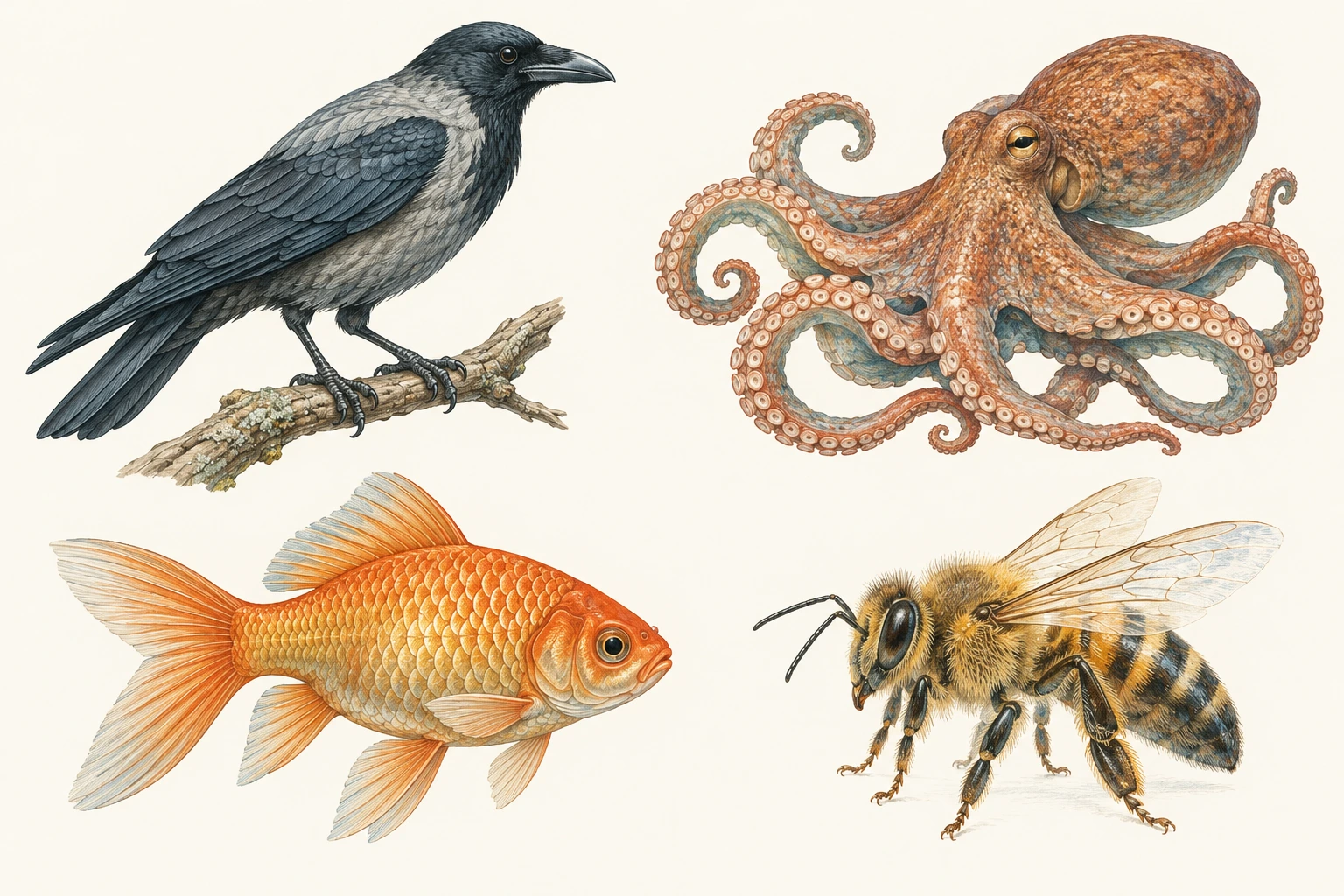
Figure 46. Different organisms and different research questions. Subject illustration: bird, octopus, fish and bee. The scale is relative. Possible bearers of experience should be compared based on specific characteristics and research; The position and size of the animal on this page does not define a scale of consciousness.
General assessment and specific experiment
New York Declaration 2024 reports strong scientific grounds for attributing experience to other mammals and birds and the realistic possibility of experience in all vertebrates and many invertebrates. This is a statement from the signatories, not a separate experiment and not the same evidence base for each species. It is useful to use as a guide to research uncertainty while maintaining differences between specific data. [33]
Overall assessment can draw on multiple lines of inquiry, but individual learning assessments must remain testable. Therefore, below are several primary works on different subjects: memory, visual content, and damage-related states. They do not constitute an animal competition for a single point of consciousness. Each work limits its range of explanations.
Memory and visual content
In Hampton's study, two macaque monkeys could accept or reject a memory test. Choice depended on memory conditions and was associated with subsequent accuracy; The results of the animals differed in the completeness of fulfillment of the criteria. The work gave grounds to discuss control over the availability of one's own memory. It did not show verbal reflection and did not immediately exclude all possible associative explanations for any such problems. [34]
In a study by Nieder, Wagener and Rinnert, the activity of crow forebrain neurons was related to the behavioral report of the presence or absence of a weak visual stimulus. The authors interpreted the result as a neural correlate of sensory awareness. The study expands the comparative base, but does not define all the properties of avian experience or establish the presence of human biographical self-awareness. [35]
The two works answer different questions. The first helps to explore decision control based on available knowledge. The second links neural activity to discrimination of reported visual content. Shared consideration is useful precisely because of difference. Calling both results simply “self-awareness” eliminates the possibility of understanding which mechanism explains each effect.
Damage and negative experience
Crook's work with octopuses examined avoidance of a location associated with a noxious stimulus and preference for a location associated with relief after it. The author interpreted the behavioral and neurophysiological results as evidence to suggest an affective component of pain. This is an argument about the experienced negative state under the conditions studied, not a direct measurement of alien qualia, nor is it an argument for the same experience of all cephalopods. [36]
Barr and Ellwood in 2024 examined how shore crabs relate the avoidance of aversive stimuli to the avoidance of bright light. The variation in choice across competing conditions was consistent with the predictions of flexible evaluation. The authors considered the outcome to be consistent with pain. The narrower implication directly demonstrated concerns the trade-off between different bases of choice. [37]
In a published study by Manzi and colleagues 2026, house crickets groomed their antennae longer after a damaging heat treatment than after control treatments. Changing the conditions, intended to be less or more stressful, did not produce a significant effect. The work strengthens the rationale for discussing directed self-defense and possible pain-like conditions; it does not demonstrate metacognitive analysis or explicit reflection. [38]
It is important here to distinguish between damage registration, organized avoidance and negative experience. A simple defensive response provides less information than a sustained change in preferences while controlling for alternatives. But even the complexity of behavior is not an independent measure of pain. The explanation must show why the set of observations fits better with the inferred state than with the nearest competing mechanisms.
Comparative foundation map
The table combines the considered data types. It indicates the direction of testing and the boundary of transfer, rather than assigning numerical probabilities of consciousness to species.
Group | The basis for this analysis | Significant unresolved issue |
Mammals | General assessment of strong bases and experience with macaque memory | What forms of control transfer between tasks? |
Birds | General assessment and neural study of crows | How generalizes the result to other contents and types? |
Other vertebrates | The declaration recognizes the realistic possibility of experience | What specific mechanisms and indicators are comparable? |
Cephalopods | Combination of preferences and neurophysiology in octopuses | How the quality and organization of the intended experience works |
Decapod crustaceans | Trade-offs of selection among shore crabs | What alternatives to assessing the experienced state are excluded? |
Insects | Directed self-defense in house crickets | How are defensive control and possible phenomenality related? |
In the line of other vertebrates, a separate experiment is not analyzed here. This is the limit of the selected material, which cannot be translated into a conclusion about the lack of experience. Likewise, data from one type should not be generalized to the entire group without additional comparative justification. The volume of research and the properties of the organisms being studied are two different things.
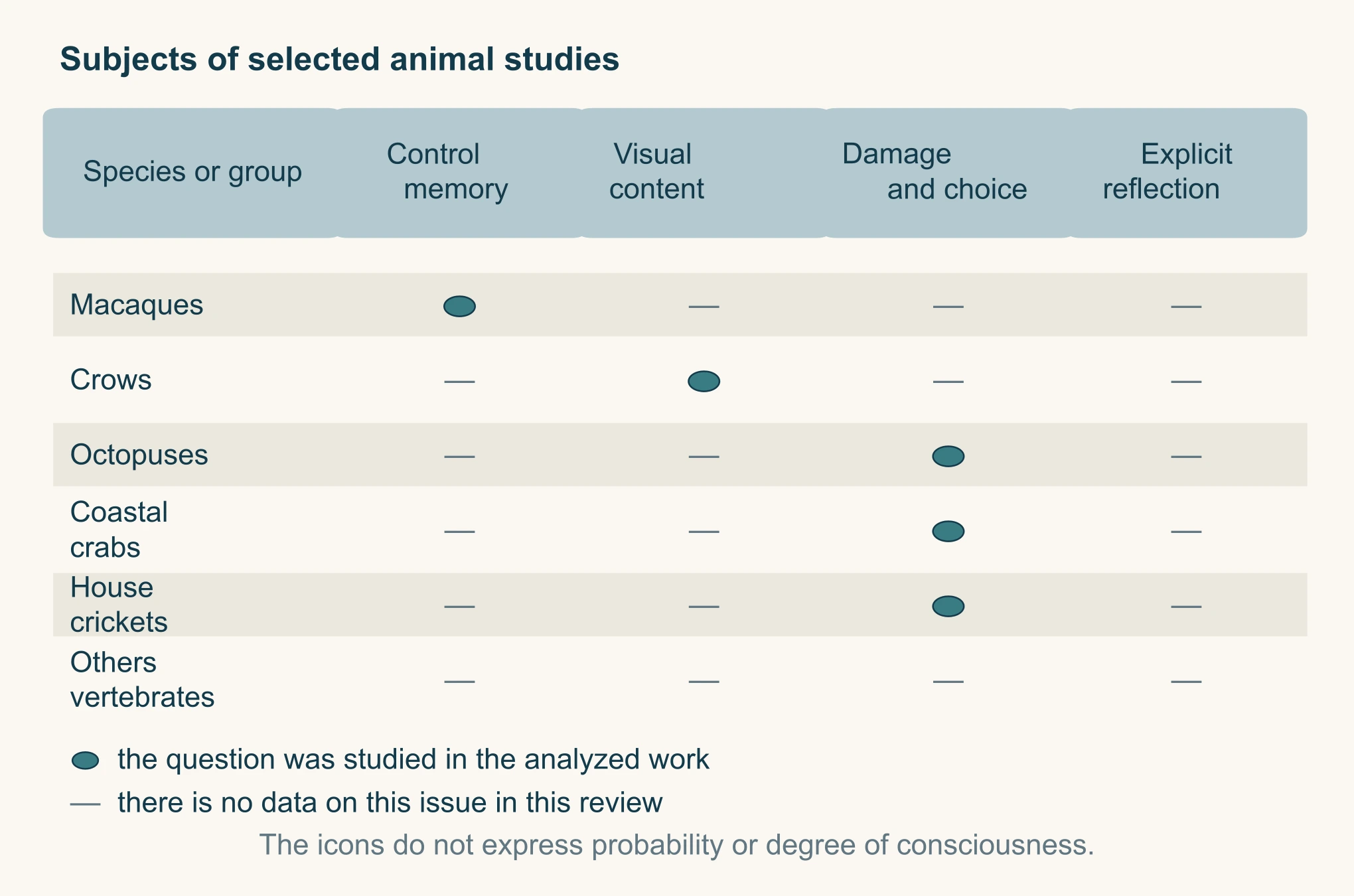
Figure 47. Matrix of questions and evidence gaps. The matrix applies only to the studies discussed in the chapter: memory in macaques, visual communication in crows, avoidance and facilitation in octopuses, choice trade-offs in crabs, and self-defense in crickets. The dot denotes the subject of the work, not the proof of the experience. A dash means a lack of appropriate analysis, and not a lack of ability in the animal. One type of data does not represent the entire group.
How to strengthen the conclusion
A strong profile is built from convergent data with various constraints. If learning transfer, sensitivity to changes in outcome value, and corresponding causal changes are observed, it becomes more difficult for a simple fixed rule to explain everything at once. However, the alternative needs to be formulated specifically. The phrase "it's just instinct" is not a mechanism unless the inputs, internal states, and rules for changing behavior are specified.
In the same way, the expression “an animal understands” requires clarification. What exactly is presented? How does knowledge manifest itself in a new situation? What changes if you remove the external cue? Can the perceived assessment of one's own error influence action before the result is obtained? The answers make the debate about explanatory richness productive.
For explicit reflection, the bar of affirmation is higher than for uncertainty control. It is necessary to show consideration of one's own reasons and their revision, excluding the available narrower rules. The absence of such evidence does not disprove the possibility of phenomenal experience. It limits the specific attribution of reflective capacity.
When comparing, you should check whether the task itself is equally understandable. If one species is presented with a habitual choice method and another is presented with a difficult movement, the difference in accuracy will confound the ability of interest with the test design. We need to control the availability of the signal, motivation and the ability to complete the response. Sometimes a fairer comparison uses different external actions but the same relationship between information and choice.
Let's imagine two training procedures: pressing a button and selecting a passage. In both, you can evaluate how much the decision depends on the quality of the available information. This dependence should be compared, and not the external similarity of the movement. This transfer also requires justification, but it shows why literally the same test is not always the same test of the mechanism.
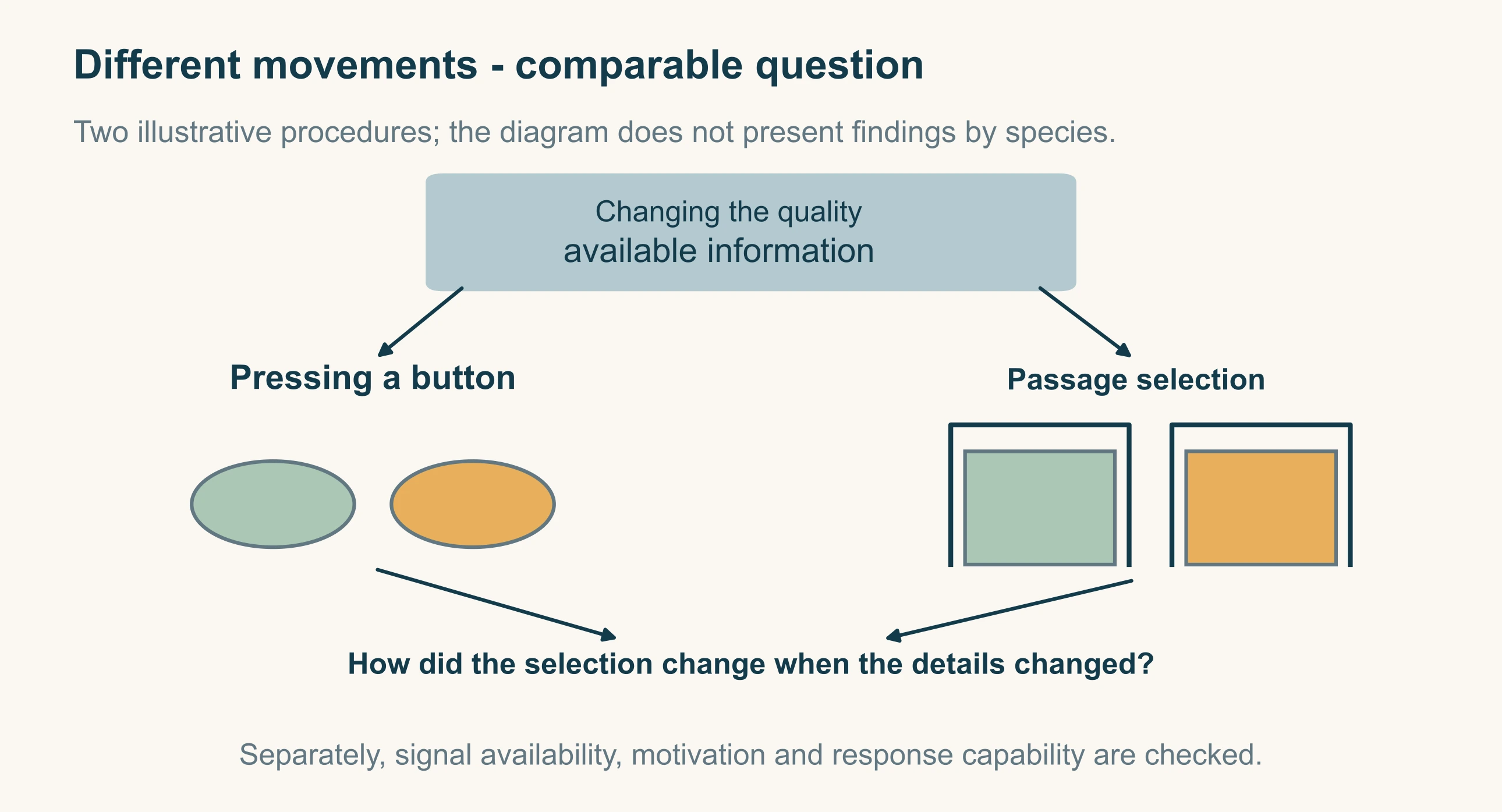
Figure 48. Comparable tasks with different external responses. Pressing a button and selecting a passage can test similar dependence of a decision on available information. When comparing, it is necessary to justify the comparability of this dependence and separately check the sensory, motivational and motor requirements. The coincidence of the external result does not make the internal mechanisms identical and does not provide a common scale of consciousness.
What does refusing a difficult test add?
The animal more often rejects the test after conditions of poor memorization, and performs the accepted tests more accurately. This is compatible with memory availability control. A competitor may suggest a choice based on external characteristics, such as delay. To distinguish between versions, you need to change the quality of memorization at a comparable delay or introduce another suitable condition. Therefore, specific criteria and data for each animal are important. The general word “metacognition” does not replace this analysis and does not attribute verbal adult reflection to the animal.
What has now been established
Individual works answer different questions. The profile of the bases allows them to be combined while maintaining the distinction between the investigated property and the unknown.
Practice 21 Profile of one species studied
Why do it: Profile a single study without generalizing its findings to an entire group of organisms.
What you will need: Research specification, difference between functional and phenomenal inference. A declaration of scientific position and a specific experiment have different statuses.
Time reference: 30–45 minutes. Can be done intermittently; This is not a speed standard.
1. Select chapter work on memory, visual content, or post-damage status. On the first pass, fill in the fields according to the text of the book.
2. Indicate the type, task, measurement, control and main result. If the number of animals is not given in the available description, mark the blank.
3. Suggest a specific alternative mechanism and a condition under which he would expect a different outcome.
4. State one strong conclusion and one broader conclusion that this work does not yet resolve.
What to keep: One study specification and a testable alternative without an overall conscientiousness score.
Hint: The absence of studies of the selected property in this review does not constitute an observation of its absence in the body.
Research follow-up: Open the primary article and clarify the sample, exclusion rules, and individual results. Check to see if the controls you suggest are actually provided.
Analysis and answers - Appendix F, chapter 21, p. 290
Self-test questions
1. Why does recognizing possible pain not mean recognizing explicit reflection?
2. Is it possible to extend the result of one species to all its relatives?
3. What to do with an explanation through a simple rule?
Now let's check what functions are available to systems without neurons. This will help distinguish memory and adaptation broadly from the complementary experiential hypothesis.
Chapter 22