Your Own Research
The book's route ends with research that another person can repeat and meaningfully challenge. A small mechanism is enough to begin with: its value is determined by the clarity of the issue and the strength of the test. A separate history of sources will provide a complete computational example. The next project will add the reciprocal determination of attribute and source and show what new grounds will be required for a stronger inference about experience.
From educational result to own task
The purpose of the book is to learn how to construct and test explanations of experience, and then to design systems that, on these foundations, can become candidates for subjective experience. The final work should connect design, mechanism and evidence. The scale of implementation can be small if the question is precisely defined and the result truly changes our understanding of the chosen mechanism.
Below is a completed educational computational mini-study. It shows a form of argument that can be reproduced and extended. Its numerical results follow from given rules; they are not derived from humans or cell cultures. After this, we will formulate the next project, aimed at a stronger hypothesis about quality organization and the presence of experience.
Educational study of the separate history of sources
Question. Is keeping history separate enough to cause the same new evidence to have different effects on the assessment of cause once the source is returned? Additional question: does the resulting difference require a special mechanism of the self or is it reproduced by a general memory of the identity of objects?
Method. A sequence of four observations is given: A with a positive sign, B with a negative sign, A again with a positive sign and B again with a positive sign. The source labels are available to the model and are error-free in this exercise. A positive sign has a probability of 0.75 for a common cause and 0.25 for different causes. The initial probability of the common cause is 0.5.
Before processing the feature, the previous belief is shifted to 0.5 with a retention coefficient of 0.8. The chapter update rule 25 is then applied. M0 starts from 0.5 each time. M1 carries one belief through all events. M2 stores a separate belief for each source; the hold is applied the next time this record is accessed. M1I implements the same individual records as a regular object tracker.
This is a deterministic parsing of a given sequence. There is no estimate of the average effect in a population of sequences and no statistical sampling of participants. Each number can be checked manually or by the source_history_example() function of the engineering workshop. The output of the model refers to the probability of a common cause after the current observation, rather than the prediction of the observation itself.
Results and explanation
Step and event | M0 | M1 | M2 | M1I |
1 A positive | 0.750000 | 0.750000 | 0.750000 | 0.750000 |
2 B negative | 0.250000 | 0.437500 | 0.250000 | 0.250000 |
3 A positive | 0.750000 | 0.710526 | 0.875000 | 0.875000 |
4 B positive | 0.750000 | 0.858108 | 0.562500 | 0.562500 |
In the third step, M2 returns to story A. Its previous estimate of 0.75, after holding, turns into a preliminary probability of 0.7. Positive evidence raises it to 0.875. M1 comes to this step after negative event B, so it gives approximately 0.710526. The difference arose from the history transfer rules, although the current attribute is the same.
The fourth step is especially useful for understanding the mechanism. The overall history of M1 is now predominantly supportive, and the new positive evidence gives 127/148, approximately 0.858108. M2 returns to the previous negative history B and receives only 0.5625. Separate memory doesn't just increase confidence: it preserves different bases and can therefore lower scores relative to shared memory.
In all four events M1I coincides with M2. This equality follows from the same rules, and not from a random lack of data. Renaming the object dictionary to "model itself" does not create an additional mechanism. The computational result establishes the role of story separation and simultaneously limits its interpretation.
Controls and conclusion of the mini-study
Renaming A and B should not change the numerical sequence if their histories are transferred along with the labels. If you replace all the marks with one, M1 and M2 will coincide. If you set the retention to zero, all versions will produce 0.75 after a positive sign and 0.25 after a negative sign. These consequences allow you to check whether the implementation actually corresponds to the stated model.
Conclusion. Separate history storage is sufficient to reproduce the described computational effect of source return. The example does not establish an advantage in any medium and does not distinguish special self-reference from general identity tracking. It provides a precise mechanism that can be tested against independent data, and a clear alternative to work with further.
The restrictions here are meaningful. An error-free mark makes the task easier; a real system must recognize the source from observations. The time rule is chosen by references, not by physical duration. The belief about the cause is not yet associated with the qualitative structure of perception. Each constraint specifies a different next hypothesis rather than invalidating an already established result.
Next Mutual Content Determination Project
Let's expand the task so that the source influences the interpretation of an ambiguous attribute, the interpretation changes the source's assessment, and the system can choose an additional check. The result will be a specific candidate for part of the organization proposed in chapter 26. First, let's set two separately changeable content properties: attribute rating and source rating. The third variable will determine the expected benefit of the test.
Before launch, we will describe targeted interventions. A forced change in source evaluation while retaining sensory input should shift the interpretation of the feature and the choice of test. Changing the representation of a feature should predictably change subsequent evaluations of the source. Breaking one feedback loop should disrupt the corresponding direction of influence while maintaining the availability of the original observation. The sizes and time windows of effects are specified by specific implementation rules.
Now comes the discriminating project. The complete system is compared to a system that has the same observations and historical records, but only one direction of influence. Separate control reproduces normal outputs without causality between components. Not only the success of the task is checked, but also the response matrix to the interventions. In this case, a fairly strong alternative controller is needed: defeating an obviously helpless recording will not explain the uniqueness of the mechanism.
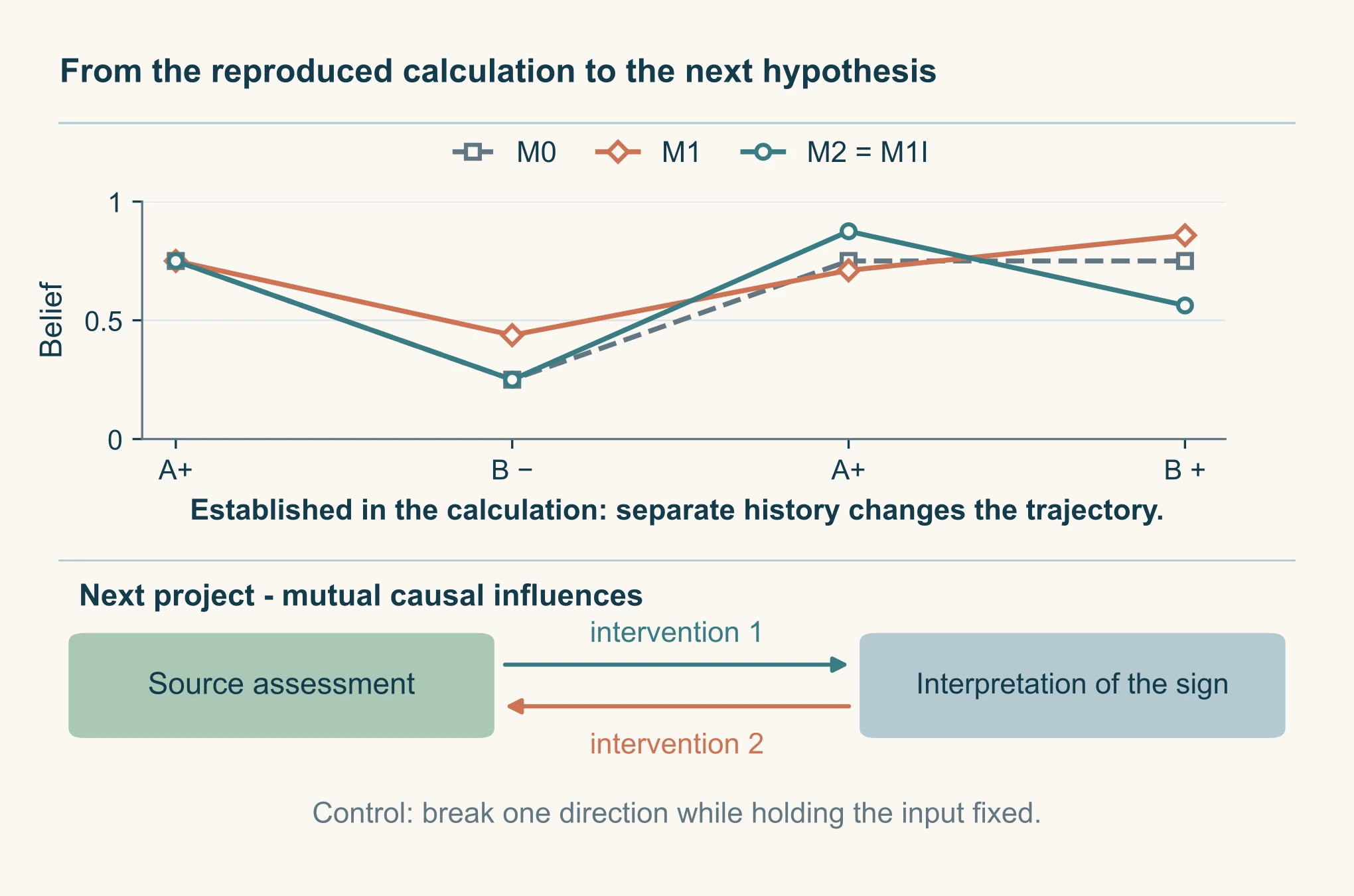
Figure 88. Completed calculation and next causal design. Above is an accurate training calculation of four events A+, B−, A+, B+. At the fourth step, M0 gives 0.75, M1 - 127/148 (approximately 0.858108), and M2 and its coinciding M1I - 0.5625. Below is a project not yet completed: interventions in source evaluation and attribute interpretation must have predetermined consequences in the opposite component. Unilateral control tests a specific causal relationship. Calculation by itself does not realize the entire strong hypothesis of Chapter 26 and does not establish the presence of experience.
How will the project approach the question of experience?
Chapter principle 26 links quality organization with sustainable relationships of distinctions and alternatives. Therefore, the future model should predict the pattern of similarities, mixtures, and content changes, not just the correct answer. For example, source interference should change some relations between ambiguous contents while maintaining prespecified other relations. This is a stronger commitment than improving overall accuracy.
Comparisons with humans will require independent data on these differences: ratings of the similarity of experiences, their dynamics, source discrimination, and control for difficulty. The proposed mechanism is compared with an explanation through general memory of objects and with an explanation through a change in decision while the experience remains unchanged. These competitors must make their own predictions before collecting supporting data.
The strong assertion of experience is retained as a hypothesis: a certain actually realized organization is sufficient for a minimal subjective process. Implementation and functional checks will verify that the proposed conditions are met. Justification of sufficiency will require connection with phenomenal data, clarification of physical implementation, and analysis of alternatives. Thus, the task of creating a subject remains a direct research goal, and each stage has its own verifiable result.
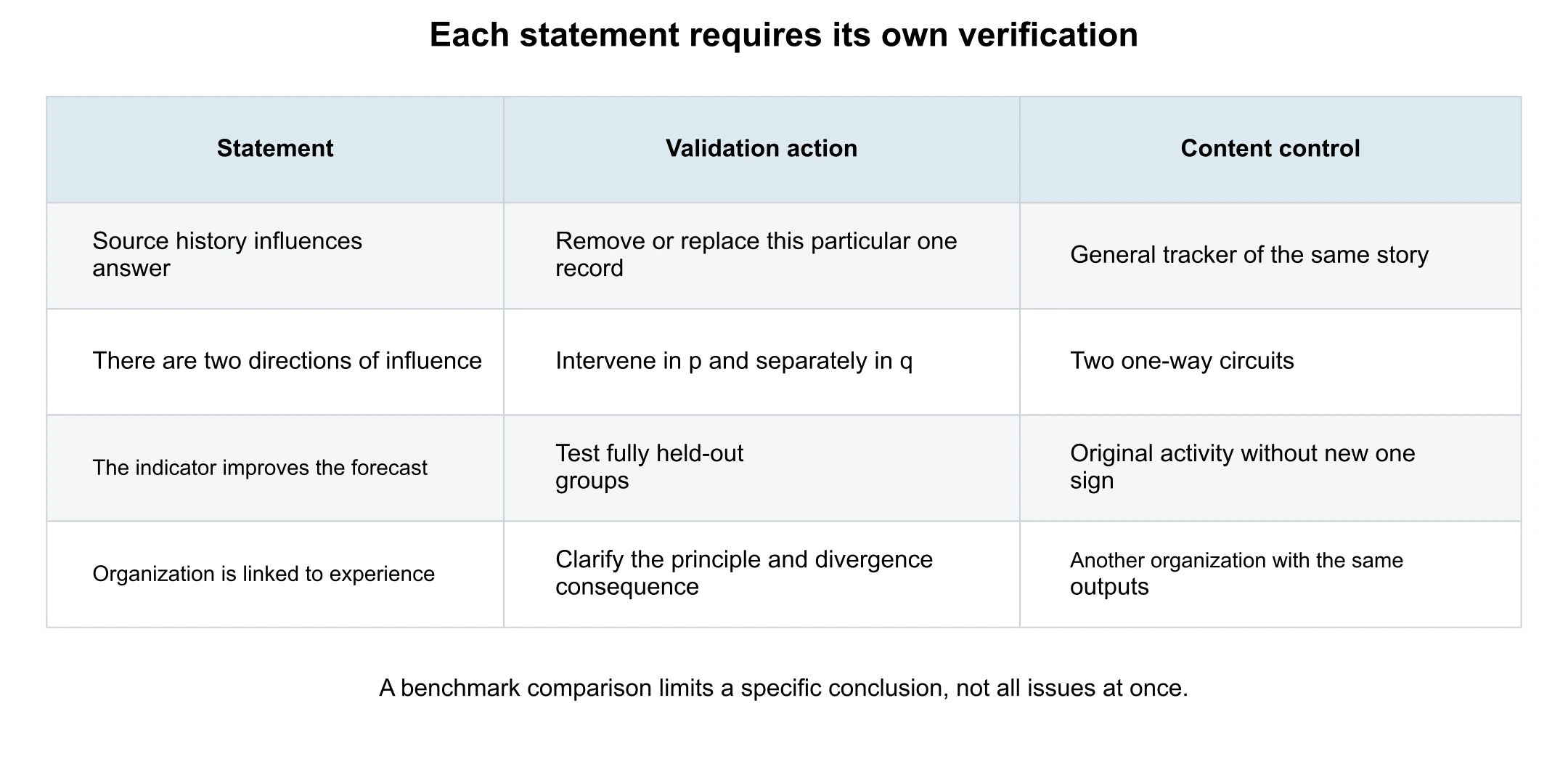
Figure 89. From approval to verification and control. Project Completion Training Matrix. Each line links the statement to a specific action and strong control. The last line preserves the independence of the theoretical argument about experience; The functional checks above do not automatically replace it.
What should be included in the final work
Prepare a coherent text with the question, rationale, mechanism, method, results and discussion. For a digital implementation, please include the executable code, environment description, parameters, stored data, and method for retrieving the tables. In the biological field, analysis of open data, a digital model and a professional experimental design with a clearly indicated boundary of the work already completed are acceptable.
Include at least one meaningful competitor, one causal or discriminative test, and one control with a known outcome. State the correspondence principle separately if you are making a statement about an experience. Indicate which of its provisions have been verified, which are assumed, and which are still underdetermined. An author's proposal requires verification of related published ideas; independent formulation does not in itself establish scientific priority.
A non-discriminating result can also become a full-fledged final work. It is important to show why it occurred and what next test will eliminate the uncertainty. The presence of a module, its beautiful description and convincing self-report do not replace the demonstration of its role. This insight is especially useful when it allows you to eliminate unnecessary complexity and more accurately design the next candidate.
How to turn a calculation into a short article
Example question: Does the individual history change when the source is returned? The method specifies four events, reliability, retention, and memory rules. The result shows all trajectories and the coincidence of M2 with the general tracker. The discussion links the effect to the separation of entries and maintains the limitations of labels, time, and relation to experience. The next step changes one assumption and produces a new forecast. This structure allows the calculation to be reproduced and the explanatory transition to be critiqued separately.
What has now been established
We have a completed functional result and an open research goal. The next project should not blur this line: it should add a new defined obligation and a suitable test.
Practice 36 Complete your own article
Why do it: Prepare your own reproducible work with one testable mechanism change.
What you will need: Specification of the mechanism, a strong competitor, a preliminary plan and a decision on the result. The novelty of the formulation does not establish scientific priority.
Time guide: Several separate sessions after reproducing the example. Can be done intermittently; This is not a speed standard.
1. Play back the four events M0-M2 and the match with the common tracker. Save the code, parameters and raw numbers.
2. Select one change: forgetting time, source recognition errors, or the mutual influence of the feature and the source. Before launching, write down the difference from the original model.
3. Prepare a strong competitor, a discriminative test, and a control with a known answer. Check and save all results.
4. Write a paper with question, reasons, mechanism, method, result and discussion. In the discussion, separate the established fact, the remaining uncertainty, and the next question about the experience.
What to keep: Study text, executable example, data, and a clear version history of the model.
Hint: A non-discriminative result is acceptable if it is clear why it arose and what new condition would separate the explanations. Do not replace this analysis with a beautiful self-report of the system.
Exploratory continuation: For a strong hypothesis, specify interventions in both directions and infer changes in relationships between contents in advance. Comparison with phenomenal data and transfer to a new physical implementation remain separate stages of the program.
Analysis and answers - Appendix F, chapter 36, p. 297
Self-test
1. What did the above calculation of four events prove?
2. Why does a strong project need interventions in both directions?
3. Could the final work contain significant uncertainty about the experience?
Further work can follow a digital, comparative or biological branch. Keep a specific question, a complete history of changes, and the possibility of getting a result that will force you to reconsider the explanation.