Artificial and biological candidates
We looked at different organisms and saw how the material itself does not determine either the mechanism or the experience. Now let's move on to artificial and hybrid candidates. Before assessing their self-reports, it is necessary to describe the available inputs, the stored state, and the use of information. The basic practice in this chapter uses a ready-made minimal circuit. The full agent will be introduced later, in chapter 28; there is no need to contact it in advance.
Media question
Can experience occur in a program, robot, or grown neural system? The answer cannot be obtained from the title of the material. A program describes a way to organize calculations, a robot describes the connection of a calculation with a physical action, and a neural culture describes the biological composition of a certain system. None of these characteristics by itself defines the complete mechanism of consciousness.
Research requires distinguishing between medium, organization, interaction history, and available metrics. Two systems of identical cells can have different connections. One program can run on different hardware. The robot can be controlled by a local controller or receive commands from outside. If the boundary of the device in question is not specified, the properties of the entire installation can easily be mistakenly attributed to one part of it.
What can be deduced from the theory
Butlin and colleagues proposed evaluating artificial systems through features derived from scientific theories of consciousness, followed by testing their implementation. The article was published online in November 2025 and included in the journal issue 2026. The method is not a ready-made universal test: the conclusion depends on the validity of the selected theories, the correct translation of their requirements and the actual design of the system. [42]
The feature test must answer three questions. Is it necessary, sufficient, or merely incidental according to this version of the theory? Which part of the device implements it? What intervention can be used to show that it actually fulfills its intended role? If a sign exists only in the developer's description, this is a reason to study the architecture, and not count the condition as fulfilled.
In chapters 13–15 we looked at different areas of requirements. The accessibility of selected content to multiple processes is important to the workspace. For the recurrent approach, a certain organization of reverse interactions is essential. For higher-order theories, a representation of one's own state. For approaches sensitive to intrinsic physical causation, functional similarity may not be sufficient. These differences should be preserved when assessing a candidate, and not combined into an indifferent sum of “signs of reasonableness.” [16] [17] [19] [20]
The program and its self-description
Let’s imagine a program that, after any failure, displays the phrase “I’m confused.” Another version of the same program displays "error code 7". If replacing the text does not change the calculation, the message itself does not prove the presence of experienced confusion. It is part of observable behavior, the origin of which must be investigated. Conversely, the absence of an emotional vocabulary does not establish the absence of all potentially relevant mechanisms.
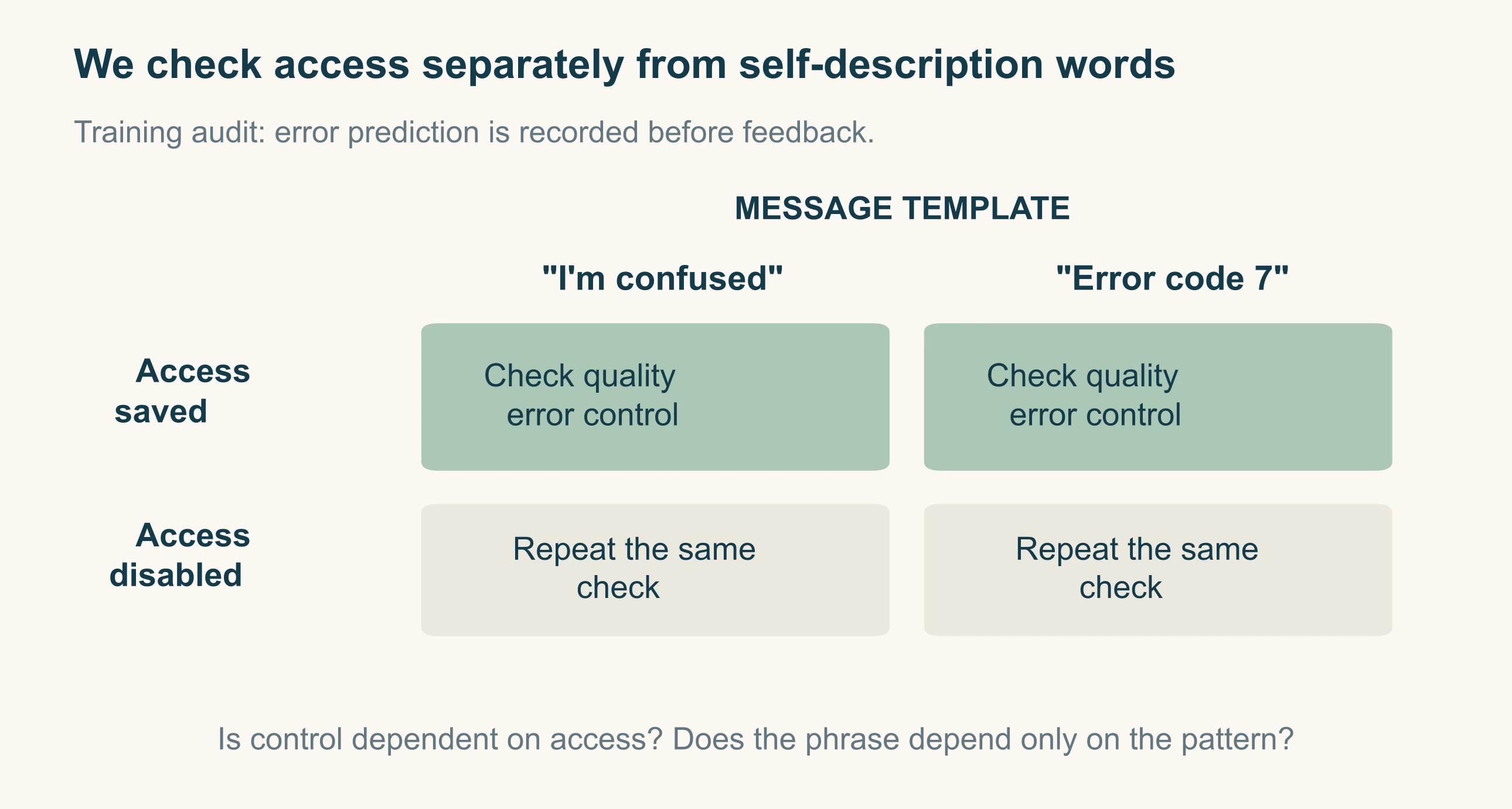
Figure 51. Separate audit of information and self-description. The design independently changes the program's access to internal information and the wording of the message. If control depends on the first factor and words on the second, their causal roles differ; This is a preliminary conditional prediction, and not the result of an experiment already performed. It is necessary to exclude access to the hidden correct answer from the environment.
A more insightful candidate is able to predict its own error before obtaining a result, consider memory limits, and change strategy when a systematic failure is detected. This can already be checked functionally. However, the story about the reasons for the decision can be formed separately from the decision itself. Then a plausible explanation does not guarantee access to the reasons that were actually at work.
In your own experiment, it is useful to separately change access to internal information and the response pattern. If the quality of control depends on the internal state, and textual explanations depend only on the template, the functions differ. If the program uses a hidden correct answer from the environment, successful assurance may generally be a data leak. Therefore, auditing inputs is as important as analyzing received phrases.

Figure 52. Artificial system in a physical environment. Subject illustration of a mobile device with sensors and computing equipment. When evaluating such a candidate, it is necessary to establish the boundaries of the system: where the command is formed, what information is available to the controller, and what consequences of the action it receives.
What does the body add?
The robot allows the interaction to be closed: an action changes the world, a new observation depends on the action, and the model can clarify the relationship between command and effect. Such a device is convenient for studying self-reference and adaptation. It does not make corporeality a sufficient condition for consciousness. It is necessary to establish exactly which functions of the physical body cannot be replaced without loss by another organization of interaction.
Consider an educational robot with a camera and a moving platform. Rotation changes the image. If the device predicts a change, it can distinguish between the movement of an object and the effect of its own rotation. If there is a subtle change in control, you will need to update the action model. In this example, the body specifies specific causal dependencies, rather than a symbolic right to use the word “I.”
If a theory asserts the necessity of a particular bodily regulation, testing it requires specifying which variable is being regulated and why it is significant. Battery reserve, represented by a number, does not automatically become an experienced need. Its integration with choice, learning, memory, and the proposed principle of connection with experience needs to be explored. Without this, we will only rename the usual control signal.
Neuronal cultures, organoids and hybrids
Neuronal culture represents biological nerve cells in artificially organized conditions. An organoid is a grown three-dimensional system that models certain aspects of tissue development and organization; this name does not mean a ready-made brain. The hybrid connects a biological component with computational control, sensors or actuators. Detailed experimental examples and limitations will be discussed in chapter 31.
The same principle of analysis is important for our purpose: learning, electrical activity, and successful control should be measured separately from perceived experience. Biological origin makes some mechanistic hypotheses more meaningful, but does not automatically inform their implementation. It is necessary to clarify the structure of connections, feedback boundaries, the role of the external algorithm and the temporal stability of interactions.
Particularly indicative is a hybrid in which an external controller selects rewards and converts tissue responses into commands. Changing the result of the entire installation may occur due to the controller settings. To attribute learning to biology requires appropriate control comparisons. To attribute experience, a separate theoretical argument will also be required. These are two sequential questions that should not be combined with one project name.
System class | What should you describe first? | Common error in drawing a conclusion |
Program | Real states and dependencies of calculations | Consider self-description as a direct measurement of experience |
Robot | The connection between the perception of action and the state of the body | Taking the presence of a hull as a sufficient condition |
Neural culture | Organization of the cellular network and external control | Attribute the properties of the entire installation to the network |
Organoid | Degree of organization and available interactions | Identify the tissue model with the whole brain |
Hybrid | Boundaries of parts and distribution of causal functions | Do not differentiate between learning the controller and the biological component |
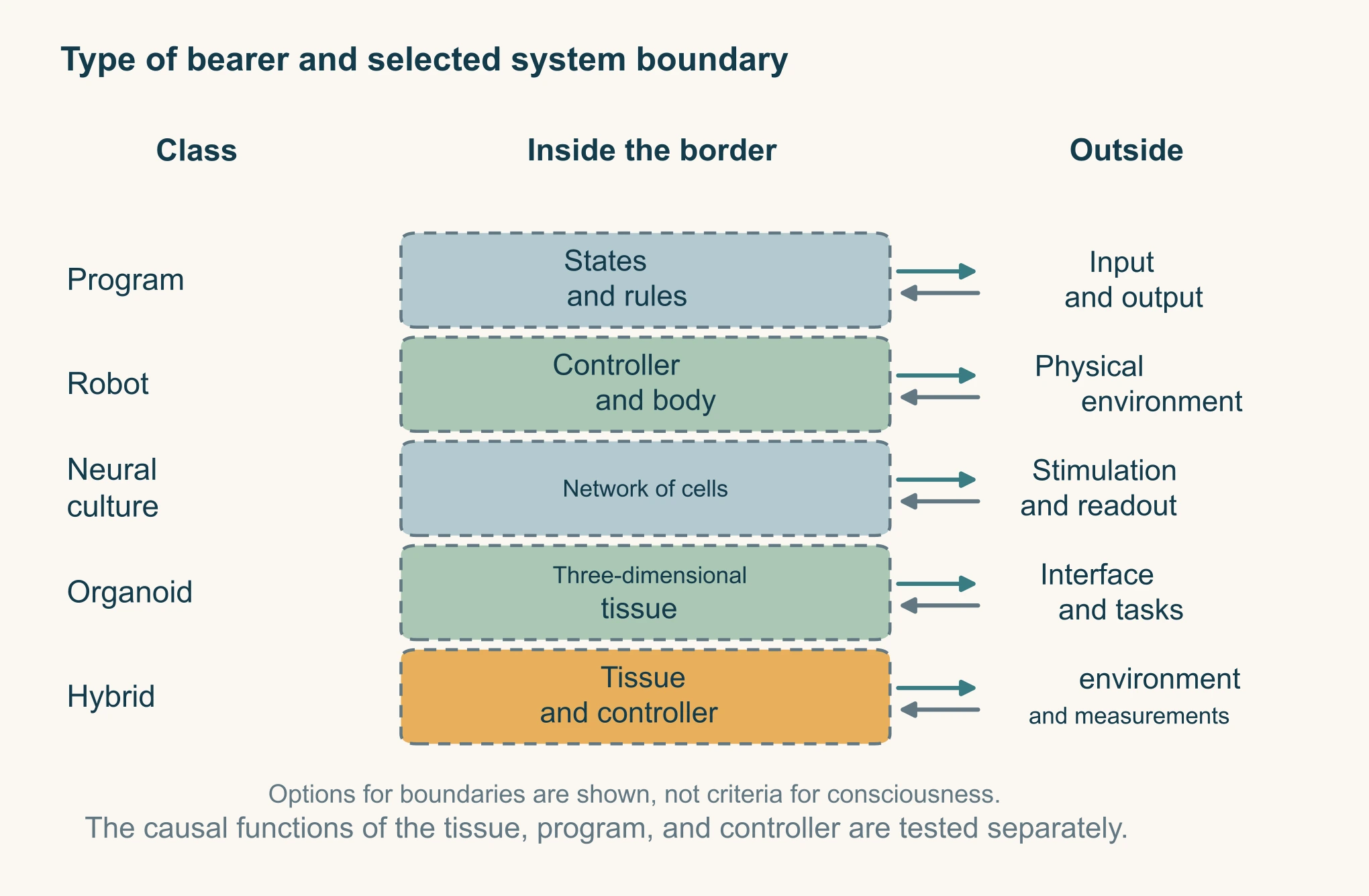
Figure 53. The medium does not define the boundary of the study. Five examples of system boundary selection. The dotted line separates the part in question from the external interaction. For a program, robot, culture, organoid, and hybrid, it is necessary to establish where learning, state storage, and control are performed. These are options for describing the installation, and not a mandatory structure of all systems of the corresponding class and not a rating of the probability of consciousness.
How not to turn signs into ratings
Let's imagine two candidates. One has well-tested error control, but the organization of content distribution is unknown. The second has a common exchange channel, but the assessment of its own reliability is formed according to a ready-made rule. Simply adding up the ticks will hide the difference. For one theory, the absence of a certain feature is critical; for another, the same feature is not necessary.
Therefore, it is better to present the audit result as a profile. For each requirement, the theory, interpretation, measurement, outcome, and remaining alternative are specified. Unknown properties are noted separately. If hardware is not available, a description of the program does not replace knowledge of physical causation when it is essential to the approach being tested.
Also check whether the intended feature is actually being used. The module can be connected to shared memory and never read the content of interest. Another module is capable of storing a confidence score that does not influence any choice. The presence of fields in the code then exaggerates the functional organization. Selective deletion, distortion, and restoration of the condition help establish a causal role.
However, the absence of change after removal does not always give a final negative conclusion. Perhaps the task did not require this function or it was performed by a duplicate mechanism. It is necessary to provide in advance the condition where the function should be required, and check this explanation of compensation. The architectural audit then becomes an examination of the working device.
A Minimal Design before the Full Practical Course
Let the device store the right target probability p and the direct control probability q. The selector module reads both numbers and selects a command. The monitor reads the same numbers and calculates the expected success. A text report can either be generated from the monitor or inserted according to a fixed template. Changing the template while the states are saved should not change the command selection. A distortion of q, on the contrary, can change both the choice and the forecast. This is a causal testing scheme; Full update rules will be discussed in chapter 28. It is already possible to distinguish an architectural requirement from the impression created by the text.
What has now been established
We can create a profile even with incomplete knowledge of the implementation, if the unknown properties are designated as such. The presence of memory, body frame or neural cells is not a substitute for testing specific connections.
Practice 23 Candidate's specification
Why do it: Separately evaluate access to states and verbal self-description on a finished diagram.
What you will need: World model and action model from chapter 15; internal access and external journal from chapter 14. The name of a component is not a test of its implementation.
Time reference: 25–35 minutes. Can be done intermittently; This is not a speed standard.
1. Draw four components: estimates p and q, choice, monitor, report. Make only the connections indicated in the analysis.
2. For each connection, indicate the sender, the recipient, and the consequences of disconnecting it. Do not add a hidden true target to the monitor.
3. Compare two interventions: changing the phrase pattern and distorting q with the same external input. Record expected changes to selection, forecast, and text separately.
4. Compile a profile on two theories: what the circuit models, what has not been tested, and what basis for drawing conclusions about the experiment is still needed.
What to keep: Mind map and profile of checked, unchecked and missing properties.
Hint: The figure does not imply that all components are actually implemented. When you go to the code, the status of each connection will need to be confirmed.
Research continuation: After chapter 28, repeat the profile on the active agent and his log. Do not replace the implementation check with a block name match.
Analysis and answers - Appendix F, chapter 23, p. 291
Self-test questions
1. Why is successful conversation about experiences not sufficient to draw conclusions about them?
2. Does a biological bearer guarantee consciousness?
3. Why is a candidate’s profile better than the number of characteristics completed?
The assessment of other candidates prepared the language of the requirements. Now let's choose a limited explained difference and build our own model, which can be compared with meaningful competitors.
Part 7