How the check works
In chapter 6 we described how a single indicator is obtained. Now consider two procedures and ask whether their difference can be attributed to the chosen cause. If, along with the method of work, the difficulty of the material and the order of execution change, the result allows for several explanations. The purpose of this chapter is to construct the comparison itself. We will prepare it before collecting data and keep a separate place for ideas that arise after reviewing the results.
Search for a possible refutation
A hypothesis becomes working when it is clear which possible outcome does not fit it. The statement “experience has something to do with information processing” is too broad for a single test. The statement “the stored pattern of temporal relations helps answer new questions about the text with the same total preparation time” already sets the conditions, the result and the possible comparison. You may experience improvement, no noticeable difference, or worsening.
Validation begins before data collection. The researcher determines what to change, what to measure, and what other changes might explain the result. The condition being changed is called the independent variable, and the result being measured is called the dependent variable. For example, the presence of a schema is a condition, and the proportion of correct answers is an outcome. These titles describe the roles in the study; they do not prove the independence of variables and the causality of the relationship.
Operationalization is the translation of a general concept into a specific procedure. “Text Comprehension” can be assessed with questions that require you to infer a new attitude from what you read. But the chosen procedure covers only a certain aspect of understanding. If the answers are allowed to be sought in the diagram, the solution to the problem with external support is measured. If the schema is removed, another situation is explored, involving the storage of information in memory.
Why a bad comparison is convincing
Let's present a training project. First, a person reads a complex text without notes and answers questions. Then he reads a simpler text, makes a diagram and answers better. The author concludes that the scheme improved understanding. In reality, the strategy, the difficulty of the material, and the order of execution changed simultaneously. The second attempt could benefit from familiarity with the question format.
Such an accompanying difference is called a confounding factor if it interferes with the isolation of the cause of interest. It is not enough to list possible obstacles at the end of the report. The test design should, if possible, change their association with the main condition. If simple texts are always used with schema, the effect of schema cannot be separated from the effect of simplicity.
Not all differences need to be resolved physically. Part can be distributed between conditions according to a pre-selected rule. Others measure and take into account in the analysis. However, the calculation will not correct the lack of necessary comparisons. If there was no complex text with the circuit, the model would have to rely on additional assumptions about how the circuit works on complex materials.
Improving the project step by step
Let's start with two sets of short texts A and B. They should be similar in length, format and required output. It is advisable to prepare them before the main test and make sure during the test run that the instructions are clear. The trial run is intended to correct the procedure; its results cannot be discreetly mixed with data from testing an already modified plan.
Some participants work with the scheme on set A and without it on set B; others get the opposite combination. Within these options, the order of conditions is changed. This balancing of order and material does not make the texts absolutely identical. It distributes their features so that one set is not inextricably linked to one strategy.
Random assignment of options helps avoid choosing a condition based on the characteristics of the participant. For example, you cannot automatically give a diagram to all more experienced readers and then attribute their advantage to it. In a small group, randomness does not guarantee exact equality of composition, but it creates an understandable procedure for distribution. It is useful to combine it with a thoughtful arrangement of materials.
If the study is carried out only on yourself, you can change conditions and materials according to a predetermined schedule. The result then primarily relates to your sessions. Repeated reading of the same text creates knowledge transfer, so it is better to use new, comparable materials. A DIY project is useful for learning the procedure and finding problems; its area of generalization must remain visible.
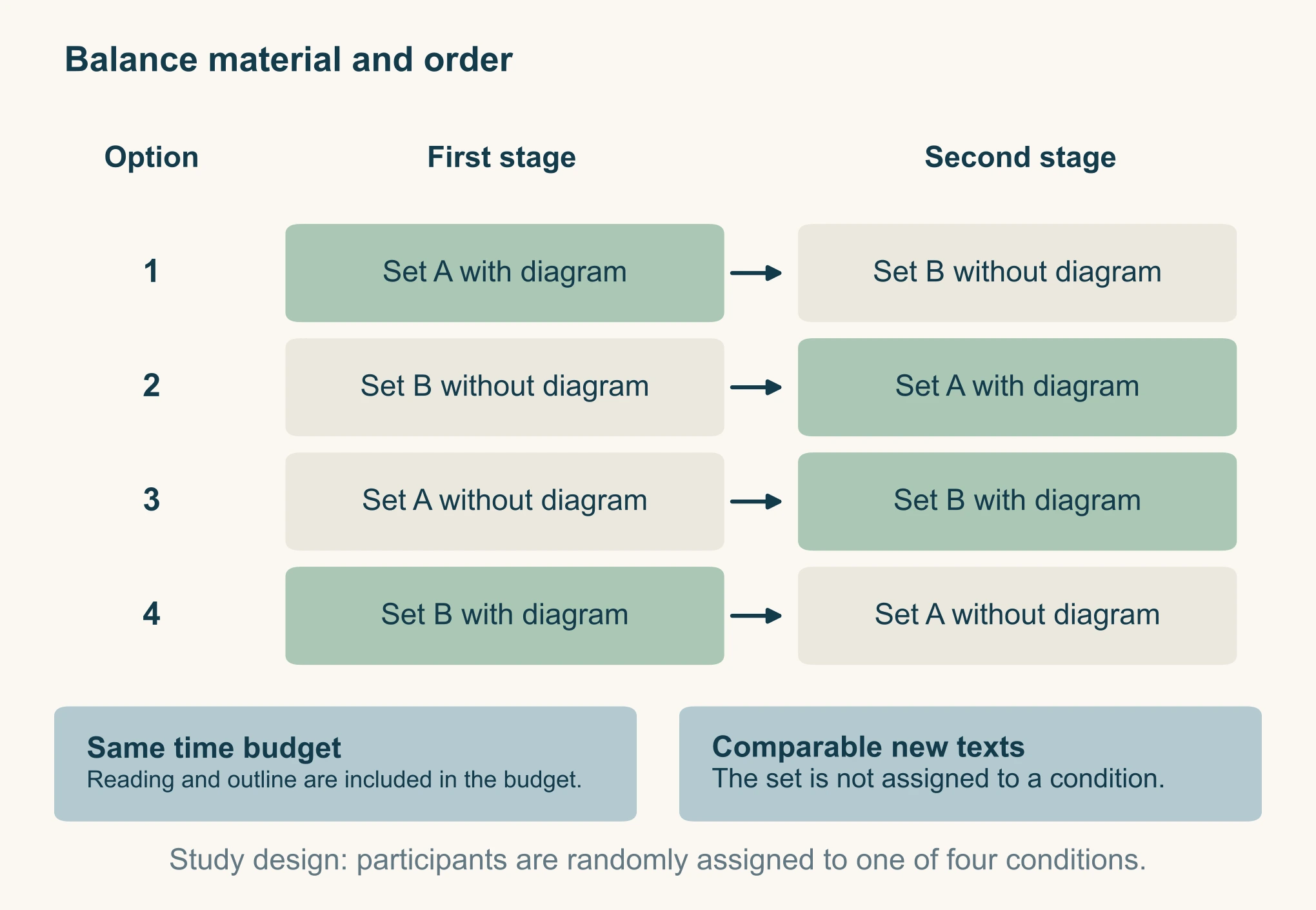
Figure 15. Distribution of material and order of conditions. The four options intersect two combinations of material with strategy and two execution orders. Each set occurs with and without a diagram, in the first and second stages. Random assignment of options and equal preparation budget complete this balancing act.
Make the result uniquely computable
Let’s assume that the main indicator is the percentage of correct answers to questions about time order. For each question you need a key in advance. If the answer is free, you should determine which formulations count. Otherwise, after viewing the results, you will be tempted to evaluate inconvenient cases more strictly and expected ones more gently. If possible, the evaluator should not see in what condition the answer was received.
We will set the total preparation time budget to be the same. This answers the practical question of whether the scheme helps when time is limited, but does not mean the same time for direct reading: part of the budget will be spent on writing. Now the negative result can be interpreted meaningfully. It is possible that the benefits of recording did not compensate for the costs of the chosen duration. The next hypothesis could concern the dependence of the effect on the time available.
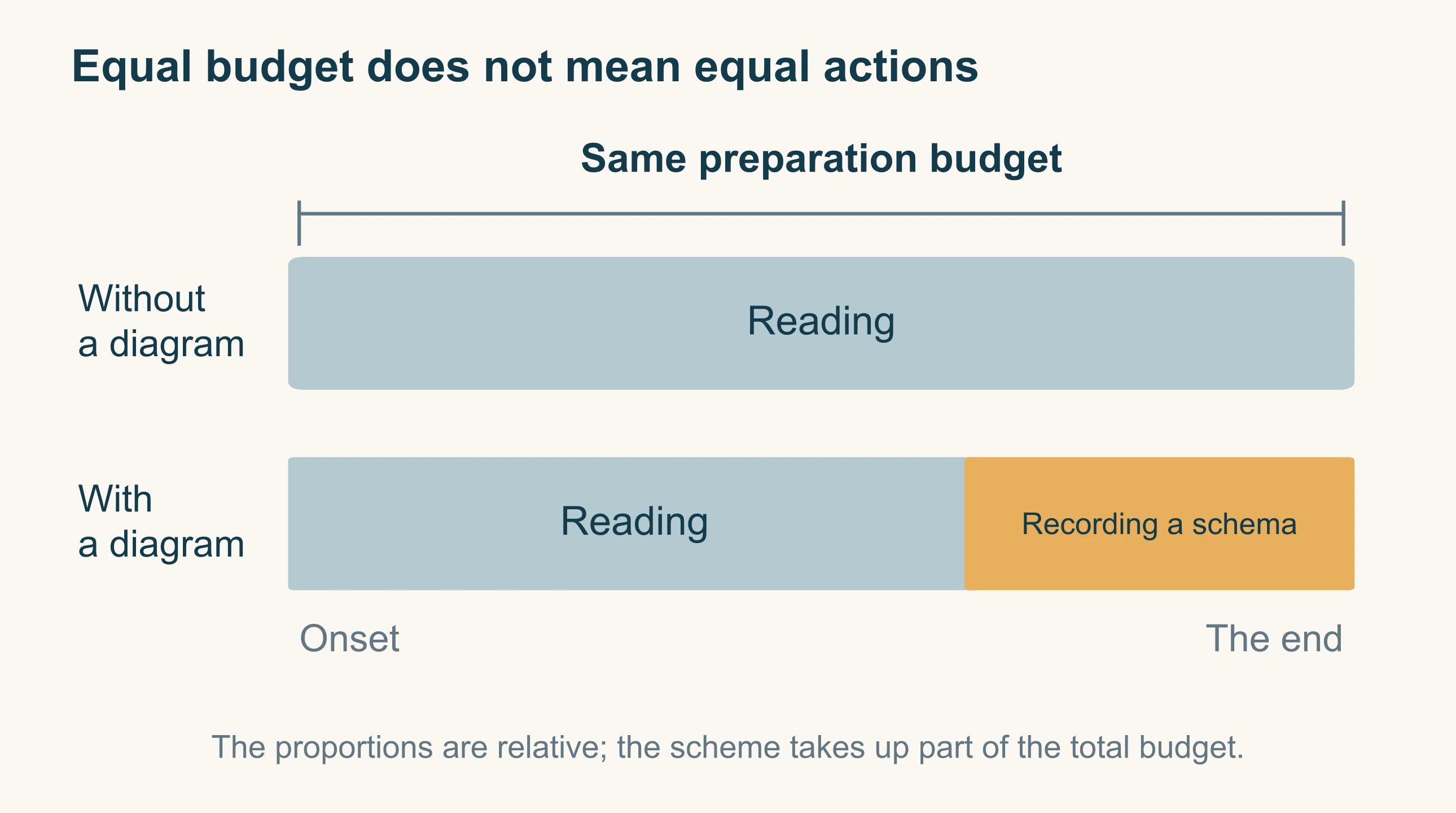
Figure 16. Overall budget and distribution of preparation time. With the same total budget, preparation with the scheme includes the time of its recording. This comparison evaluates the benefit of the procedure in a limited time, but does not equate the duration of the actual reading; The proportions of the parts in the figure are relative.
In addition to correctness, one can collect confidence and a description of the experience of clarity. But it is better to choose the main result in advance. If any of the ten indicators are allowed to be declared as evidence after review, the verification procedure loses certainty. Additional indicators remain useful for finding new questions if their research role is named honestly.
Plan before data and study after data
Brian Nosek and colleagues describe preregistration as a way to fix questions and a plan for analysis in advance. Its methodological function is to distinguish between the verification of a prediction and the explanation of the result already seen. The article does not promise that recording will correct a weak theory or poor measurement; it is devoted to the structure of the research process. [10]
For a teaching project, a dated outline is sufficient at first, which you keep unchanged next to the results. This is training in the same discipline, and not a replacement for the formal registration procedure. In the plan, indicate the question, conditions, main indicator, rules for eliminating ineligible records, number of sessions planned, and method of comparison. Record changes separately along with the reason.
Research after reviewing the data is also necessary. You may notice that the diagram only helps on texts with four events. This is an interesting new hypothesis. The next step is to test it on new texts, and not present it as the only pre-expected prediction. Scientific work includes both the discovery of patterns and their subsequent verification.
What changes when conditions are balanced?
Let's imagine that the scheme is always used with a second, lighter text. Even an accurate measurement of success will not separate the benefits of the scheme from simplicity and training. Four distribution options break this connection: A with the scheme, then B without it; reverse order of the same pair; A without a diagram then B with a diagram; reverse order of the second pair. Now every set and every order encounters both ways of working. Random assignment of options does not guarantee the identity of people in a small group, but it does not allow the researcher to systematically assign a convenient option to expectedly strong participants.
What has now been established
The comparison plan should not eliminate all differences altogether. It must make the cause of interest discernible. The interference named after the result is useful as a constraint, but does not replace the missing control.
Practice 7 Fix a weak experiment
Why do it: Fix a project that takes increasing the length of journal entries as an improvement in the discrimination of experience.
What you will need: Measurement specification from chapter 6 and distinction between mechanism and indicator. You need two comparable sets of tasks and a pre-selected result.
Time reference: 30–40 minutes. Can be done intermittently; This is not a speed standard.
1. Formulate the result as success in distinguishing predetermined types of new episodes. Separately store the length of records as an additional indicator.
2. Set two comparable sets A and B, the same time budget and estimation rules before starting work.
3. Write down four options for the distribution of material and order, using the diagram of the worked example. Name a condition that takes into account the habit of writing or extra time.
4. For improvement, agreement, and divergent results, write down acceptable findings in advance. The project is enough for now; Gathering of participants is not included in this exercise.
What to keep: A plan with conditions, distribution, main indicator, scoring rule and three interpretation options.
Hint: The benefit of a scheme with equal total time and the benefit of a scheme with additional time are different issues. Choose one explicitly.
Research Continuation: Keep a dated version of the project. After the trial run, separate the instruction changes from the main test results and formulate a new hypothesis for the new materials.
Analysis and answers - Appendix F, chapter 7, p. 282
Self-test questions
1. Why doesn't the same preparation time mean the same preparation process?
2. What does random assignment of conditions do and what does it not guarantee in a small group?
3. How does a new hypothesis after analysis differ from a previously tested prediction?
Even a well-designed comparison produces changing numbers. In the next chapter, we will examine effect size and precision of estimation, while maintaining their distinction from causal inference.
Chapter 8