Requirements for the future model
So far we have looked at the available explanations and implementations. Now let's start our own project. Consider the specific question of the influence of source history on affiliation assessments. It is narrow enough to construct a mechanism and at the same time connected with the broader theme of the subject. First, we determine that the model must explain what facts have already been published and what results are still only our expectation.
From an interesting question to an obligation to explain
Imagine that you are controlling the image of a hand on the screen. The movement usually follows your command, but is sometimes delayed. After several minutes of stable communication, a short delay seems to be a random interruption. If the connection was constantly changing, the same delay may be perceived differently. A substantive question arises: does experienced belonging depend only on the current match of cues or also on the history of the putative source? This is a mental teaching example, not a report of an experiment. Its purpose is to transform the general idea of self-continuity into specific requirements for the model.
The model begins with a commitment to explain difference. The phrase “the brain builds itself” allows for almost any outcome. The statement “given the same current alignment, the history of a stable source changes the subsequent dynamics of membership” already limits expectations. Now we can ask how long the influence of a story lasts, whether it transfers between sources, and whether it persists when the mode of response changes. The more precisely these questions are posed, the clearer what result will be the success of the explanation.
Identify the object with the required accuracy
The initial subject of the project is the experience of bodily belonging. In the experiment by Kalckert and Ehrsson, the ownership of the artificial hand and the sense of authorship of the movement could diverge. Therefore, belonging cannot be determined solely by successful arbitrary control. The model must account for this difference by maintaining separate indicators of ownership, control, and evaluation of the correctness of the action. [4]
The subject can be written in one sentence: “We explain the change in experienced belonging when the history of consistent bodily signals changes.” The next line specifies the scope of application: adult participants, short episodes, a specific method of presentation and reporting. This record retains the possibility of expansion. It does not require now to explain color, dreams, biographical self-awareness and the initial emergence of consciousness in one variable.
When extended, the explanatory obligation itself will change. First, the model predicts body-ownership ratings. Then you will need to justify their connection with the experiencing organization. Finally, a stronger hypothesis should say why the proposed organization constitutes or supports the presence of experience. These transitions will become separate tasks, rather than a subtle increase in the volume of a single output.
Distinguish between data and desired results
It is useful to have two lists. The first contains published results that the model must take into account. The second is the yet untested expectations of our project. If you mix them up, your own assumption begins to look like an established fact. For example, a statement about the transfer of history between two similar images still belongs to the second list, if we have not found such a comparison in the literature.
The work of Samad and colleagues shows how belonging can be examined through a common cause inference model of visual, proprioceptive, and tactile signals. This is the closest published guideline, not our new idea. One’s own contribution will have to be sought in certain dynamics, transfer conditions or the discrimination of alternative mechanisms. [15]
Each entry in the first list must include an objective, a metric, and an limits of inference. "Signals combine" is too broad. “Under such conditions, the assessment of belonging changed, and at the same time the position of the hand was measured” already allows us to find out what kind of observation is being reproduced. Also note whether the results of several indicators are consistent. Their divergence may be the main requirement for a future model.
Four requirements for our project
The first requirement concerns the present. The model must respond to the current compatibility of the signals: their coordination cannot be completely insignificant. In this case, it is necessary to determine which compatibility features are available to the system. Geometric coincidence, temporal proximity and dependence on action are different information; they cannot be replaced by the undeciphered “consistency” variable.
The second requirement concerns the past. The influence of history must have computable dynamics. It is not enough to add memory and then declare any delay to be its confirmation. It is necessary to indicate in advance what is preserved: individual events, an assessment of the stability of the environment, the expectation of a common cause, or the history of a specific source. Each solution offers its own mechanism of forgetting and transference.
The third requirement concerns identity. If a story belongs to a specific source, the model must explain why it is returned when it appears again. At the same time, a competitor is needed that tracks external objects in the same general way. Otherwise, the advantage of source memory will be mistakenly called evidence of a special mechanism of self-awareness.
The fourth requirement concerns measurement. The same internal state can give different answers when the wording of the question or the criterion of agreement changes. Therefore, the assessment generation model must be separated from the source model. This separation will allow us to check exactly where the effect arose: in the processing of signals, in their attribution, or in the way the result is reported.
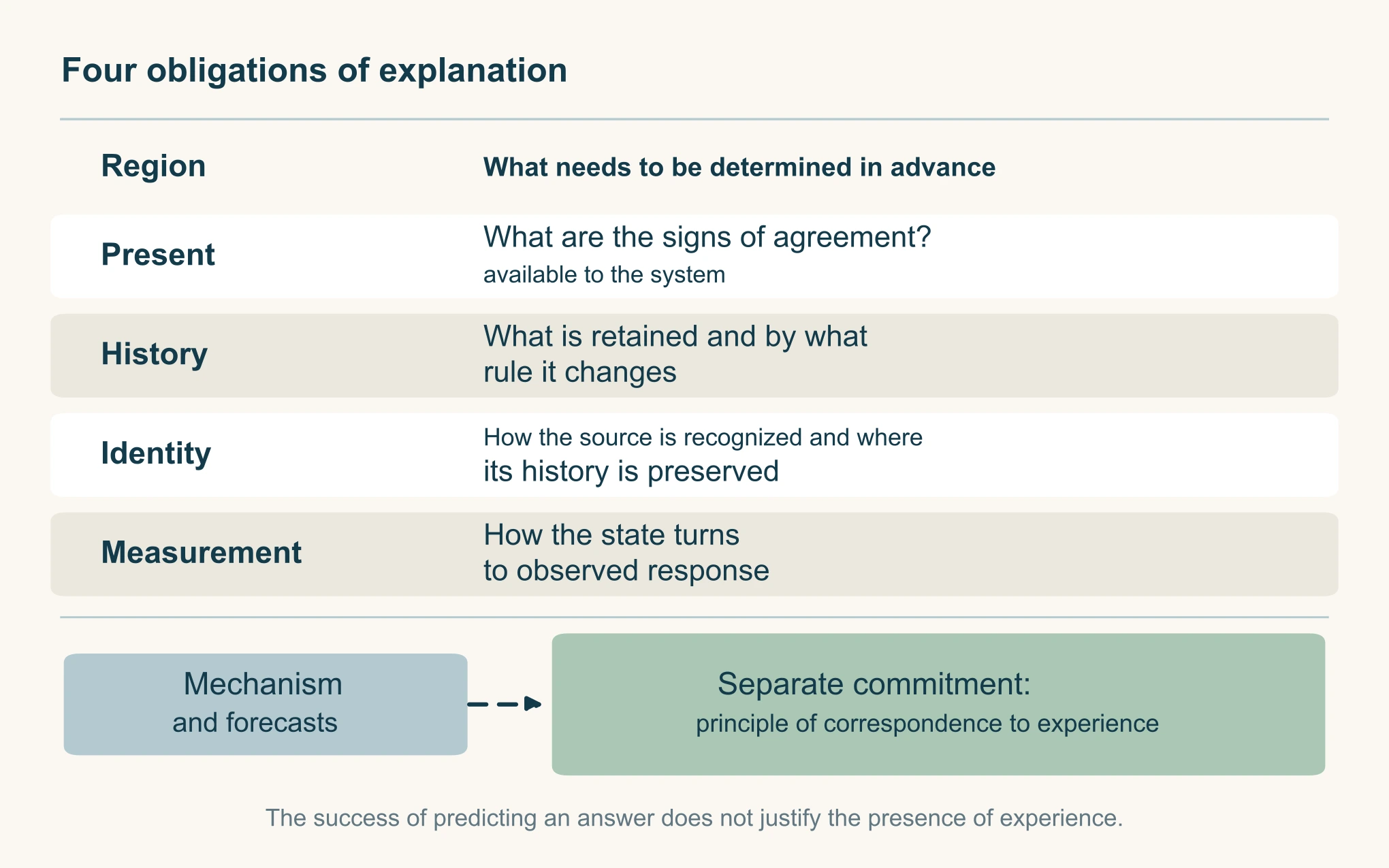
Figure 54. Model commitment map. Methodological scheme. Four requirements relate to design and model verification. The dotted line denotes a separate argumentative task: to explain the connection between the mechanism and experience; it does not mark a fixed transition from accurate forecast to the presence of experience.
Formulate several competitors
Let's call M0 the current coordination model. It uses only the selected current window. M1 maintains an overall history of confirmations and contradictions without separate records of sources. M2 maintains distinguishable histories of suspected sources. These names represent families of future computing; For now, specific rules need to be chosen for each family.
Let's add M1I - a general model for tracking the identity of objects. It is needed because M2 can benefit from conventional thread splitting. A comparison of M2 with M1I should show whether additional bodily organization is required or whether a mechanism applicable to any stable object is sufficient. A possible answer of “a fairly general mechanism” would be the result of an investigation into the nature of self-reference.
Don't intentionally make your competitor weak. If M0 receives less current information, and M2 additionally sees hidden labels, their comparison checks the advantage of the entry. If M2 has significantly more configurable parameters, it needs to be checked on new data. The requirement for fair comparison is included in the model specification from the very beginning.
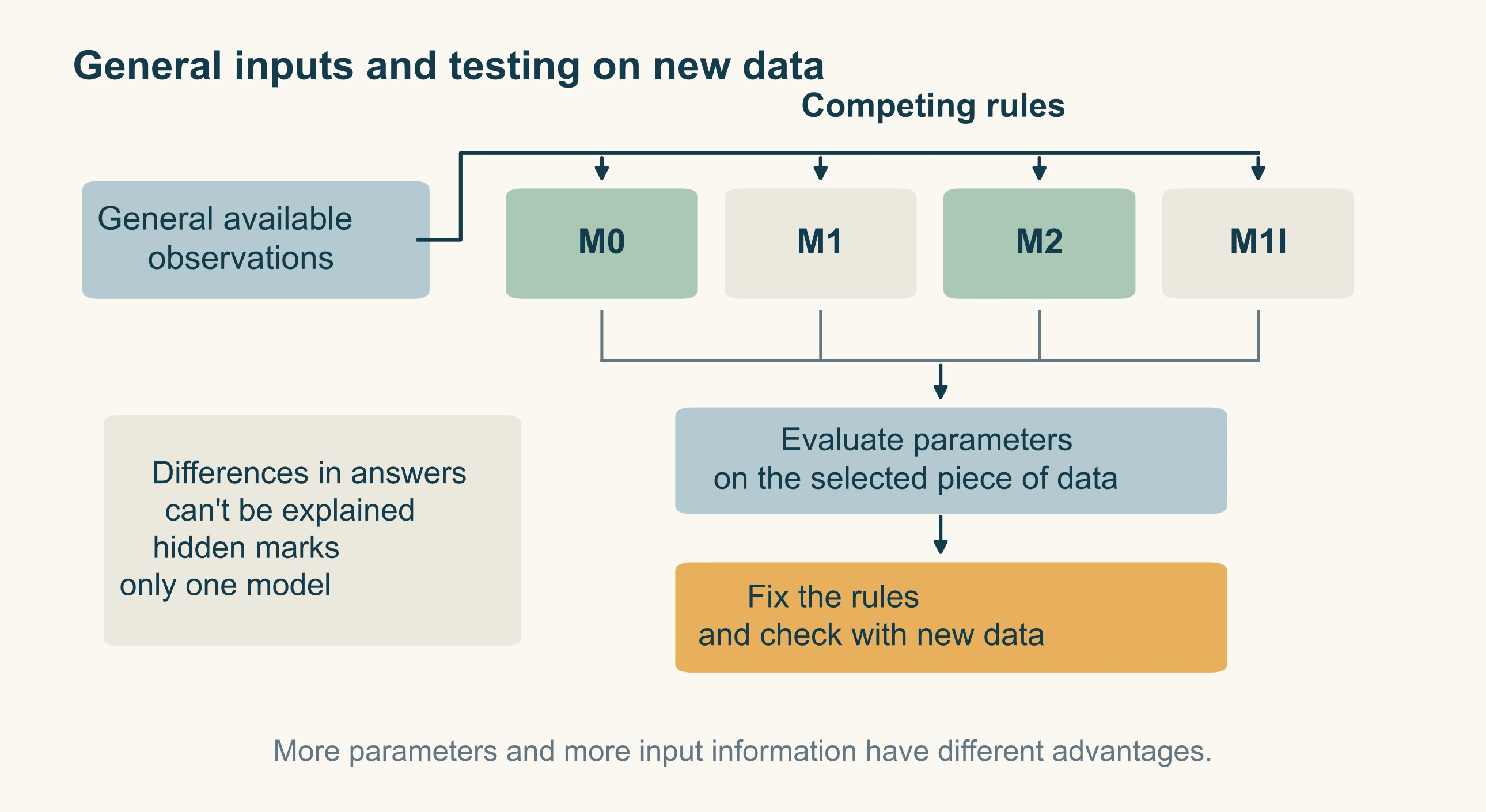
Figure 55. A fair comparison of computing competitors. M0, M1, M2 and M1I are compared with a common set of available observations, preserving the differences in their memory rules. Options are evaluated separately from testing on new data, and the hidden source label cannot be provided only to the preferred option. The advantage in such a comparison relates to the given task and does not yet confirm the special nature of self-reference.
Set a positive criterion for success
Suppose the model were to predict the restoration of affiliation upon the return of a familiar source. Success will not be simply matching the average score. We need a predicted direction, rate of change, and conditions under which the effect disappears. It is especially valuable if the parameters estimated in one problem help predict another without new arbitrary settings.
For a training project, you can set a requirement: the model must distinguish between two sequences with the same number of consistent events, but different organization of sources. This is not yet an experimental pattern. It is the chosen test that challenges the theory to explain the role of order. In the next chapter we'll build a simple sequence where the computational options actually diverge.
It is useful to supplement the success criterion with a stopping condition. If the available data does not distinguish between M1 and M2, the project does not yet answer the question about the history of the source. Then you should change the task, rather than increase confidence in your favorite model. A good specification helps you see in time what research needs to be done next.
How a shared vision turns into a commitment
The idea of “history helps you feel yourself” allows for too many results. A clarification relates the initial difference to the procedure: given the same test sequence, the membership assessment should be restored differently after returning a familiar or new source. Next, you need to indicate what familiarity means, what sign the source recognizes, and how the dynamics of the response are measured. A competitor is recorded separately, which stores the history of any external objects. If he gives the same prediction, the special bodily function has not yet been highlighted. Such a limitation helps to choose the next experiment, rather than devaluing the project.
What has now been established
A good requirement limits both the expected success and the conditions for revision. It is now possible to create a specification in which past, present, identity, and measurement are given separate roles.
Practice 24 Make requirements for one model
Why do it: Prepare requirements for one model before choosing convenient calculation rules.
What you will need: Distinguishing between ownership and authorship; common cause model; fair comparison of competitors. The success of predicting the answer and the presence of experience require different reasons.
Time reference: 35–45 minutes. Can be done intermittently; This is not a speed standard.
1. In one sentence, define the difference being explained and the scope of the conditions. For basic work, use the return of a source after another source has intervened.
2. Separate published limitations from your own expectations. For a published result, indicate exactly what was measured.
3. Write down four requirements: current signs, preservation of history, recognition of identity, formation of a response. Name M0, M1, M2 and the general tracker as future competitors.
4. Determine the result that would support the chosen difference and the result that would make the special version redundant. Don't assign arbitrary human averages just yet.
What to keep: One specification with the subject, requirements, competitors and criteria for the next decision.
Tip: Increasing the number of parameters and adding available information have different benefits. Both need to be checked.
Exploratory continuation: Propose a second problem to which the model should transfer parameters without free tuning. Explain why she tests the same relationship.
Analysis and answers - Appendix F, chapter 24, p. 292
Self-test
1. Why does not the retention of information about the past in itself confirm a special mechanism of self-reference?
2. What does the advantage of M2 show over M0 if the first one receives a hidden source label, and the second one does not?
3. Why separate the established limit and your own expectation?
The requirements do not yet determine the next step of the model. In chapter 25 we will set the input, state and update and follow one calculation to the end.
Chapter 25