Where data differentiates between theories
We are able to describe several mechanisms and obtain their expectations. But the same successful result can be compatible with several theories. To move forward, it is important to find the conditions under which their predictions diverge and understand what the experiment measured. Reported and non-reported studies are particularly illustrative of why theory and procedure should be discussed together.
Why confirmation is not enough
Suppose two models expect some signal to be amplified when an image is visible. The experiment reveals an increase. The result may support both models, but does little to help you choose between them. Discrimination requires a situation in which expectations diverge. For example, the first model predicts the persistence of a signal without a requirement to respond, while the second relates it to response preparation. Then changing the instructions becomes a meaningful intervention in the testing conditions.
Theories of consciousness are particularly sensitive to this problem. One experiment includes recognition, retention, confidence, decision, and movement. If everything changes together, the difference found can be explained in several ways. Research work consists of separating a related set of processes as much as the specific task allows. The name of the brain region by itself does not make this distinction.
Agreeing in Advance on the Test
In the COGITATE project, proponents of competing approaches and the research consortium agreed in advance on the design, differing predictions, and interpretations. In the study published in 2025, 256 participants viewed highly visible stimuli of varying durations; functional magnetic resonance imaging, magnetoencephalography and intracranial electroencephalography were used. The results supported some of the expectations and created difficulties for both theories: among them, the lack of the expected sustained posterior synchronization and the overall expected burst upon stimulus disappearance. Consistent predictions were tested, not all possible versions of theories. [23]
For your own project, the principle of prior commitment is important here. Before receiving data, you need to write down what will be considered support, difficulty and uninformative results. If any observation after analysis is declared expected, the theory ceases to risk error. This also applies to the textbook author’s favorite hypothesis: personal interest does not replace the conditions for its revision.
Nor does prior registration make the interpretation infallible. You can choose a weak indicator or a too rough prediction in advance. Therefore, two tests are needed: whether the experiment follows the written design and whether the design actually tests the central claim. If the latter is in doubt, the wording should be explicitly changed and a new test should be carried out, keeping the previous result in the history of the study.
The report changes the problem under study
A study by Cohen and colleagues in 2024 compared visual masking in conditions with and without a report. The late component P3b and some robust decoding characteristics were associated with report execution. In the no-report condition, the earlier component N2 corresponded to a nonlinear change in visibility. It is the result of a specific task and measurement method; it does not set a universal time for the appearance of any experience. [24]
When a person needs to report what he has seen, he must convert the perception into a response, store the necessary information and carry out the rule. Therefore, the disappearance of the signal after canceling the report may indicate its connection with these operations. But the absence of a requirement to respond does not guarantee the absence of internal naming, attention, or remembering. The participant is able to continue to perform part of the previous task independently.
The opposite difficulty also arises. If you don't ask about a perception, how do you know that it has arisen? Some designs use indirect measures, such as eye movement patterns. Their connection with experience must first be justified, and then transferability to new conditions must be checked. Otherwise, a method designed to exclude a report simply replaces one controversial indicator with another.
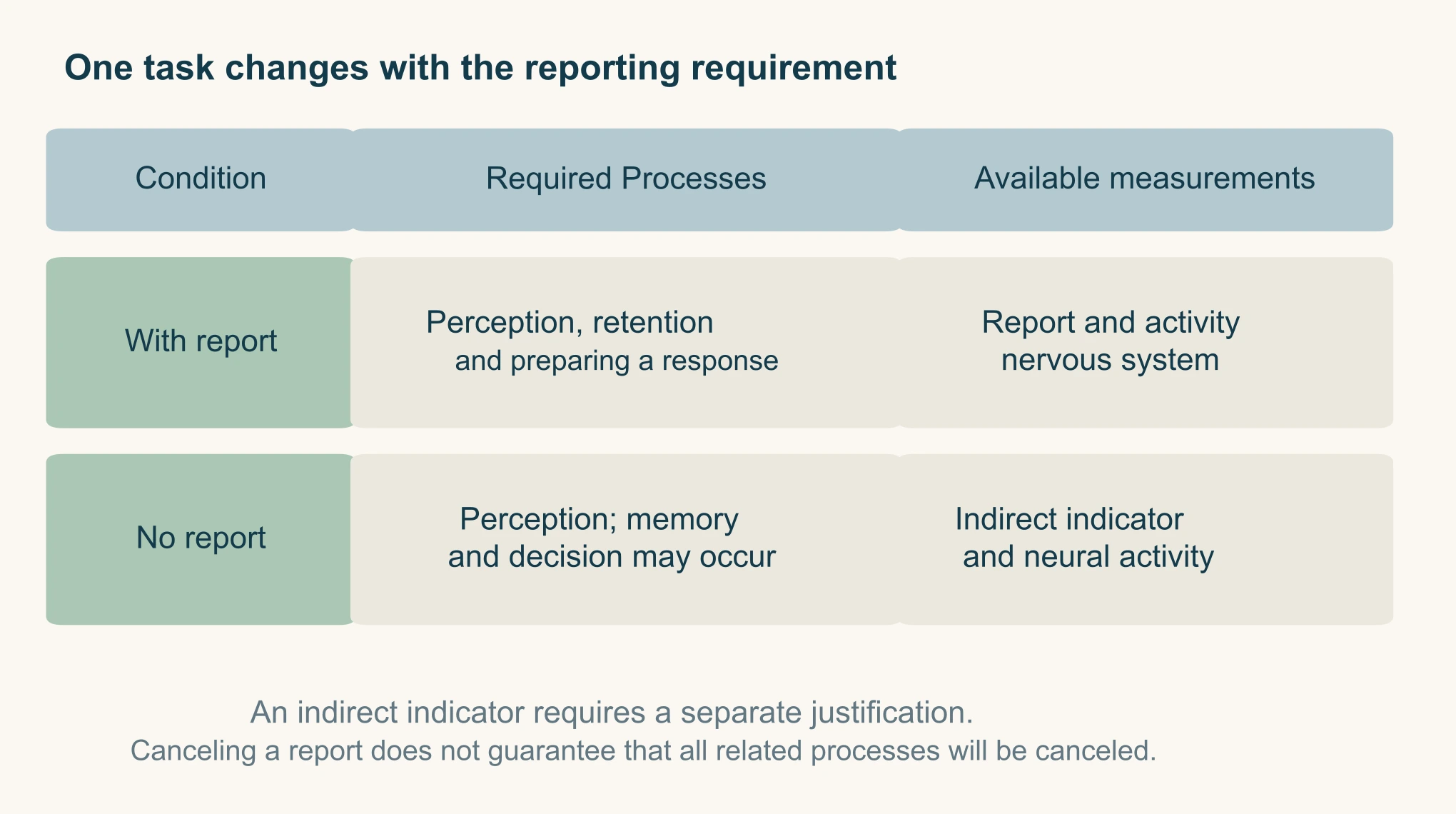
Figure 34. Report and measurement boundaries. Conceptual comparison of conditions with and without explicit reporting. Removing the response requirement changes the task but does not automatically remove attention, memory, or internal decision. Indirect signs of perception also need to be verified. The table does not contain quantitative research results.
Why the Anterior and Posterior Cortex Do Not Form a Simple Choice
He and colleagues, in published work 2026, compared visual perception with and without a report while recording magnetic brain activity. Representations in posterior sensory areas were maintained in both conditions, whereas the detected prefrontal representation of content was dependent on report. This supports the separation of content processing and task demands. Observational recording, however, does not prove the causal sufficiency of a single region. [25]
In another published paper, 2026, Zhang and colleagues found differences between frontal subsystems. Decoding associated with frontal regions of the dorsal attention network carried over between report and no-report conditions; other frontal representations were dependent on report. In the no-report condition, oculomotor measures were used. The result prevents the generalization “all frontal activity relates only to the response,” but does not establish that the selected network itself creates the experience. [26]
It is useful to read these works together, without averaging them into one slogan. They may differ in stimulus, attention, how awareness is measured, spatial precision, and analysis sensitivity. “Could not decode content” means that the selected analysis did not extract it from the data under the specified conditions. This is different from the claim that content is nowhere represented and plays no causal role.
Successful decoding must be interpreted with equal caution. The classifier may use a perceptual consequence, a common source of variation, or a spurious feature. The mere presence of stimulus information in a signal does not determine the function of this information. The question of necessity requires additional intervention or strong causal argumentation.
How to read contradiction productively
Let's say one article reports a connection between signal and visibility, and another does not find it. Start with the exact subject of comparison. The signal could be measured at different time intervals; participants may have used different strategies; the lack of effect may have been accompanied by too much uncertainty. First, it is determined whether the results are inconsistent under comparable conditions, and only then a revision of the mechanism is discussed.
The following table is useful for educational analysis. It compares the logical strength of results rather than judging publications by prestige.
Observation | Direct conclusion | What has not yet been established |
Signal associated with report | Dependence on response conditions detected | That the signal is not involved in other functions |
Content is decoded | Data carries discriminating information | What area is necessary or sufficient |
Intervention changes outcome | There is a causal effect under these conditions | What exactly has changed is the experience |
No effect detected | The analysis did not reveal the expected difference | That the distinction is missing with useful precision |
What Changes When a Report Is No Longer Required
Suppose the signal is related to visibility in a task where a response must be made after each presentation. Versions about the perception and preparation of the message are possible. Maintaining a signal under a justified condition without a required response limits the second account, but does not establish the causal sufficiency of the signal for the experience. The disappearance of the signal also requires verification: along with the answer, attention and memory could change. Therefore, one question is formulated narrowly: what characteristic is preserved when the requirements of the report change and in what independent way the perception itself is confirmed.
What has now been established
The research becomes discriminating against clearly defined competitors. A large sample does not replace the desired comparison, and the absence of a statistical finding does not mean an exact null.
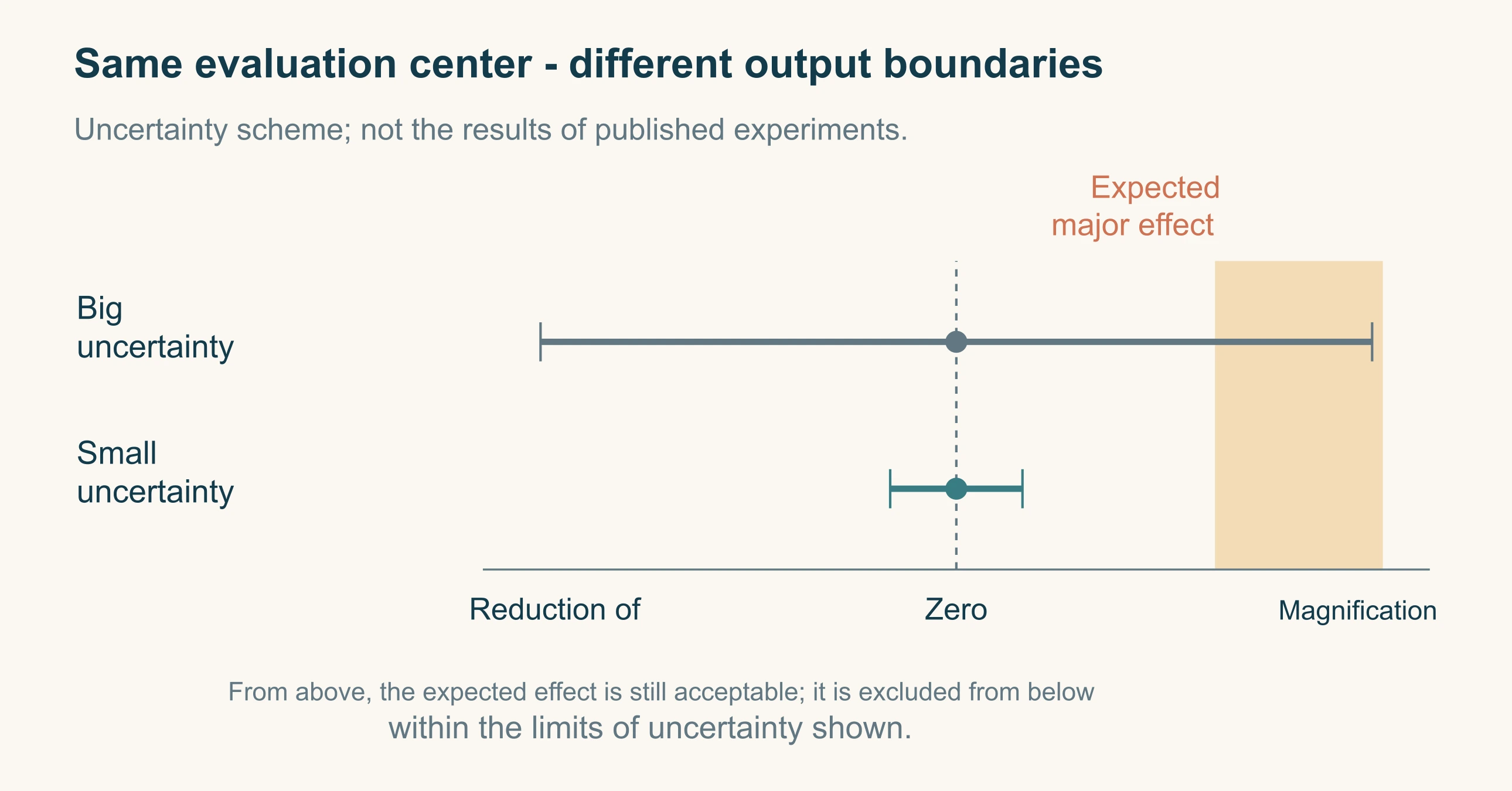
Figure 35. Why lack of significance is not exactly zero. The two schematic intervals have the same center around zero, but allow a different range of effects. Only the narrow interval in the figure excludes the expected large increase. The numerical scale is deliberately not specified: a real test requires an estimate of the effect, a reasonable interval, and a quantitative promise of the theory.
Practice 16 Comparison of two studies
Why do it: Compare two studies on the same question, while maintaining differences in methods and conclusions.
What you will need: Measurement specification from chapter 6, comparison quality from chapter 7, magnitude and uncertainty of the effect from chapter 8. Decoding means extracting discriminative information by a selected analysis.
Time guide: 35–50 minutes for basic analysis. Can be done intermittently; This is not a speed standard.
1. Select two jobs from the chapter with and without report conditions, for example sources 24 and 25. First, use their analysis in the text, without taking credit for reading the full original.
2. For each, fill out five fields: stimulus, task, visibility indicator, measured activity, main comparison. Mark unknown information explicitly.
3. Write down one general question and one supporting and limiting observation for each activity.
4. Make the following prediction when changing the response method and ask whether the competitor expects the same result.
What to keep: Two comparable passports and one prediction indicating whether it distinguishes between theories.
Hint: Do not transfer the result between EEG, MEG and tomography only based on the similarity of words. Separately indicate the time interval and method of analysis.
Research follow-up: Open both primary publications, clarify omissions, and check whether the tasks being compared have changed. Separately estimate the magnitude and uncertainty of the key effect and maintain a distinction between the authors' conclusion and your own.
Analysis and answers - Appendix F, chapter 16, p. 287
Self-test questions
1. Why shouldn't a major study finally settle the theory debate?
2. Is the no-report condition a direct measurement of experience?
3. What changes confidence in a model more—the expected outcome or the discriminative prediction?
The comparison of theories prepared the question of emergence. Let's first narrow it down to one episode: how content emerges and is maintained over time.
Part 5