Boundaries between adaptation and experience
Complex coordination and past influences occur outside of nervous systems. To understand the significance of such data, we start with the response being measured and several possible mechanisms. The weakening of the response may arise from specific habituation or from general exhaustion. Comparison with a new signal and a pause will allow these versions to be separated. The question of experience will require the next, separately justified step.
Why systems without neurons are important
If we want to explain the conditions of experience, we cannot a priori limit our search to human-like creatures. At the same time, any useful reaction cannot be considered a sign of qualia. Studying plants, single-cells, and other nonneuronal systems is useful precisely because it forces us to separate signal processing, history storage, learning, and putative experience.
The initial question should concern the phenomenon being measured. Did the reaction change after repeated exposure? Has the change persisted? Does it depend on a specific signal? Can an organism use connections between events? Only after the answers do the following question arise: what grounds connect the found mechanism with experience? This arrangement leaves the study open-ended while protecting against over-inference.
Signaling and coordination
Toyota and colleagues showed in Arabidopsis that damage is associated with a glutamate signal, the propagation of changes in calcium concentration and the activation of defense reactions in distant parts of the plant. This is the primary study of the mechanism of long-distance communication within the body. The similarity of individual molecules and modes of signal transmission with known neural processes does not establish the identity of the overall organization or the presence of pain as an experience. [39]
Using our own example, let’s imagine a system of several tanks. A change in one triggers a signal that closes valves in the others. There is local detection, information transfer and coordinated protective action. If the signal depends on previous influences, the influence of history will also appear. All of these properties can be explored without attributing self-beliefs or negative experiences to the system.
The analogy does not explain the whole plant. It shows a logical boundary: the presence of signal transmission does not determine what additional properties are implemented. A stronger claim would require data on the interaction of processes, choice flexibility, internal state, and the theoretical basis of the connection to experience. The word "defense" describes a function and does not have to imply a conscious intention to defend oneself.
Memory as the influence of the past
In a minimal functional sense, memory exists where history changes the current response given the same present input. Such memory may be distributed by system state and not contain a separate event record. It is necessary to distinguish between this broad meaning and memory as an experienced return to the past. The same word does not make the functions the same.
Let's build a training model. It has an habituation variable that is initially equal to zero. After each presentation of the signal, it approaches one by a fifth of the remaining distance. The response is equal to the difference between one and the current habituation. The first reactions will be one, eight tenths, sixty-four hundredths and so on. During the pause, the variable is reduced by a fifth each step, so the reaction is restored.
All numbers are given by us for the sake of simplicity. The model demonstrates how maintaining a state creates response reduction and recovery from an interruption. There are no neurons, no verbal beliefs, and no observer inside the model. But from a single reaction curve it is impossible to know whether such a rule coincides with a real biological mechanism. Selection requires additional interventions and measurements.
Let's add two signals and two separate habituation variables. Then repetition of the first signal reduces the reaction only to it, while the second remains effective. If you use a single shared resource variable instead, both responses will decrease. Thus, testing the new signal helps distinguish between specific change and general attrition. It is still not a test for phenomenal experience.
What is shown in slime mold
Boisseau, Vogel and Dussutour studied the slime mold Physarum polycephalum, an organism without neurons. With repeated exposure to chemicals, the reaction weakened, and after a break it was restored; The specificity of the change was also analyzed. The authors interpreted the results as habituation, a simple form of learning. The study shows the possibility of such plasticity without a nervous system. It does not measure qualia, self-awareness, or overt reflection. [40]
Here it is useful to separate the recognition of the result from the expansion of its meaning. If the habituation criteria are met, there is no need to deny learning just because the system is unfamiliar. But acknowledging learning does not necessitate attributing experience. The next scientific step is to figure out the mechanism of history storage, the rules of transfer, and the limits of plasticity, and then compare them with the requirements of a particular theory of consciousness.
Another issue concerns the unit of analysis. In a distributed system, you can measure a separate area, an entire organism, or interaction with the environment it has changed. If traces of past activity are stored externally and influence future movement, part of the functional memory may be in interaction with the environment. Such a description requires an explicit indication of the boundary of the system, otherwise the external trace can easily be misrepresented as an internal memory.
Why the teaching debate requires replication
Markel in 2020 did not reproduce the previously stated effect of associative learning in peas. The work called into question the sustainability of a particular result. A negative attempt at reproduction does not prove the impossibility of all forms of learning in plants; a positive initial message does not resolve the question of qualia either. Evaluation requires comparability of conditions, control of alternatives and new independent verifications. [41]
In an association task, it is important to show that the result depends precisely on the connection between two events. If the group received more light, heat, or time to grow, the change may have another explanation. Control should, if possible, maintain the number of influences, changing their ratio. Otherwise, the researcher compares different physical conditions and attributes the entire result to communication learning.
Even a successful association check answers a limited question. In our own program, we can set a weight between two signals that increases when they appear together. The program will begin to predict the second according to the first. This is a clear functional result. To move from prediction to experienced expectation, additional justification will be required, applicable not only to the example you liked.
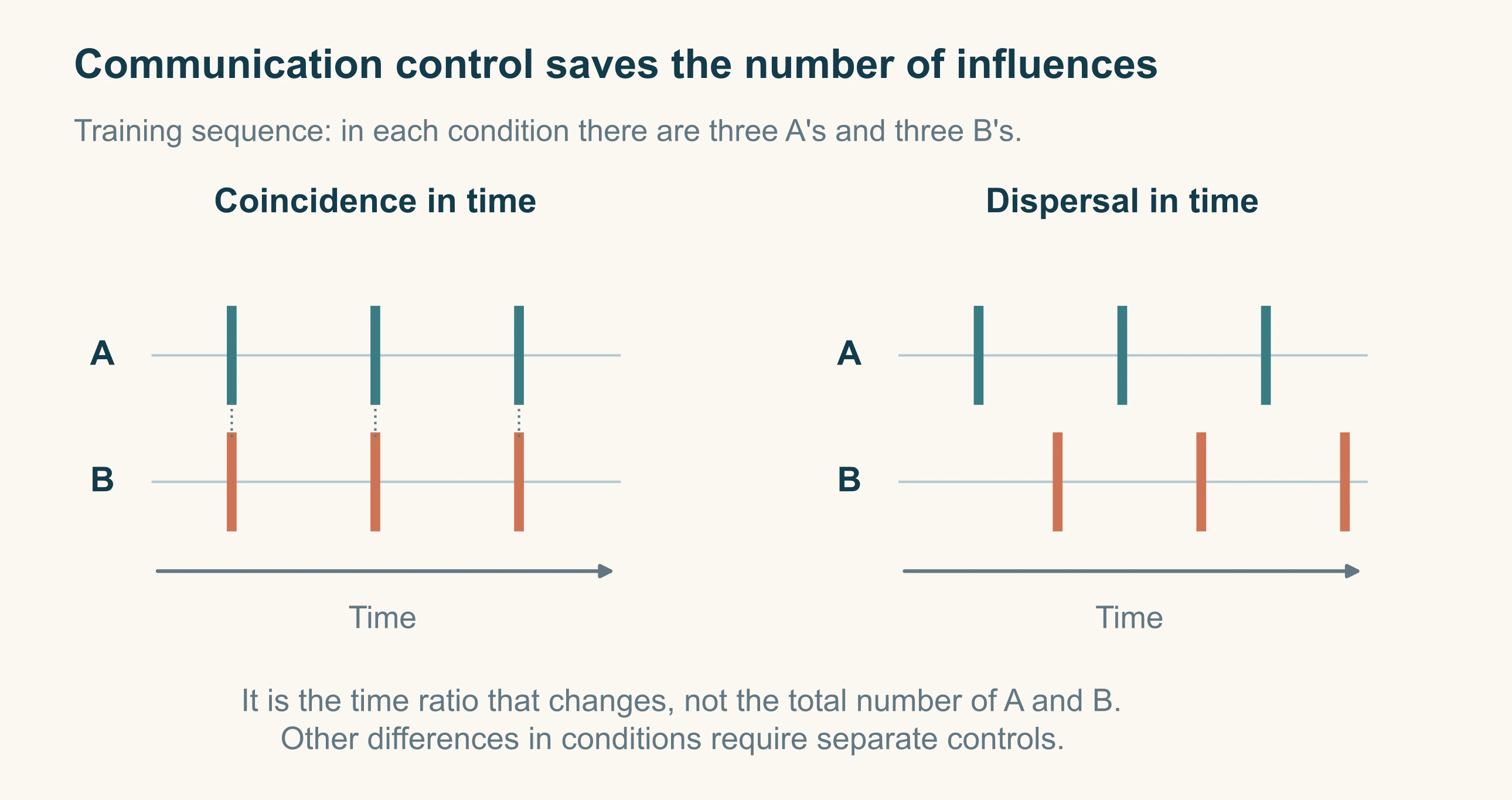
Figure 49. Division of the number of events and the relationship between them. The two fictional sequences have the same number of signals, but their temporal relationship is different. This control tests the role of coincidence while maintaining the number of influences; the shifted events can still form another predictable connection. To draw a conclusion about learning, it is necessary to test precisely the stated rule, and not to attribute the entire effect to differences in association conditions.
What should a hypothesis about experience add?
Suppose the researcher claims that any memory and any feedback is sufficient. It is necessary to apply such a rule to control devices, where both properties are implemented in a simple way. If the rule attributes experience to them as well, the author must acknowledge this consequence or clarify the original condition. You cannot save a broad formulation for an attractive biological case and subtly narrow it for an inconvenient engineering example.
Another hypothesis may require a special integration of cues and internal perspective. Then it should be shown how these properties are realized without neurons and how they differ from distributed regulation. The expression “an organism acts in its own interests” does not in itself define such a mechanism. Variables, dependencies, and conditions for breaking the function must be specified.
Finally, it is useful to distinguish between a positive hypothesis and the absence of a prohibition. Just because a theory does not exclude plant experience does not mean that it predicts it. For a positive conclusion, appropriate conditions must be established. This difference helps maintain research openness without unduly expanding the circle of confirmed bearers of experience.
Two models with the same beginning
In the habituation model, each signal has its own h, initially 0. The answer is 1 minus h, then h is increased by 0.2 the remaining distance to 1. In the depletion model there is a shared resource r, initially 1. The answer is r, then the resource is multiplied by 0.8. On the first five presentations of A, the responses of both models are equal to 1; 0.8; 0.64; 0.512; 0.4096. On the new B, the specific model corresponds to 1, and the total resource is already equal to 0.32768.
During each pause step, all h's are multiplied by 0.8 and r's are increased by 0.2 from missing to 1. First we write down the response, then we update the state. These are completely specified training rules, not measured parameters of the plant or slime mold.
What has now been established
A downward curve alone is not enough to select an explanation. A new signal tests specificity, a pause tests recovery. Both results must be calculated in the same predefined order.
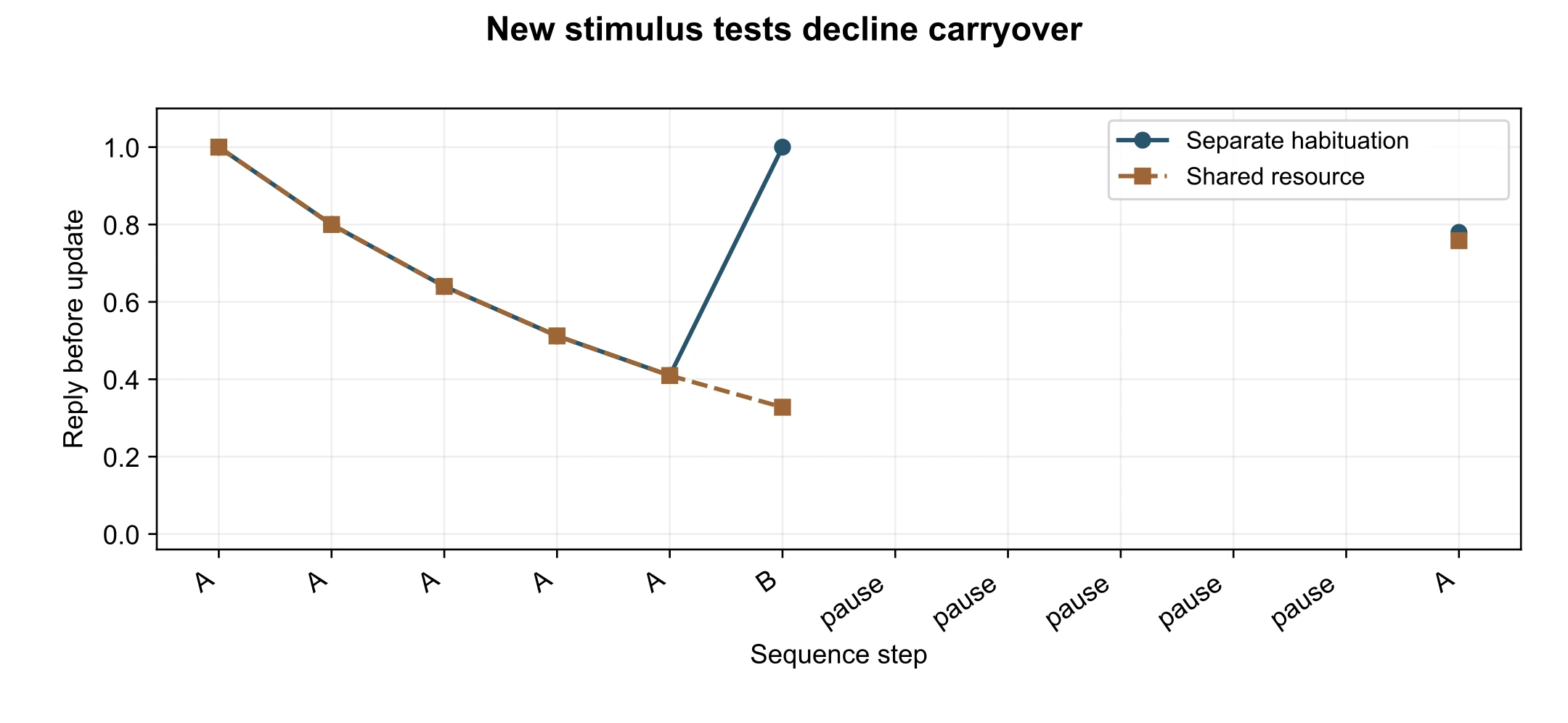
Figure 50. Habituation and exhaustion differ in transference. Calculation according to the explicit rules of the chapter: for the presented stimulus h ← h + 0.2(1 − h); shared resource after each event R ← 0.8R; during a pause h ← 0.8h and R ← R + 0.2(1 − R). The response is logged before the state changes. After five A, the first B gives 1 for a separate mechanism and 0.32768 for a resource mechanism. These are conditional mechanisms, not experience on the body.
Practice 22 Two models of one reaction reduction
Why do it: Separate specific habituation and a general resource using the same sequence of influences.
What you will need: State change rule from chapter 9 and control logic from chapter 7. Before practice, both algorithms are given in the same order below.
Time reference: 25–35 minutes. Can be done intermittently; This is not a speed standard.
1. Start with h for A and B equal to zero and a share of 1. Submit A five times, updating the state after each answer.
2. Predict the answer to B before calculating it. Then present B once.
3. Perform the five pause steps according to the rules above, then present A again. Compare the two models.
4. Check the calculations using python teaching_lab.py --chapter 22. Separately, write down what the result reveals about the mechanisms and what it does not establish about the experiment.
What to save: Step-by-step table of two models, new signal prediction, and specificity inference.
Hint: With new B, state h for A does not become state B. No cues are presented during the pause, so no answer is generated for these steps.
Research follow-up: Match the control to one primary work of the chapter. Indicate which observations the training model takes into account and which it does not represent at all.
Analysis and answers - Appendix F, chapter 22, p. 291
Self-test questions
1. Can functional memory exist without a nervous system?
2. Why doesn't a decrease in response prove learning?
3. Does the absence of neurons make the question of qualia meaningless?
Functional memory turned out to be wider than nervous tissue. The next chapter will consider artificial and biological implementations, for which it is important to establish the structure, boundaries and sources of self-description.
Chapter 23