From mechanism to experience
We can calculate the history of causes and predict certain responses of the model. The central hypothesis of this chapter adds an independent step: it involves the connection of some physically realized mutual organization with a minimum of experience. Let's look at this step one by one. First we define the mechanism under study without phenomenal words, then a strong statement of sufficiency, then structural consequences and methods of objection. This order preserves the research's courage and makes its commitments negotiable.
What question has not yet been answered?
The model from the previous chapter can store history, distinguish between sources, and change the probability of a common cause. Let's say it predicts human affiliation ratings well. We will learn something significant about the mechanism of these estimates. However, the question remains: why are the corresponding processes accompanied by experience at all? In Chalmers's philosophical setting, an explanation of the ability to discriminate and communicate is not automatically an explanation of the presence of subjective experience. Here we use this distinction as a requirement of the argument rather than as a pre-established prohibition on explanation. [2]
To move forward, we need a correspondence principle: an explicit statement of how the system's organization relates to the quality and presence of experience. It may turn out to be wrong. But if there is no such statement at all, the technical project will never go beyond what is directly programmed into it. Let's formulate a strong working hypothesis and find out what obligations it creates.
Define organization without the word experience
We propose to study processes in which several distinctions mutually determine each other. One component distinguishes the properties of the observed object. The second evaluates the source of the change. The third specifies what additional observations or internal transformations are now possible. Their states are updated together: the inferred source changes the attribute's interpretation, the attribute changes the source's expectation, and the selected test rebuilds both representations.
Reciprocity here has a causal meaning. For each hypothesized relationship, targeted interventions and expected changes in both directions are specified in advance: for example, how a change in the source's evaluation will change the interpretation of the attribute and how a change in the presented attribute will change the source's evaluation. General activity or correlation is not enough. In addition, the system must distinguish between alternatives that are not currently occurring: what would change with another observation, another command, or abandonment of the previous interpretation. These alternatives should influence processing and not exist only in the developer's explanation.
Finally, individual distinctions form a general dynamic. It is not possible to replace each component with an independent reproduction of its normal outputs and store responses to all predefined interventions. This check distinguishes mutual determination from the coincidence of multiple recorded streams. It does not define consciousness by name; it specifies the system device under study.
A Working Correspondence Principle
Let us formulate a hypothesis: a certain class of physically implemented processes of mutual determination of differences is sufficient for minimal subjective experience; the qualitative organization of this experience corresponds to stable relations between the distinctions and alternatives available to the process. This is the author's research hypothesis for this book. Its independence relative to existing approaches and its truth have yet to be established.
In the working version, the class is limited by three requirements: several separately variable features or degrees of freedom of content are presented; their changes are causally connected in closed dynamics; the relationships between them are used to select and review alternatives. Separate variability does not mean statistical independence: it is the interaction of features that is the subject of verification. A counter, history record, or self-name is not enough to meet these requirements. However, the presence of all three is also not yet an established sign of experience: it is the sufficiency of the organization that constitutes the strong part of the hypothesis.
Sufficiency does not mean necessity: the principle does not say that without this organization any experience is impossible. Predictions of qualitative changes should follow from its structural part and the conditions of a specific intervention.
In principle, no verbal "I" or constant external movement is required. The choice may concern internal refinement of the representation. Self-ownership appears as additional content when the system associates changes with a sustainable source of its own impact. Therefore M2 can become part of the proposed mechanism of self-awareness, but the table of individual stories itself does not yet implement the entire proposed organization.
Why is this hypothesis worth testing?
The first reason is the unity of explanation. Mutual constraints can simultaneously specify which contents are compatible, how they are preserved, and why changing one changes the others. Instead of separate, unexplained labels for quality, unity, and time, a single, explorable process emerges. This is the merit of the design, not proof of its truth.
The second basis has to do with perspective. The state matters for subsequent changes to the system itself: it determines what differences it can check and what errors it can correct. An external observer can describe this process, but its causal organization is not created by description. The hypothesis proposes to consider such internal certainty as a possible basis for subjective perspective.
The third basis is the ability to derive consequences beyond the original problem. If the proposed organization is related to experience, breaking certain reciprocal connections should change its organization in a predictable way, even when the simple distinction remains. Reconciling such predictions with independent human data would provide grounds for considering the implementation as a candidate. The transition to an artificial system will still require an argument about the transferability of the principle.
Quality through relationships and invariants
Let the learning system differentiate between hue, brightness, and source of visual change. The value of one coordinate in its vector is not a ready-made “redness”. The relationships need to be explored: which states it mixes, which it contrasts, how changes in luminance affect hue discrimination, and what interventions maintain the difference. The resulting structure is much more meaningful than a separate numeric code.
If we only renamed states or changed coordinates, retaining all significant transitions, the working hypothesis predicts the preservation of high-quality organization. If the salience relationship and their mutual influence have changed, it predicts a change in organization. This is how an invariant arises: the content depends on certain relationships, and not on the notations chosen by the developer.
This does not yet establish which human color experience corresponds to the machine state. For such a comparison, additional grounds are needed. Even complete coincidence of the structure of similarities does not automatically resolve the issue of absolute qualitative correspondence. At the same time, the explanation of the relationships between qualities represents an independent meaningful result and limits the possible future answer.
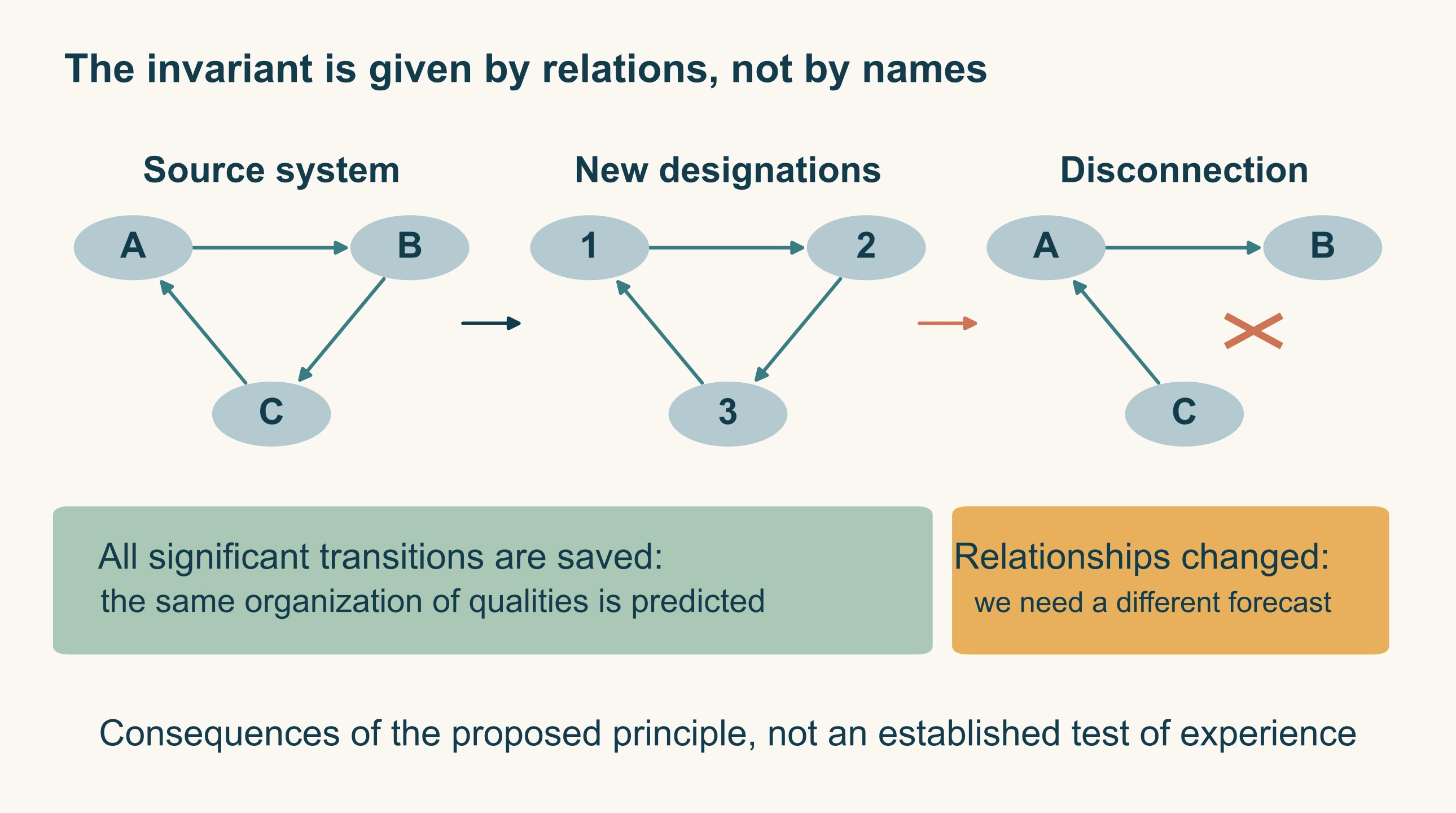
Figure 58. Renaming and changing the causal structure. A schematic example of an invariant of the working hypothesis of chapter 26: renaming preserves significant relationships, and removing a relationship changes the subject of the forecast. The principle offers sufficient organization for the experience; the necessary disappearance of experience does not follow from the disruption of a separate connection.
Explaining the Existence of Experience
The strong part of the principle asserts the sufficiency of the organization, and not just the consistency of its structure with self-reports. We take this as a testable identification hypothesis in a broad research sense: some process of mutual determination and minimal experience represent one specific process described from different perspectives. Such an identification cannot be achieved by simply defining the word “experience.”
Its justification must consist of independent connections: explanations of already available experiences, predictions of their changes, elimination of competing mechanisms and consistent application to new realizations. If the theory only explains the texts of the machine, the foundation remains weak. If one mechanism links a variety of phenomenal differences to specific causal changes, the argument becomes stronger, although the logical possibility of alternatives remains.
The critic has the right to ask why mutual determination should be felt at all. Our principle does not derive the answer from neutral arithmetic: it proposes a concrete identity and takes on its consequences. Future work should show that this identity provides better explanation and prediction than its competitors. In this way we really pose the question of the existence of experience, without replacing it with the success of one function.
Clarify implementation and boundaries
The word “physically” does not automatically resolve the issue: any running code has a medium. It is required to establish what causal organization should exist in the execution itself. If only a certain computational structure is essential, various suitable devices can implement it. If additional physical interactions are significant, program matching is not sufficient. These versions of the principle must be separated before the results can be compared.
IIT 4.0 provides an important example of a theory that explicitly relates proposed properties of experience to physical postulates. Our workpiece is not an IIT calculation and does not derive its basis from the similarity of the words “reason” or “unity”. The comparison must address specific requirements and divergent implications. [19]
The example of a simple regulator is especially dangerous. It can have feedback and several states. Therefore, it is necessary to check whether our three requirements really exclude overly simple designs, and on what basis. If an exception has to be introduced just because we don't like the result, the principle is underdefined. This counterexample helps improve the definition of the class under study.
Three stages of testing a strong hypothesis
The first stage establishes the organization. We need several distinguishable states, certain rules for their mutual change, and the participation of alternatives in further processing. For each suspected connection, an intervention is specified. Having a correlation, a common source, or a nice loop in the diagram is not enough. The result of this stage can be positive regardless of the acceptance of the hypothesis about the experience.
The second stage connects the organization with quality relationships. Let the theory assume that the content belongs jointly to the source. It should then predict how interference with source evaluation will change the discrimination of ambiguous contents and which relationships will remain the same. We need to compare this with an alternative that changes only the response criterion while maintaining the experience. The usual correctness of classification does not solve this issue.
The third stage concerns the presence of minimal experience and transfer between implementations. Here the strong principle proposes the identity or sufficiency of a certain class of processes. The argument is supported by a system of independent correspondences and predictions, an analysis of alternatives, and a consistent application of the boundary. An organizational test from the first stage does not become an independent proof of sufficiency just because it is repeated many times.
This arrangement allows progress without the promise of a final solution with one program. One can rigorously demonstrate the desired causal reciprocity, discover an incorrect structural consequence, or establish that a proposed concept is too broad. Each result changes the research program in a particular way.
Computable example of two directions
To test the logic, we will build another proprietary training circuit. Let p and q be between zero and one. They denote the evaluation of an ambiguous attribute and the evaluation of a source. Let us introduce the function s(z) = 1 / (1 + exp(−z)), which transfers any real number to this interval. Both new estimates are calculated from the previous ones simultaneously: p_new = s(x + b × (2q − 1)), q_new = s(h + d × (2p − 1)). Here x and h are the available external evidence, b and d are forces in two directions.
With x = h = 0, b = d = 1 and the original p = q = 0.5, the estimates remain 0.5. Now, with the input unchanged, we will force q = 0.8 before updating. The next p will be approximately 0.645656. A separate intervention p = 0.8 changes the next q by the same amount. If b = 0, the first direction disappears; if d = 0, the second one disappears. Thus, the reciprocity condition receives a specific verification matrix.
The check selection option can be set separately: the query is enabled when 1 − |2p − 1| exceeds the selected price. This is a conditional policy used for the sake of transparency. It shows how changing the view can change the next step. The verbal name of the request does not add experience to it.
The command python teaching_lab.py --chapter 26 reproduces the baseline condition and targeted interventions. The example tests the causal organization of certain numbers. It does not yet realize the strong demand for quality structure and minimum experience. To do this, it is necessary to determine the content of the distinctions, derive the corresponding phenomenal consequences and justify the physical implementation.
A strong alternative controller should receive the same observations and comparable resources. If it saves the entire answer matrix, the selected test does not yet highlight our organization. This is a meaningful possibility of a result. The conclusion about uniqueness cannot be obtained by defeating only a pre-recorded fixed sequence.
Testing Reciprocity without Defining Experience by the Test Result
Let p evaluate an ambiguous attribute, q its source. In the training loop, the source estimate affects the next p, and the feature estimate affects the next q. If the external input remains unchanged, let us forcibly change q. If p changes according to a given rule, one direction is checked. Then we independently change p and check q. One of these experiments is not enough to make a statement about two directions.
Even the success of both interventions so far establishes a causal organization. The correspondence principle additionally presupposes its relation to experience. For a qualitative conclusion, it is necessary to state in advance which relationships between contents will change and which will remain. To transfer to another medium, you need to clarify which device should actually exist in physical form. Therefore, the next practice begins with an audit of a ready-made principle, and an independent proposal becomes the second level of work.
What has now been established
We separated three results: the presence of a reciprocal relationship, the prediction of difference structure, and the strong statement of the presence of experience. They can be part of the same project, but require different reasons.
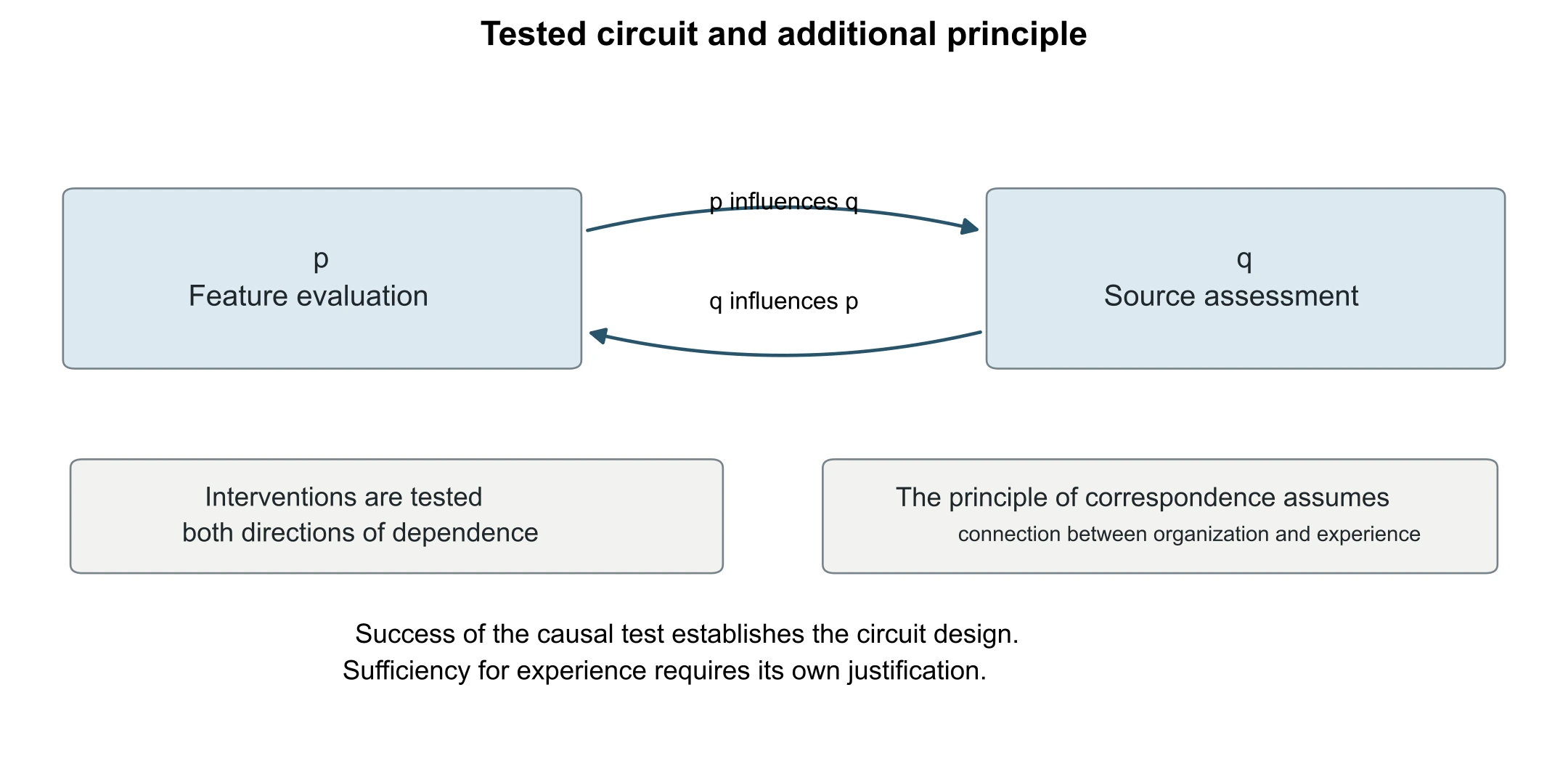
Figure 59. From causal organization to the hypothesis of experience. The teaching loop p and q is implemented in teaching_lab.py --chapter 26 and tested by two targeted interventions with one-way controls. The connection of such an organization with experience is a separate author’s hypothesis. Violation of the proposed sufficient condition does not prove the absence of any experience.
Practice 26 Protect one principle
Why do it: Test the obligations of the correspondence principle and distinguish sufficiency from necessity.
What will be needed: Causal intervention, sufficiency and necessity; separate story from chapter 25. First, read the full analysis of the circuit and principle, then move on to your own version.
Time reference: 40–60 minutes. Can be done intermittently; This is not a speed standard.
1. Rewrite the principle of the chapter in three sentences: organization, intended connection to experience, structural consequence for qualities.
2. For each requirement, provide an observation or intervention to verify the fulfillment of the organizational condition without the words “consciousness” and “experience.”
3. Consider three controls: independent output entries, a one-way controller, and a simple regulator. Indicate which conditions of the principle they satisfy and which are unknown.
4. For one intervention, separately write down the functional prognosis and the phenomenal consequence that still requires justification. Do not infer the absence of any experience from the violation of a sufficient condition.
What to keep: The principle card, three counterexamples, and two separate levels of predictions.
Hint: The phrase “this process is sufficient” allows for the possibility of other sufficient processes. The absence of a chosen process is therefore not a logical negation of all experience.
Research continuation: Offer your own updated version. Derive the invariant, the change in the essential relation, and the revision condition. Compare it with the closest scientific approaches before declaring the independence of the idea.
Analysis and answers - Appendix F, chapter 26, p. 293
Self-test
1. How does a strong principle in this chapter differ from good report prediction?
2. Why shouldn't renaming coordinates itself change the predicted quality?
3. Can the proposed hypothesis be considered proven after assembling a system with the three specified properties?
The principle received separate obligations. The next chapter will turn the differences between engines into a design that can support one version and limit another.
Chapter 27