How to Explore Subjective Experience
We have mechanisms and predictions. Now we need to decide which observations will allow us to verify them. The experience is not transferred directly to the table: a record of the answer is created under certain conditions. Let's consider what the participant's message, the success of the action and the physiological indicator provide. The main skill of this chapter is to reconstruct the path from the question to the data and from the data to a valid conclusion.
Experience does not produce a finished table
You look at the drawing, notice a familiar shape, and press the button. The researcher can save the image, the moment you pressed, your response, and a recording of the physiological signal. The episode of experience itself does not become another file that can be opened next to the others. A bridge is required between the research question and the data: why is this particular answer or indicator informative about what we are studying?
For a beginner, it is useful to distinguish three lines of data. The first is reports about the experience: verbal descriptions, category selection, clarity assessment. The second is behavior in the task: correctness of discrimination, response time, transfer of knowledge to a new case. The third is physiological measurements. They complement each other if the researcher understands how each line is intended to relate to the original question.
Such work is not limited to searching for the most objective instrument. The number also requires interpretation. If the participant pressed the “clear” button, the press in response to the instruction was directly recorded. The conclusion about the clarity of the experience is based on the participant's understanding of the scale, the reporting conditions, and the reporting model adopted by the researcher. This does not invalidate the data: it shows what exactly should be checked.

Figure 12. Participant and observer in the study. Subject illustration of a conditional task with a screen and a response button. The researcher records the activity and obtains a description of the participant; the relationship of this information to experience requires a separate justification in the procedure.
Get a description of a specific episode
Compare the questions “how do you usually perceive music” and “what did you notice at the moment of the last sound.” The first invites generalization and a story about habits. The second directs to a specific episode. If we want consistency in an experience, it is useful to anchor the description to the event and time, and then separate what is directly observed from conjectures about causes.
Claire Petitmengin described an interview method aimed at in-depth exploration of specific subjective experiences. The article discusses the difficulties of awareness and description, ways of working with them and criteria for the consistency of the resulting descriptions. This is a methodological suggestion for data collection and is not a guarantee that any detailed account will be error-free. [8]
For your own practice, ask questions that leave room for an unexpected answer. “What changed before the click?” is usually more helpful than “you felt confident, right?” The second option names the expected experience in advance. Even a negative answer is then built around the proposed category. Once the description is free, specific differences can be clarified while maintaining the participant's original wording.
If a person answers “I don’t remember,” this is also the result of the procedure. You can’t automatically replace it with “I didn’t experience anything.” Perhaps the episode has not been preserved, the question is unclear, or the necessary difference was not noticed. For the next study, you can reduce the reporting delay or change the question. But you can't retroactively get a missing message from a convenient guess.
What Behavioral Evidence Tests
Let's imagine the task: determine which of two lines is longer. Correct selection indicates successful use of information for a given discrimination. If the participant additionally says “the difference was very clear,” a separate report arises. When accuracy and clarity diverge, one metric should not be thrown away for the sake of a consistent story. The conditions for the divergence need to be explored.
The response time is also ambiguous. Slow response may occur due to difficult discrimination, careful checking, or awkward button placement. A quick answer can be the result of an easy decision or a hasty choice. Therefore, time is interpreted together with the task structure and other data. The question “the faster, the more conscious?” doesn't get a reasonable answer without a theory that explains why the connection was expected.
The behavioral task is especially useful when testing access to content. If the information can be used for new output, instruction, or selection, we have obtained information about its functionality. However, access varies by task: a person may correctly indicate the location of an object and find it difficult to describe it in words. One poor response format does not cover all the ways information can be used.
How to read a physiological indicator
Electroencephalography records electrical potential differences through electrodes; conventional functional magnetic resonance imaging uses a signal related to blood flow and blood oxygenation. These are different measurements with different temporal and spatial properties. A colored region in a brain image is the result of processing measurements, rather than a photograph of an individual experience.
Nikos Logothetis and colleagues correlated functional magnetic resonance recordings with electrical neural signals in the visual cortex of monkeys. Their work examined how the measured signal was related to neural activity. For our topic, the step itself is important: the relationship between the instrumental indicator and the process that they want to evaluate is an independent research question. [9]
Suppose the indicator increases before the answer “I see”. It may reflect image processing, message preparation, attention to task, or a combination of processes. To clarify the role, you can change the method of answer, the timing of the question, or the requirement to report the result. Such comparisons are useful when other essential conditions are preserved. The absence of an immediate report removes some of the associated action, but does not yet create a direct measure of experience.
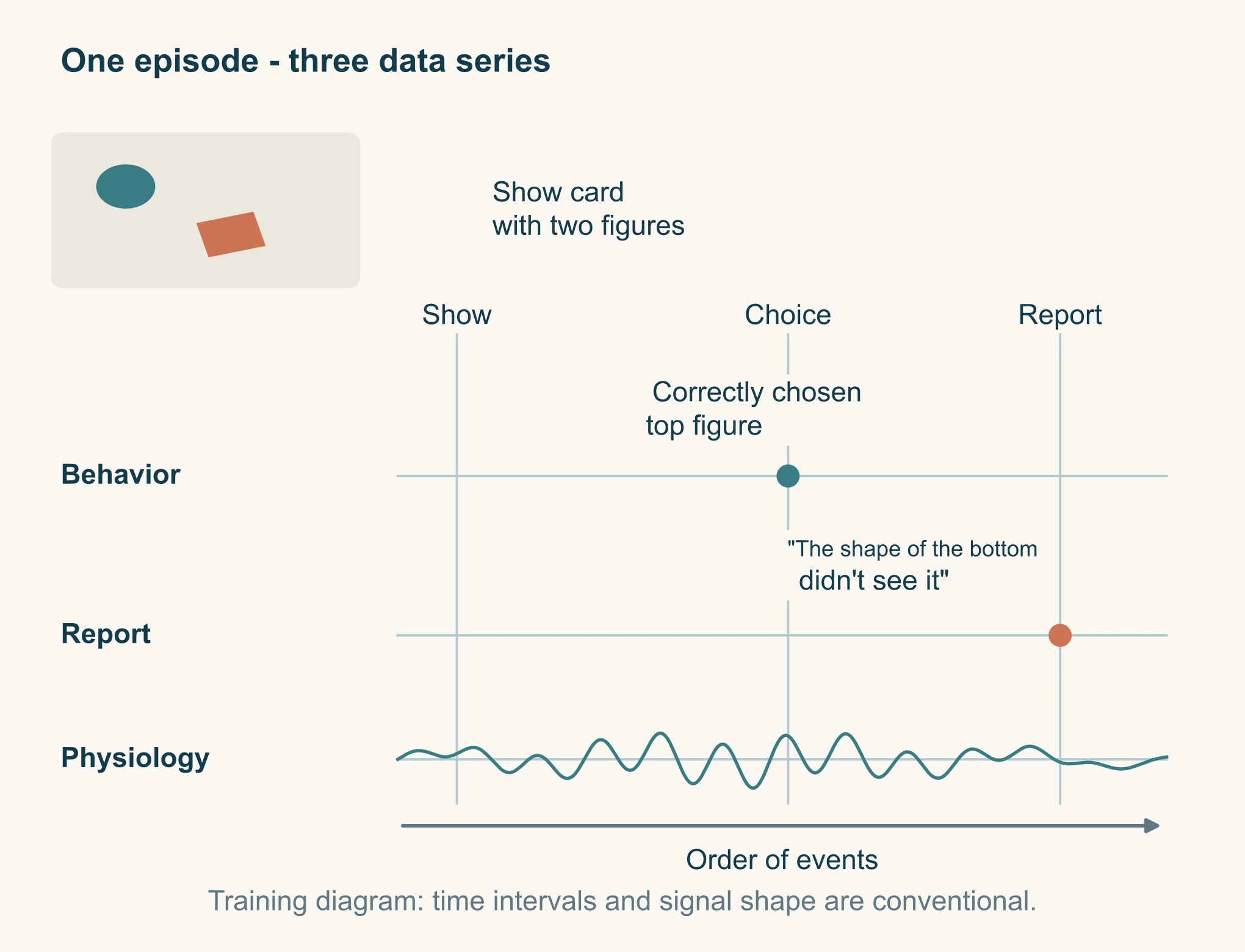
Figure 13. Coordination of different data over time. A fictional episode from the chapter: correct discrimination of the position of a figure is combined with a report of an unclear shape. Pressure, message and physiological recording are represented on a common time axis. The curve shape and time intervals are schematic and do not represent experimental data.
Worked example of mismatched data
Consider a fictitious learning situation. The card shows two figures. The participant correctly chooses which one is higher, but says: “I didn’t see the shape of the bottom one.” There is no necessary contradiction here. Position and shape are different properties. A successful solution to the first question does not establish a clear perception of the second. The researcher’s error would arise if he designated any correctness with one general label “fully realized the picture.”
Let’s say that the physiological indicator turned out to be higher precisely in cases of correct choice. At least two versions are possible: the indicator is associated with the quality of spatial processing or with confidence in preparing an answer. To distinguish, you can select cases with the same correctness, but different confidence, and separately change the method of reporting. The following study is designed from a specific prediction discrepancy.
Combining methods is sometimes called triangulation. Its strength lies in limiting alternatives, not in voting three devices. If the report, the press, and the neural index depend on a single response preparation, their agreement is not three independent confirmations of the experience. It is necessary to find out which reasons for the indicators are common and which differ.
Why doesn't the correct answer correct the previous description?
After briefly viewing the pen, the person reports its color, but does not mention the inscription. Repeated inspection shows that there really was an inscription. It sets a property of the item, but does not choose between versions: the inscription was not noticed, was noticed and forgotten, or was omitted in the short answer. Another comparison is needed, such as a change in report latency. If the question about the inscription is known before viewing, he directs the search; such viewing cannot be considered the same situation of free observation.
What has now been established
Some data limit the properties of an object, others characterize the use of information and communication about it. The discrepancy between these series helps to pose the question more precisely. Now let's try to describe the procedure so that its meaning is visible to another person.
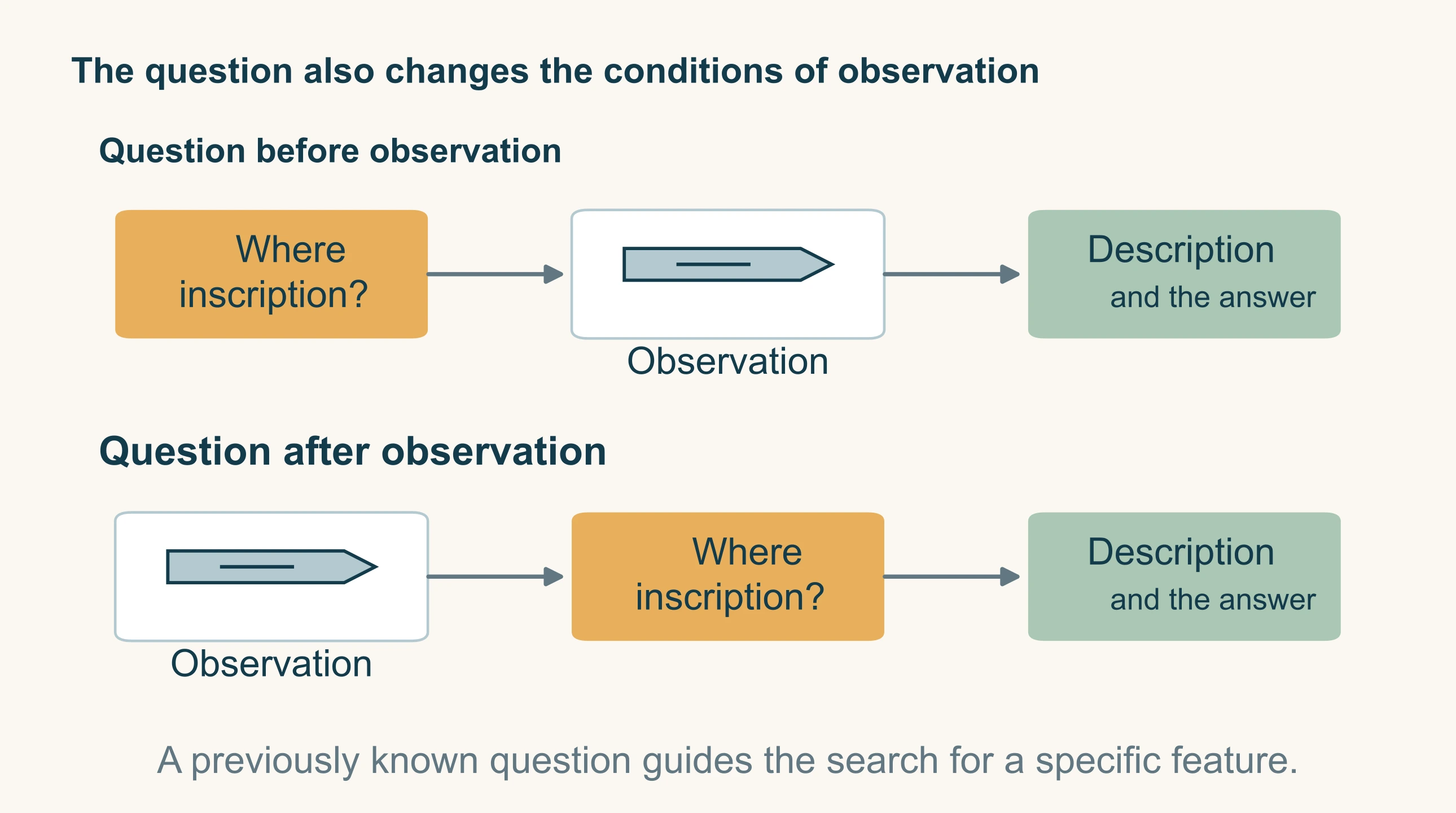
Figure 14. Question time as a condition of the procedure. The upper procedure informs the question about the inscription in advance, the lower one - after observing the object. In the second case, the moment of the question changes; therefore, the results cannot be explained only by differences in the properties of the object, ignoring the direction of observation.
Practice 6 specification of one measurement
Why do it: Create a measurement specification with explicit conditions and limits of inference.
What you will need: Distinguishing between an indicator and an explained phenomenon from chapter 5. Consider question time and answer time.
Time reference: 20–25 minutes. Can be done intermittently; This is not a speed standard.
1. Choose an item with color and a distinctive detail. Note in advance that you already know the following questions; This is an educational demonstration of the procedure.
2. Watch for about fifteen seconds, remove the object and write down the episode you experienced. Then answer separately about the color and placement of the part.
3. Check the structure of the item. Retain the original record and distinguish between the external fact and the content of the report.
4. Fill out the five lines of the specification: presentation, instructions, moment of question, message delay, evaluation rule. Add two conclusions, one allowed and one not yet allowed.
What to keep: A transcript of the episode, checkable answers, and a procedure sheet with one suggestion for improvement.
Hint: The answer “I don’t remember” is not the same as reporting no experience. Clarify which part of the chain remains unknown.
Research continuation: On new subjects, match the question before and after viewing. First, note what difference you expect and why this comparison simultaneously changes the focus of the observation.
Analysis and answers - Appendix F, chapter 6, p. 282
Self-test questions
1. Why can’t the answer “I don’t remember” be equated with the absence of experience?
2. What does the correct distinction between two objects directly demonstrate?
3. Why is the agreement between report, behavior and physiological measure sometimes weaker than it seems?
The specification shows the device of one procedure. Now we need to organize the comparison of procedures so that the possible causes of the result do not all change at the same time. This is the task of chapter 7.
Chapter 7