How does a single episode occur?
So far we have compared mechanisms and indicators. Now let us clarify what the appearance of a conscious episode means. This question is different from the development of the child, the evolution of species, and the basis of the very existence of experience. In this chapter, we will analyze only the dynamics of one event: the launch conditions, the maintenance process and the subsequent message. The threshold accumulator from chapter 9 provides a language for such a task, but not a universal time limit for consciousness.
Four Meanings of Emergence
The question “how consciousness arises” combines problems of different scales. The dynamic task concerns a single episode: why a certain content appeared now and what supported it in the next moments. The developmental problem examines the change in capabilities of one organism over the course of life. The evolutionary problem asks about the history of mechanisms in lineages. The ontological problem concerns why a certain physical process is accompanied by experience at all. The answer to one problem can help another, but does not replace it.
This chapter deals with the dynamic issue. For example, let's take the brief appearance of a silhouette in a window. It is necessary to distinguish between the system’s preparedness for perception, the processing of the received signal, the content of the experience and the subsequent response. Even if everything happens quickly, logically these are different links. The latest record of an event need not coincide with the beginning of the event, and the earliest response to light need not be the beginning of conscious vision.
Preconditions Process and Consequences
A premise makes an event possible under given conditions. The process directly implements the change of interest according to the model being tested. A consequence occurs because the event has already occurred. These roles are determined by causal relations, not just by the order of the clock. One process is capable of participating in several roles: the memory of the previous stimulus influences the next episode, although it itself was formed as a consequence of the previous one.
Let's consider a training setup. A figure appears on the screen; the participant reports its form after a few seconds. The advance instructions tell you what to pay attention to. Sensory processing discriminates shape. Memory holds the result. Selecting an answer converts it into a movement. If memory deteriorates, the later report will become less accurate, even when the initial discrimination has not changed. Therefore, inferring the occurrence of an episode requires monitoring the time chain.
The reverse bias occurs when an early change is considered a sufficient explanation for the entire episode. Let's imagine a sensor that quickly distinguishes between two stimuli. It does not follow from this that the difference is accessible to further behavior or that it is experienced. The name “early marker of consciousness” should be accompanied by an explanation of why the indicator refers specifically to conscious content and not to its input condition.
Instructional dynamics of emergence and maintenance
Let's build our own simple model. It has an activity number from zero to one. At each step, half of the previous activity is retained. The presence of an input signal adds four tenths. If the previous activity has already reached half, an additional internal rule adds three tenths. The value is limited to one. All numbers are chosen for transparency of calculation; they do not assess human brain parameters.
Two consecutive inputs give an activity of four tenths and six tenths. Then the entrance disappears. If there is internal support, activity remains at six-tenths; without it it falls first to three tenths, then to fifteen hundredths. The same entry history gives rise to different durations of the internal state.
Step | Input | Without internal support | With internal support |
First | Yes | 0.40 | 0.40 |
Second | Yes | 0.60 | 0.60 |
Third | No | 0.30 | 0.60 |
Fourth | No | 0.15 | 0.60 |
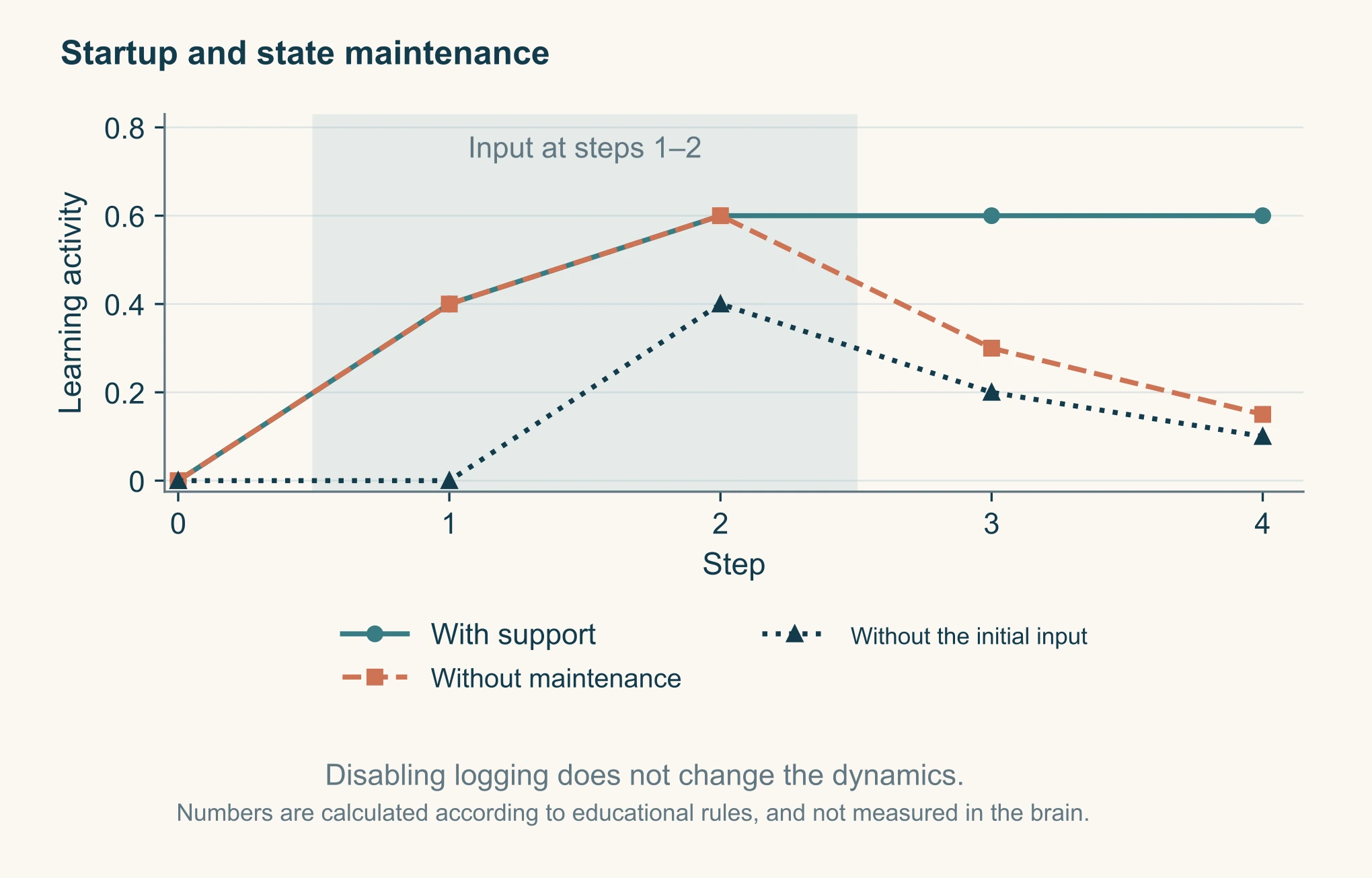
Figure 36. Three trajectories of one learning mechanism. Calculation of the chapter rule 17: at each step, half of the previous activity is retained, the input adds 0.4, and with the previous activity not lower than 0.5, internal maintenance adds 0.3. With two inputs, the supported activity remains at level 0.6. Removing the first entry and deleting the maintenance have different consequences. The observer log entry is not included in the status rule.
In the model, you can examine starting and saving state separately. One input is not sufficient to trigger steady state; two are suitable. After launch, further entry is no longer needed according to the given rules. However, we obtained a stable variable, not evidence of experience. Moreover, the number alone does not explain how the red circle differs from the quiet sound. Meaningful explanation requires representations of the differences between possible episodes.
In a real study, similar logic requires different interventions before, during maintenance, and after the end of presentation. If the intervention only affects triggering, this is one limitation of the model. If only for preservation - something else. The coincidence of effects is also informative: perhaps the proposed division does not correspond to the design of the system or the intervention affects too many processes at once.
What does the change in mechanism show?
Two studies by Noorman et al, using brain electrical activity, examined the effects of memantine on visual figure processing. Changes were found in neural measures interpreted as recurrent integration; Perceptual sensitivity did not improve. The version of eLife used here was published on June 18 2025. For our question, the gap between a change in the proposed mechanism and the absence of a corresponding change in behavioral sensitivity is significant. [27]
This result teaches us not to consider all indicators interchangeable. Perhaps what is being measured is a process that is not limited to that particular task. It is possible that the behavioral measure is not sensitive enough to the change of interest. It is possible that the initial mechanistic interpretation is incomplete. Choosing between explanations requires new data. It does not happen automatically in favor of your favorite theory.
The rule for your own model follows from this. If turning off a variable does not change the outcome being measured, you cannot immediately conclude that the variable is not needed for anything. It is necessary to check whether the intervention actually worked, whether the task was sensitive to its function, and whether another mechanism compensated for the change. However, the endless addition of unverified compensations also does not save the hypothesis: each must generate a new verifiable consequence.
Content time and message time
When someone says, “I noticed it immediately,” the phrase reports their assessment of the event. Turning it into a temporal measurement requires instructions, a scale, comparison conditions, and an error estimate. The press of a button cannot simply be equated with the onset of an experience: decision-making and movement may intervene. Subtracting the average movement time does not remove every difficulty, because the different stages may interact.
It is useful to seek agreement across multiple metrics with different constraints. For example, changes in visibility at different presentation durations, the nature of errors, subjective assessment, and neural dynamics provide different aspects of the episode. Coincidence does not guarantee a definitive explanation, but it does help rule out some alternatives. The discrepancy should be saved as a result and not resolved by renaming the indicators.
A dynamic explanation must also describe completion and change of content. A model that only knows how to increase activity may get stuck on the first stimulus. It will need a mechanism for termination, competition or renewal. Checking the sequence of different inputs is therefore often more informative than demonstrating one successful recognition.
A separate problem arises when averaging time. Let's say that in each trial the training system switches abruptly, but the moment of switching is slightly different. The average curve across samples will appear smooth. The opposite situation is also possible: selecting samples based on the threshold can create the impression of a sharper transition than exists in individual trajectories. Therefore, the shape of the average signal does not uniquely determine the dynamics of a single episode.
For verification, save the complete trajectories of individual samples and their sampling rules. Compare two models: a gradual change in each trial and an abrupt change with different start times. If they describe the mean curve in the same way, an additional measure of distribution or transport over time will be required. This is a concrete way of making the question of the occurrence of an episode more precise, without assigning one moment as the universal boundary of consciousness.
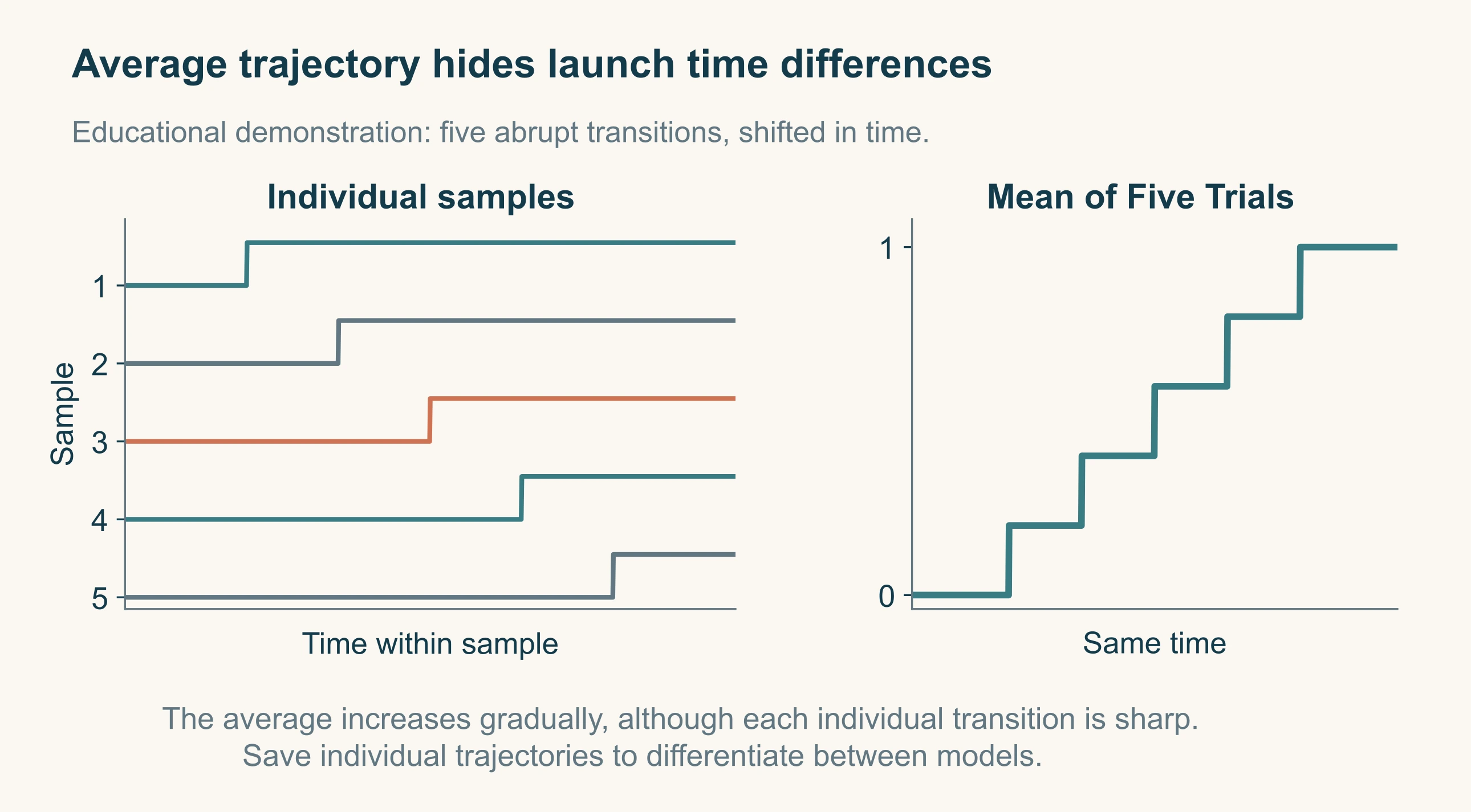
Figure 37. Averaging and dynamics of a single episode. In five artificial samples, the state changes abruptly from zero to one, but the transition moments are different. On the right is their exact average, which increases in steps; with many shifts, the middle curve can appear smooth. This example explains the problem of measuring dynamics and does not indicate the moment of occurrence of the experience.
Why the Mean Curve Does Not Determine the Dynamics of a Single Trial
Five samples may contain the same sharp transition from zero to one, but are triggered at different moments. The time average then rises in steps and, with a dense scatter, looks smooth. Another model may grow smoothly in each individual sample and have a similar average. Keeping only the average curve makes these explanations difficult to distinguish. Complete trajectories, distribution of transition times, or additional maintenance checks are needed.
What has now been established
We distinguished between running, saving and logging the result. These roles need to be tested with suitable interventions. Now we will see them on a small predetermined mechanism.
Practice 17 Checking startup and saving
Why do it: Compare starting and maintaining activity according to the rules of the chapter's educational model.
What you will need: State change rule and threshold; distinction between preconditions, process and consequences. Temporal proximity does not by itself establish a causal role.
Time reference: 25–35 minutes. Can be done intermittently; This is not a speed standard.
1. Start with activity 0. At each step, keep half of the previous value; input adds 0.4; if the previous activity is not less than 0.5, add 0.3. Limit the total to one.
2. Apply input at steps 1 and 2, then remove it. Predict the trajectory up to step 4 in advance.
3. Repeat without the support increase 0.3, and then without the first entry. Compare each trajectory with the full version.
4. Separately put a mark for recording the result after step 4. Check to see if this label changes the dynamics itself.
What to keep: Three trajectories, distinguishing between initiation and maintenance, and clarification of the role of subsequent recording.
Hint: The additional increment condition is checked against the previous state, and not against the already updated value of the same step.
Exploratory follow-up: Create several samples with different start times and compare their average to the smooth variation model. Suggest a metric that distinguishes between these cases.
Analysis and answers - Appendix F, chapter 17, p. 288
Self-test questions
1. Why is dynamic emergence not the same as evolutionary origin?
2. Does sustained activity prove the presence of a conscious episode?
3. What does the discrepancy between neural and behavioral indicators mean?
The dynamics of a single episode did not answer how a person’s abilities change with age. The next chapter will maintain this distinction and examine the development of several capabilities separately.
Chapter 18