What answer are we willing to accept?
A hypothesis becomes part of a study when it ceases to determine its outcome. Before this, you can freely choose an image: the brain as a computer, the body as an avatar, consciousness as a fundamental property. Once a specific mechanism emerges, the choice is limited by measurements. It turns out that some time is too short, the connection is too weak, or the expected effect is already explained by a known process. This is where the opportunity to discover something that was not in the original plan begins.
Now the interface image has already changed. It no longer automatically presupposes a ready-made personality that uses the body as a replaceable shell. In the proposed model, individuality arises through the organization of interaction, history and differentiation of one’s own states. A more fundamental basis, if it exists, does not relieve one from the need to explain why experience is the way it is and belongs to an individual subject.
The proposed model has several possible outcomes. It is useful to consider them in advance, because otherwise any observation can easily be turned into confirmation of a favorite idea.
When the physical mechanism is not found
The most direct negative outcome is that the chosen medium does not exhibit the desired properties. The state retention time turns out to be too short for the proposed chain, the connection with biological processes is not confirmed, or the calculated effect is absent in the sensitivity range of the device. Then the particular version of the model loses its basis.
This outcome does not require declaring all questions of consciousness resolved. But keeping the question open does not save the rejected mechanism. If the spin-carrier hypothesis fails testing, it cannot be considered confirmed simply because the origin of qualia is still unclear. Ignorance of one is not positive knowledge of the other.
The scientific value of the work may be preserved. Measuring the relaxation time clarifies the physics of the structure. Channel testing limits the range of its possible influence. The improved method helps distinguish sample properties from instrument features. These results have their own meaning, even if the original interpretation does not stand up to scrutiny.
For the author's program, it is especially important to maintain the connection between the negative result and the conditions. The failure of one model of interaction does not amount to a refutation of every possible external basis. But if each subsequent option is changed in such a way as to avoid the experiment already carried out, the program risks losing testability. The new version should offer a new substantive basis and a predetermined difference in forecasts.
When the quantum effect turns out to be real
A more favorable and at the same time more modest outcome is possible: a quantum process is discovered, reproduced and affects biological function. This would be an important physical result. However, the relationship to consciousness would have to be established separately. The mechanism may be involved in energy transfer, chemical sensitivity, or regulation without being a specific source of subjective experience.
Here it is useful to distinguish several types of necessity. Some interaction may be necessary for cell life in general. Its violation will then change consciousness and many other functions. Another mechanism may influence a specific processing channel. The third may turn out to be specifically related to a certain organization that the theory considers necessary for experience. These statements require different precisions of intervention and comparison.
Physical success may therefore bring the hypothesis closer to conventional neuroscience. If quantum dynamics operates within biological structures and its functional outcome is incorporated into neural organization, an external carrier may not be needed. The quantum approach to the brain will still make sense, but the original idea of the receiver brain will need to be changed.
This result should not be considered a disappointment. It would answer a more precise question: what features of the physical structure of the nervous system are important for its operation and why the appropriate description must sometimes be quantum. Further debate about the fundamental status of experience would continue on a more substantive basis.
When an Additional Bearer Is Found
A stronger result would arise if an independently measured subsystem E was found to interact with the organism according to the predicted law. Independence here does not mean lack of connection with the brain. It means that the existence and properties of the medium are established not only from the same behavioral data that are supposed to confirm its influence.
Then the consistency of several observations could be checked. The parameters obtained from measuring the carrier itself should predict changes in the associated biological system. A change in detuning should affect the response as predicted by the model. The measured state retention time should limit the possible duration of the transfer. The connection between these quantities would make the explanation stronger than a set of separately selected relationships.
But the external physical medium is not yet an external subject. The environment constantly affects the body in many ways. In order for a new process to change the theory of consciousness, it is necessary to show its special causal role and formulate a rule of relation to experience. Otherwise, the discovery will expand biophysics, but the question of the connection between physical processes and experience will remain open.
The subject also does not have to be entirely in E. The co-formation hypothesis allows that experience refers to the organization of the connection between B and E. Then the question “where is consciousness” may turn out to be poorly posed: the spatial arrangement of elements does not have to coincide with the level at which the property of the whole is determined. However, such an explanation must set the boundary of the whole, so as not to attribute one subject to any set of interacting objects.
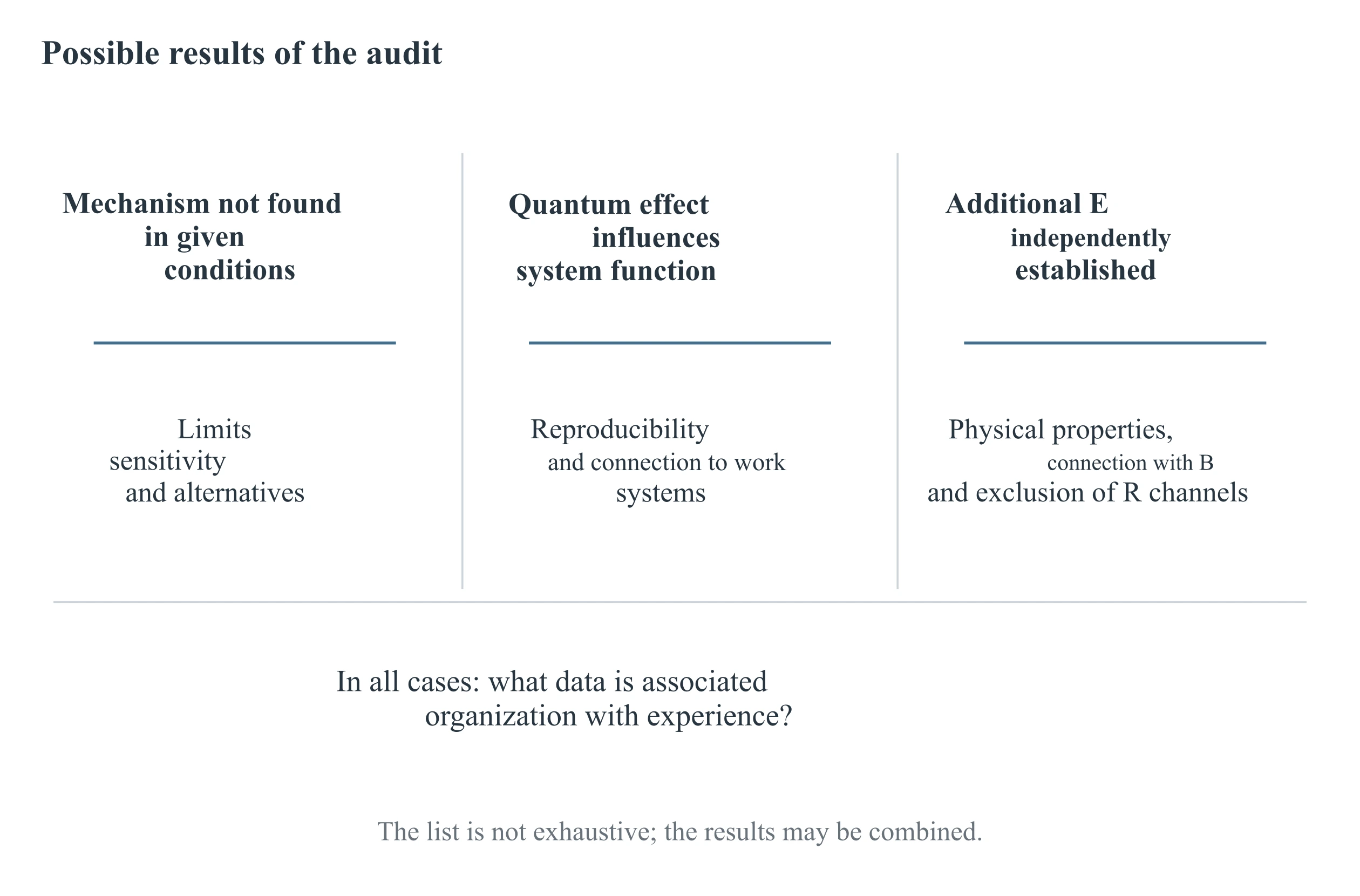
Figure 35. Possible outcomes of the research program. Confirmation of the physical effect, the additional carrier, and the relationship to the experience requires different reasons. The results shown do not exhaust all options and may be combined.
The most vulnerable link
The most difficult part of the program remains the rule connecting physical organization and subjective experience. One can describe state, transitions, and memory in detail, and then discover that the explanation still only speaks of observable relationships. Calling the totality of these relationships consciousness does not mean explaining the qualitative side of experience.
The author's hypothesis suggests looking for this connection in the organization of interaction, which forms a separate perspective: through a stable border, one's own history and selective access to states. This is a research hypothesis. Its strength will depend on whether one can derive from it limitations that the more general descriptions do not have. For example, what changes do the subject retain, what changes divide his organization, and why the same amount of information can correspond to different possibilities of experience.
It is not enough here to declare the fundamental basis to be equally present everywhere. Such a statement may have philosophical content, but without the rule of individuation it does not explain the difference between a person, an animal, an artificial system and a simple physical connection. The theory must clarify under what conditions a distinct perspective emerges and what is independently tested under those conditions.
Perhaps a mature explanation will require new concepts. However, new concepts should increase accuracy and not just replace old words. If the "field of subjectivity" does not allow the definition of a state, interaction, or discernible effect, it remains the name of the problem. If possible, it becomes possible to compare it with a competing description on the same data.
Some consistent evidence
A substantial change in our picture will usually require agreement among different tests. The bearer's physical property, its change under intervention, the biological effect, and the relationship to independent indicators of a conscious state must support a single causal model. Reusing one data set does not turn it into several independent confirmations.
It is useful to imagine a model that accurately describes already known curves, but each time requires a new adjustment on a different sample. It may have good quality of fit but poor predictive ability. Another model describes the data a little more roughly, but in advance connects the results of different experiments with one set of parameters. The choice between them cannot be reduced to the beauty of one design or to the impression of the complexity of the formula.
The comparison must also take into account strong alternatives. A classical nonlinear system is capable of complex oscillations, memory, and history dependence. The neural model may include feedback and internal representations. Therefore, unusual behavior is not sufficient to conclude a quantum mechanism. You will need an observation that explicitly states which alternatives it limits and under what assumptions.
This type of work allows for gradual accumulation of bases. It is not necessary to wait for an experiment that will immediately answer all questions. You can first limit the communication time, then establish the functional role, and then clarify the psychophysical correspondence. Each step must maintain its significance without taking credit for the success of the next.
What will change in the question of a person
If the proposed program receives confirmation, a person will appear as an organized connection of processes, some of which were not previously included in a sufficient description of the brain. This may change ideas about the boundaries of the subject, memory, and possible physical realizations of experience. But the specific consequences will depend on the mechanism discovered. Immortality, telepathy, or the possibility of personality transference cannot be inferred in advance from the mere fact of a wider connection.
If the program fails, an important result of a different kind remains: the avatar image will be translated into a set of verified and constrained statements. It will become clearer which properties of the body are truly essential and why some attractive analogies do not stand up to physical detail. Science advances even when there are fewer possible explanations.
In both cases the question of other beings takes on a more precise form. Similarity to human language ceases to be the only support. Attention shifts to the interaction structure, history, self-regulation and those physical properties that the theory considers necessary. The differences between organisms and artificial systems then become a material for comparison, rather than an obstacle that must be eliminated in advance.
Philosophical and theological questions do not have to disappear. The meaning of personal experience, attitude towards death and understanding of one's place in the world include more than a description of the mechanism. But statements about the physical structure of the world receive a separate responsibility: they should be associated with observations as accurately as the content of the statement allows.
The proposed program combines three independent hypotheses. The selective interface hypothesis concerns the physical connection of an organism with an additional carrier. The identity co-formation hypothesis links the individual perspective to the body, the organization of interaction, and history. The external memory trace hypothesis allows for the recording and subsequent reading of part of this history outside the selected biological subsystem. Confirmation of one of them will not automatically confirm the others: the communication mechanism, the conditions of individuality and the storage architecture require their own reasons.
The minimal model yielded a narrower but more specific result: the connection can be selective, and the maximum probability of transfer depends on the detuning and the interaction coefficient. These values limit the possible effect and relate its amplitude to temporal dynamics. The calculation did not discover the carrier E in nature and did not deduce the occurrence of qualia; it showed how part of the original intent could be translated into a testable statement. It is at this boundary between what has been calculated and what has not yet been established that further work begins.
Return to presence
At the beginning of the book there was a room, a cup and a short question about who notices what is happening. Now distinctions have arisen around this issue: experience and report, state and measurement, correlation and channel, memory and continuing personality. They do not make the immediate experience any less real. They allow us to ask more precisely about its nature.
The brain may prove to be a sufficient physical basis for human consciousness. A description of the broader system may be required. It may turn out that the very connection between physics and experience requires a law that does not yet exist. These possibilities are not equal on the basis of the available grounds, but each should be discussed in a form in which it can be meaningfully explored.
The main requirement for the selective interface hypothesis is specificity. One must name the medium, describe the interaction, relate the story to the individual, and provide an observation that might change the conclusion. As long as these requirements are met, a bold assumption can work in science. When they are replaced by confidence that does not depend on the outcome, the study stops.
The room remains the same. The light on the table does not need theory to be seen. Theory is needed for something else: to understand what relationships in the world make this vision itself possible - and why there is an internal side to what is happening.