Nuclear spins and possible memory
A memory device faces conflicting demands. Its state must be preserved for a long time, but at the same time remain accessible for writing and reading. Complete isolation protects against interference while preventing use. In a biological system, the contradiction is especially noticeable: the cell continuously exchanges matter and energy, and its supposed quantum memory must be built into this exchange.
The idea of using nuclear spins takes the search to a different physical scale. Nuclear spins represent quantum degrees of freedom that, under certain conditions, can interact relatively weakly with their surroundings. Of interest is the possibility of linking their preservation with biochemical action. It is the combination of two possibilities that makes a hypothesis meaningful for research.
What stores the spin state?
Spin is a quantum property of a particle. The image of a spinning ball may help one remember the word, but it does not reproduce its mathematical meaning. For a spin-one-half system, measurement along a chosen direction gives two possible outcomes. This allows the corresponding state to be described as a qubit. Two measurement outcomes alone, however, do not mean that the system is already functioning as part of a computing device. [14]
Working memory must provide distinguishable states, their preparation, sufficiently stable storage and an accessible way of reading. Quantum memory additionally needs to store relationships that are essential for the chosen task. If only the ordinary probability of one of the outcomes remains, not all the information of the original quantum state remains available.
In a mental technical device, one can store one classical bit for a very long time and still completely lose the quantum phase. For the task “there was or was not an event” this is enough. For a problem that depends on interference, no longer. Therefore, the expression “long life” requires clarification: what exactly lives, in relation to what interference and for what subsequent operation?
Human memory introduces another distinction. A memory of an event contains relationships among many features and is embedded in the processes used to retrieve them. A stable quantum carrier does not automatically specify either this content or its belonging to a particular person. Even an ideal physical register remains a register until we describe how its stored state is organized and used.
This distinction can be expressed through language. Preserving a sequence of symbols and reconstructing the meaning of a story are different tasks. The latter requires connections with other knowledge and with the current situation. Likewise, a physical state becomes part of personal memory only within a broader organization. Choosing an unusual carrier can change what can be stored, but does not relieve the model of the need to explain that organization.
Fisher's proposal
Matthew Fisher proposed considering phosphorus nuclear spins as possible elements of quantum processing in the brain. In this model, protection of the states is associated with hypothesized calcium-phosphate structures called Posner molecules. The proposed chain includes the formation and transfer of spin correlations, and the effect of certain chemical events on calcium availability and, in turn, neuronal activity. This is a theoretical research program connecting several testable physical and chemical assumptions. [7]
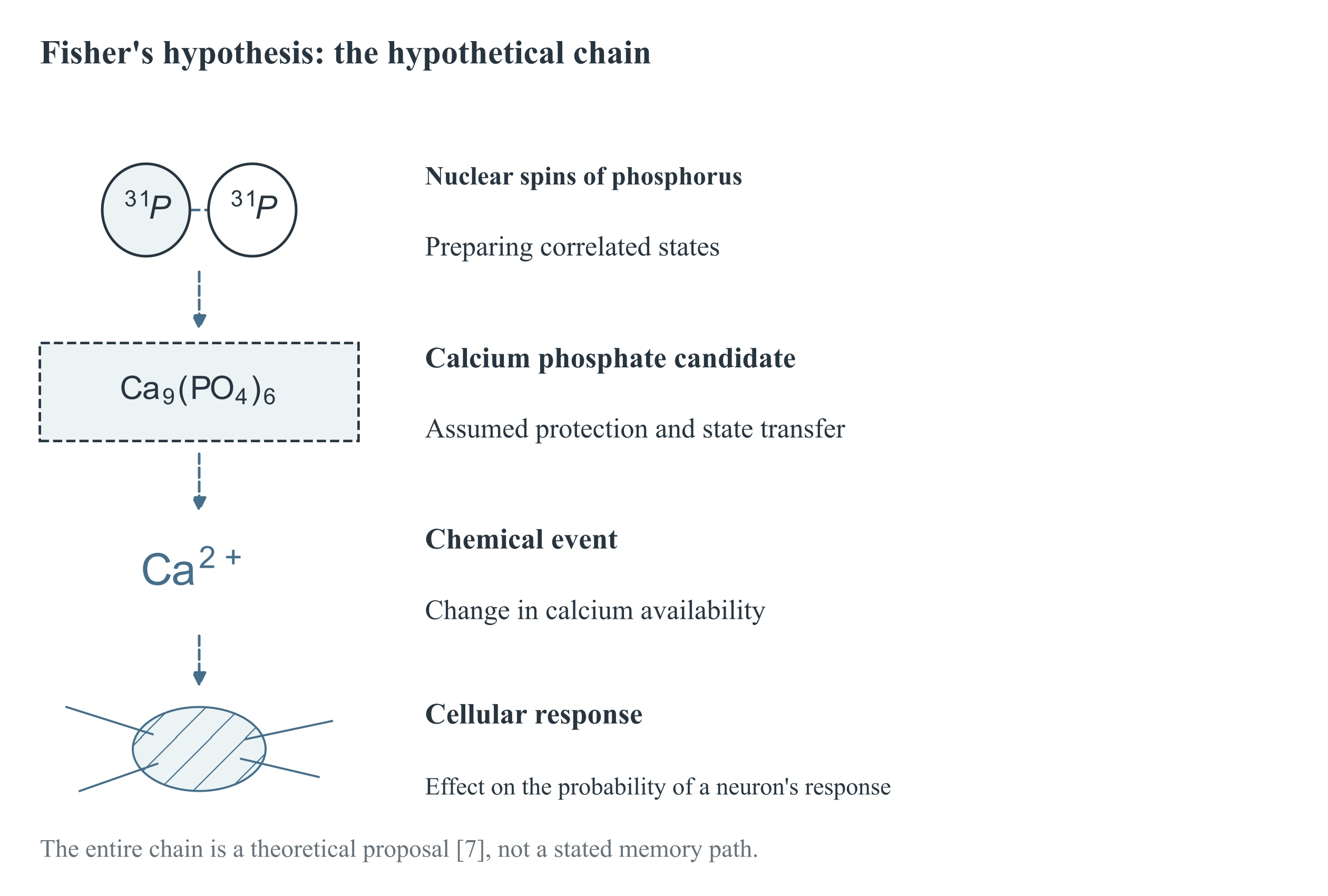
Figure 18. Fisher's hypothesis links nuclear spins to hypothesized calcium-phosphate structures and subsequent cellular effects. The existence and operation of the entire chain require separate tests.
Its appeal lies in its specificity. A specific chemical element, a possible structure, and a path from microscopic state to cellular action appear. Each choice narrows the explanatory space. Instead of a general assumption about quantum memory, the question becomes whether specific molecular processes fulfill the necessary conditions.
The detailed diagram, however, still needs to be checked at each link. A chemically possible reaction may be dominated by channels that do not maintain the required correlations. A structure that is convenient to calculate may be unstable in the corresponding environment. The association with cellular function may be too weak or nonspecific. All these outcomes relate to the physical content of the hypothesis.
It is especially important to keep the explanation in the right direction. One should not first accept the presence of quantum memory and then take any finding of calcium or phosphate as confirmation. These substances are involved in many processes. Confirmation must concern precisely those properties and relationships that distinguish the proposed mechanism from more conventional biochemistry.
Protection depends on the environment
Thomas Player and Peter Hoare investigated the spin dynamics of the putative Posner molecules and obtained an upper estimate for the persistence time of intermolecular spin entanglement of about 37 minutes under idealized conditions. They emphasized that real processes can significantly reduce this period. The number refers to a specific calculation, not the measured duration of quantum memory in the human brain. [8]
The very concept of an upper bound is easy to misunderstand. It tells you how favorable the limit may be in the chosen model. It does not guarantee that the biological system reaches this limit. Similar to the maximum range of a technical device in an ideal environment, the estimate must be revised when specific sources of loss are added.
Changes in the chemical environment are especially significant here. If the proposed structure binds to other molecules, becomes deformed, or changes to a different composition, the physical description of the spins also changes. It is impossible to first calculate the safety in one structure, and then transfer the result to another without checking, only retaining the previous name.
Nevertheless, even limited calculation is useful. It shows which interactions are most dangerous and where measurement will bring the most clarity. If the main source of loss is associated with a specific process, an independent assessment of it can dramatically change the credibility of the entire chain. Thus, theoretical work helps to choose the next experiment without promising in advance the desired outcome.
From correlation to chemical action
Let us assume that the required states are indeed prepared and persist for a long enough time. It is now necessary to explain how their difference changes the chemical result. If all possible spin states equally influence the subsequent process, quantum information remains functionally invisible. It may exist, but not fulfill its stated role.
Therefore, in any such model a selectivity mechanism appears. Some states should increase the probability of a certain transition, while others should decrease it. After the transition, the difference must be strengthened or consolidated so that it becomes noticeable at the cellular level. The amplification does not have to preserve the original quantum structure: the devices also turn a microscopic event into a macroscopic record. But the amplification path itself must be described.
A mental diagram with two chemical channels makes the problem clear. The first channel depends on the spin state, the second is almost independent. If the second channel is much stronger, the observed result will be poorly sensitive to the protected medium. The presence of a beautiful quantum mechanism in the first channel does not save the model from the quantitative question of its contribution.
On the other hand, a small contribution can be significant if the system operates close to the threshold and then amplifies the difference. But reference to the threshold does not exempt you from the calculation. It is necessary to show that the amplification preserves the desired pattern, and does not turn a weak signal into a result indistinguishable from noise. The words “small contribution” must be given a quantitative expression: how weak the signal is and how much amplification is necessary for its effect.
Thus, the chain contains two different forms of stability. The quantum state must survive the time before useful interaction. The resulting functional difference must survive until the cellular response occurs. These times can vary greatly. A long-lasting neural effect does not in itself mean that the original entanglement was there all along.
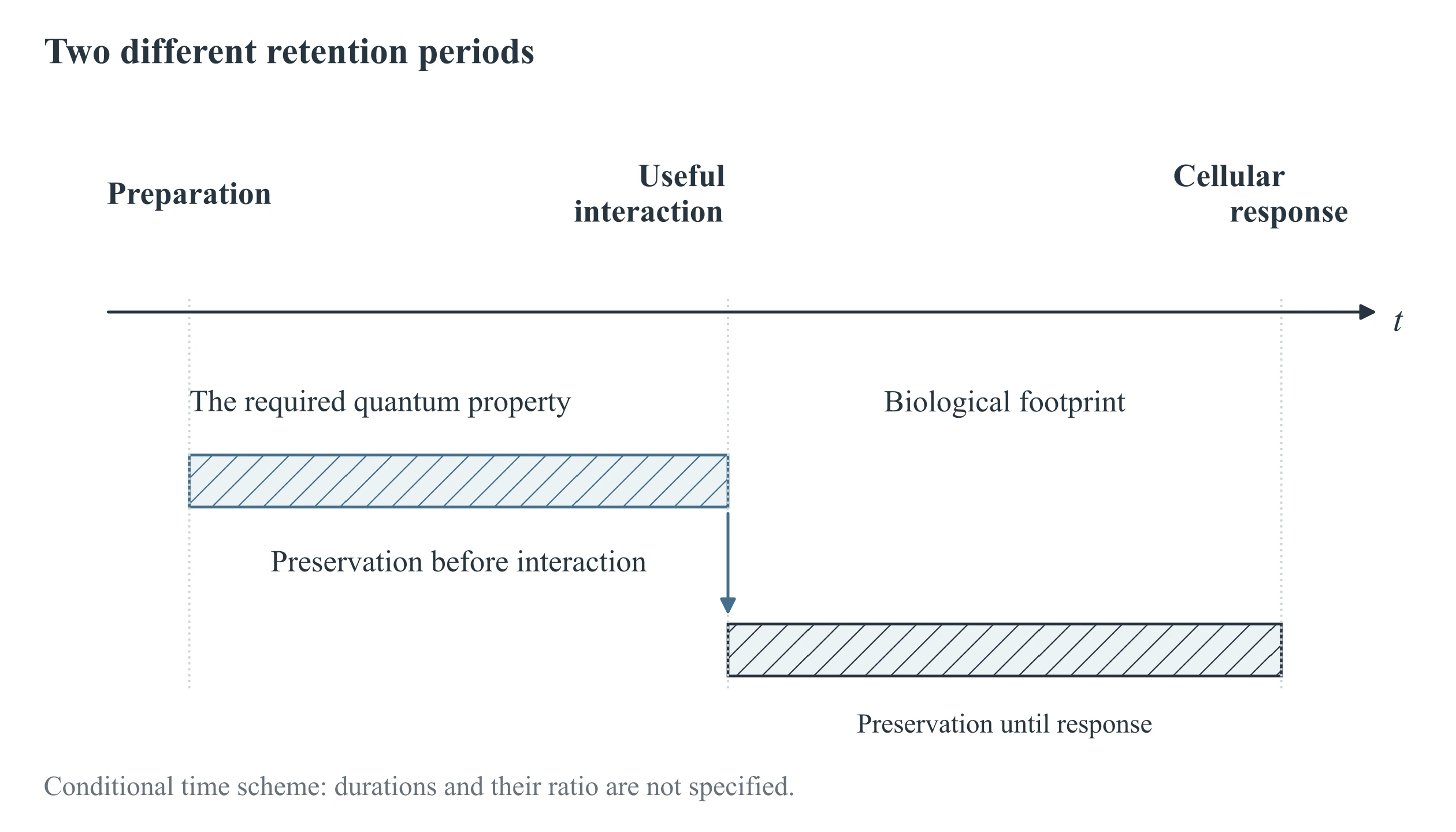
Figure 19. The quantum state must persist until the interaction, and the resulting functional difference must persist until the cellular response. The duration of the second process does not measure the lifetime of the original entanglement.
The comparison of operation time with coherence decay is shown in Figure 11.
How to distinguish a mechanism from neighboring causes
If changes in chemical composition affect an organism's behavior, many possible explanations arise. The intervention could change the concentrations, structure, metabolism or properties of other molecules. To isolate the spin mechanism, it is necessary to find consequences that are quite specific to it and consistent with quantitative calculations.
For example, a physical model may predict a certain dependence on magnetic influence. But any detected magnetic influence does not indicate the chosen medium. It may have another source. Therefore, the form of dependence, characteristic times and accompanying features are important. The more accurate the joint prediction, the more difficult it is to replace it with an ex post explanation.
Similar caution is needed when discussing isotopes. Differences in isotopic composition can be used to study spin properties, but other associated changes must be taken into account in a particular system. Any difference cannot be assumed in advance to be the result of quantum memory. First, a model of the expected effect is built, then physical reasons that can give a similar picture are considered.
In this logic, reversible experiment is especially valuable. If the proposed mechanism can be weakened and restored without changing everything else at the same time, the causal explanation is strengthened. However, restoration of function must correspond exactly to the path stated by the theory. The return of general activity after broad exposure is not an automatic restoration of a specific spin process.
This reasoning relates to the design of the study, and not to recommendations to intervene in one’s own body. Physical and biological variables must be controlled in a suitable laboratory system. Otherwise, the inability to separate causes makes even a subjectively striking result almost useless for testing the model.
Where does the question of consciousness begin?
Let’s assume that the entire proposed path is confirmed: the spin state is preserved, affects chemistry and changes the operation of the neural network. Then a new mechanism for biological information processing was established. The next task is to determine its relation to the experience. It may be necessary for some functions, but not fulfill a special role in subjectivity.
A mental example helps to separate the possibilities. One mechanism supports learning, another is involved in current perception, and the third influences the stability of the waking state. All of them have the ability to change behavior. However, a theory of consciousness must clarify exactly what aspect of experience will change when they are disrupted and why. The general word “cognition” does not replace the distinction between memory, attention and experience.
An additional boundary arises for the external interface model. Long-lived quantum memory inside a molecule is not automatically memory outside the body. Its carrier can completely belong to the biological system. To move on to an external trace, it is necessary to show interaction with another system and the storage of certain information in it after changing the internal media.
Explaining access is equally important. Even if information about past events is distributed throughout the environment, this does not mean that the body can restore it as its own memory. Addressing, discrimination of the desired signal, and a way to incorporate the received content into ongoing activities are required. Quantum correlation by itself does not perform all these functions.
Memory as a process of retaining differences
The search for an unusual physical medium forces us to re-formulate the very concept of memory. Memory exists for a system insofar as a difference in its past is capable of influencing the available difference in the future. In this definition, not only the safety of the trace is important, but also the possibility of its use. A trace that is fundamentally inaccessible to any subsequent process does not explain the memory.
Therefore, a good physical model should connect recording, storage and recovery. You can achieve an impressive result in one part and lose all meaning in another. The supposed subject additionally requires coherence of history: different traces must be assigned to one developing center of perception and action, and not remain a random collection of stored states.
Nuclear spins are of interest precisely as a way to make these questions precise. It becomes possible to ask about preparation, interaction, lifetime and reading. If the mechanism is not confirmed, the questions themselves will remain and will be applicable to another medium. If confirmed, they would separate the discovery in quantum biology from a more powerful conclusion about the nature of experience.
Now we can return from the molecular carrier to the organism as a whole. Anesthesia changes communication with the outside world, behavior and memory, allowing explanations of consciousness to be compared with observed transitions. But first we need to find out exactly what abilities have changed and what was measured in each case. This is the subject of the next chapter.
Chapter 11