Continuity limits
The question of consciousness changes when time is added to it. One can ask why the experience exists in the present moment. It is possible - why today’s experience belongs to the same person as yesterday’s. One can finally ask whether this connection is capable of being preserved after the destruction of the organism. These questions are close emotionally, but require different explanations.
The hypothesis of a more fundamental basis of experience often seems to be the answer to all three at once. If the basis is not limited by the brain, there is hope that the personality is not limited by the time of its work. However, there is an essential link between these statements. The general possibility of experience does not yet contain specific memories, relationships and habits. In order for a given subject to continue, that which makes its continuation individual must be preserved.
In this area, precision of language is especially necessary. It does not diminish the importance of the issue. On the contrary, it allows you not to lose the subject of research among the words “energy”, “information” and “eternity”, each of which has many meanings.
Stopping and irreversibility
Stopping blood circulation creates a severe disruption of the working conditions of the brain. During resuscitation, doctors try to restore blood flow and vital functions. The very fact that after stopping a person was able to survive and talk about his experience means that a condition from which recovery was possible is being examined. It cannot be identified without additional reason with the continuation of personality after irreversible destruction of the brain.
In the everyday expression “after death” these differences often disappear. In a scientific description, the sequence of events, the state of the body, the interventions taken, and the accuracy of the measurements are important. This is not a matter of choosing a convenient definition, but rather what period of time the data covers. Instrument readings in one phase should not be transferred to the entire history of the event.
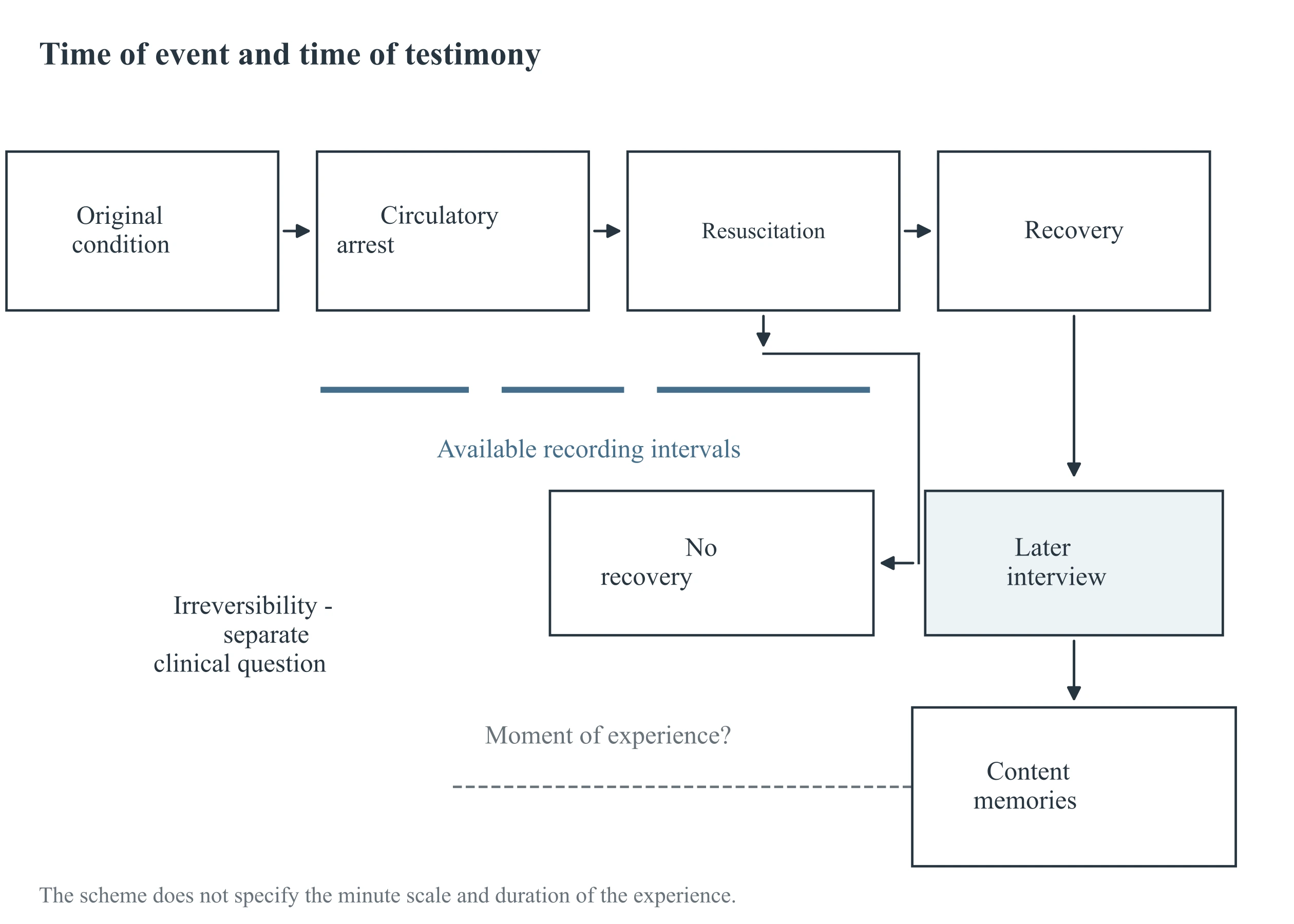
Figure 34. Time linking of medical records and subsequent narrative. Circulatory arrest does not equal established irreversible brain damage, and the timing of the interview does not determine the moment at which the described experience occurs.
Even a reliable account of an unusual experience does not have an internal timestamp that matches the medical record. A person can remember the content well and make mistakes in its location relative to external events. Therefore, the task of research is not only to collect the story, but also to relate it to independently recorded circumstances.
This applies to any hypothesis. A neural explanation must show when and how the experience might have arisen. The external basis hypothesis should indicate which features of the story require an additional channel. The statement “the brain no longer worked” requires a description of the specific measurement, its sensitivity and spatial coverage.
What was observed during resuscitation?
The AWARE II study by Sam Parnia and colleagues, published in 2023, examined 567 cases of in-hospital cardiac arrest. Individuals survived 53, interviewed 28; eleven reported memories or perceptions, which the authors linked to possible conscious activity. No participant named the presented visual target; one recognized the auditory stimulus. In some patients, during ongoing resuscitation, organized EEG activity was recorded, including 35–60 minutes after its start. These are observations in a resuscitation setting, not a demonstration of brain-independent personality. [29]
Such a study has several different results. Stories report the subjective side of an event. A physiological record describes measurable processes. The presented target is intended to verify specific information. Linking all three components at the individual case level is more difficult than simply detecting each of them in the overall sample.
Therefore, the duration of resuscitation should not be read as the duration of proven continuous experience. And the frequency of reports among interviewed survivors cannot be automatically transferred to all patients with cardiac arrest, much less to all those who have died. Screening for survival and interviewability is part of the very method of obtaining data.
The important question for the interface hypothesis is: what coincidence between content and external event would be unexpected given the normally available channels of perception and memory? This question can be verified. The overall impression of unusualness or clarity of experience is less certain, since different mechanisms can give rise to subjectively compelling states.
Dying Brain Activity
Gan Xu and colleagues in 2023 examined recordings of four comatose patients before and after withdrawal of ventilatory support. Two showed increased gamma activity and connectivity changes. The patients did not survive, so it was impossible to compare these processes with their subsequent stories. The work shows certain dynamics of the brain during dying, but does not establish the content of the experience and does not prove its presence in each of the observed patients. [30]
This raises a useful caution against hasty interpretation of biomarkers. If a certain dynamic occurs in a conscious state, its occurrence in a different context does not guarantee the same experience. The value of the indicator depends on the conditions under which the connection was established. Situations of dramatically altered physiology require particularly careful transfer.
The reverse inference is equally unreliable. A weak or absent recording in a selected range does not amount to complete knowledge of every brain process. Any method detects a particular class of changes. This does not imply that consciousness must be present beyond the method's sensitivity. It only requires the scope of observation to be stated correctly.
For a scientific model, such a result is valuable without a final metaphysical interpretation. It clarifies what processes are possible in the transitional state of the organism. Any theory of the continuation of experience must take into account this complexity, and not be built on a pre-simplified image of instantaneous complete shutdown.
What the similarities between stories don't tell you
Let some collection of stories repeat light, an encounter, a space of transition, or the feeling of observing the body from the outside. This is a mental example of a classification problem, not a description of a new study. Repeatability can be interesting, but first it is necessary to establish how the information was collected, whether leading questions were asked, and which stories were not included in the selection.
The same similarity allows for several explanations. It may reflect shared biology, shared cultural expectations, similar conditions of recollection, or properties of a putative external process. To choose between them, you need to figure out where their forecasts diverge. The presence of a common motive does not in itself distinguish between these options.
Particular care should be taken when combining stories about different events into a single sequence. Experiences during resuscitation, reports of alleged prenatal memories, and descriptions of dreams may contain similar images. But the coincidence of the image does not establish that the narrators observed adjacent stages of the same external path. For such a conclusion, an independent connection between events is necessary.
A scientifically meaningful goal would be a predetermined classification applied to independent sets of messages, taking into account the language, culture and circumstances of collection. Even consistent similarity after such tests will first require explanation. To regard such similarities as a ready-made description of posthumous existence would be to miss the test of competing explanations.
Preservation of information and preservation of identity
The image of indestructible information easily becomes a promise of immortality. In the standard quantum description of a closed system, unitary evolution does preserve the distinguishability between complete states of the system in a certain mathematical sense. However, man is not an arbitrarily chosen collection of all the physical traces of his existence. What is essential to the individual is the organization through which history is accessible, connected to the present, and influences the continuation of experience. [14]
Imagine a letter that gradually disintegrated into many chemical traces. Information about its past may remain in the correlations of a huge number of particles. This does not mean that a coherent text continues to be read somewhere. Moreover, the existence of a reader does not follow from the presence of traces. The example concerns the difference between a physical trace and an operating organization, not a literal model of the brain.
Likewise, the law of conservation of energy is not the law of conservation of memory or personality. The energy balance describes the value, and not the entire way, of organizing a process. The personality continuation hypothesis would require showing which states preserve individual differences, how they are protected, and how they participate in subsequent experiences.
The external trace introduced in the fifteenth chapter gives this question a definite form. If part of a personal history is encoded in an additional medium, three possibilities must be distinguished: the trace quickly disappears; the trace is retained but not used; the trace enters into a process capable of supporting further individual history. Only the third possibility brings the model directly closer to a continuation of the subject. The first two have a different content, even if they can be physically confirmed.
The differences between storage and access architectures are illustrated in Figure 27.
What an Effective Continuation Would Look Like
For a working hypothesis, we can consider a carrier E, which during its life receives certain changes through a connection with organism B. If, after the termination of this connection, E remains only a passive record, the model describes the preservation of a trace. If E has its own dynamics, holds differences, and connects successive states, the stronger hypothesis of autonomous continuation arises. This is an addition to the original interface model, not an automatic consequence of it.
Autonomy will require a physical explanation. Where do the conditions for maintaining the structure come from? Which interactions destroy it, and which compensate for the disturbances? How exactly is the record that was associated with a given organism selected? Why don't neighboring stories mix? While these questions do not have specified mechanisms, the expression “consciousness remained in the external field” indicates an assumption, but does not explain it.
But questions already allow you to compare versions. If continuation depends on a stable material state, the time of its preservation can be estimated. If it depends on an ongoing process, you will need to determine the source and mode of that process. If the absence of space and time in the usual sense is assumed, the usual dynamic model is inapplicable without an additional rule of connection with observable events.
A separate requirement concerns content. A system that continues general activity may not retain individual memory. Conversely, retained memory does not guarantee ongoing experience. The author's hypothesis therefore distinguishes between the stability of the medium, the accessibility of personal history and the presence of a subjective process. Between these conditions we need laws of connection, and not just the same word “conservation”.
Identity after an Interruption
Let's imagine a device that can reconstruct a person based on a complete description of his condition. In this mental case, the restored person can remember the previous life and consider it his own. But if the description is used twice, two sequels arise, which soon receive different stories. The coincidence of memory at the initial moment does not make further experiences one stream.
The story divergence diagram in Figure 26 helps to separate the similarity of the initial state from the further continuation.
This reveals the difference between the similarity of properties and numerical identity - the fact that we have one and the same subject, and not two similar ones. Two systems can coincide in their accessible properties and yet occupy different places in causal history. If a theory posits the transference of one subject, it will have to explain how the transference is different from the creation of another subject with the same memories. The story of the restored system alone may not be enough, since such a story is provided for in both scenarios.
There is also the opposite difficulty. The loss of some memories does not necessarily mean the emergence of a new person in every ordinary sense of the word. Therefore, one cannot define a person only by the set of available stories. Perhaps what is essential is a broader continuity of organization, body, and relationship. In the interface hypothesis, a supposed connection with E is added to it, but its own contribution still needs to be highlighted.
If two theories give the same observable results and differ only in which flow to declare as the same, experiment will not be able to choose between them until an additional consequence appears. This is not a ban on thinking about identity. This is the exact location where physical research ends and interpretation continues.
What result would change the conclusion
Strong evidence in favor of an unusual information channel must contain information that is not available through known paths under predetermined conditions. You will need independent target registration, protection against leakage, clear timing and reproducibility of the result. Such success would not yet prove the continuation of personality after death. It would confirm the narrower claim of information acquisition and require a new explanation of the mechanism.
Strong evidence in favor of external storage would require an additional step: showing that a particular history is stored in an independently defined medium and can be retrieved through the described channel. Evidence of the continuation of the subject would also require a valid rule connecting this process with individual experience. These requirements should not be compressed into one spectacular experiment, since they relate to different parts of the hypothesis.
This type of research does not need to intentionally endanger life. Medical observations are possible within the framework of already necessary assistance, and work with memory, channels and physical media begins much earlier than the issue of irreversible destruction of the body. The main difficulty here is establishing a causal relationship, and not bringing a person closer to a dangerous border.
The question of the continuation of experience remains open in the precise sense that the data considered do not provide a settled answer about personal existence after irreversible death. This does not equate to equal confirmation of all conceivable scenarios. Each version must receive its own reasons and withstand its own tests.
It is essential for the book to be able to hold both sides of the issue. Consciousness may require a deeper physical description than is currently available. And human personality may depend on the particular organization of the body much more than the simple receiver metaphor suggests. The relationship between these possibilities can only be determined by examining what is preserved, how it continues, and why the supposed continuation belongs to a given subject.
Chapter 20