Where could the contribution come from?
Every receiver has selectivity. It responds not to everything that happens in the Universe, but to certain influences. A signal that is too weak is lost in noise; too fast does not have time to change the state of the device; the wrong frequency causes almost no response. It is these limitations that make it possible to distinguish a physical device from a metaphor. If the brain is truly involved in communication with an additional carrier, this connection must also have conditions of existence.
So far, the focus has been on existing research programs. On this basis, we can formulate the author’s version of the interface hypothesis. Its underlying assumption is that some bodily states are capable of selectively interacting with physical degrees of freedom not included in the usual neural description. Sustained interaction could be involved in the organization of subjective experience. Let's call this the selective interface hypothesis. It must connect two questions: how the proposed mechanism operates and why its operation should have an experiential side.
Carrier instead of metaphor
The word "carrier" means a system whose states are physically distinguishable and can change. Such a system can be a field, a collection of particles, or a selected collective mode. The name itself doesn't solve anything. If the carrier exists, it is required to indicate its observable properties: energy, spatial structure, rules of change, or method of interaction with already known matter. Even if some of these characteristics are not yet available for direct measurement, they should participate in the calculation of consequences.
The letter B will denote the selected biological subsystem. It is not necessarily the entire brain described at all scales at once. In a particular model, B may include certain molecular states and their relationship to cellular processes. The letter E denotes the intended additional media. The usual environment - thermal movements, chemical reactions, known electromagnetic influences - will be denoted by R. It remains part of the explanation even when the hypothesis E is rejected.
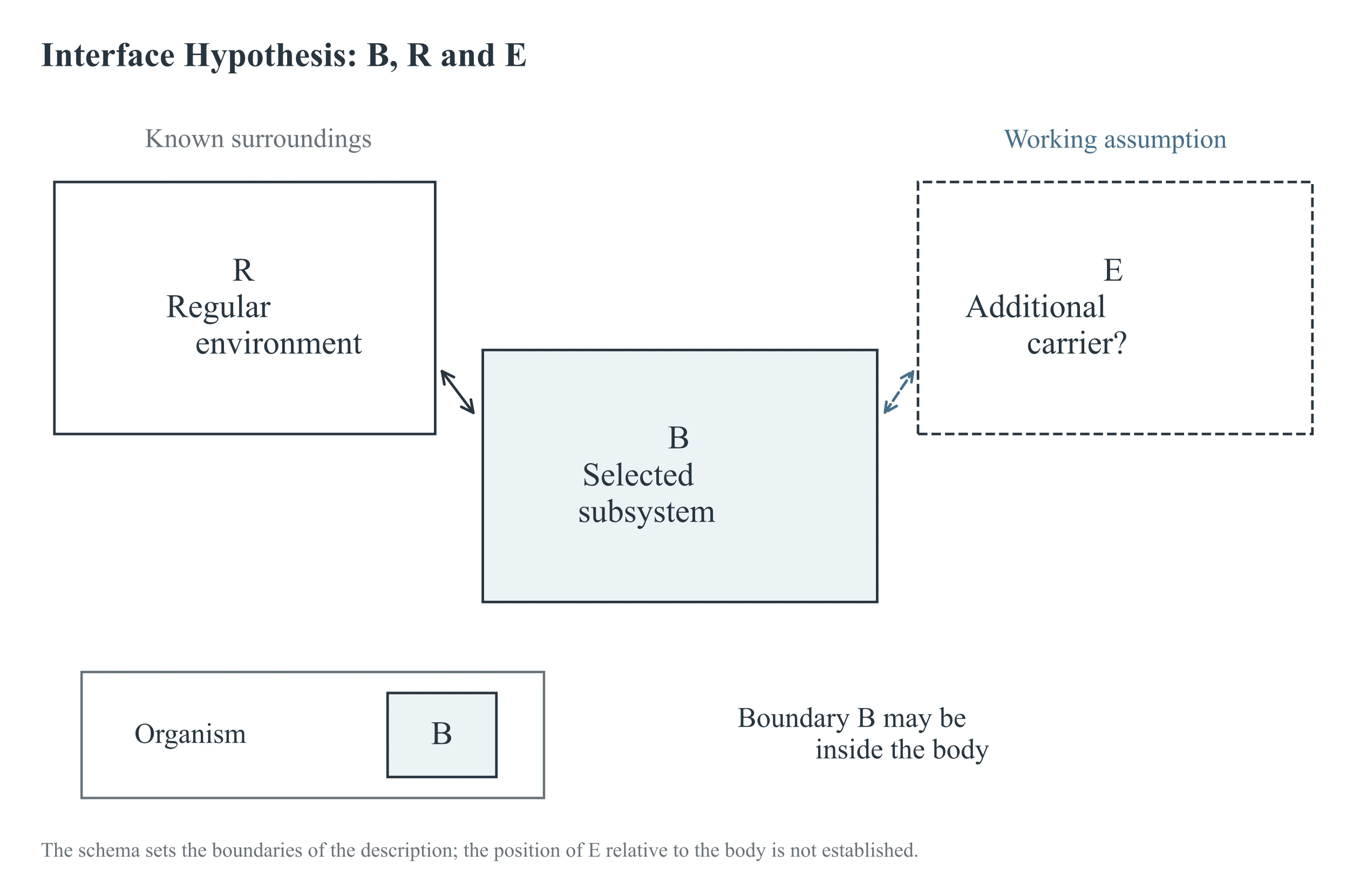
Figure 23. In the hypothesis, B denotes the selected biological subsystem, R the normal environment, E the proposed additional carrier. The exclusion of E from the description of B does not in itself determine its position relative to the body.
This division does not determine the location of consciousness. A subsystem within a cell may be mathematically external if it is excluded from the chosen description B. Therefore, the expression “consciousness outside the brain” requires a separate spatial statement. The discovery of a new intracellular mechanism may change neurobiology, but will not take the subject beyond the boundaries of the body. A spatially external carrier must exhibit precisely the properties of the external source: for example, a certain law of propagation or the dependence of communication on geometry.
The supposed fundamentality also does not mean limitlessness. If a general physical process is involved in the basis of an experience, a particular system can still receive only a limited set of its states. Ordinary light belongs to a common electromagnetic field, but two photodetectors do not become one detector. Likewise, a common carrier, if it exists, does not yet explain the unity or plurality of subjects. These properties will have to be derived from the organization of communication, and not from the word “common”.
There are two different search paths possible. In the first, the carrier is detected independently and then its relationship with the organism is examined. In the second, a persistent discrepancy between the observation and the existing model first appears, and an additional system is introduced as an explanation. The second way is acceptable, but requires special discipline: one discrepancy can have many reasons. A new medium becomes useful if it explains several independent features with one set of rules and predicts a consequence that has not yet been observed.
Geometry could be one of those rules. For a spatially external source, it matters whether the effect depends on distance, direction, or shielding. However, a specific law cannot be borrowed from a familiar field just for the sake of clarity. It must follow from the selected type of interaction. If normal electromagnetic influence is expected, the program must take into account its known properties. If a different interaction is claimed, reasons will be required to explain why it could not be identified before and where exactly it should appear.
There is also a useful mental limit. If E does not differ in any way from the usual environment in any possible observation, the introduction of a new letter does not add anything to the physical explanation. The distinction may retain philosophical significance, but it does not change the experimental program. Therefore, the study begins with a search for a property due to which the supposed additional contribution ceases to be just another name for the already taken into account environment.
The equation that defines obligations
To begin with, a standard notation of interacting quantum subsystems is sufficient. It is known independently of the question of consciousness and is used here as a language for formulating a hypothesis. [14]

The Hamiltonian H specifies the energy and dynamics. The first two terms describe B and E separately. The latter sets the connection between them. The identity operator I does not change the state of the subsystem on which it acts. The sign ⊗ denotes a tensor product: this is how operators acting on different parts of a composite system are combined. The operators A and F here are dimensionless, the coefficients g have the dimension of inverse time, and the constant ℏ has the dimension of action. All terms therefore have the dimension of energy. In this notation, the operators A and F are chosen to be Hermitian, and the coefficients g are chosen to be real, so that the interaction specifies an admissible Hamiltonian. Hermiticity is important here because such an operator has real eigenvalues - possible results of measuring the corresponding quantity. [14]
The formula requires meaningful choices. Operator A must correspond to a certain biological property, operator F to a certain characteristic of the carrier. The g coefficient cannot be changed every time in order to agree with the next observation. It must be evaluated independently or derived from the general model and then stored when testing new conditions. The number of terms of the sum also matters: an unlimited number of free connections allows you to describe almost any data, but deprives the model of the risk of making mistakes.
In a real organism, two subsystems are not enough. State B also depends on the usual environment R. If measurements are available only on B, its state is obtained as a partial trace over the remaining degrees of freedom:
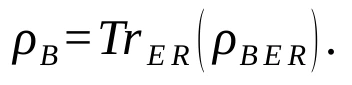
This record makes it possible to calculate the statistics of measurements on B. However, it cannot be used to unambiguously reconstruct the structure of hidden systems. Different environments can produce the same observable effects. Therefore, even a very accurate recording of brain activity does not in itself guarantee that it will be possible to distinguish an additional medium from a complex normal environment. We need the ability to change conditions so that the compared models diverge in their forecasts.
Selectivity as a physical property
Suppose the connection is strongest in a narrow range of frequencies. Then the hypothesis should predict not only an enhanced response at the center of the range, but also a weakening response away from the center. If the mechanism depends on the relative orientation of the structures, rotation should change the response according to a certain law. If phase conservation is required, random changes in phase must suppress precisely the corresponding component of the effect. This gives the general idea measurable limitations.
However, resonance can also be classical. The swing, the electric circuit and the acoustic instrument selectively respond to external influences. Therefore, detecting a response peak does not yet establish a quantum mechanism. It helps define the parameters of interaction. Its quantum nature requires additional observations related to selected states, measurements, and classical description capabilities. This limit is especially significant when a weak molecular effect is amplified by a large number of cellular processes.
The proposed hypothesis gives selectivity a central role. The brain is not an open window to any external content. Its structure limits the interactions available; the current state changes their effectiveness; history restructures future response. The image of a stationary antenna gives way to a system that constantly changes its own communication conditions. The meaning of this assumption can be revealed even with a very small model.
Small model of a big idea
Let the selected element B have two energy levels, and element E also have two levels. For simplicity, we will leave only the exchange of one excitation. The initial state is chosen such that E is excited and B is at a low level. The raise and lower operators move each element between these two states. The interaction has the form

The first term transfers excitation from E to B, the second allows for the reverse process. Coefficient g characterizes the exchange rate. This is the standard model of coupled transitions, chosen as a concrete example of the physical part of the hypothesis. It does not contain person, memory or qualia. The model is simple enough to be fully calculated and makes a specific enough prediction that it can be tested.
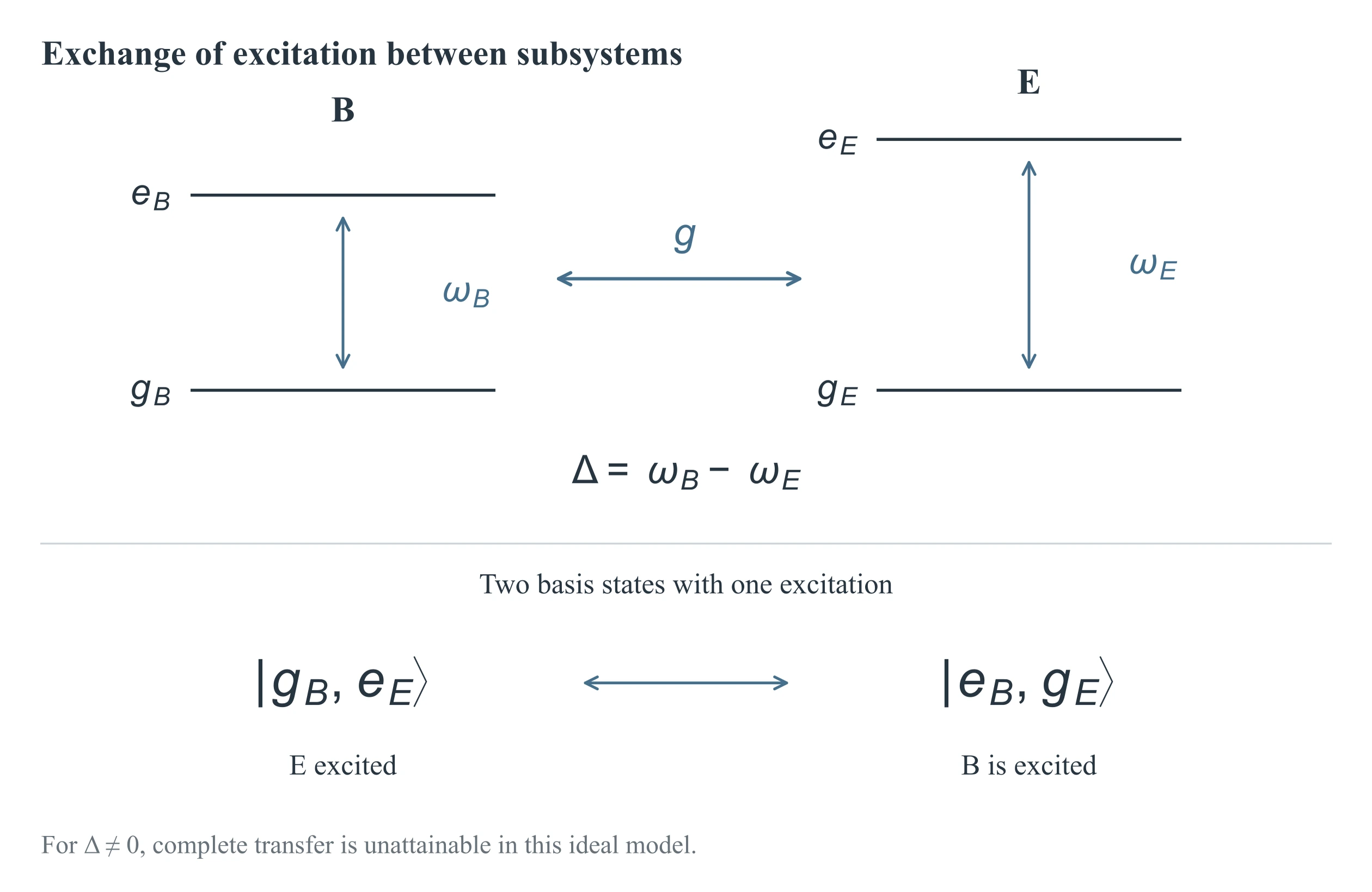
Figure 24. The minimal model allows the exchange of one excitation between B and E. The coefficient g specifies the coupling, and the detuning Δ is the difference in the angular frequencies of the transitions. With a non-zero detuning, the maximum transfer is limited. The model describes physical dynamics without the variable of subjective experience.
The calculation of the transfer probability for this model is shown in Figure 36 of the mathematical appendix.
In the ideal lossless case, the probability of detecting excitation on B after time t is equal to
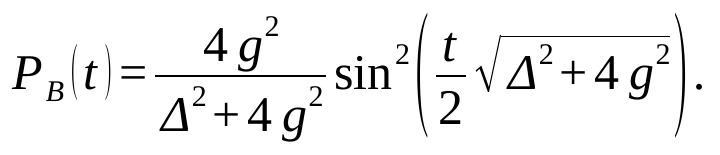
Here Δ is the difference in the angular frequencies of the two transitions. The formula is obtained for the specified initial state and the selected Hamiltonian. If the frequencies match, the probability becomes sin²(gt): the excitation can completely move from E to B and then return. With a large detuning, the maximum probability decreases. This is how specific selectivity arises, which can be expressed in numbers, and not just in words.
For example, with |Δ| = 2|g| the maximum probability of transfer in this ideal model is one in two. This is a mathematical example, not the result of brain research. It shows a useful predictive structure: the measured detuning constrains the effect size in advance. If the observed carryover violates such a limit, the cause may be additional levels, an incorrect model, or measurement error. The limit itself cannot be quietly undone once the data has been received.
In a biological environment, coherence fades, and levels can change population due to other processes. Then the ideal formula needs to be replaced by an open system calculation. For a preliminary assessment, the dimensionless parameter K is useful: the product of the effective communication frequency and the lifetime of the desired coherence. If the phase disappears much earlier than the characteristic exchange time, the described picture of complete coherent transfer does not have time to form. K is not a universal criterion of consciousness.
The change in transport probability can still be reproduced in some classical models of coupled oscillations. Therefore, this little construction does not serve as a single-curve proof of quantumness. It specifies a set of requirements for the hypothesis: what states are involved, how the initial condition is prepared, what is measured, why the response changes. Quantum signs should be sought in the additional structure of the experiment, and not any oscillation should be declared as such.
How a connection becomes biological
For the model to be relevant to the brain, state B must influence the subsequent process. Perhaps the probability of a chemical transition, the availability of a particular protein configuration, or the timing of an event involved in cellular signaling changes. Each option will require its own path from a microscopic state to an observable biological effect. The word “amplification” does not replace this path: both the useful signal and random fluctuations can be amplified.
Here a difficult condition of consistency arises. A bond that is too weak does not change the biological process in a noticeable way. Too strong can destroy the states that were intended to be used. The appropriate range should be determined by joint dynamics rather than by the desire to maintain a hypothesis. If it is necessary to assume exclusive protection from the environment, it is necessary to show how such protection arises and why it is compatible with access to the system.
The energy footprint also depends on the mechanism. The exchange of excitation presupposes a certain energy balance. A net change in the relative phase need not be accompanied by the same change in the average energy of the subsystem. Therefore, the requirement “a new connection must necessarily heat up the brain” is too harsh. The correct question is what observable changes result from the selected interaction and where energy, information, and noise fit in the full description.
The underlying biological prediction must persist across scale transitions. If a model explains a change in behavior through a change in a certain molecular probability, intermediate dependencies must be shown. Otherwise, at one end there will be an exact quantum formula, and at the other - a free verbal interpretation. Between them, a causal chain is required that can withstand independent measurements of each significant link.
Where does the question of experience begin?
Even successful completion of this chain would establish an additional physical mechanism. To explain consciousness would require a separate statement about why its organization corresponds to experience. In the proposed version, such a condition is considered to be the inclusion of communication in a stable process that distinguishes its own states, combines them with memory and uses the consequences of its actions for further changes. This is a working psychophysical postulate, and not a consequence of the reduced Hamiltonian.
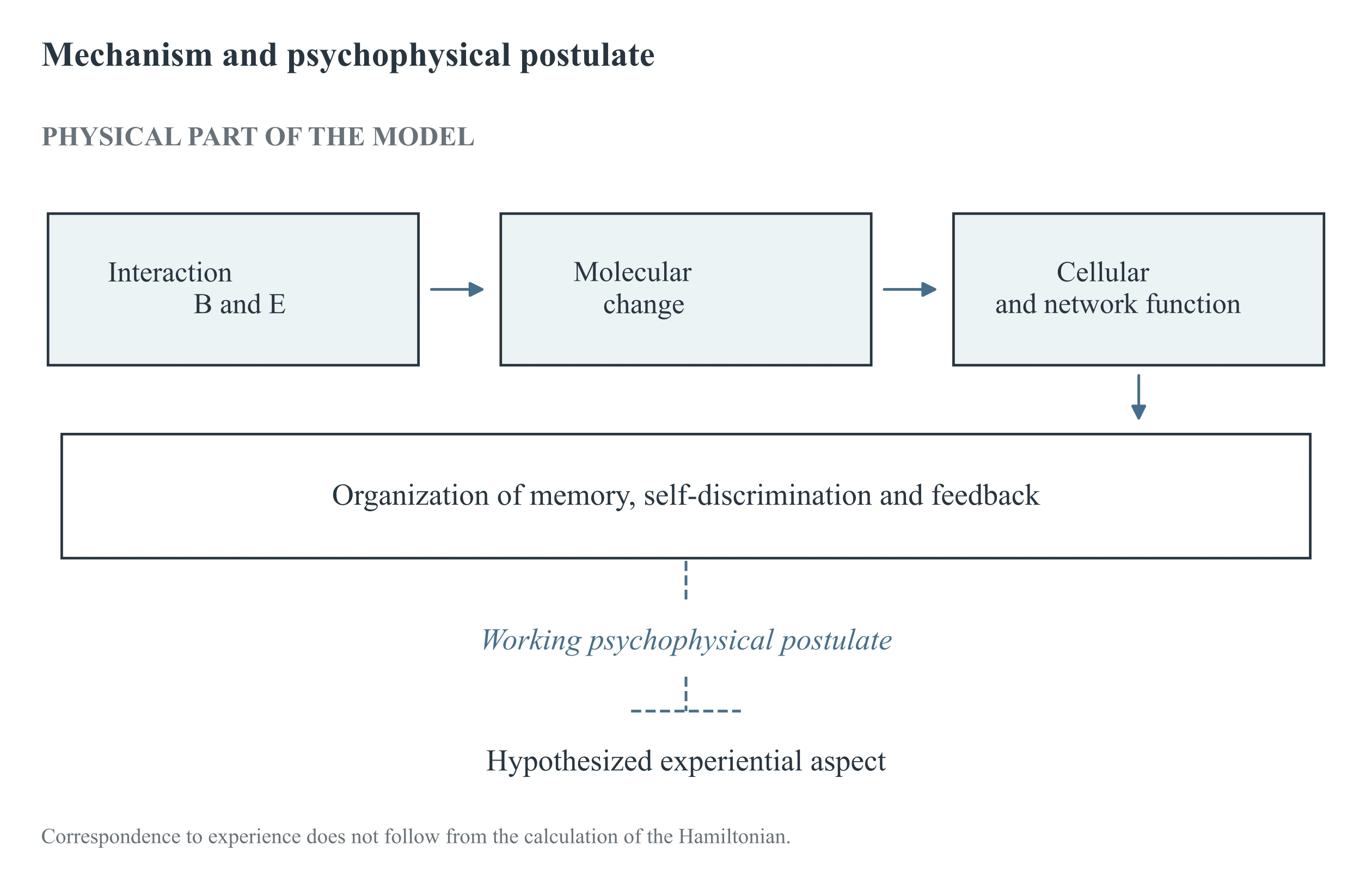
Figure 25. The calculation of physical interaction does not infer a subjective experience. In the author’s hypothesis, their connection sets a separate working postulate, which requires independent justification.
The postulate intentionally links the putative carrier to the organization of the organism. A separate quantum transition is not announced by a separate thought. The same physical resource can participate in different processes, and the presence of the resource does not yet determine the shape of the subjective world. The question of consciousness then refers to the stable organization of interactions through which events become states of a particular participant in what is happening.
The weak point of this version is clearly identified. While there is no independently confirmed rule for the transition from physical organization to experience, the model does not allow one to calculate the quality of sensation using known coefficients. But the physical part can already become verifiable: transfer of excitation, dependence on detuning, the effect of noise and biological consequences have their own verification conditions. Their result is capable of limiting the hypothesis even before the emergence of a complete theory of experience.
So, a minimal calculation scheme has been proposed and requirements for the future theory have been formulated: to determine the carrier, its connection with the body, the biological path of influence and the condition for the occurrence of the experience. This is not yet an established physical model of consciousness. No additional carrier E was found and the psychophysical condition remains a working prerequisite. But it is clear which links require verification and where the hypothesis may face refutation. The next difficulty concerns individuality: even if the common carrier is real, it is necessary to explain why through it many separate points of view arise, each with its own history and boundary.
Chapter 14