An Experiment That Distinguishes Explanations
The researcher faces two curves. Both describe the data already obtained quite well. The first is built with an additional carrier E, the second - without it, but with a more detailed account of the usual environment. If we evaluate only the similarity to known points, the question of the nature of the mechanism may remain unresolved. What is required is a situation in which the models make different predictions in advance.
This is the task of the decisive experiment for the interface hypothesis. It must test a specific connection, not the general possibility of a deeper reality. The hypothesis has specific parameters, a range of applicability, and an observable value. Then a negative result can exclude the selected version, and a positive result can provide grounds for continuing the study. Both outcomes only make sense relative to a clearly formulated model.
Statement with address
The sentence “quantum processes are involved in consciousness” is too broad for a single experiment. Almost any living substance is fundamentally subject to quantum physics. The scientific question begins with clarification: what condition, what mechanism, what function, and what observable effect are hypothesized? Without such an address, the outcome is easy to explain after the event, but difficult to predict before it.
The working version may sound more limited: certain B and E states interact with the measured coupling frequency, and changing the detuning between them changes the probability of a particular transition. This transition, in turn, influences the selected biological process. There is still no complete explanation of consciousness, but there is a sequence of statements, each of which can turn out to be incorrect.
A good place to start is to examine the weakest link in the chain. If an interaction does not exist within the stated range, a debate about its role in personality is premature. If a physical effect is found but does not affect the biological function, the program stops at another level. If a function is found, but it is not related to available measures of conscious state, what remains is a real mechanism without a claimed explanatory role.
This division helps to focus resources and accurately interpret the result. Successful spectroscopy does not translate into evidence of an external entity. An unsuccessful search for one carrier does not disprove all possible theories of consciousness. The study answers the question that is actually posed by its device. Its power is determined by the precision of this question.
Two devices and one forecast
Let's return to the small model of coupled transitions. Its parameters can first be studied in a physical analogue, without attributing experiences to it. It is required to determine the frequencies of the subsystems and the strength of the connection, then predict the dependence of the transfer on time and detuning. It is essential that the forecast be tested under conditions for which data were not used when selecting parameters. Otherwise, reproducing observations will be a test of the flexibility of the description rather than its predictive power.
In the ideal formula of chapter 13, the amplitude and frequency of oscillations are related by the same parameters. It is not possible to independently adjust the amplitude for one measurement and the frequency for another without maintaining the appearance of a single mechanism. This connection between observable quantities is a useful advantage of the model. The disagreement of one dependence with another indicates the insufficiency of the assumptions, even if each individually allows for a beautiful approximation.
For comparison, you will need a classic model with reasonable capabilities. Coupled oscillators, noise, and nonlinear transformations are capable of producing many response shapes. If a complementary model allows environmental memory, a similar capability cannot be unreasonably taken away from a competitor. Otherwise, the advantage will be a consequence of the rules of comparison, and not a property of nature. The opponent must describe real alternative reasons, and not a deliberately weakened caricature.
The result of the comparison may be modest: both models predict the selected data set equally well. This means insufficient discernibility in this particular experiment. The next step is to look for another intervention or additional observable. If there is no such distinction in principle, empirical choice between these descriptions at an accessible level is impossible. It should then be made clear how much of the disagreement remains interpretive.
Ambiguity also arises within a single model. An equally small response may arise due to a weak connection, large detuning, or rapid destruction of the desired state. If only the average amplitude is measured, these causes are sometimes difficult to separate. Then adding a parameter does not necessarily make the explanation more precise: it may increase the number of interchangeable options. Independent measurement of frequencies or relaxation times reduces this ambiguity.
A useful strategy is to predict different observations with the same quantities. The parameter estimated from the spectrum must participate in the calculation of the time response; the noise parameter obtained independently should limit the permissible visibility of the effect. If each observation requires its own new coefficient, the model gradually loses the connection between the phenomena being explained. In this case, it is worth simplifying the statement or recognizing that the suspected common cause has not yet been established.
At this stage, a negative result can also be local. The model is able to correctly describe the physical analogue and is not transferable to biological conditions, where significant scales have changed or additional processes have appeared. Then it is this transfer that needs to be investigated. The success of a model on a small system cannot be considered proof of the operation of the same mechanism in the body, just as one cannot ignore an analogue just because it itself is not alive. In such a comparison it is necessary to establish what essential physical conditions are preserved.
How to isolate a quantum property
Temporal fluctuations and resonance do not yet highlight quantum dynamics. To do this, the measurement must relate to the property on which the hypothesis is based: for example, a certain coherence, incompatible measurements, or entanglement of selected subsystems. The specific criterion depends on the design of the system and assumptions about the preparation of states. There is no universal picture according to which any unusual signal can be recognized as quantum. [14]
If coherent coupling is claimed, it is useful to compare conditions in which the level populations are maintained, but the relative phase changes. The predicted sensitivity to such change may separate the phase mechanism from simple energy transfer. But here, too, an analysis of alternatives is necessary: an effect designed to change the phase can simultaneously change the temperature, chemical conditions or registration efficiency. Selectivity of intervention must be part of the evidence.
If entanglement is claimed, observing correlated oscillations is not sufficient. One test is the entanglement witness: a measurable quantity for which a limit is predetermined and respected by all separable states. Exceeding this limit while meeting the test conditions indicates entanglement. If the limit is not violated, entanglement is not yet ruled out: a particular witness may not detect some entangled states. [31]
Whatever test is chosen, it must take into account the actual measurements available and the connections between the parts of the device. A common external influence can create correlated signals without the desired quantum property. Therefore, the conclusion depends on the fulfillment of the test conditions, and not only on the external similarity of the recorded vibrations.
This result establishes a quantum property only for the studied degrees of freedom. From the correlation of two elements one cannot infer the unification of two personalities or the transmission of a message without a channel. For the interface hypothesis, the result is valuable as evidence of the presence of a physical resource. It is now necessary to determine whether this resource is involved in biological function.
From mechanism to function
Let's assume the resource is found. Now we need to find out whether the selected biological process changes through it. Simple joint change is not enough: one impact can simultaneously change several systems. A useful program compares interventions with different side effects but the same predicted effect on the intended link. Consistency of such results helps to separate the mechanism of interest from random accompaniment.
The path of influence is especially important. If the hypothesis involves a change in molecular transition, then cellular response, then accessible behavior, the intermediate quantities must change in accordance with this sequence. This does not mean that the entire causal chain must be simple and linear. Feedbacks are acceptable, but they are included in the model in advance. The phrase “complex system” should not serve as a license to any direction of causation.
Statistical comparisons here require caution. If brain activity mediates the expected effect, statistically eliminating its contribution may also remove the effect under study. If the common cause affects both the carrier and the brain, failure to take it into account will create a false connection. Therefore, the choice of variables is determined by the causal scheme, and not by the desire to obtain a convenient coefficient after automatic processing.
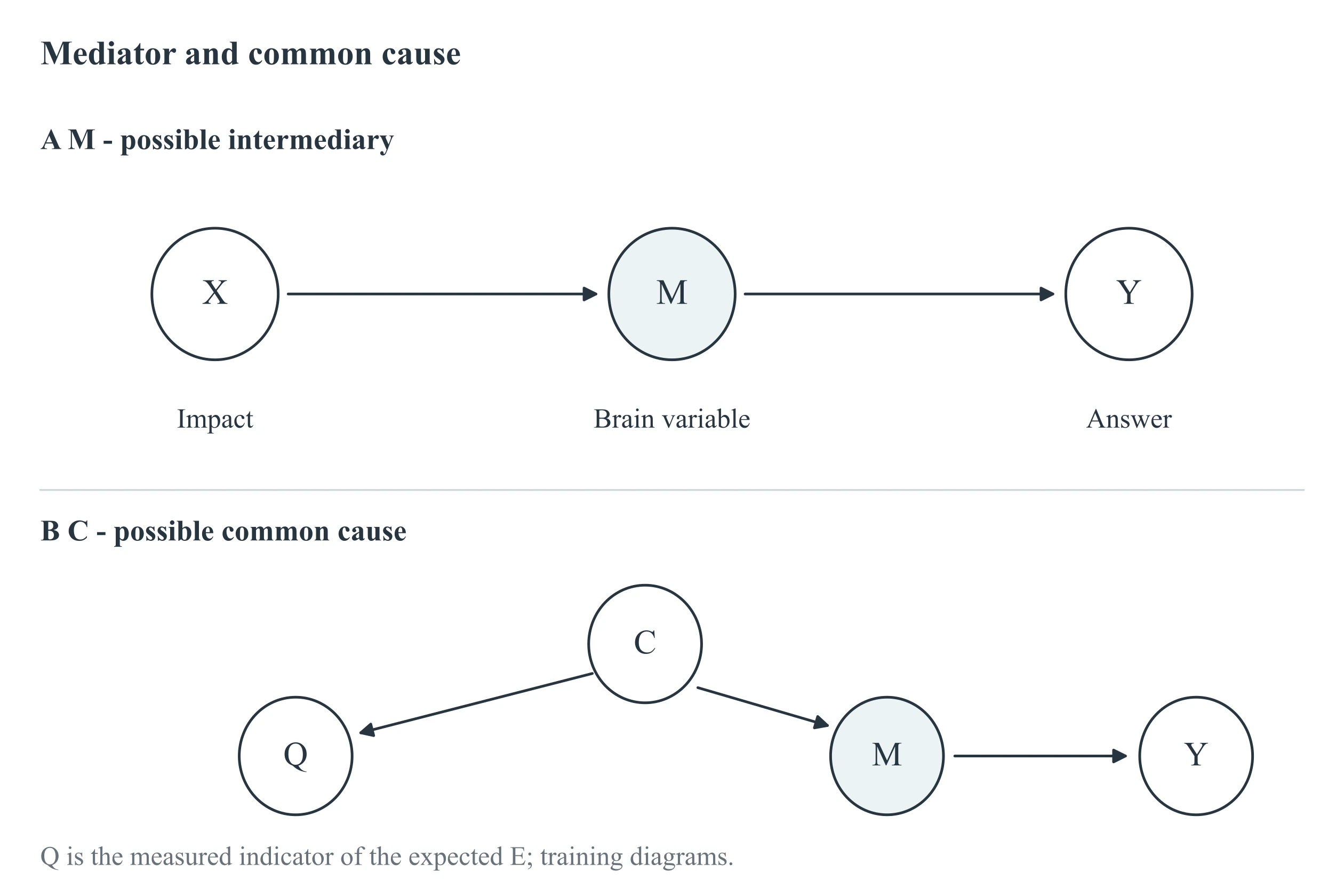
Figure 30. Two different causal roles of a variable. Statistical exclusion of the contribution of a mediator may obscure the influence path under investigation, and omitting a common cause may create a spurious association. The choice of analysis depends on the sound causal model.
At the human level, one will have to distinguish between the waking state, the content of experience, memory and the ability to respond. One change in an indicator does not allow us to conclude without additional data that everything else has changed. The study must consider how the available report is generated and what alternative causes change it. Interventions in the functioning of a living organism require professional research training; the logic of inference is considered here, and not a set of independent physiological procedures.
The forecast must survive new data
The model parameters have uncertainty. If the communication frequency is only approximately known, the prediction should not be depicted as a single perfect line. What is important is the range of expected results and how it changes with acceptable parameter values. A range that is too wide may formally include almost any observation, but then the model tells little about future experiment.
It is convenient to separate the data on which the structure of the model is clarified, and the data on which its prediction is checked. However, the separation itself does not protect against hidden adjustment if, after each failure, the selection rules, the observed value, or the acceptable carrier change. Changing the hypothesis is acceptable and often necessary, but the new version must receive new independent testing. The old check does not become successful retroactively.
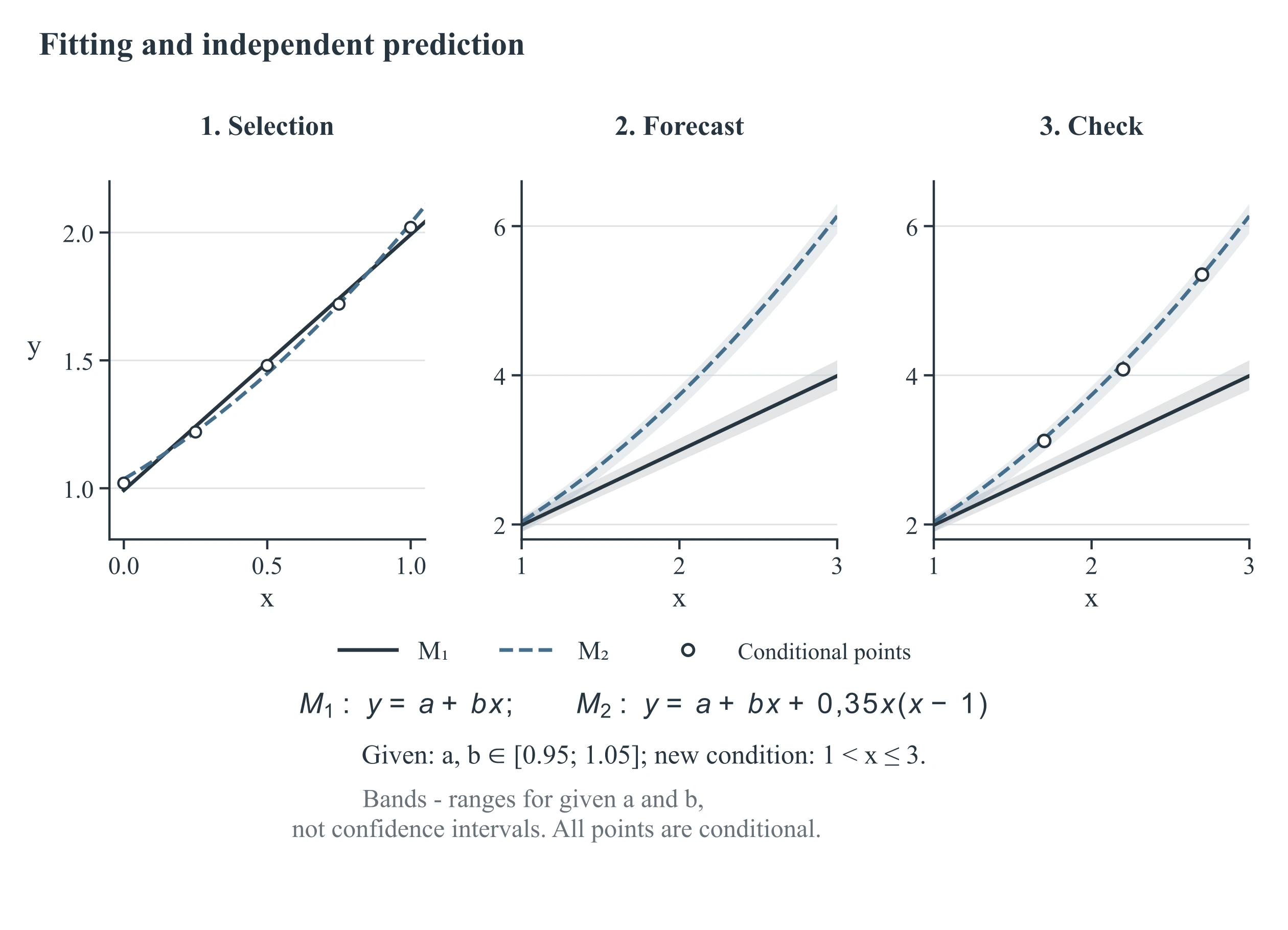
Figure 31. A conditional example of independent verification of two mathematical models. The bars show ranges of predictions given a, b ∈ [0.95; 1.05], rather than confidence intervals. All points are educational; verification observations are not involved in the selection of parameters and comparison conditions.
The Cogitate study used pre-consensus predictions to compare different theories of consciousness. The very principle of such comparison is useful for the author’s program: to identify discrepancies before the result becomes known. [1] This does not require any registered model to be considered correct. On the contrary, predetermined expectations make it possible to more accurately see which parts of the program failed the test.
Predictive accuracy must also be evaluated along with complexity. A model with more free parameters can better describe familiar data simply because it has more power. More convincing is an advantage that persists under new conditions and does not disappear after taking into account uncertainty. Sometimes a more complex version is truly necessary; then its additional elements must provide measurable explanatory benefit.
What does a negative result mean?
The absence of an expected effect has different meanings for different measurement possibilities. If the instrument does not discriminate between the quantities predicted by the model, experiment does not test its key assertion. If the sensitivity is sufficient and the conditions meet the assumptions, a negative result limits the parameters or rejects the implementation. Therefore, the detection threshold must be compared with the prediction before interpretation begins.
It is also important to explore the area of conditions rather than rely on one point. In the excitation exchange model, a small probability at a particular moment can arise even with a strong connection: the system could go through part of the cycle and return. Therefore, one low measured value does not automatically provide an upper bound on the interaction force. The time dependence and spectral structure help distinguish the lack of communication from the inopportune moment of observation.
A more meaningful limitation occurs when the predicted effect is absent across the entire preselected range where the model promises a detectable response. Then it is impossible to maintain the previous version by simply transferring the effect to an area not yet measured without a new basis. You can propose a different model, but this will be a change in the program, not a confirmation of the original one. The scientific value of a negative result lies precisely in the narrowing of acceptable explanations.
If the additional carrier cannot be described at all in such a way as to indicate such a range, the physical hypothesis is not yet ready for decisive experiment. This condition can be recognized directly and the model can be worked on. The lack of certainty should not become a privilege that allows an idea to escape any scrutiny.
What would significant success look like?
A strong positive result would present a consistent picture. The additional carrier or specific resource is discernible regardless of the desired psychological output. Its parameters predict the body's response. Changing the inferred connection changes this response in a particular way. Alternative models with comparable capabilities give worse forecasts on new data. Reproducibility is not dependent on a single instrument, a single group, or a single analysis method.
Even such success would not yet tell us where the experience “is.” It would establish a new causally significant participant in the processes associated with consciousness. A stronger fundamental statement would require an explanation of the relation of physical organization to the subjective side. But after such a result, this question would already be based on a new mechanism, and not just on an attractive analogy.
Thus the interface hypothesis becomes a research program with discernible outcomes. It may lose its intended physical basis, be narrowed down to a biological effect, become part of a broader neural model, or lead to the discovery of an additional interaction. None of these outcomes are determined by the title of the book. The predicted differences and the results of independent testing are critical. One way to carry out such tests is to study artificial systems in which the structure of memory, feedback and action is specified explicitly.
Chapter 18