Old questions in verifiable form
The question of whether man is exhausted by the visible body arises before any complex device. Death, sleep, memory and the feeling of one's own separateness force one to search for an explanation of what it means to be someone. Religious language can answer this question through the soul and its purpose. Philosophical - through the relationship between experience and the world. The scientific approach begins with a different requirement: what observation must change if the proposed explanation is true?
These ways of talking cannot simply be declared to be different names for the same theory. They can solve different problems. A statement about the meaning of life does not become a measurement when a formula appears next to it. But an image or a philosophical assumption can pose a question for which a physical model can subsequently be found. It is this transition that is of interest to this book.
What is saved during translation
There are different meanings of the word “soul”. It can denote personality, moral worth, a living presence, an immortal principle, or a bearer of memory. These values do not have to match. Therefore, scientific work accordingly begins with the choice of a specific statement, and not with the search for an instrument that should detect everything at once.
If soul is understood as the capacity to experience, the question arises about the conditions of subjective experience. If an independent bearer of biography is assumed, questions about recording, storing and retrieving information are necessary. If we are talking about the action of an immaterial cause on a body, it is necessary to understand what observable changes will distinguish this action from already known interactions.
During translation, some of the original meaning may be lost. Science is able to test a certain statement about memory without resolving the question of human purpose. It can limit the pattern of external influence without making a judgment about the religious picture of the world as a whole. The boundaries of the conclusion are determined by which specific statement was verified.
This book retains the original question but takes it into a testable form. Instead of the statement “the personality is larger than the body,” a problem appears: are there any observed dependencies that require an additional carrier to be included in the model to explain? Instead of saying “everything is connected,” the question is what connections are significant, how they are discovered, and what differences they create.
Primacy allows for different models
The assumption of primary consciousness may mean that experience refers to fundamental properties of reality. In this case, it does not have to be at a separate point in space. This situation concerns what is considered initial in an explanation. To relate it to physics, we need a rule of correspondence between a fundamental property and specific physical organizations.
Another version assumes an independent physical system outside the body. It interacts with the brain and contributes to the human condition. Here the usual research task already arises: to determine the medium, the method of communication, the magnitude of the effect and the conditions for its occurrence. The unknown nature of the medium does not negate these requirements.
The third version shifts the emphasis to relationships. Neither the organism nor the putative wider system alone constitutes a complete human person. The individual subject emerges from the sustained interaction between them. This version is closer to the hypothesis of joint formation of personality developed further, but for now it also requires its own physical content.
The difference between versions is important for assessing failure. If a particular external field is not detected, this may weaken the model of that field. It does not automatically refute any idea that experience is fundamental. Conversely, the philosophical appeal of fundamentality does not support the specific meaning of coupling strength in a physical experiment.
The idea becomes more precise when it stops moving between these values based on convenience. Each statement must retain its own subject. Otherwise, a positive result will be counted towards all versions at once, and a negative result will not apply to any one.
The cause must leave a discernible trace
Let's imagine two models of one experiment. In the first, a person’s state is determined by the functioning of the body and normal interactions with the environment. The second one adds an external carrier that acts on a certain brain process. If both models predict the same observations under all available conditions, the choice between them is not yet decided by this experiment.
For a difference to occur, the participation of an additional carrier must lead to a certain observable effect. For example, it can change the response to an independently measured stimulus or specify a dependence on distance, orientation, or time. These examples indicate the type of prediction that is possible, rather than reporting already discovered properties of consciousness.
However, any unusual coincidence does not indicate a new channel. Two systems can respond to a common external factor. The measuring instrument may introduce similar errors. The way episodes are selected can highlight matches and leave out discrepancies. Therefore, the model must include not only the desired cause, but also the real ways in which the observed result occurs.
Caution is also needed in the other direction. If the intended effect is realized through a change in brain activity, you cannot simply exclude all brain activity from the analysis and expect the effect to persist. Such a procedure may remove the action path itself. The question is one of comparing causal explanations, not of mechanically subtracting everything known.
This gives rise to the constructive meaning of the image of the receiver. Its scientific version begins where there is a certain connection between input, transformation and output. The receiver is interesting not by its name, but by the fact that it allows you to predict how the result will change after changing one of the links.
The formula does not replace the relationship between concepts
Mathematical notation can give precision to the model. But it can also hide emptiness if familiar symbols are assigned uncertain meanings. It is enough to designate consciousness with a letter, enter the coefficient of “spiritual energy” and write an equality to obtain an external resemblance to physics. As long as there are no definitions and measurement procedures, the similarity remains superficial.
An equation is useful when it relates quantities whose values can be specified, measured, or derived from other conditions. It is also necessary to check the dimensions. Energy, time and probability do not become interchangeable just because a complex subject is being discussed. If a new quantity is introduced, its meaning must be determined before it is used in the explanation.
Even a correct physical calculation does not automatically resolve the issue of experience. You can get the lifetime of a state or the probability of a reaction. To move from this value to consciousness, an additional assumption is required: why exactly does it matter to the subject and how to discover this meaning regardless of the original idea.
Therefore, the mathematical part of the book will serve two purposes. It must describe a possible mechanism and at the same time show its limits. The standard recording of the interaction of two subsystems will remain standard physics. The author's contribution will begin in the selection of testable connections between these dynamics and specific aspects of experience.
This order does not reduce the boldness of the hypothesis. It makes visible exactly where a new step is being proposed. Without this, it is impossible to understand what needs to be tested: a long-known equation, an unknown biological mechanism, or a new rule of correspondence between physical organization and experience.
When the question has not yet become an experiment
It is possible to formulate a statement about consciousness that by definition has no observable consequences. For example, assume an additional entity that does not affect the body, memory, actions and measurement results. Such a statement may have philosophical implications. But the experiment does not provide a way to distinguish between its presence and absence.
This does not give the right to call a statement false simply because it is currently unverifiable. However, it does not allow us to present it as a confirmed natural scientific result. There is a separate distance between logical possibility and data support.
There are also intermediate cases. The model may have observable consequences that are currently too small for available instruments. It also happens that the type of effect has already been determined, but the biological carrier has not yet been sufficiently studied. Future measurement sensitivity, range of acceptable parameters, and indirect limitations can then be discussed. It is important not to confuse the technical inaccessibility of a certain experience with the absence of any conceivable difference.
A negative result also depends on the conditions. If the method was only able to detect strong effects, the lack of signal limits the strong variations. It does not show that every weak effect is absent. But the possibility of an infinitely weak effect should not be turned into a way to save any explanation: such an effect must still be significant enough for the function that is attributed to it.
This is where physics and the explanation of consciousness come together especially closely. A carrier that cannot be detected due to its negligible effect is difficult to simultaneously claim as the cause of large and lasting differences in body performance without an additional amplification mechanism.
The same observation can support different stories
Let's imagine that after changing some physical parameter, a person distinguishes visual signals differently. A proponent of the interface model might attribute this to the setup of an additional channel. The neural model could explain the result by changes in cell sensitivity. Both stories may be compatible with one observation. So the important question is: what additional outcome do they expect differently?
The first model, for example, would have to relate the change to an independently determined property of the putative carrier. The second is with measurable cellular processes. The difference may be small, but it is what makes the comparison a study. If a new mechanism is introduced only after the result has been obtained and does not set its own expectations, its explanatory role remains unclear.
Nor can a theory be considered superior just because it uses more variables. Additional parameters allow you to adapt the description to already known data. A content check appears when moving to conditions that were not used to set up the model. The more accurately a new observation is predicted, the stronger the reason to continue working with the corresponding mechanism.
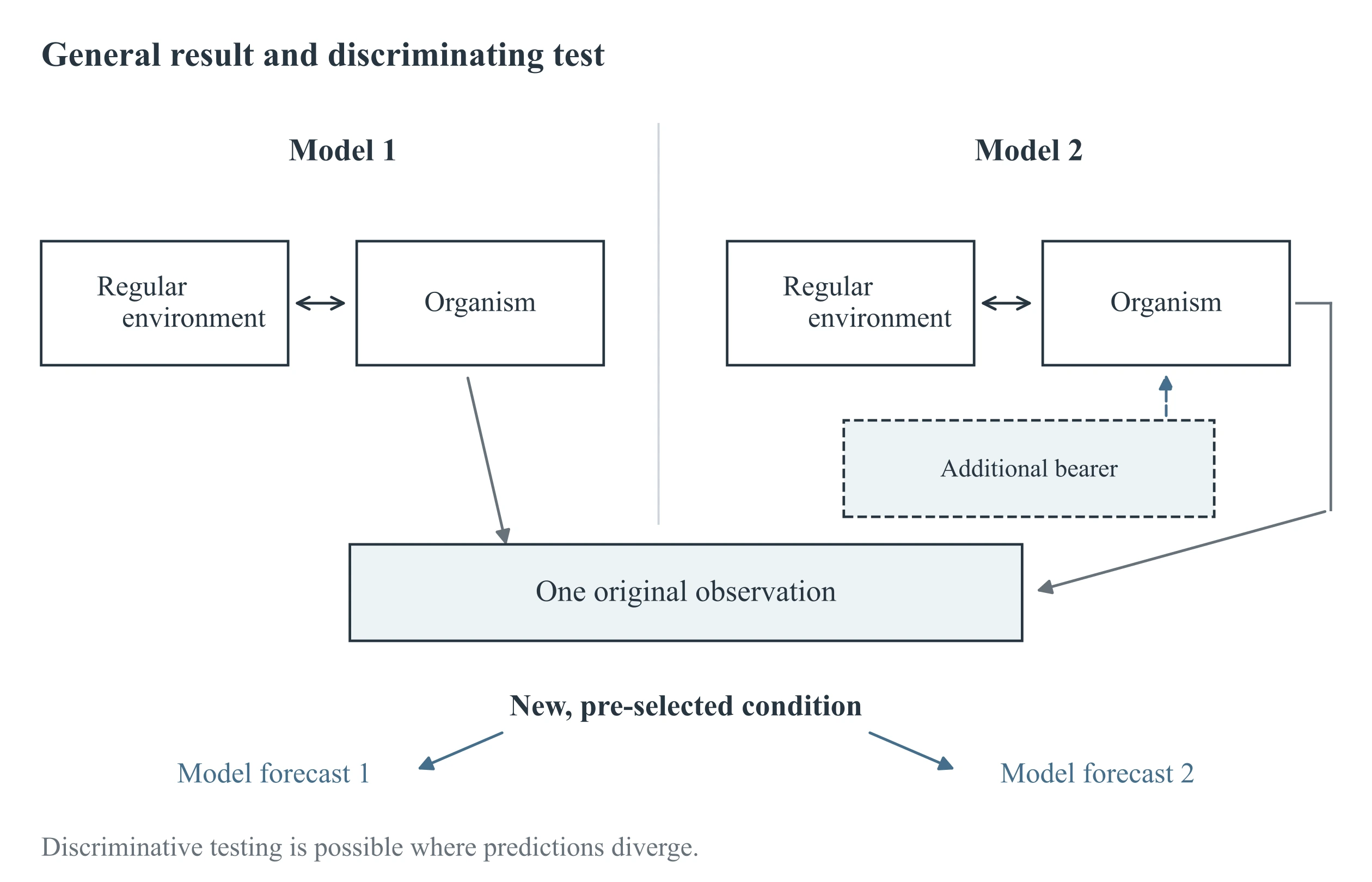
Figure 7. The same initial result can be compatible with different models. Discriminative testing requires a new condition and pre-formulated expectations.
For controversial issues, this rule is especially useful. It allows you not to decide in advance which image of a person should win. The study may reveal a broader physical system, or it may reveal the sufficiency of mechanisms that were previously underestimated. The scientific value of a work is determined by how much it reduces uncertainty, not by whether the result matches the original expectation.
Therefore, a scientific basis must also include data that resists the hypothesis. The external medium, if it exists, does not exempt the model from explaining the subtle dependence of experience on the brain. And the success of a neural explanation of a particular function does not automatically turn all questions about experience into solved ones. Each approach must clarify what exactly it managed to explain.
The hypothesis becomes stronger through restrictions
Suppose that external input is needed only for the occurrence of the experience, and all information used in behavior is completely formed by the brain. This version differs from the assumption that an external system stores memories and transmits them to the body. In the first case, it is necessary to find an indicator that is sensitive to the expected condition of the experience itself. In the second, additional requirements for the information channel and memory appear.
If these options are separated in advance, the data may change their assessment differently. Detection of external physical influence does not yet show the presence of an external biography. Discovering the ability of a system to store information does not yet show that this information is being experienced. Each transition requires its own foundation.
Existing scientific programs already have examples of such refinement. The Orch OR theory links consciousness to specific assumptions about microtubules and objective reduction. Fisher's hypothesis highlights other media and processes. They can be discussed precisely because they name the physical links to which certain questions arise. The joint use of quantum concepts does not make these programs one theory. [4, 7]
The authors' interface hypothesis must also acquire its own set of constraints. It cannot serve as a general name for everything that remains unexplained. It must specify what is connected, why the connection is selective, how individuality arises, and how this construction differs from a neural explanation of the same observations.
Old questions retain their depth. The method of promotion is changing. Instead of seeking definitive confirmation of a pre-selected picture, it becomes possible to gradually eliminate inappropriate mechanisms and strengthen those that stand up to comparison. The next part of the book begins with an area where such an approach already has a specific subject: with physical processes in living matter.
Part two