Memory on both sides of the border
There is an old photograph on the table. The person who pressed the camera button may no longer be there, but the photograph retains the distinction between what was in front of the lens and what was not there. It contains a trace of the event. If the photo is seen by another person, the trace will again affect the living system. However, it does not follow that the former observer continues to look through the photograph.
This simple example separates three things that can easily be confused: retention of information, retrieval of content, and continuation of subjective experience. The external memory trace hypothesis concerns primarily the first two. It assumes that some of the information that is significant for the body can be recorded in an additional medium and subsequently become available again. To discuss the third, we will have to add the conditions of identity and continuity; they are not included in the fact of storage itself.
Trace and memory
A physical trace can be called a difference in the state of a system caused by a previous event. For usable memory, one difference is not enough. It must be preserved long enough, remain distinguishable in the presence of interference, and participate in the reading process. In addition, the reading system must distinguish which content the received signal relates to. Without this, the unusual response does not yet become a memory.
Moreover, human memory is not limited to preserving arbitrary details of a microstate. It includes relationships between events, assessment of their significance, skills and methods for reconstructing content. Therefore, the theory of external storage must answer the question of what exactly is stored: a separate sensory feature, a sequence of events, rules of action, or an entire organization of personality. Different answers require different media capacities, different storage times, and different reading mechanisms.
The neural level cannot be considered optional. In an experiment by Xu Liu and colleagues, certain hippocampal neurons involved in the formation of a conditioned fear response were reactivated in mice. This activation caused corresponding freezing in a different context. The result links a specific cell population to the reproduction of an acquired response; it does not mean that it was possible to read a human biography from cells. [25]
These data pose a specific challenge to the interface hypothesis. Even if some information is stored additionally, it is necessary to explain why certain neural changes help reproduce it, while others interfere. A possible external trace does not negate the internal access device. But declaring neurons just a “key” is not enough: a key also has a structure, a mechanism of action, and verifiable constraints.
Three different storage architectures
The simplest version assumes regular internal memory. The E bearer, if it participates in the experience, does not keep a biography. The acquired content is preserved in biological changes, and the additional connection affects only the current organization of experience. This version is compatible with the hypothesis of a more fundamental basis of experience, but in itself does not allow us to expect the preservation of personality after the destruction of the organism.
The second version assumes shared memory. Some of the content or supporting data is stored outside the selected biological subsystem. Recovery requires both an external trace and an internal access state. This architecture is familiar from conventional computing devices, so the location of the storage outside the subsystem itself is not a sign of consciousness. Scientific novelty might lie in the discovery of a specific previously unknown mechanism in an organism.
The third version is much stronger: sufficient organization is preserved in the external medium to continue the individual perspective. This requires more than just an event archive. We need rules for their relationship, access to history, differences between this person and others, and a process that can continue. If the external system contains only information from which another organism can construct a similar story, the question of preserving the former subject remains open.
These versions cannot be combined into one formula: “everything is stored outside.” They give different forecasts when the internal access is damaged, the external media changes, and the connection between them is disrupted. In the first version, the loss of a biological trace should eliminate the possibility of recovery; in the second, information can be stored while remaining inaccessible; in the third, independent continuation of the process is assumed. Each subsequent version requires additional physical conditions.
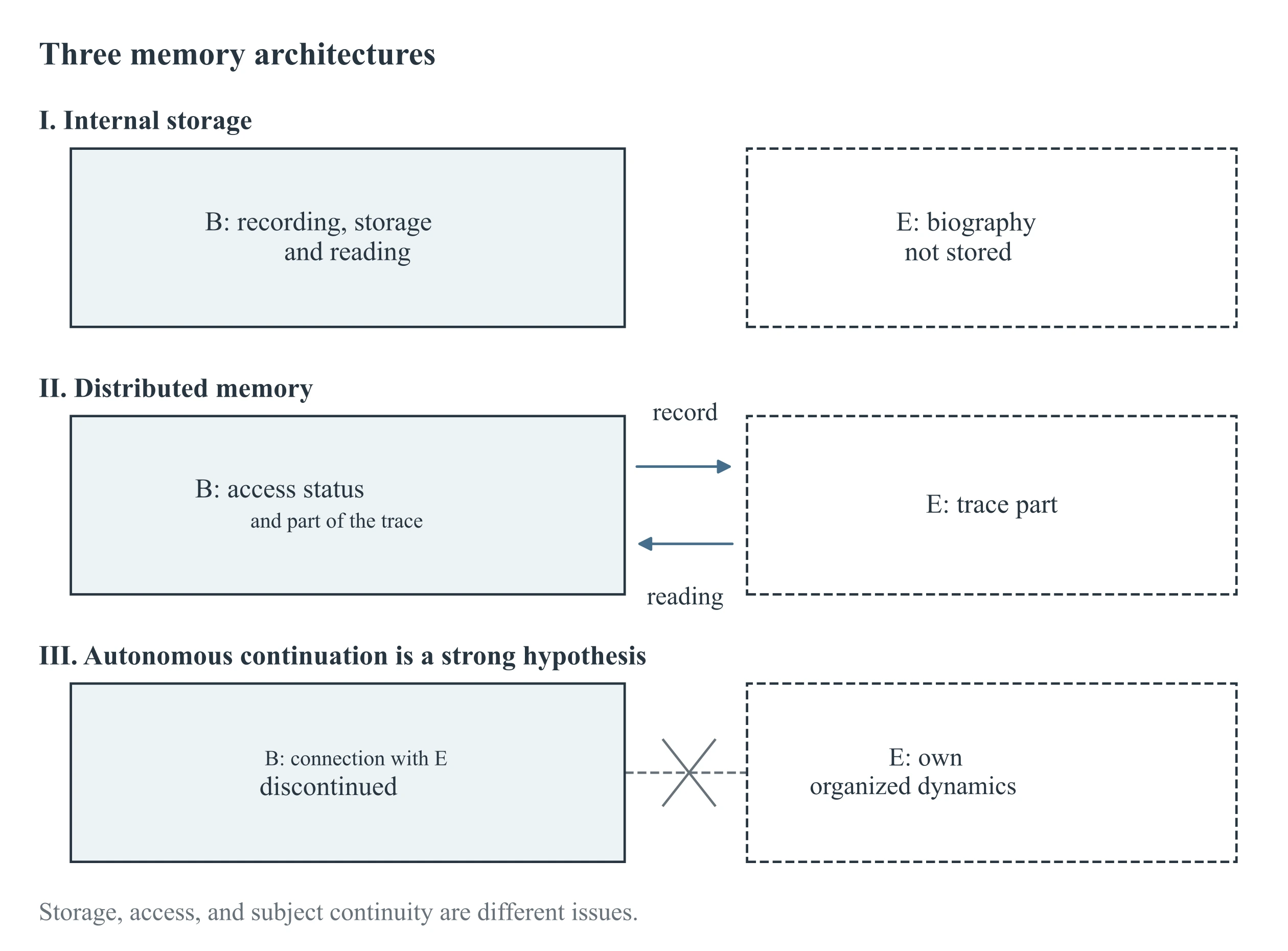
Figure 27. The three versions differ in storage location and access conditions. A trace external to B does not automatically mean a location outside the body; autonomous continuation requires additional assumptions.
The recording must leave consequences
Suppose an event M changes the state of the biological subsystem B. For an external trace to appear, this change must influence E through a certain interaction. This means that the direction of recording appears in the hypothesis. Later, state E must influence B so that reproduction depends on the earlier event. This is the reading direction. Constant interaction between two systems alone is not enough to prove that a memory with the desired properties has arisen.
The recording has limitations. Various events must leave sufficiently distinguishable traces. If a huge number of states of an organism are mapped to the same state E, it is impossible to reconstruct their differences without additional information. If the trace quickly becomes mixed with noise, reading becomes unreliable. If the method of addressing changes, information may be physically preserved, but no longer be accessible to a specific organism.
Addressing is especially important for the common carrier assumption. If it records events from many systems, a selective access mechanism is needed. A memory cannot simply be called “mine” in hindsight. The model must explain what features of the connection highlight the desired trace, how confusion is prevented, and why new events do not destroy all previous records. The ability to share a physical environment does not relieve one from normal memory tasks.
Reading errors may be more informative than a single successful recovery. If the trace itself is damaged, one would expect errors to depend on time and storage conditions. If the address is violated, the content of another entry may be substituted. If the transformation of the signal into an available response changes, errors may retain some of the structure of the original content. These are conditional options for the model, and not a description of the already discovered human external memory. Their value is that they associate the suspected malfunction with a certain type of error.
It is especially important to distinguish inaccessibility from absence. A failed recall attempt does not, by itself, indicate whether the trace was destroyed, access was lost, or whether the record was not generated in the first place. In a model device, these cases can be separated by independently changing the storage and reading mechanism. For a living organism, such a division is usually much more difficult, so the conclusion about an external archive should not arise only from the fact of the unexpected restoration of content after a long break.
The reverse limitation is just as significant. Successful recovery from damage to one path does not mean that the information came from outside. They could be stored in another internal process or restored according to the remaining characteristics. The external trace hypothesis should show exactly which dependencies are not explained by these possibilities. Its advantage is determined by the content of the prediction, and not by the emotional persuasiveness of the returned memory.
In this case, the external media may turn out to be quite ordinary. The system is capable of leaving traces in the environment and subsequently receiving them again through the senses. To claim a special mechanism, you need to separate it from such paths. Otherwise, the detection of external storage will be reduced to the well-known fact that the world changes after interaction with the organism. A new hypothesis requires a specific channel, not just a long-lasting trace.
The Limits of Quantum Copying
If the medium is declared quantum, the usual image of backup needs to be clarified. The No-Cloning Theorem states that it is impossible to create a universal device that perfectly copies an arbitrary unknown quantum state. Wutters and Zurek showed the connection of this limitation with the linearity of quantum evolution. The prohibition does not apply to the ordinary copying of distinguishable classical records, nor does it prohibit the transfer of state from one system to another. [24]
Therefore, the hypothesis needs to clarify what exactly is supposed to be preserved. If we are talking about a classical description of events, it is not necessary to refer to quantum copy protection. If unknown quantum states are significant for a person, it is impossible to simultaneously promise their exact copy, preservation of the original, and free repeated reading without justification. The physical limitations of the chosen medium become part of the theory of personality, and not a decorative addition to it.
Transfer is also not equal to the continuation of the subject. Quantum state can be transferred between laboratory systems containing no biography or self-representation. Consciousness requires an explanation of the role the transferred state plays in the stable organization of experience. If it only regulates the probability of a single event, its preservation does not yet ensure the preservation of the entire personality. If it encodes much more, this must follow from the capacity and access model.
Reading becomes a separate problem. A single measurement result usually does not provide a complete description of an unknown quantum state. Therefore, the image of an external library from which the exact internal states of all people can be read without restrictions requires special justification. Possible storage methods differ in what content is available to one reader and how the act of reading itself changes the medium. [14]
An Experiment with Controlled Memory
For the first check of the external trace, it is reasonable to consider a model device where the boundaries of the subsystems are specified by the design. Let it receive a randomly selected sequence during recording. The available internal records of B are then moved to a predetermined state, and the state of E is either saved or independently modified. After communication is restored, it is examined whether the device's response depends on the original sequence.
The input sequence is chosen randomly; until the assessment is completed, it is known to the experimenter, but hidden from those who analyze the responses. If a device plays a frequently occurring story, it is difficult to rule out learning from similar data. If it reconstructs pre-selected random differences, the question becomes quantitative. You can compare the proportion of correct answers, the structure of errors, and the dependence of accuracy on storage time.
But even this result does not automatically select the desired media. Residual memory may remain in power, controller, temperature, hardware log, or the normal R environment. The test must be designed so that the availability of each known channel has predictable consequences. A change in E should be distinguished from general damage to the device. Otherwise, the disappearance of the result after the intervention will only show that the intervention is interfering with something.
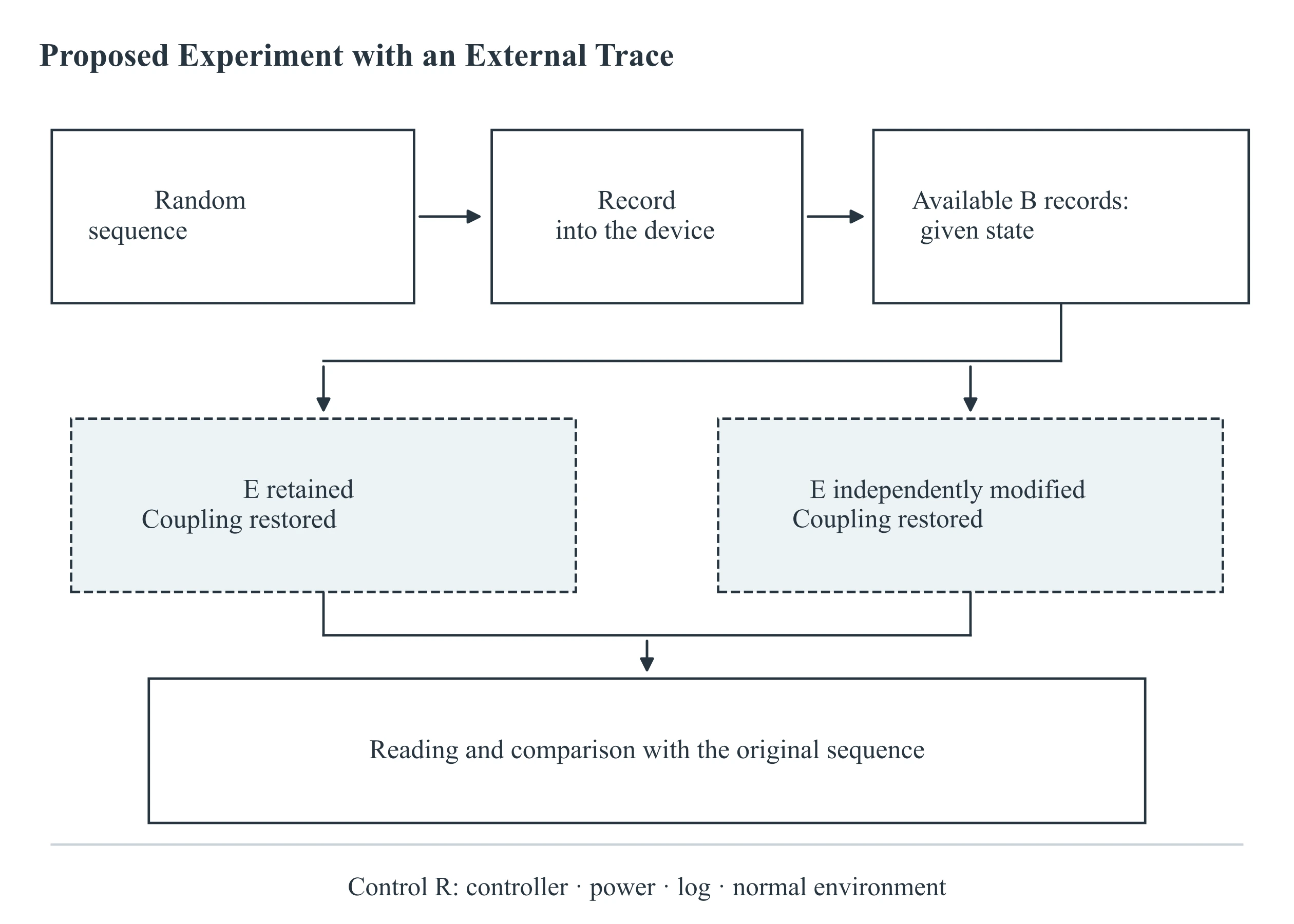
Figure 28. Proposed verification of the external trace in a model device. The retention and change of E are compared while monitoring the available entries B and the normal channels R. The figure does not depict the experiment performed.
Strong evidence would be to fit multiple dependencies into a single model: trace retention time, capacity limit, addressing mode, and predictable read failure. This is more than the unexpected recovery of one fragment. The mechanism must explain both successful responses and the nature of errors. At this level, research concerns the physics of memory; the transfer to human autobiography will require self-verification.
Why recognition does not yet solve the question of identity
Let us mentally assume that the device accurately restores previously unknown information about a person’s life. Even such a strong result will first establish access to information. Then you will have to find out where it came from and why it belongs to this particular source. Only after this will the question arise whether the restoration is accompanied by a continuation of the previous perspective or the emergence of a new system that has the same information.
The difference becomes noticeable in the case of two copies. Let two systems receive the same biographical record and both confidently claim to be its owner. The similarity of the answers does not allow one of them to automatically exclude the other. Continuity theories require additional conditions: a specific causal history, the conservation of a certain process, or some other connection that can be clearly formulated. It is impossible to deduce the only successor from the coincidence of stories.
This limitation also applies to conventional memory technologies. An archive can outlive its creator, and a program trained on it can reproduce a speech style. The usefulness of such systems does not depend on their acceptance by the same person. If a claim is made about the continuation of subjective life, the criterion must be stricter than the accuracy of the reproduction of texts or the recognition of character. Information similarity and personal continuity solve different problems.
The author's external trace hypothesis therefore leaves several outcomes open. Additional storage may not be available. It may exist, but support only a narrow physical process. It can participate in memory access while remaining completely dependent on the body. Finally, it is possible to explore a stronger version of the external continuation of the personality organization - provided that additional mechanisms and methods for their verification are named for it.
The photograph on the table continues to exist. She reminds us that information can indeed cross the boundaries of time and the individual organism. But to turn a trace into a memory, a reading process is needed. To turn a memory into a part of personality, you need to organize the story. And in order to talk about the continuation of the experience, it is necessary to understand what exactly makes this organization one and the same participant in what is happening.
This organization does not exist separately from the ways of perception and action. Therefore, the question of memory leads to the structure of the body: what signals it makes available, what actions it allows, and how the content of personal experience is formed through them.
Chapter 16