Where to Look for the One Who Experiences
A person reaches out to a cup and almost never decides separately who owns the moving hand. Belonging is already present in action. The cup is on the outside, the hand serves as a means of movement, the effort is felt as one's own. This little episode seems simpler than the question of the origin of consciousness. However, it already combines the perception of the world, the representation of the body, the expectation of the result and the feeling of one’s own participation.
If you only look for the subject as a hidden point inside the head, this whole device is easy to miss. In such a search, consciousness is presented in advance as a small spectator: the senses provide him with pictures, memory shows him the past, the will allows him to press internal buttons. But then the same question arises for the viewer himself. How does he see pictures and feel pressure? Moving the observer inside the system does not solve the problem.
Body Ownership Does Not Always Follow Anatomy
In an experiment by Matthew Botvinick and Jonathan Cohen, the participant's real hand was hidden from view, and an artificial one was placed in front of him. Simultaneous touching of both hands could cause the feeling that the visible artificial hand belonged to the participant himself. The authors also compared matched and mismatched touch conditions and assessed changes in the perceived position of one's own hand. The work showed the connection of bodily identity with the coordination of visual, tactile and proprioceptive information. She did not show the transfer of consciousness into the object. [16]
The difference is fundamental. The physical hand has not moved, but the way the body is represented has changed. Therefore, the experienced boundary of the body is not a simple photograph of an anatomical boundary. There is a work of coordination between the body and the sensation of the body. Its results are usually so familiar that they are taken for granted.
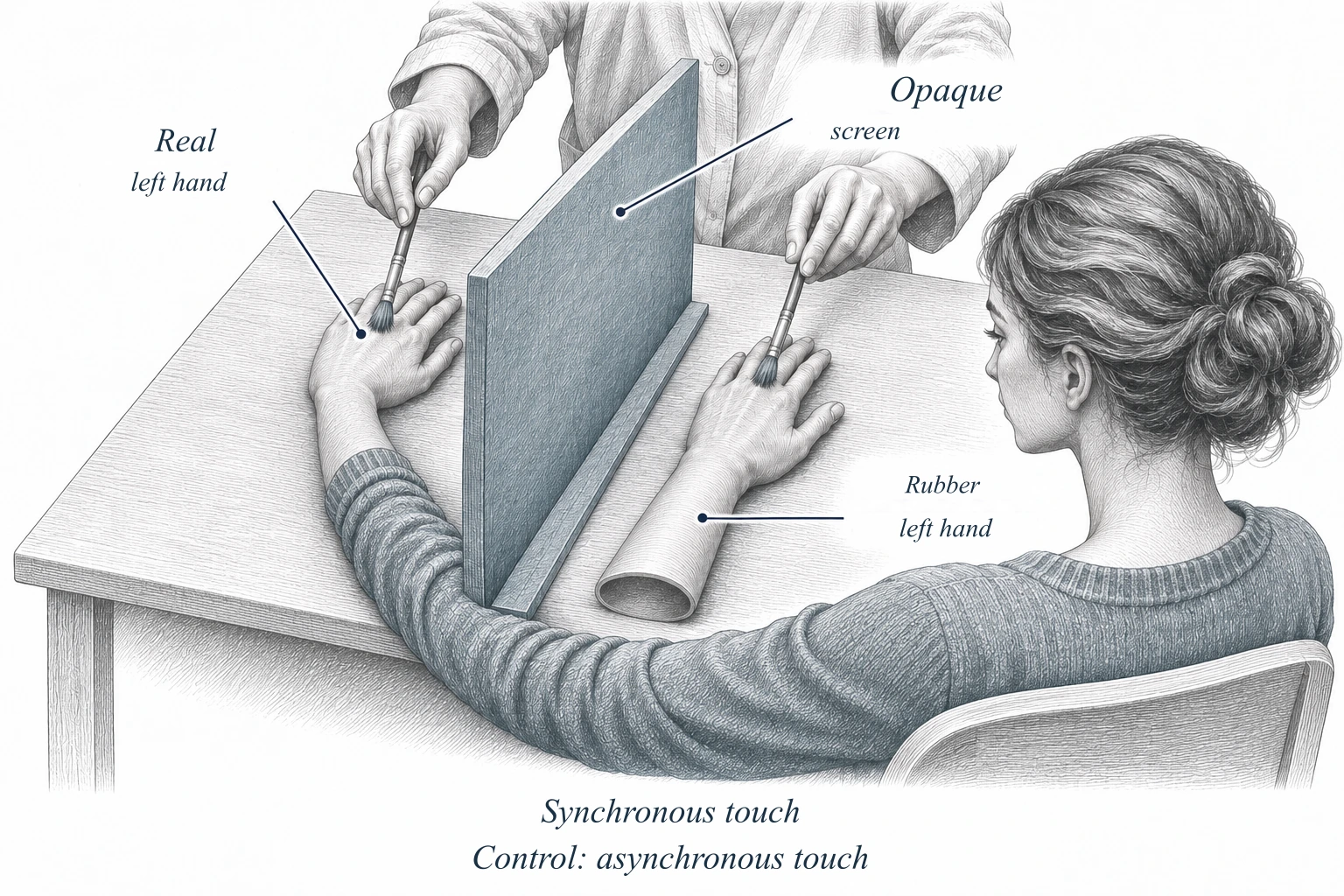
Figure 6. Principle of experiment with rubber hand [16]. The participant sees an artificial hand, while the real hand is hidden from him by an opaque screen; it is shown to the reader from a different angle. Touching the two hands coordinates or diverges in time. The juxtaposition of visual, tactile, and proprioceptive information can alter the sense of bodily belonging. The transfer of consciousness into an object is not assumed here.
Such coordination of signals does not have to be reasoning in words. Belonging may be felt before an explanation emerges. This is why observation of the bodily self should not be confused with an account of character or biography. It is possible to examine a particular component of self-representation without assuming that it exhausts the personality.
A meaningful possibility arises for the idea of an interface: the boundary of an individual's experience may depend on how the system relates events to its own body. However, this possibility is not yet chosen by the physical carrier of the experience. It first of all indicates what kind of organization any theory that places the basis of consciousness within the organism or outside it must explain.
The body communicates itself from within
Some information about the body comes through vision and touch. The other is related to internal processes: breathing, heartbeat, state of organs. A person does not see these processes the way he sees a cup, but they can participate in the well-being and emotional coloring of what is happening. The concept of interoception is used to perceive internal states.
Hugo Critchley and colleagues examined brain activity during a task to estimate the timing of one's own heartbeats. They found associations between task performance and activity in a number of areas, including the right anterior insular and adjacent opercular cortex. The study also found correlations between interoceptive discrimination accuracy and several subjective measures. This is evidence for the involvement of specific neural systems in accessing bodily signals, rather than the detection of a single location where the subject is located. [17]
You can mentally compare two organisms that receive the same image of the external world, but are in different internal states. For one, the path to water is of urgent importance, for another it remains a neutral opportunity. The difference here isn't just about the image. It concerns what the body requires and what activities become valuable.
Therefore, the metaphor of the body as a screen is insufficient. The screen has no needs of its own, whereas the body must maintain its existence. In a research model, this allows us to connect self-representation with regulation: the system distinguishes events not only by form, but also by how they influence the conditions of its further existence.
Such a functional explanation does not yet reveal the qualitative side of hunger or anxiety. It describes why internal signals may have a special place in the organization of behavior. For the hypothesis of a more fundamental consciousness, this organization represents a possible mode of individuation: the general physical process, if it exists, must receive a certain perspective through the specific needs and limitations of the body.
Several meanings of one “I”
The word “I” brings together various faculties. You can recognize your own reflection, remember your past, distinguish your own movement from an external push, report an experience and doubt the correctness of your decision. Having one ability does not automatically mean having the others. It is useful to distinguish them even when they work together.
Bodily self-representation refers to what one's body perceives and where the perspective of action is located. The sense of authorship refers to participation in an event: the movement was due to one's own action or was imposed from the outside. Autobiographical representation connects the present state with history. Reflection allows you to make your own ways of perceiving and deciding the subject of further consideration.
These distinctions provide a working framework for analysis. They do not mean that several independent people exist inside the head. Rather, the word "I" describes different relations between one system and its own states. This distinction helps us avoid demanding the full complexity of a human biography from a brief sensation.
The working differences between experience, self-representation and reflection are summarized in Figure 1.
Suppose a device has been created that accurately distinguishes between its own commands and external disturbances. It demonstrates a certain form of action control. If the device additionally stores history, it becomes possible to connect the present with the past. But even the combined presence of these functions does not allow us to simply write the word “experience” into the technical description. The question of subjectivity remains separate.
The opposite mistake is to consider subjective experience impossible without a developed story about oneself. In such a definition, consciousness would be identified in advance with one of the complex forms of human self-consciousness. Then the study of other creatures would be limited to formulating the question before obtaining the data.
Perspective of action without an internal spectator
In everyday life, events are usually presented in relation to the body. Closer or further, reachable or unattainable, dangerous or safe - these differences acquire meaning from a certain position. A behavior model requires a center of reference. However, the center of reference does not have to be a separate object.
Geographic coordinates do not require that the small owner be inside the map. The observer's position can be determined by the relationships between objects and the possibilities of movement. Likewise, a system's functional perspective can be determined by the way it links perception, memory, and action. This analogy does not explain the subjectivity of a card or a machine; it shows only the logical possibility of organization without an internal spectator.
In the brain one can look for processes necessary for a certain aspect of experience without expecting to find an organ in which a ready-made “I” sits. The research by Parvizi and colleagues discussed in the first chapter shows how local interventions change the specific content of perception. It helps distinguish features, but does not turn the face recognition area into a storage area for the whole observer. [15]
The absence of a single center found is also not an argument in favor of its external location. This would be a conclusion based on the principle: if the item you are looking for is not here, then it is somewhere else. Perhaps the original expectation of an individual item was incorrect. And perhaps a broader theory is indeed needed. The result of the research must choose between these options, not the usual image.
The present needs to continue
The perspective of action has not only a position in space, but also an extension in time. For a movement to be part of one action, the system must somehow connect its beginning, continuation and expected result. Otherwise, the sequence of states would remain a set of independent episodes. This is a functional requirement that can be formulated even before solving the issue of subjective time.
Let's imagine a device whose state is completely erased after each step. It receives a new image and produces a response, but does not retain a trace of the previous event. Another device uses the previous step to interpret the current one. The difference between them can be found in tasks where the same signal has different meaning depending on the context. However, the presence of such a difference does not mean that the second device survives the passage of time.
This example allows you to separate the two statements. Certain forms of self-representation require the accessibility of history. But the availability of history is not sufficient evidence of subjective continuity. Both statements must remain in the model, otherwise it will either lose functional certainty or too quickly declare any memory to be consciousness.
In the hypothesis of joint personality formation, the history of connection takes on special significance. If individuality arises in interaction, it is necessary to explain how the current properties of the system were formed and what consequences they have. A list of instant characteristics alone is not enough for this. Two systems may look similar now and yet have different histories of relationships with the world.
Therefore, the expression “same subject” requires a selected criterion. We can talk about preserving memory, continuing a causal chain, or a feeling of self-recognition. These criteria may coincide in ordinary life, but their coincidence cannot be considered in advance as a law for all conceivable physical implementations.
Where is the boundary of the subject?
The bodily boundary seems a natural candidate for the boundary of consciousness. However, even at the level of functions, the body is constantly dependent on the external environment. Writing aids memory, a tool enhances movement, and language connects personal decisions to the experiences of others. This dependence forces us to clarify what exactly it means to include something in the system.
To complete a task, you can consider a person together with a notepad. For a neurophysiological experiment, it is possible to limit the analysis to the brain and a specific set of input signals. To study metabolism, a different boundary will be needed. All of these descriptions are acceptable if the choice of boundary is appropriate to the question.
But functional inclusion does not equate to belonging to subjective experience. The fact that a notebook supports memory does not mean that it feels together with the owner. From the fact that without external oxygen the body stops working, it does not follow that all the air becomes part of one subject. Causal dependence is too widespread to define the limit of experience on its own.
The author's interface hypothesis will require a narrower criterion. It can be assumed that individuality is associated with a stable mutual influence between certain internal processes, the memory system and the putative additional carrier. Then the boundary should be determined not simply by the presence of a connection, but by its structure and consequences. This is an exploratory assumption from which measurable differences have yet to be derived.
For example, breaking a connection must change something specific, rather than explain every possible change. Reduced agreement may impair information fusion, access to history, or the stability of self-representation. If the proposed mechanism is specifically related to experience, it will be necessary to show why its action cannot be fully explained by disturbances in response, attention, or memory.
What remains of the avatar image
An avatar in a virtual environment usually already has an external user. The avatar itself does not create its biography, needs or ability to distinguish between itself and the world. Therefore, transferring this image to a person imperceptibly brings too many ready-made answers. It presupposes personality even before its origin is explained.
A more cautious version retains only the idea of mediation. The body sets a set of available influences and methods of action. The brain connects them in time and maintains the idea of their relationship to the body. The supposed fundamental basis of experience, if it exists, participates in this organization, but is not yet required to contain a complete human personality.
In such a model, the subject is considered as a stable process. His present states are dependent on history, bodily needs guide action, and the structure of interaction must explain how multiple events come together into one perspective. It is the device of this connection, and not the image of the hidden passenger, that becomes the subject of research.
This is not a ready-made theory, but already a direction for its construction. Instead of searching for the little observer, questions arise about belonging, access, continuity and boundaries. Each of them can be associated with different measurements and different possible errors.
The subject remains the central difficulty. However, it is now formulated more precisely: how is it that the physical organization that distinguishes between the world and itself is also the organization for which what happens is experienced? To move forward, it will be necessary to examine the old ideas about the soul and the primacy of consciousness so that they receive clear commitments to observation.
Chapter 4