When theory meets competition
The theory is especially compelling when viewed in isolation. For every successful result, you can find a beautiful explanation, and inconvenient details can be attributed to future work. The situation changes when another theory appears nearby that can explain the same observations. The question then is no longer whether the story is possible, but which explanation stands up better to general scrutiny.
Consciousness research needs this comparison as much as other areas of science. The subject itself is complex, and the data allows for multiple levels of interpretation. Therefore, it is especially important to distinguish between the explanation of the state, the mechanism of access, the content, and the very presence of the experience. Theories can argue about different questions while mistakenly believing that they offer incompatible answers to one.
Strong neural alternative
It is easy to present the neural theory as too primitive: as if it simply states that it is enough to collect a lot of nerve cells and consciousness will appear on its own. Real-world research programs try to determine what process organization matters, what interactions are necessary, and why information is made available to different functions in some cases but remains local in others.
In global neural workspace theory, a significant role is played by the strengthening and maintenance of representation through recurrent interactions, allowing information to become available to different specialized processes. A review by George Mashour, Peter Roelfsema, Jean-Pierre Changeux, and Stanislas Dehaene considers this approach as an explanation of the mechanisms of conscious processing, including relations with attention and working memory. [22]
As a mental example, one can imagine a system where the visual signal is first used only for local recognition, and then becomes available for planning, memorization, and response selection. The difference is not simply the presence of a signal, but a change in the way it is subsequently used. Such an explanation has specific functional content regardless of whether it is sufficient to explain subjectivity.
The interface hypothesis does not benefit from ignoring this organization. If an external basis exists, human experience still manifests itself through memory, attention and action. Therefore, a new model must either incorporate the established functional relationships or explain why a different device produces the same results. The simple dichotomy of “brain or mind” obscures this responsibility.
Unity as a Causal Structure
The theory of integrated information starts from other premises. IIT version 4.0 maps properties of experience to requirements for the internal causal structure of a physical system. The theory relates experience to an irreducible cause-and-effect organization, rather than simply to the amount of data conveyed. Its mathematical description imposes certain conditions on what is considered a system and what relationships within it are significant. [21]
This approach cannot be reduced to the statement “the more complex, the more conscious.” A random stream may be difficult to compress and lack the required causal organization. The amount of memory, the number of connections and computational performance are also not identical to the stated criterion. Therefore, the use of a convenient indicator of complexity rather than a complete theoretical definition requires a separate justification.
A mental contrast between recording a process and the process as an operating system is helpful. A video recording of a complex mechanism may contain a lot of information about its operation, but it does not itself reproduce all the causal interactions of the mechanism. For a theory that relies on internal causes and effects, this difference is fundamental. For other theories, a different level of organization may be decisive.
This approach has its own difficulties: defining the system's boundaries, establishing its causal structure, and connecting mathematical properties to specific contents of experience. However, difficulty in calculating or testing a theory does not justify replacing it with a caricature. The comparison must concern the theory's actual claims, available data, and the predictions of a competing explanation.
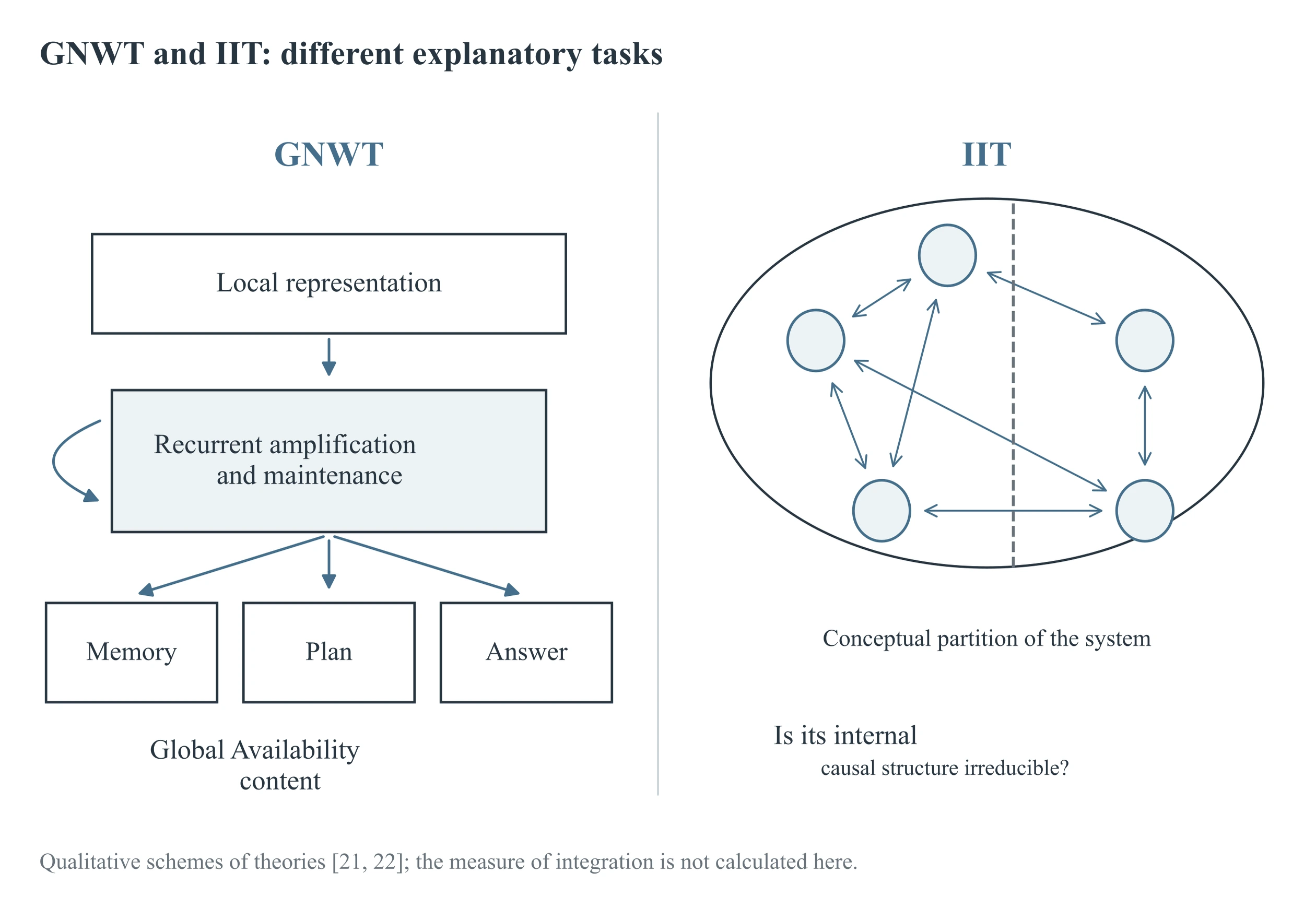
Figure 22. GNWT emphasizes the global availability of representation across processes. IIT links experience to an irreducible internal causal organization. Diagrams show the direction of explanation rather than calculating consciousness.
A Jointly Agreed Test
In the Cogitate consortium study, IIT and GNWT proponents agreed in advance on differing predictions and scoring rules. In 256 participants, brain activity was studied when presented with visual stimuli of different durations. Functional magnetic resonance imaging, magnetoencephalography and intracranial electroencephalography were used. Some of the results were consistent with the expectations of both programs, but specific difficulties were also discovered. For IIT, this was the lack of predicted stable synchronization in the posterior cortex. For GNWT, the absence of the expected repeated burst of activation in the prefrontal cortex after the disappearance of the stimulus. These results relate to the predictions and experimental conditions tested; they do not provide grounds to declare the entire content of one of the theories completely rejected. The main methodological achievement of the work is that the comparison criteria were determined before getting to know the data. [1]
The principle of such verification is more important than the spectacular announcement of the winner. If predictions are written down in advance, it is more difficult to subtly change the meaning of the theory after experiment. However, the pre-selected test also has a scope of applicability. It concerns specific versions, objectives, measurements, and connecting assumptions. The failure of one forecast does not necessarily destroy the entire program, but it does create an obligation to explain the revision.
The general logic for distinguishing models is shown in Figure 7; the separation of fitting and independent verification will be further illustrated in Figure 31 in Chapter Seventeen.
One must distinguish between the central statement of the theory and the auxiliary way of relating it to the instrument. For example, a model may predict a certain organization of information, and the researcher selects one physiological indicator as its trace. An unexpected result may call into question both the model and the chosen relationship to the indicator. For a meaningful revision, you need to indicate exactly which part is supposed to be changed and what new consequences this will give.
This distinction should not become an endless defense. If any inconvenient result is declared to be a failure of the auxiliary assumption, the theory is no longer at risk. Therefore, it is useful to determine in advance which relationships are considered sufficiently reliable for a given comparison and which combination of results will be a serious problem. Then the revision remains a scientific work, and not a way to preserve the formulation at any cost.
The new version may be better than the previous one. But its advantage should be tested under new conditions. Repeated explanation of the very result for which the version appeared does not yet show that its predictive ability has increased.
Let us imagine two models that differ in the expected place of stable representation. The result obtained may not coincide with any one. This does not yet mean the victory of the third model, which did not participate in the comparison. First you need to understand whether the formulation itself, the method of measurement, or the connection between the observed signal and the theoretical concept was a general error.
For the external interface hypothesis, there is a useful caveat here. The difficulties of neural theories create space for new explanations, but do not provide ready evidence in favor of an external carrier. Evidence will emerge when one's own model explains in advance the difference that competitors do worse at, and the result stands up to independent scrutiny.
Explanations may be at different levels
The quantum model and the neural model are not necessarily mutually exclusive. The first may describe a microscopic mechanism that provides a specific cellular function. The second is organizing a network that uses this function. If both give a compatible multi-level description, the argument about “which one is correct” is misleading: they answer different questions.
Direct competition occurs where observed consequences differ. For example, one model states that a certain quantum process is necessary for a function, while another allows for the persistence of a function after it is selectively eliminated. Then a specific subject of comparison appears. But first you need to make sure that exactly the desired property is eliminated, and not the entire cellular system is destroyed.
Not every quantum effect makes the classical description of a function useless. Sometimes microscopic physics leads to stable, effective rules on a larger scale. Such rules can predict behavior well without describing every particle. Therefore, the question of the need for a quantum description should relate to the chosen task and precision, and not to matter in general.
In turn, a successful classical model of behavior does not necessarily resolve the issue of the nature of experience. It can reproduce observed patterns, leaving open the explanation of the subjective side. This is not a failure of the simulation, but a difference between its outcome and the broader goal. Precise boundaries help you avoid demanding everything from one model at once.
What an External Bearer Adds
Suppose the brain model already explains observed states, memory errors, information availability, and responses to interventions. An external system is added to it. For an addition to make physical sense, it must either improve the prediction, explain a consistent pattern with fewer independent assumptions, or propose a new testable mechanism.
If the state of the external media can be freely chosen for each outcome, the model becomes too flexible. It is easy to reconcile with the past, but difficult to verify. The problem is not in the external system itself, but in the lack of restrictions. The same difficulties arise for any model, the number of free possibilities of which increases along with the number of inconvenient results.
A mental example illustrates the difference between explanation and adjustment. The first model predicts in advance a certain delay in response to the influence. The second one, after each measurement, selects a new delay, calling it the property of an unavailable source. Both can describe the data obtained, but only the first risks making mistakes on the next measurement. It is this risk that gives the forecast scientific value.
Therefore, the external media should be limited to properties that are defined independently of the desired output. Interaction time, sensitivity range, information retention, and modes of state change should not be free explanations for any result. The more such properties can be linked by one mechanism, the more meaningful the model becomes.
New data is more important than the convenient past
An explanation of already known results is necessary, but not sufficient. The model can be specifically tuned for them. Therefore, observations that were not used in the selection of parameters and assumptions are of particular value. They show whether the model retained its ability to predict or just adjusted to the previous data set.
This difference is not limited to the mechanical division of the table into two parts. If the researcher looks at the validation set repeatedly and changes the model, the set gradually becomes part of the tuning. For a convincing comparison, it is important to define the procedure in advance and preserve the possibility of a truly new test. Independent replication adds another layer of protection against hidden lab quirks.
The success rate should also be agreed upon in advance. If one model predicts timing, another predicts the strength of an effect, and the winner is chosen based on a feature that happens to be convenient, the comparison becomes unclear. It is necessary to determine what quantity is relevant to the claimed mechanism and how accurate the prediction must be for the result to be discriminative.
A negative outcome can have several meanings. The mechanism may not be present in the conditions tested. It may exist, but is too weak for its stated function. The measurement may not be sensitive enough. These options should be distinguished by the capabilities of the experiment itself. Otherwise, any negative result can be declared “too rough a measurement,” and any positive result can be declared a final confirmation.
Rival as part of the plan
A good theory should be able to describe which explanation will beat it in a fair comparison. For the selective interface hypothesis, such a rival could be a neural model that reproduces all the claimed additional effects without an external carrier. It may turn out that the supposed carrier exists, but is not associated with consciousness. It may turn out that the chosen quantum property is not required to explain the function.
These outcomes do not render the study meaningless. They determine what knowledge will emerge regardless of the fate of the original expectation. If a model with an external system produces better new predictions under clearly constrained assumptions, its support increases. If the benefits disappear after controlling for alternatives, it should be reconsidered, even if the original idea remains attractive.
Comparison also helps to more accurately formulate a positive goal. What is required is not to prove the entire metaphysical picture with one experiment, but to discover a certain physical contribution and establish its significance. One can then ask what additional conditions link this contribution to individual experience. Dividing tasks preserves the possibility of movement without requiring a premature final response.
Testing competing explanations sets requirements for one's own model. In the next part, it is necessary to determine the hypothesized carrier, the mechanism of its interaction with the body, the boundary of the subject and the testing conditions. The selective interface hypothesis will be evaluated by the same rules: how specific its predictions are and how they hold up against alternatives.
Part four