What changes with a quantum description
In an ordinary room, things seem to have predetermined properties. The cup is on the table, the lamp is turned off, the book is open to one page. Ignorance of the observer does not prevent objects from being in some state. If you hide a coin under your palm, the uncertainty concerns which side it is facing. The coin itself does not have to wait for a glance to get its side.
This image is so familiar that it imperceptibly becomes a universal model of reality. I would also like to translate quantum theory into this language: a particle is supposedly a small object about which not enough is known yet. However, in a quantum description, not only the amount of information changes. The rules relating the preparation of the system, possible interventions and the distribution of results are changing. It is these rules that must be understood before looking for an explanation of consciousness in them.
State as a set of possibilities
A physical state can be understood by asking which differences it allows us to detect. If two preparation procedures yield identical outcome distributions for every admissible measurement, they are indistinguishable within the chosen description. If a measurement distinguishes their statistics, the states differ. This makes "state" a working concept rather than a promise to reveal an object's hidden essence.
For the simplest quantum system, we select two states that a suitable measurement can accurately distinguish and denote them with the symbols 0 and 1. They form a basis—a set of reference states through which any pure state of this system can be expressed. They can be selected states of spin or polarization of light. The pure state is written as a superposition:

Here ψ denotes the state, and α and β are complex amplitudes. Vertical bars and angle brackets are included in the accepted notation for state vectors. When measured in the chosen basis, the probabilities of the outcomes 0 and 1 are equal to the squared modules of the corresponding amplitudes. This is a special case of the Born rule. [14]
Amplitude differs from ordinary probability by the presence of a phase. For probability, what matters is how often the result occurs. What is also important for amplitude is how it combines with other amplitudes. Therefore, two systems with the same probabilities in one measurement may behave differently in another measurement. The quantum state cannot be completely described by one table of answers to one question.
There is no consciousness in this recording yet. It applies to systems that are not assigned the ability to feel. The content of the formula is determined by physical training and measurement, and not by how mysterious the subject of study seems.
Why superposition does not equal ignorance
Let's imagine two methods of preparation. In the first case, the device randomly selects the 0 state or the 1 state, with each occurring in half of the runs. In the second, it prepares the same state each time with equal amplitudes of the two options. A measurement that differentiates only between 0 and 1 will produce the same statistics in both cases. But this does not mean that the same physical states are prepared.
The second method has a certain phase relationship. An appropriate transformation before measurement allows this ratio to be converted into a probability difference. For a random mixture there is no such certainty. The difference is revealed by the results of the sequence of physical operations. [14]
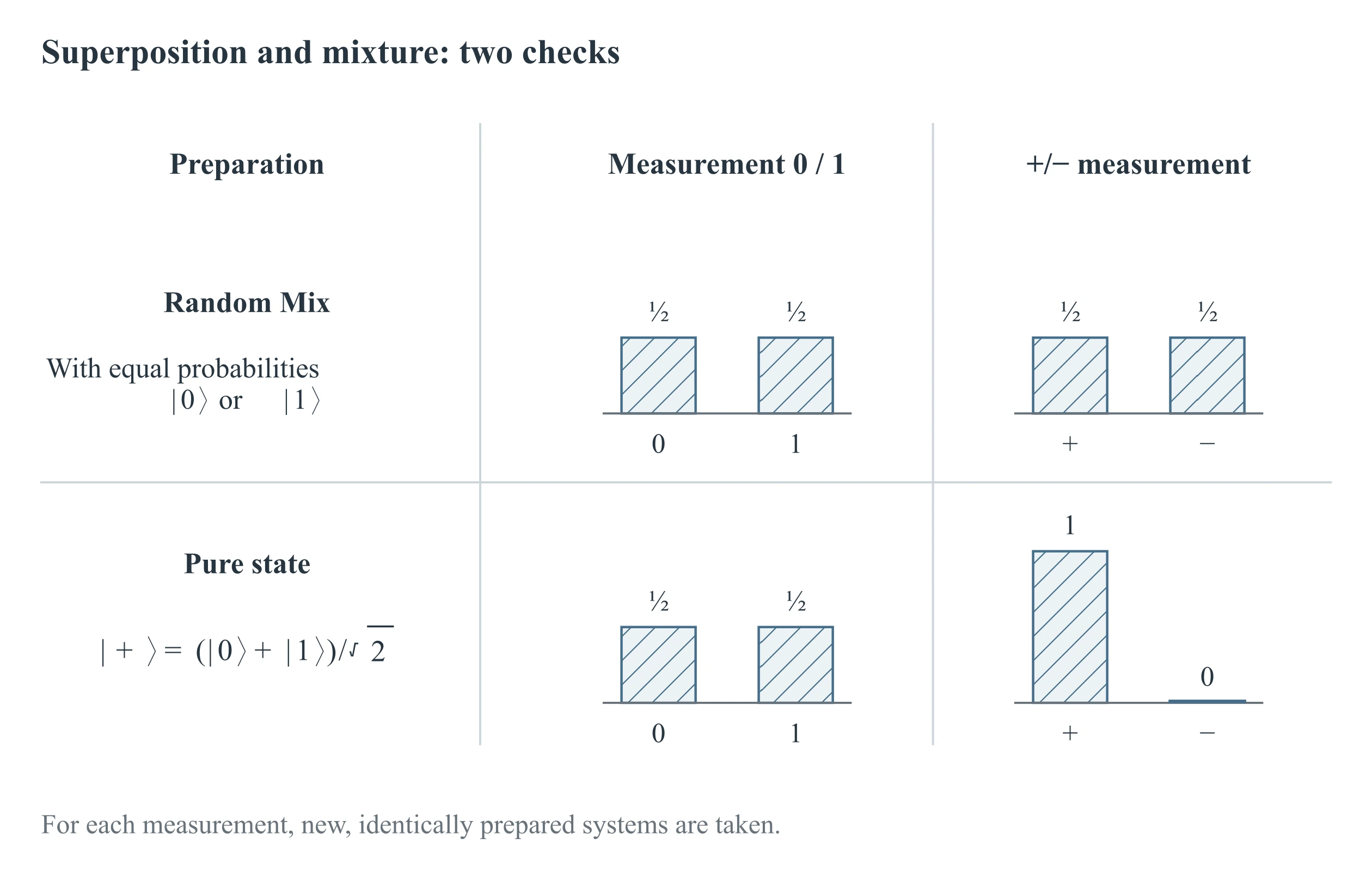
Figure 4. Case Study: Two preparations produce the same probabilities on one measurement but differ on the other. The numbers are calculated for selected ideal states and are not experimental brain data.
It is helpful to imagine two waves on the surface of the water. At one point their rises coincide, at another rise meets with a decline. The resulting picture depends on the relative shift. This analogy conveys the role of the phase, but does not make the quantum object an ordinary water wave. It only helps to understand why adding amplitudes in a quantum calculation is different from simply adding probabilities.
This implies an important limitation of language. The phrase “the brain simultaneously processes several options” does not say anything about quantum superposition. A typical computing system can also support multiple competing solutions. For a quantum statement, it is necessary to specify physical states and an operation that will reveal precisely the phase relationships between them.
It is equally not enough to call a thought indefinite. Human uncertainty can be described by classical probabilities. The coincidence of the words “probability”, “choice” and “uncertainty” in psychology and physics does not establish the identity of the mechanisms.
Measurement leaves a physical trace
The measuring instrument must vary differently depending on the system being studied. Otherwise, its testimony will not reveal anything about it. Detecting light requires the interaction of light with matter; determination of magnetic properties requires appropriate coupling to a field or other sensing device. Observation begins with physical discrimination.
In the quantum description, such an interaction can link the system to the device and then to the environment. Different alternatives leave different traces. If these traces become virtually inaccessible to joint control, the observed interference may disappear. No one is required to read the screen to do this. What is important is the structure of the interaction, and not the subsequent awareness of the result by the person. [14]
But it would be just as hasty to declare that this has already solved all questions of measurement. The theory allows one to calculate observed probabilities and the evolution of composite states. The question of how to understand the single reported outcome and the status of the remaining alternatives allows for different interpretive approaches. Their difference cannot be subtly replaced by the assertion that experiment has already established the decisive role of human consciousness.
For a book, this boundary is useful. It frees the study of consciousness from the need to rely on the ambiguity of the word “observer.” A physical observer may mean a recording system. The subject of experience means the one for whom something is experienced. These are different roles, even if in a particular laboratory a person performs both.
How to describe part of a general system
Any study distinguishes the system from its environment. In one case, the system is an electron; in the other, a molecule, a cell, or a network of neurons. The choice depends on the question. It does not mean that the selected part has actually stopped interacting with the rest of nature.
If two parts are in an entangled state, describing each separately does not contain all the information about their joint correlations. To describe one part, a reduced state is obtained from the general state: it allows one to predict the results of measurements only in this part, without a separate description of the other. The mathematical operation of such a transition is called a partial trace. The local state may be mixed, although the state of the whole is pure. [14]
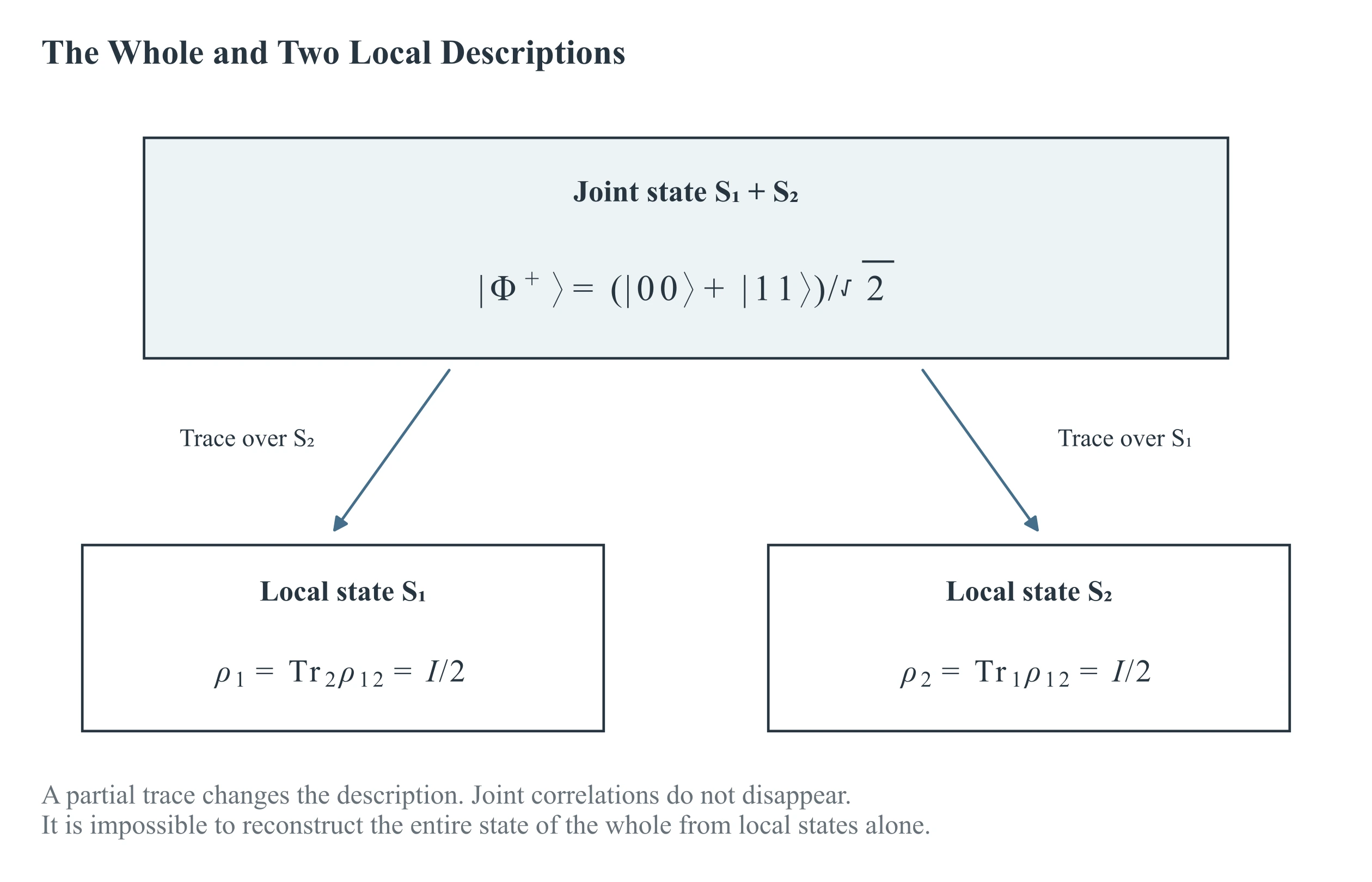
Figure 5. The state of the subsystem is obtained from the state of the whole as a partial trace. Local descriptions generally do not contain all joint correlations. The diagram explains the physical description; the unity of experience requires a separate explanation.
Here the temptation arises to immediately place consciousness in the “whole.” It seems as if the irreducibility of joint correlations automatically explains the unity of experience. However, these are two different questions. Correlations show how measurement statistics are related. Unity of experience concerns why certain events are given to one subject. A meaningful correspondence between them is still required.
If it is argued that consciousness belongs to a broad composite system, its boundary must be determined. Which interactions involve the process in the subject, and which simply connect it with the environment? Why does experience not extend without distinction to all objects causally connected with the body? How should a change in connection change the observable properties of experience? Without answers, the word “whole” only transfers uncertainty to a larger scale.
Such questions do not prohibit expanding the boundaries of the system. They make expansion meaningful. If one does need to take into account a previously overlooked subsystem to explain the data, it will be a physical result. But the belonging of this subsystem to the subject will require one more argument.
From physical information to its meaning
In conversations about consciousness, the word “information” often refers to everything at once: a physical difference, a written sign, a message, and the meaning of the message. Meanwhile, the same sequence of signs can be understandable to one person and not communicate anything to another. The physical media remains the same. The meaning depends on the rules of use and on the history of the system that receives the record.
Quantum information theory considers, in particular, the distinguishability of states and the possibilities of transferring, transforming and storing these states. This analysis allows us to determine what is available to the recipient through a given channel. It does not by itself attribute understanding or experience to the recipient. Therefore, the expression “consciousness is quantum information” requires an addition: what state is meant, what process uses its differences, and why should this use be accompanied by a subjective quality?
There is one more border. An unknown state cannot simply be read in its entirety from a single instance of the system, like a ready-made line on the screen. Restoring a description from measurements requires certain assumptions and a set of data. The result of a particular measurement is not a snapshot of all potential properties. [14]
This is especially significant when trying to talk about human memory as a quantum record. It is necessary to distinguish between the preservation of a physical state, the ability to extract information from it, and the restoration of a meaningful history. Even perfectly stored media does not guarantee that an arbitrary recipient will be able to access its contents. And an accessible record of biography does not yet establish the continuity of experience of the person whose biography it describes.
Thus, the word “information” helps build a model only after the relationships have been clarified. What's different? For which system? Through what kind of interaction? What are the consequences of discernment? These questions do not require in advance to abandon fundamental consciousness, but do not allow us to replace its explanation with a single physical term.
The quantum mechanism must have time to change something
Let a state be discovered that preserves the required phase relationships. Its existence in itself does not explain the function. The mechanism must have time to influence a process that is related to behavior, memory or the content of perception. For this, not only the lifetime of the state is important, but also the strength of the connection, the speed of transfer of influence and the stability of the result.
You can imagine a device with excellent internal memory, to which it is impossible to write anything and from which it is impossible to extract anything. It may be suitable for storing a predetermined state, but not for processing external information. The opposite extreme is also understandable: a very sensitive system easily accepts influence, but just as easily loses its differences under the influence of random disturbances.
A possible biological quantum mechanism falls between these extremes. It needs selective openness: to interact with the necessary processes and retain the properties on which the result depends for a sufficiently long time. In a physical description, such properties are associated with degrees of freedom - for example, with the position of a particle or its spin. This task has physical content even before the construction of a theory of consciousness.
Therefore, the question “is the brain quantum” is too broad. The substance of the brain is described by quantum physics already at the level of chemical bonds. The more meaningful question is: Does a particular brain function use a particular quantum property in such a way that, without it, the observed outcome changes? The answer will require a model that can be compared with a suitable classical approximation.
What questions can you ask now?
After the introduction of the quantum description, the original idea takes on several independent directions. You can explore which states are generally available to the selected medium. It is possible to find out how long the difference between superposition and mixture lasts. It is possible to test how this difference affects the molecular response or function of nerve tissue. One can separately ask what relation the found process has to experience.
None of these transitions are accomplished by mathematical notation alone. The state vector does not contain a ready subject. The interaction operator does not explain the meaning of sensations. The probability of an outcome does not equal the freedom of decision. But precise language allows you to see the location of each gap and set a specific research task for it.
For the brain-as-interface hypothesis, this means the possibility of a more rigorous formulation. The intended external contribution must change the physical state of the observable system. If this contribution is quantum, it is necessary to indicate how its action differs from an ordinary random signal. If contribution is associated with subjectivity, it is necessary to explain why a change in the physical connection should be accompanied by a change in a certain aspect of the experience.
The possibility of a meaningful negative result also appears. Measurements may show that the proposed states lose the necessary properties too quickly. Or that a difference predicted for an additional mechanism is absent where the method would detect it. Such a result will limit the specific construction, preserving the very question of the nature of consciousness.
Quantum theory makes the search more demanding. Instead of indeterminate depth, it offers distinguishable states, operations, and constraints. The next question arises on a human scale: what exactly must be preserved and changed in order for what happens to be felt to belong to one being?
Chapter 3