An Observer without a Human
The detector can leave a recording at night when the laboratory is empty. In the morning, the researcher will read it, compare it with other records and draw a conclusion. In the standard quantum description, the moment of human familiarization is not introduced into the equation as a special influence. Measuring interaction occurs between physical systems, and a person learns about its result later. This difference alone is enough to make us use the expression “observer consciousness” more carefully.
For the study of consciousness, the question is especially tempting. If quantum theory uses the word "observation" and a person is able to observe, it would seem that the theory has already found a fundamental place for experience. However, the same word does not guarantee the same concept. Before connecting them, it is necessary to understand what exactly makes a measurement a physical process and what remains open after its mathematical description.
Recording occurs in interaction
In the simplest measurement model, the state of the system is associated with the state of the device. Different possible values of the measured quantity correspond to distinguishable states of the pointer. If the system was in a superposition, the joint quantum description generally contains correlations between its states and the states of the device. The device then interacts with its environment, and information about the result is propagated through other physical degrees of freedom. [14]
This description explains why measurement cannot be considered a weightless gaze. The device must physically interact with the object. The photon is absorbed, the charge is transferred, the molecule changes state. Even when the interaction is very weak, its role is determined by the ability to relate a difference in the system to a difference in the record. Without such a connection, no information about the selected value can be obtained.
Let's mentally replace the researcher with an automatic program that reads the detector and closes the shutter. Then we will replace the program with a simple electronic relay. The physical circuit continues to operate as long as the necessary interactions are maintained. To calculate the measured probabilities, you do not have to determine whether the relay is experiencing anything. Therefore, human self-awareness is not a necessary element of the standard quantum measurement procedure.
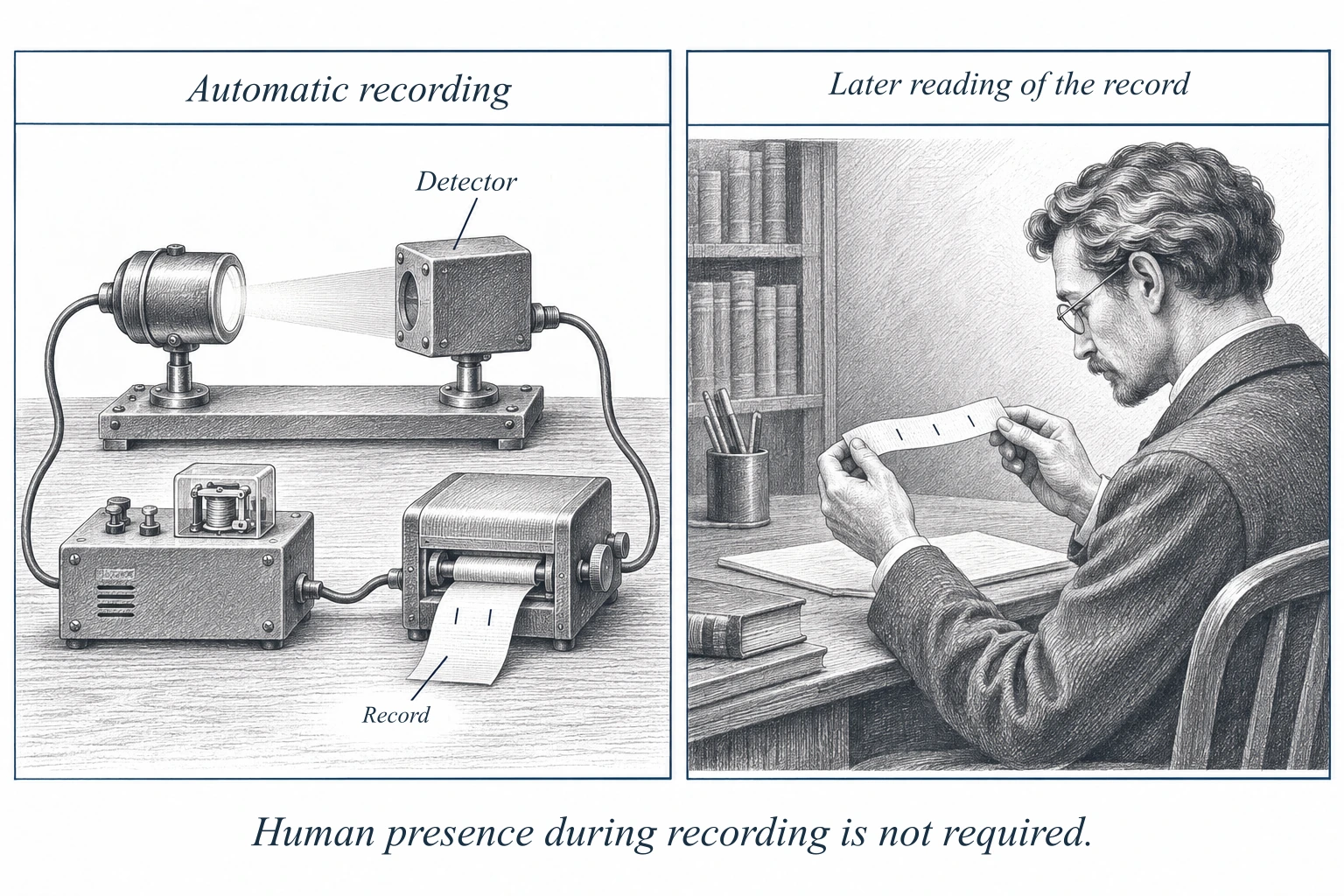
Figure 15. Physical registration and reading of the result are separated in time. In the standard measurement model, a record is created by the interaction of systems; the presence of a person at the device at this moment is not required [14]. The device and marks on paper are shown conditionally and do not reproduce the data of a specific experiment.
Here we were able to separate two questions: how a measurement record arises and why some processes are accompanied by experience. The first question allows for physical description without appeal to human self-consciousness. The second one remains open. A theory in which consciousness alters quantum dynamics must propose a concrete law and new testable consequences. The word “observer” alone is not enough for this.
Decoherence and outcome selection
Decoherence describes the loss of available interference relationships in a selected subsystem due to its interaction with its environment. As a result, certain alternatives begin to behave as a statistical mixture for local observation. The expression “for the selected subsystem” is essential here: the description of the entire composite object and the description of one of its parts solve different problems. [14]
This process helps to understand the sustainability of everyday records. To restore interference between macroscopically different records, it would be necessary to control a huge number of connections with the environment. Under normal conditions this is not possible. However, the explanation of the practical inaccessibility of interference does not yet exhaust the question of why experience is given as one definite outcome. Interpretations of quantum theory describe this transition in different ways.
For further reasoning, restraint in both directions is useful. It cannot be declared that decoherence does not explain anything at all: it describes quite definite physical dynamics. But you cannot entrust its with the answer to any question about the experience. The success of one level of explanation does not eliminate the need for another. An interface theory must specify at what level it adds the mechanism.
One can imagine that the additional carrier affects the probability of outcomes. One then needs to explain how the observed probabilities are obtained when the carrier is not available to direct control, and under what conditions the deviation will occur. It can be assumed that physical probabilities do not change, but only the description of their relationship to experience changes. Then the experimental possibilities will be different. These two versions cannot be considered one theory simply because they both use the word “consciousness.”
Entanglement Is Different from Correlation
Two systems can produce similar results for the usual reason: they have a common source or have interacted before. If two envelopes contain pre-agreed numbers, opening one allows you to predict the contents of the second. But this analogy does not reproduce all quantum correlations for different measurement methods. It is the ability to change measurement settings that makes the test meaningful.
Bell's inequalities set restrictions on correlations for a certain class of local models under specified assumptions, including the independence of the choice of settings from the corresponding hidden variables. Quantum theory allows for the violation of these restrictions. Therefore, the experiment does not test the abstract “unity of everything,” but the specific structure of statistical dependencies between settings and results.
In 2015, Bas Hensen and colleagues performed a test with electron spins separated by a distance of 1.3 kilometers. The scheme simultaneously closed the main loopholes related to registration efficiency and locality of measurements. The resulting violation of Bell's inequality supported the quantum description of correlations against the class of local models tested. The experiment did not measure either people's thoughts or the connection of personalities across distances. [20]
This sets a high standard for the study of living systems. Synchronous oscillations of two neuronal populations are not evidence of entanglement. The similarity of the stories of two people is even more so. Each such result is subject to a variety of common causes, ranging from general effects to sampling patterns. A claimed quantum property must have its own criterion that truly distinguishes it from the alternatives being considered.
Why correlation doesn't convey the message
If two parts of the system are entangled and the measurement result of the first is known, this knowledge allows us to refine the prediction of the measurement result of the second. However, a person who has only the second part does not receive a controlled message in this way. It does not have access to the necessary sorting of data based on the results of remote measurements. To perform it, you need to transmit additional information via a regular physical channel. [14]
A simple thought experiment illustrates the difference. Two researchers agree in advance to label one outcome "A" and the other "B." After their systems are separated, the first researcher measures their part. If they cannot choose the outcome they obtain, the agreement does not become a way of sending the desired letter. The second researcher sees a sequence of results from which no message chosen by the first can be extracted.
Post-selection sometimes gives the opposite impression. After the experiment, one can select only those events in which a particular outcome was obtained on the first side. The conditional statistics on the second side will change. But the list of selected events itself must be communicated to the second side, so the procedure already uses an additional channel. The information is not obtained for free: it arrives together with the selection condition.
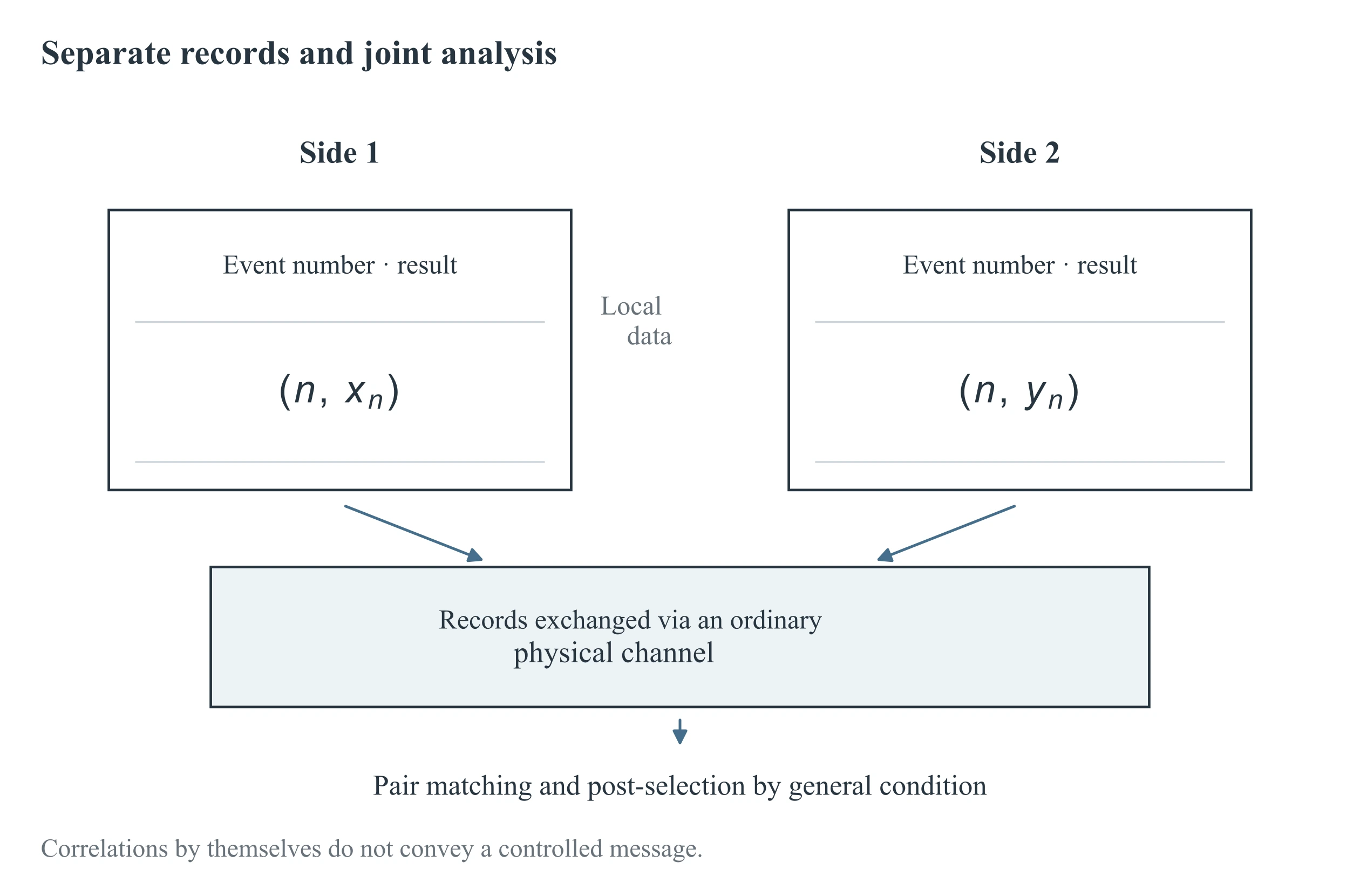
Figure 16. To compare remote results and perform post-selection, records need to be exchanged over a physical channel. Quantum correlations alone do not produce a controlled message on the other side.
This implies a specific limitation for external consciousness as a physical source. If it is to select the organism's actions, there must be a way in the system to convey the difference between the choices. Entanglement alone does not provide such a controlled channel. The model will need an ordinary interaction, a feasible quantum channel, or an explicit change to the standard dynamics. The latter option is especially demanding, since its consequences must not contradict already tested restrictions.
An important distinction arises between knowledge and influence. When the researcher learns the result on the remote side, his description of the available options changes. But a change in description is not yet a physical signal received by another system. In everyday life, these events often occur together: a message brings new knowledge and at the same time represents a physical signal. In discussing entanglement, they have to be separated especially strictly.
Let's imagine that the body must choose between two movements at the command of an external carrier. The observed probability of movement should depend on which command the carrier chose. If the local statistics of the organism are the same in both choices, no controlled difference has been generated. Subsequent detection of correlations may inform the joint structure of the data, but does not explain the choice of movement at the right moment.
This does not prohibit building a model of an interacting composite system. On the contrary, conventional channels allow the transfer of information, and quantum technologies use both correlations and real interactions. Constraint refers to the attempt to gain control only from the existence of entanglement. Refusal of such an attempt makes the hypothesis more specific: it is necessary to describe what exactly connects the subsystems and with what delay the influence spreads.
If a carrier outside the usual spatial description is assumed, the task does not disappear. It is necessary to determine the rules of connection between its states and observed events. While there are no such rules, the word “outside” does not explain why the body receives this particular information. It marks the location of the unfinished part of the model. Once the rules are in place, their compatibility with causality and experimental probabilities can be examined.
Common carrier and individual points of view
The assumption of a fundamental basis for experience may be broader than the hypothesis of message transmission. Perhaps consciousness is associated with a certain organization of the whole, and the body sets a local way of accessing its states. Such a thought is logically possible, but for it it is necessary to distinguish between physical correlation, functional accessibility of information and the subjective identity of experience.
Let's imagine a single physical object with two weakly connected subsystems. They may have a common past and some correlations. One subsystem is able to use only a small part of the information about another. Even if there is entanglement in the general description, it does not follow from it that both parts form one point of view. Such a conclusion requires an additional principle about what physical relations correspond to the unity of experience.
This principle should define the boundary. Why are certain processes of the body included in one subject, but the processes of the room do not usually become part of the same experience? Why can changing the availability of information change behavior but not necessarily create a new subject? And why does a common source of physical states not mean a common human memory? Such questions cannot be resolved by merely pointing to the integrity of the quantum state.
Here the interface hypothesis has the opportunity to become more precise. It can connect individual experience not with any correlation, but with a certain form of stable interaction, memory and organization of feedback. Then the mathematical description of the state of the external carrier becomes only part of the model. The other part must explain how a particular center of discrimination arises and why its history is not arbitrarily confused with the history of the others.
What should the conscious observer add?
It is not enough for the theory of consciousness to reproduce the operation of the detector. It is necessary to explain why some processes correspond to experience, while others serve only as a condition for registration. One can try to deduce this from the organization of information, from the causal structure, or from an additional psychophysical law. But each path requires an argument connecting the physical description with the qualitative side of experience.
It is especially important to avoid a closed definition: the system causing the collapse is conscious, and the collapse is caused by the conscious system. This definition does not allow either party to be independently identified. To exit the circle, you will need either an independent physical criterion for reduction or an independent criterion for the state of the system, after which you can check their connection. Therefore, the objective reduction hypotheses and the idea of human attention as the cause of measurement must be considered separately.
Quantum theory really changes the usual ideas about state, probability and separability. Thanks to it, it is possible to formulate much more subtle models of the interaction of the organism with the environment. But the extension of physical language brings new responsibilities: respecting communication constraints, distinguishing between conditional and local statistics, specifying a testable property of the medium. It is these responsibilities that make the quantum hypothesis scientifically interesting.
The theory of Penrose and Hameroff assumes that the reduction of a quantum state is a real physical event associated with the fundamental properties of space and time. Thus, the question of consciousness is connected with the hypothesis of a new physical mechanism. The next chapter examines these two links separately: if a mechanism exists, it can be sought regardless of which explanation of consciousness ultimately turns out to be correct.
Part three