The body as a condition of concrete experience
In the imagination, an avatar often looks like a changeable costume. The subject remains himself, and the shell only determines what external appearance he takes. However, the human body sets much more than the form of presence. It determines available signals, possible actions, speed of reaction, needs and ways of changing the environment. If we assume a more fundamental basis for consciousness, these limitations do not disappear. It is through them that the supposed basis receives specific content.
The body in the selective interface hypothesis is therefore not treated as a random container. It participates in the formation of perspective. The organism does not simply miss a ready-made picture of the world, but constantly selects which differences are important for its existence. To explain human consciousness through external connection, one will have to show how this connection becomes the sight, movement, hunger, expectation and personal history of just such a body.
An avatar that changes its owner
Imagine a system with access to only two distances: to the obstacle ahead and to the surface below it. For such a system, the action space is arranged differently than for a device that distinguishes color, shape and movement over a large distance. The same external events provide different opportunities. A step may be an immediate fall hazard, a route marker, or may not be in the available description at all.
If experience is assumed in both systems, its content cannot be considered the same just because the physical world around is common. There is a distinction between what can appear in experience and what the system is able to do in response. The body defines a set of interactions, and the interactions create meanings. An additional carrier must be included in this structure, otherwise it will remain an abstract cause that does not explain the features of a specific experience.
Even changing one channel can restructure the task. A device with delayed feedback cannot control movement as well as a device with fast response. A system with a wide field of available signals allocates resources differently than a system with a narrow one. In such mental models, the differences result from control constraints. They need not be called qualia distinctions in advance; they show what physical conditions a potential experiment must take into account.
This is where the author’s principle of bodily certainty arises. According to the common ground hypothesis, differently constituted bodies can produce different forms of subjectivity. This assumption does not require a priori attribution of experience to each sensor. It asserts a conditional dependence: if an experience occurs through organized interaction, the participant's device must influence the available content. A completely body-independent ready-made stream of experience would require a different model of communication.
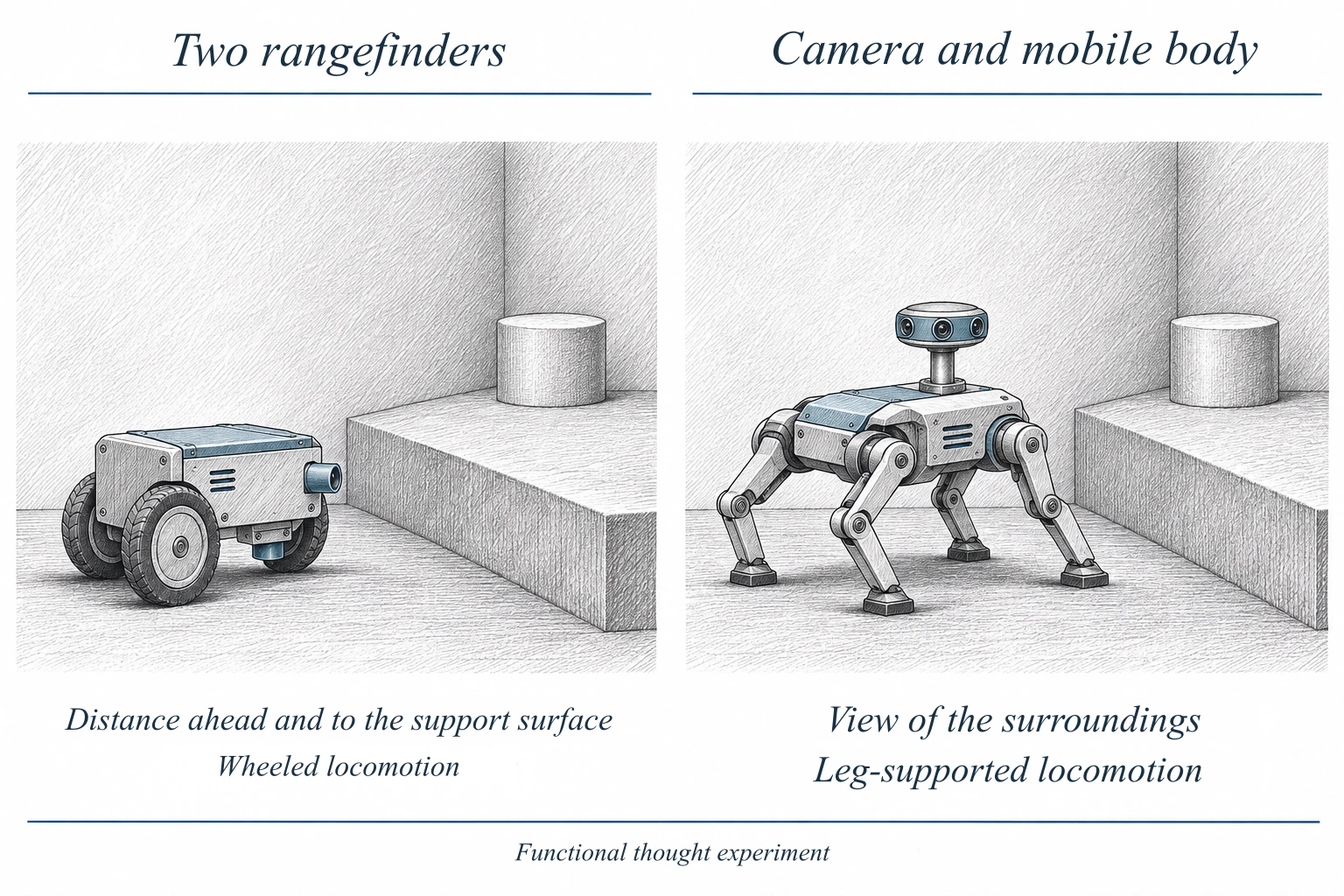
Figure 29. One world sets different tasks for systems with different sensors and action capabilities. On the left, the conditional device has access to the distances ahead and to the support; on the right is an overview of the stage and movement based on the legs. This is an example of the differences in available information and control; the presence of subjective experience does not follow from it.
Signals from within
The body receives information not only about the outside world, but also about its own condition. Interoception refers to the perception of internal bodily signals. The work of A. D. Craig describes the neuroanatomical system for representing the physiological state of the body and discusses its role in the formation of feelings and self-awareness. This is a scientific interpretation of the connection between bodily regulation and subjectivity; it does not establish that a single center of personality has been found. [26]
For the interface hypothesis, internal signals are especially important. They define the difference between an external event and its significance for a particular organism. The same smell, path or sound can have different meanings depending on the current state. To explain the experienced world, it is not enough to reconstruct the external picture. It is necessary to take into account what is happening to the participant in this picture and what consequences are expected for him.
Here it is easy to confuse physiological need with experienced value. A technical device can maintain temperature and charge without having an established ability to experience discomfort. The thermostat reacts to the deviation, but the reaction does not yet serve as proof of the sensation. Therefore, the presence of regulation is considered in this book as a possible part of the organization of the subject, and not as an independent universal test of consciousness.
However, the opposite extreme does not help much either. If value is completely separated from the design of the system, it remains unclear why some states are experienced as requiring change and others as desirable. The author's hypothesis assumes that an individual perspective is formed along with the limitations of one's own existence. This line of explanation must link physical regulation, accessible history, and experienced significance without substituting one for the other.
Shape of the accessible world
The body creates not only needs, but also scale. For a small mobile system, some obstacles become significant, for a large one - others. The speed of events also matters in relation to the capabilities of perception and action. If the mechanism is too slow, a short change does not have time to influence the choice; if too quickly and without keeping track, the event may not connect to subsequent actions.
Therefore, a theory of consciousness that claims to explain different organisms must take into account several temporal levels. There are rapid physical transitions, slower biological consequences, and an even longer learning history. A quantum process, if it is functionally important, must enter into a consistent chain of these scales. Its own speed does not establish the speed of subjective time and does not tell how many experiences occur in a second.
Equally important is the connection between perception and action. A system that can change the position of the sensor gains capabilities that are not available to a stationary recorder. It is able to check an ambiguous signal, return to the object and compare the expected result with the received one. Such activity does not prove experience, but makes the hypothesis of a separate perspective more meaningful: the accessible world is built through real opportunities to explore it.
The avatar image in this version signifies a special way of participation. Different bodies may open up different areas of interaction, even if they share the same supposed basis of experience. To talk about the experience of another system, one must first understand its accessible differences. Human words about color, fear, or intention should not automatically transfer to any mechanism that exhibits a superficially similar response.
The means of action may extend beyond the anatomical boundaries of the body. An object in the hand changes the available distance; the notebook saves information that is not in the current attention; an external sensor expands the range of measurable differences. When analyzing a specific task, such tools can be included in a broader functional system. But the decision to include an object in the model does not mean that the object has an experiential side or that the boundary of the subject has automatically moved.
This clarification protects the concept of external contribution from being overextended. Any organism depends on its environment. Therefore, the dependence of conscious behavior on an external device does not prove a special carrier E: it can completely pass through ordinary channels R. To justify an additional quantum connection, it is necessary to highlight a property that is not reduced to the arrival of ordinary sensory information and a change in the possibilities of action.
At the same time, functional expansion provides a useful development model. One can explore how access to new signals restructures choice rules and the representation of one's own capabilities. Then the body is understood not as a set of unchanging parts, but as a system of accessible interactions with specific physical limitations. If the putative subject persists through such expansion, the theory must explain what relationships ensure continuity and why new abilities become part of that particular history. These questions arise regardless of whether the additional media is confirmed.
A connection that develops
The design of the interface may depend on the development history. As a working model, one can imagine a system that first maintains a few simple regulatory relationships, then associates them with memory, and later begins to take into account its own errors and limitations. At each stage, new ways of combining events are added. In such a model, developed reflection appears as a special function; it does not have to be present at every possible form of experience.
This allows you to separate multiple transitions. The emergence of sensitivity to the signal is one transition. Sustainable use of the consequences of actions is another. Imagining oneself in time is the third. A linguistic story about one’s own thoughts is another one. The hypothesis must explain the relationship between them, without declaring them to be one instantaneous birth of consciousness. Otherwise, the distinctions between reaction, memory, self-representation and experience are lost in the debate about what to call consciousness.
If interaction with E is truly necessary, development must change some of the physical conditions under which this connection operates. Perhaps a certain organization of sensitive structures arises, relaxation times change, or ways to enhance a weak effect appear. Such assumptions can be compared with a version where all changes are explained by neural organization without an additional carrier. But age or complexity alone does not indicate which mechanism is correct.
Particularly strong would be the prediction of a transition associated with a measured physical parameter and a predetermined function. For example, the model might expect sensitivity to change when a particular interaction structure appears. Here it is impossible to assign a person or an animal the moment of occurrence of an experience according to an arbitrary number. First, it is necessary to confirm the mechanism itself and the boundaries of its connection with the observed abilities.
Another physical implementation
The question of an artificial subject depends on what is considered obligatory in the hypothesis. If the organization of relations is decisive, different physical ways of its implementation are allowed. Then the biological body represents one of the possible options. If a specific quantum carrier is needed, simulating its equations on a conventional computer can reproduce predictions without creating the required physical process itself.
This difference is familiar from other models. Numerical calculation of fluid movement does not make the processor wet. But the impossibility of digital consciousness cannot be immediately deduced from this analogy: one must first know what physical properties are essential for the experience. If they are in a functional relationship, the simulation can implement part of the required organization. If certain material dynamics are significant, the coincidence of the calculated outputs will be insufficient.
The selective interface hypothesis leaves both possibilities open until the criterion appears. In its strong physical version, the artificial system must have a real channel of interaction with E, as well as an organization of memory, self-reference and action. In a more general version, an additional resource can be substituted if a causally significant relationship holds. These options cannot be mixed: they answer differently the question of what should be built and what should be measured.
The virtual body also requires a clear status. The program can obtain information about virtual position, resources, and damage. These variables may control its behavior, but the names themselves do not establish the pain or need experienced. It is useful for research to analyze how such a body model changes memory, predictions and decisions. The assertion about the subjective side will require an additional basis, equally strict for biological and artificial systems.
Who is included in the scope of the hypothesis?
If one seeks only the human self-narrative, most potential forms of experience will remain unexamined. If any reaction is considered consciousness, the concept will lose its distinctive power. Between these extremes lies the task of describing what abilities and physical conditions are actually required by the chosen theory. For different systems, these conditions may be met partially, to varying degrees, or through different mechanisms.
In the proposed program, it makes sense to distinguish between the possibility of experiencing, the ability to imagine oneself and developed reflection. The absence of the latter does not automatically exclude the former. But the presence of a complex answer also does not give the right to consider the first one established. For each class of system, suitable observable features, methods of comparison, and analysis of possible alternatives will be needed. One test of speech or self-recognition cannot address all three issues without justification.
The relationship between experience, self-awareness and reflection is shown in Figure 1.
Biological affiliation does not replace a physical explanation. If a hypothesis connects consciousness with a certain organization, it must explain why this organization is possible in some organisms and insufficient in others. If it associates it with a specific carrier, the prevalence and functional role of the carrier needs to be investigated. The presence of a molecule in almost all cells does not in itself mean that all cells implement the same process of experience.
For artificial systems, a symmetrical requirement applies. The absence of cells is not an automatic refutation as long as biological exceptionalism is not inferred from the model. However, the possibility of implementation is not equal to its actual implementation. Between a program that describes itself, a physical system with a certain internal organization, and a subject with an experience, there remain differences that research must clarify rather than eliminate by definitions.
Thus the body returns to the center of even a theory that admits a more fundamental basis of consciousness. It sets limits, history, modes of action and areas of accessible content. A possible external contribution becomes an explanation only when it shows how it passes through these conditions. The next step is to take the program out of the realm of general requirements: it is necessary to construct a study in which the communication device will produce predeterminable results.
Part five