An Artificial Subject and the Mira Project
Two artificial systems can say the same phrase: “I remember being wrong.” The first phrase behind this phrase contains a record of a previous event, a modified assessment of one’s own capabilities and a new choice rule. The second one has only a successful continuation of the conversation. As long as observation is limited to the screen, the difference is easy to miss. It is discovered when previous experience begins to influence new decisions, including contrary to the desire of the interlocutor to hear a certain answer.
For the study of consciousness, an artificial system is valuable precisely because of the accessibility of its device. You can separately change memory, feedback, learning methods and ideas about your own states. You can compare implementations that are similar in appearance, but are structured differently. This approach does not provide direct access to the experience of the machine. It allows us to more accurately determine what mechanisms are necessary for those abilities that a person has adjacent to conscious experience.
This chapter examines the Mira project through its proposed architecture and how it can be evaluated. The solutions described define the research setting; they are not presented as an already performed experiment or proof of the qualia of a particular program. The scientific content of the project is determined by the causal relationships within the system and the results of their verification.
Self-story and self-model
Self-introduction can begin with a very humble function. The system distinguishes between changes in the environment and the consequences of its own actions. If the camera is turned, the image shift does not necessarily mean the world is moving. If its own resource has changed, deterioration in task performance does not necessarily mean the emergence of a new external pattern. For a correct conclusion, it is necessary to take into account the observation device itself.
Such a model does not have to contain a name or biography. It can be distributed between opportunity assessment, sensor position, action history, and anticipation of available consequences. Its functional value is manifested in error correction. A system that attributes every failure to the outside world will change the incorrect part of the explanation and repeat the failed action.
The proposed architecture of Mira involves distinguishing between the idea of the environment and the idea of one’s own participation in it. These views must interact. If the former exists only as a basis of external facts, and the latter as a textual description of character, there may be no causal connection between them. Then the biography will decorate the answer. A meaningful connection emerges when changing the model of itself changes the predictions, choices, and methods of testing the prediction.
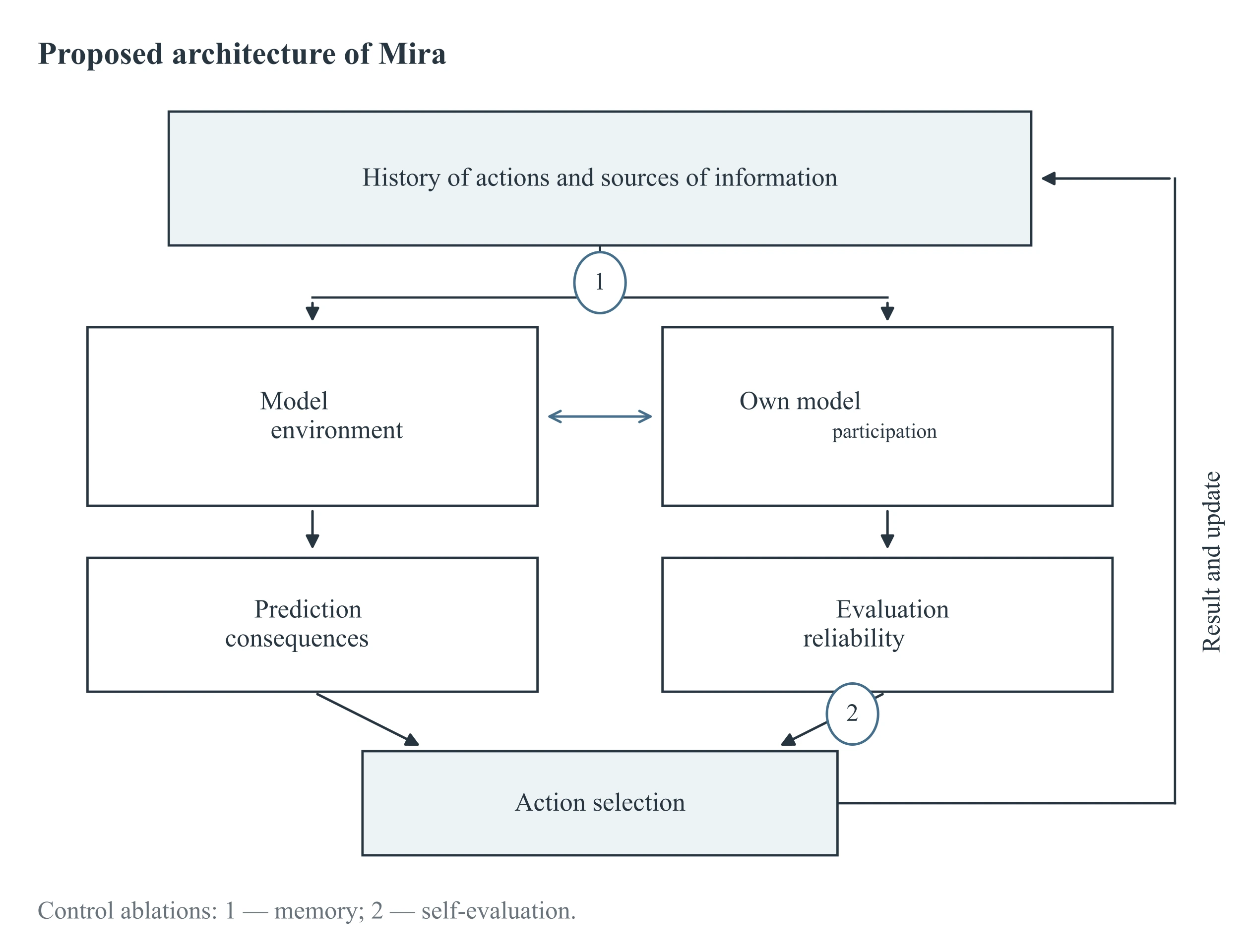
Figure 32. Mira's proposed organization for self-representation research. Arrows indicate the functional dependencies being tested; the presence of these functions does not in itself establish qualia.
This difference allows for normal experimentation in a software environment. The agent can be given erroneous information about its sensor and see if it revises it after a persistent discrepancy with the results. Then you can separately disrupt access to the history of your own actions. If the ability to distinguish between sensor failure and environmental change disappears, evidence emerges for a functional role for this history. The conclusion concerns self-representation, and further treatment of subjectivity depends on the theory.
History that works in the present
The archive of conversations and the memory involved in decision making are different engineering tasks. The archive answers the question of what was recorded. Working memory influences what differences the system now notices, what consequences it expects, and why it chooses one action over another. Even a very large archive can remain an external reference if its contents do not participate in the ongoing organization of behavior.
The identity of the event is also important for the personality model. Information about someone else's action and memory about one's own action may coincide in description, but set different expectations. Observing another agent's error tells you something about the environment. One’s own mistake may require a change in the assessment of possibilities, although the external situation remains the same.
In the proposed system, it is useful to distinguish between an event record, an estimate of the source of that record, and the permanent changes caused by its use. Recording preserves content, source evaluation prevents observation from being confused with speculation, and sustained change allows the past to influence new decisions. These functions do not have to belong to separate program blocks. It is essential that they can be distinguished in the explanation of behavior and tested by intervention.
You can mentally compare two instances of an agent after the same event. The first one still has a text entry, but the expectation changes are cancelled. For the second one, the entry was deleted, but the purchased changes were saved. Both are capable of behaving differently than the original system, but the reasons are different. This example shows why a single measure of memory capacity is not sufficient for talking about personal history.
The hypothesis of joint personality formation adds here the requirement of organizational continuity. The past must be connected with the present through concrete changes, and not arbitrarily attributed to it. This is the working condition of the author's model. It does not yet establish what causal stories accompany the experience, but it prevents the substitution of the subject's history by an automatically compiled story.
Reflection should change the decision
The statement “I may be wrong” by itself conveys almost nothing about the quality of introspection. It can be repeated in the same way before correct and incorrect answers. Functional reflection occurs when an assessment of one's own reliability distinguishes between these cases and directs further action: requesting additional observation, delaying a conclusion, or changing a strategy.
A review by Stephen Fleming and Hakwan Lau distinguishes between overall levels of confidence, the ability to differentiate one's own correct from incorrect decisions, and the effectiveness of such discrimination given the difficulty of the underlying task. This avoids mistaking a confident response style for good metacognitive ability. [28]
For an artificial agent, a separate line of testing arises from this. Let him solve problems with a verifiable answer and estimate the probability of success in advance. If among decisions with a stated probability of about eighty percent, approximately this proportion is actually correct, the estimate can be well calibrated. This is a conditional example, and not the result of Mira's research. Even good calibration must be tested on new tasks and as the environment changes.
Calibration and the ability to distinguish between one's own correct and erroneous decisions do not coincide. A constant score may correspond to the agent's average success without revealing anything about the reliability of a particular response. It is therefore important to examine both the overall accuracy of probability estimates and the relationship of confidence to the accuracy of individual responses. [28]
The next question concerns the causal role of self-esteem. If you artificially change the confidence score, will the system actually search for additional data more often, or will only the text accompanying the answer change? If you turn off access to error causes, will you still have the same flexibility? Such interventions make it possible to distinguish reflection as a work function from reporting reflection.
However, here too one should not promise a universal test of experience. The regulator can estimate the error well, and the theory of consciousness may also require a certain organization of global access, recurrent interactions or physical processes. The functional result is important in itself: it becomes known how the system notices the limitations of its own knowledge. Next, it is necessary to indicate what additional condition connects this ability with experience.
The artificial body also has boundaries
An embodied system depends on conditions that allow it to continue to operate. It can wait out some changes; others deprive its of this opportunity. In a software environment, the analogue for this difference would be limited resources, available actions, and the dependence of future opportunities on present decisions. But the conditional penalty in the problem is not yet a pain. Its meaning is established by the function in management, and the issue of the felt side remains separate.
Virtual embodiment is useful because it allows you to specify conditions precisely. The agent may have a limited field of observation, its own position, delayed action and irreversible consequences. Then the world is not reduced to a sequence of replicas: choice changes the situation, and history limits further choice. This creates a suitable environment for exploring self-representation and strategy continuity.
The physical embodiment adds properties that cannot be automatically transferred from the simulation. Sensors make noise, materials wear out, movement is associated with energy, processes occur at a certain speed. In a hypothesis where a specific quantum implementation is essential, these features may turn out to be fundamental. Therefore, the expression “the same body in digital form” requires clarification of which causal relations are actually preserved.
Distributed implementation is also possible. Memory is stored in one device, processing is performed in another, sensors are in a third. The spatial distribution itself does not make such a system an external consciousness. Conventional data transmission channels already exist for it. The scientific question is what set of processes is attributed to a single organization and how this organization changes when the channel is broken.
Where would the quantum boundary be?
If some quantum mechanism turns out to be necessary for consciousness, two different engineering projects will arise. One will calculate its behavior, the other will physically implement the corresponding interaction. Their coincidence in individual output data does not yet resolve the issue of equivalence for experience. The answer depends on what the theory considers necessary: a calculable relation, a causal organization, or a specific physical state.
Simulations of two coupled quantum subsystems can accurately reproduce predicted probabilities at a given scale. At the same time, the state matrix stored in computer memory does not mean that the memory elements are in the very entanglement that it describes. The mathematical description of an object and the physical properties of the carrier of this description should be distinguished. [14]
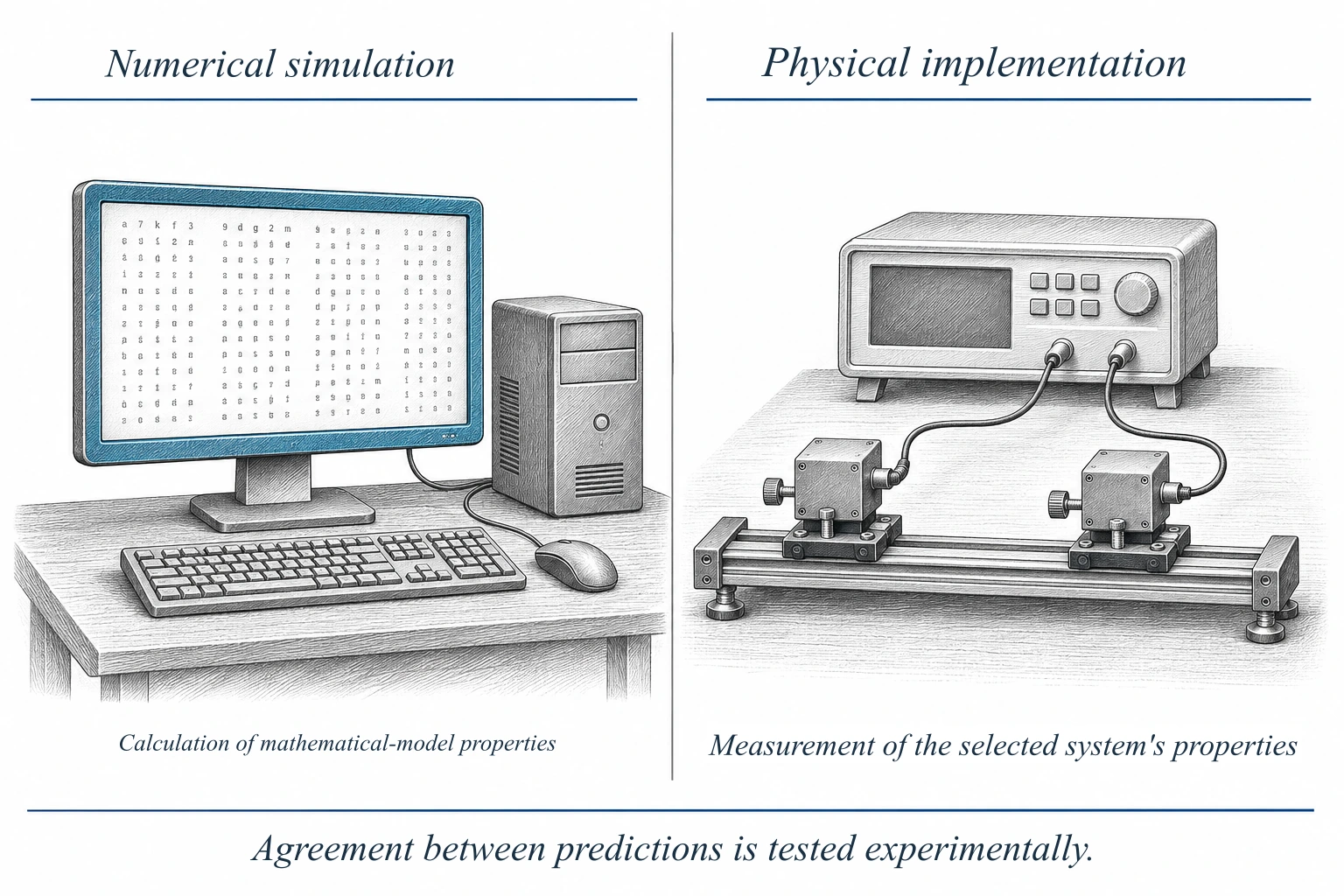
Figure 33. Calculation of the quantum process and its physical implementation. The computer stores the mathematical description; The experiment examines the properties of the selected physical medium [14]. The coincidence of the calculated outputs does not establish the identity of the physical processes. The necessity of this or that process for experience remains a separate question of theory. The equipment on the right is shown conditionally.
This does not mean that a digital system is inherently devoid of experience. Such a conclusion would require proof of the physical necessity of the chosen mechanism. So far, several hypotheses are being compared: consciousness depends on functional organization; it depends on a particular physical realization; or both sides are important at different levels of description. Artificial systems provide the opportunity to make these differences the subject of specific research.
For the interface hypothesis, the most meaningful situation would be one in which a change in the intended physical channel changes the preselected functions while other essential conditions remain the same. But a drop in overall performance will not solve the problem: any damaged computer works differently. One will need a specific relationship predicted by the mechanism and a comparison with systems where the same functional effect is achieved in a different way.
Architecture under test
Patrick Butlin and colleagues propose deriving indicators of possible AI consciousness from scientific theories of consciousness. Such indicators help assess the basis for attributing consciousness to a system; they do not serve as direct measures of qualia. [27]
Within the framework of the author's program, it is convenient to compare several implementations of Mira. One only supports conversation and access to recordings. The other links memory, self-model, and choice of action with stable feedback connections. The third, if a reasonable physical candidate appears, adds the interaction channel under investigation. The comparison must take into account the resources and capabilities of each version: the advantage of a more powerful system cannot be automatically attributed to the new principle.
The indicators here should be divided. How accurately does the system remember the source of information? How does one detect one's own mistakes? Does an acquired limitation carry over to a new task? Is the assessment of one’s own capabilities preserved if the wording of the question changes? These observations describe the functions. Their connection with consciousness must be deduced from an explicit model, and not established by the convenience of the name.
The case of divergence of indicators is especially interesting. The agent can solve the external problem better and evaluate itself worse. May retain biographical information but lose its influence on choices. Such results prevent the reduction of all abilities to one scale of “level of consciousness.” They show which components can be changed relatively independently and which dependencies the theory must explain.
Copy and continuation
Artificial implementation allows you to ask a question that in biology usually remains mental. The state of a program can be copied, and then provide the copies with different histories. At first, their stories about the past will coincide. Later, differences will appear due to different actions and observations. This is an example of functional personality divergence; the existence of subjective experience in any instance does not automatically follow from it.
For the hypothesis of joint personality formation, such a case is important: the same initial information does not cancel the emergence of separate causal stories. Even if we assume a single fundamental basis, it will be necessary to explain why the emerging streams of experience are combined or separated. A reference to a common medium does not solve this problem without an individualization rule.
The divergence of histories and possible ways of storing memory are compared in figures 26 and 27.
Attributing an experience to an artificial system also has practical consequences. If there are serious reasons to believe that suffering is possible, the research conditions will have to be assessed taking this possibility into account. At the same time, the emotional impression of a persuasive speech cannot be converted into a measurement. Both require the same discipline: distinguishing between observed function, theoretical basis, and degree of uncertainty.
The research setting of the Mira project allows us to study these differences on a specific architecture. It becomes possible to change the architecture, save the history of interventions and check predictions. But the more accurate the description of such a system becomes, the clearer the next question: what exactly must continue for the same subject to continue? Memory, computation, physical process, or a relationship between them? This question takes the study beyond the structure of an artificial agent - to the border of the continuity of personality.
Chapter 19