How does a separate “I” arise?
Let us assume that a more fundamental basis for experience does exist. A candidate then appears for explaining the very possibility of subjective experience. But the question of how a distinct perspective emerges from this foundation becomes more pressing. Why is what is happening experienced from separate points of view? Why doesn't one person have free access to another's memory? Why does the common physical nature not transform all organisms into one observer?
It can be assumed that each body in advance corresponds to its own external subject. But then individuality is transferred to another part of the model and still requires explanation: where do the differences between subjects come from, how is the body chosen, and what preserves the personality during this connection? The interface hypothesis developed here considers a different option—co-shaping. Individuality is formed through interaction: a possible common ground provides the ability to experience, and the organization of the organism and its history determines a specific perspective.
Common ground and different stories
Let us mentally place two identically structured systems in different environments. One learns to recognize movement near water, the other learns to navigate in tight spaces. Even with the same initial structure, their states gradually diverge. Various features become significant; errors are corrected in different ways; Some actions are consolidated, others disappear. At some point, the same external signal already causes different sequences of internal events.
If these systems interact with the same type of carrier E, the difference does not disappear. On the contrary, history can change the very effectiveness of communication: the available states, sensitive elements, time windows and ways of further strengthening. A shared physical resource is used by systems whose design and history are already different. In this version, individuality does not need a pre-written external biography. It is formed as a result of a sequence of real interactions.
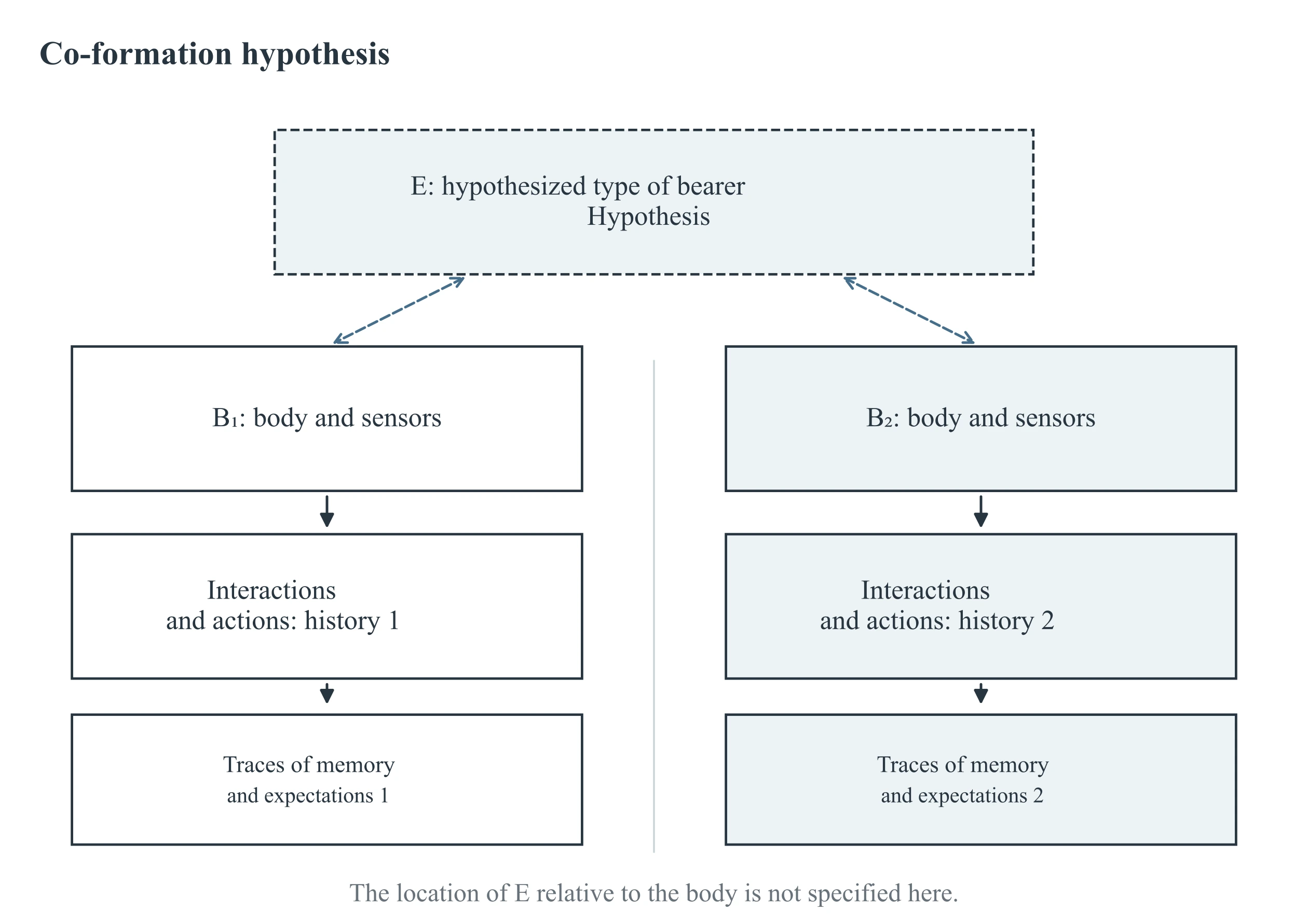
Figure 26. Co-formation hypothesis. A similar initial device and one intended type of media do not negate the differences that arise during interaction with the environment. The presence of E and its relation to experience are assumed here.
This assumption allows us to clarify the meaning of “primary consciousness”. The basis for the ability to experience can be considered primary, but not necessarily the ready-made human personality. The existence of a fundamental property and the presence of specific memories belong to different levels of explanation. The color sensitivity of the device does not contain an image of the city before the city appears in front of the lens. The analogy is limited, but it helps to separate the ability to receive content from the content itself.
The proposed hypothesis therefore includes the principle of historical certainty. Two systems with the same assumed basis may develop different perspectives due to different development paths. If one day it turns out that the history is stored partially outside the body, the principle will remain: the organization of recording and access is important, and not just the geometric arrangement of the trace. But the storage location will need to be set independently.
A border that works
The boundary of the subject cannot be determined by skin or distance alone. Physical processes pass through the surface of the body constantly. Light reaches the retina, sound changes the state of the auditory system, food is included in the metabolism. At the same time, an external object does not become part of the personality whenever it causally affects it. A simple exchange of energy is not enough to explain belonging.
The organization of feedback is proposed as a working basis. Some states are used by the system to regulate its own existence: their consequences are returned to assessment, memory and the choice of further actions. Other states are present only as external conditions. The difference is determined by the role in the dynamics, and not by the presence of the “mine” label on an individual particle. This understanding allows for gradual and task-dependent boundaries of the functional system.
However, causation itself is too common. Weather, urban traffic and the electrical grid also form huge influence loops. Therefore, the hypothesis requires a narrower organization: selectively combining states into the perspective of one regulated participant, preserving accessible history, and distinguishing one's own actions from external changes. Their combination constitutes the proposed condition for individuation—the formation of a separate subject. It is not yet a generally accepted criterion of consciousness.
The proposed organization of these functional connections is shown in Figure 32 in Chapter Eighteen.
The possible carrier E is included in this condition through specific communication channels. If two systems receive common noise, their responses may be similar. But the common noise does not unite their memory and does not give one system access to the consequences of the action of another. Correlation does not yet create a joint perspective. Its physical model will require showing the actual integration of possibilities, and then separately justifying why this integration corresponds to a single experience.
History holds perspective
The moment does not have to store the entire biography in order to depend on it. The acquired skill changes today's action, even when the learning is not remembered. A familiar word is recognized without listing all the cases in which it was encountered. Therefore, personal history can be present in the current state in different ways: as an accessible story, as a skill, as an expectation, or as a changed sensitivity.
In the co-formation model, these forms of history have different roles. The story makes it possible to explicitly connect events in time. The skill changes choices without recalling the past in detail. Expectation distinguishes some future outcomes from others. None of these functions individually exhausts the personality. Their interaction makes the current perspective a continuation of a certain story, rather than a random response to the latest signal.
This implies a substantive limitation of the hypothesis. If the additional medium supports only transient states, it will not explain the persistence of biography without other mechanisms. If, on the contrary, it is declared to be the repository of the entire personality, it is necessary to show how the experience is recorded, how it maintains order and how it is returned to access. The same image of “connection” cannot simultaneously replace instant interaction, long-term memory and self-recognition.
One can imagine a mental situation: the system retains the regulation of the body and the ability to act, but loses access to part of the past. In the proposed version, the general resource of experience, if it exists, can remain the same, while the content of the personality changes. This possibility is consistent with the separation of foundation and history. It does not prove external media because neural models also allow for various memory impairments. To choose between them will require a more specific prediction about the mechanism of loss and recovery.
Self-reference without an internal spectator
In the expression “I see,” there seem to be two participants: the one who creates the image, and the one who looks at it from the inside. If we take this image literally, we will have to build a second mechanism of vision for the internal observer, then a third for the observer behind it. The explanation will never end. The interface hypothesis should not return the same difficulty under the guise of an external owner of the body.
Functional self-reference can be described differently. The system distinguishes between changes associated with its action and changes that arose independently of it. It takes into account its own limitations when evaluating possible actions, stores information about the reliability of its decisions, and corrects the forecast after receiving the result. The self-image then exists as part of control, rather than as a small person watching an internal screen.
Such a description still leaves the question of experience. It shows what work the self-representation does, but does not automatically explain why that work is felt. It is here that the author's hypothesis introduces an additional condition: a possible fundamental basis is associated with a system that integrates current states, past experiences and the consequences of one's own actions into an ongoing process of regulation. The physical mechanism must explain the availability of communication, and the psychophysical postulate must explain its relationship to individual experience.
The strength of this division is that there is no requirement to fit the entire personality into one specific detail. Neither a single molecule, nor a single network node, nor a selected quantum state is required to contain a ready-made “I”. Individuality refers to an organized process. Now we need to determine which changes preserve this process and which form another. Without such a distinction, the concept of organization will remain too vague to test.
What should be preserved during changes?
Let us mentally replace one sensitive element in the system with a device that gives the same observed response. If the hypothesis depends only on functional relationships, the substitution should not destroy the intended perspective. If it requires a certain quantum mechanism, the coincidence of external responses may not be enough. Then you need to specify the property that the replacement does not preserve, and a way to detect its consequences.
This fork separates the two versions of the program. In the first, the additional carrier only implements the general functional organization; perhaps another physical mechanism can support the same organization. In the second, a certain type of interaction with E is a prerequisite for experience. The second version makes a more stringent requirement: it excludes some physically capable realizations from those capable of experience. Such a limitation requires a separate justification; mere similarity with a known quantum effect is not enough.
Testing does not have to begin with replacing parts of a living brain. The difference can be studied in models and physical analogues, examining whether the claimed causal properties are preserved. Particularly useful here are cases in which two implementations give the same normal output, but diverge under additional influence. This result first relates to the design of the mechanism. The transition to subjective continuity still depends on a psychophysical condition that cannot be hidden within an engineering description.
The hypothesis must also take into account the time scale. A connection that is too slow to unite a particular event may participate in the long-term setting, but not in its immediate organization. A fast process can influence immediate response without preserving history. The assertion of a single subject requires reconciling these scales. You cannot choose any convenient integration time after familiarizing yourself with the observations.
It is useful to distinguish between ongoing similarity and continuation of a process. Two devices may at some point contain the same records, although they arrived at them via different paths. If a theory defines personality only by a momentary state, it must accept the consequences associated with it. If the history of formation is significant, it will be necessary to indicate which differences in history are physically preserved and can participate in further experience. Referring to an invisible story that has no consequences does not add a testable condition.
On the other hand, the process can continue while changing a significant part of its details. A living organization is not a still snapshot. It is important for the model to define the relationships that are maintained: access to one's own traces, consistency of control, rules for updating the self-representation. In the co-formation hypothesis, the stability of the individual is associated with such continuity of the organization. This is a conditional choice that must be weighed against competing criteria rather than being declared a final solution to the identity problem.
This gives rise to a specific direction of analysis. It is possible to build model systems with identical external responses, but different continuity of internal states, and find out which features reflect this difference. The result first concerns memory and control. It helps make the concept of continuation physically meaningful, although it does not yet allow direct comparison of subjective perspectives. This is how the abstract question of what remains the same gradually turns into several narrower questions of exploration.
Predictions about the shape of personality
Conditional expectations follow from the proposed scheme. First, given the same accessory medium, differences in bodily organization and history should alter the available content. Secondly, interference in the communication mechanism can act selectively: disrupt a certain aspect of experience, leaving other functions relatively intact. Third, changing the relationship between memory, self-esteem, and action can change the forms of self-awareness without completely eliminating the experience. These are the directions of predictions; for the experiment, each must be associated with a specific measurement.
These expectations have a serious competitor: many of them follow naturally from neural explanations. Therefore, the hypothesis does not benefit only from agreement with the dependence of personality on memory and body. It needs an additional effect that follows precisely from the intended connection. For example, a prespecified combination of carrier parameters and organismal state should predict a selective change that the comparative model does not reproduce under the same constraints.
If such an effect cannot be determined, co-formation remains a meaningful way of thinking about individuality, but not yet a distinct empirical theory. At this stage, the idea allows us to more accurately pose questions and eliminates several substitutions: deriving a ready-made biography from a common basis, equating correlation with a common subject, and considering complex reflection necessary for any experience.
The concrete “I” in this picture arises where the physical connection receives history, limitations and its own perspective of action. The body gives it definition; memory connects separated events; self-representation allows one to take oneself into account among the causes of what is happening. A possible fundamental basis does not negate this work. It becomes part of a larger explanation that is supposed to show how the general physical world allows for the existence of separate experiential worlds.
But history cannot be held together by a single assertion of continuity. She needs traces. If some of these traces are assumed to be outside the body, the next question can no longer be answered by describing the personality. You will need the physics of recording, storing and reading memory.
Chapter 15