The Brain and the Observer's Boundary
When we say “consciousness,” several different things often come into play at once. The man is awake. He distinguishes objects. He feels pain. He knows his name. He notices his own mistake. These abilities are related, but the differences between them are important for any study.
In this book, by subjective experience we will understand the presence of an experience: for the system, what is happening is somehow felt. Qualia is the word for the qualitative aspect of such an experience, such as the experience of color or taste. Self-awareness will be the form of representing oneself as a participant in what is happening. Reflection is an appeal to one’s own thoughts, decisions and reasons for action.
These are working definitions that are used below. They help us not to demand from each conscious state a developed story about ourselves and not to accept any story about ourselves as direct evidence of experience.
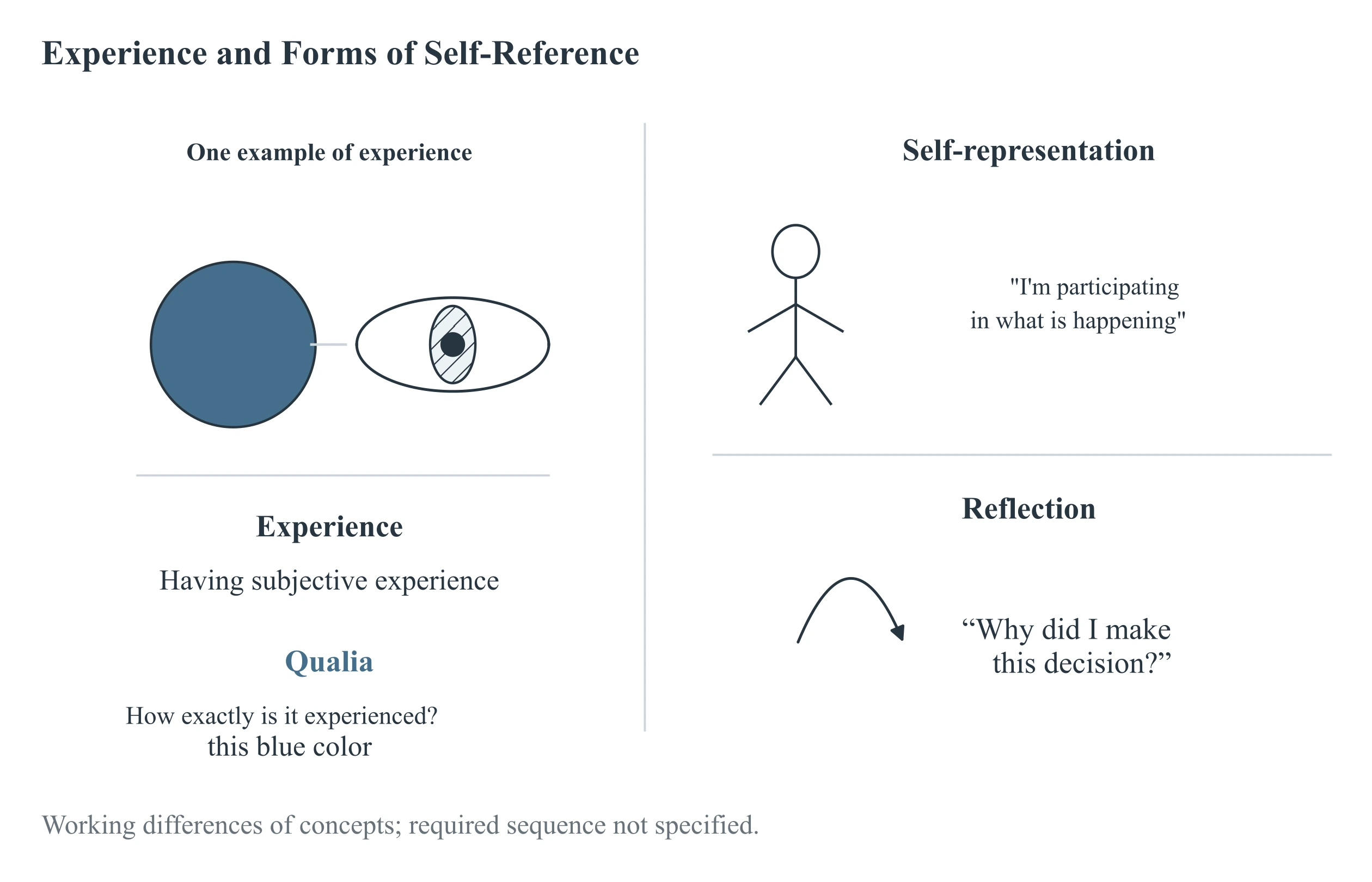
Figure 1. Working differences book. Qualia denote the qualitative side of experience; self-representation and reflection refer to different ways of addressing the system to itself. The diagram does not set a ladder for the development of consciousness.
The same principle is needed when studying artificial systems. The program can describe its states, correct errors and maintain a detailed autobiography. These possibilities are observable. The question of whether she has an experience requires a separate justification. The Mira Project will be discussed throughout the book as a research context for models of memory, self-representation, and reflection. The name of a project or the complexity of its behavior does not resolve the issue of qualia.
Experience and its traces
The researcher does not have an instrument that would show someone else's experience in the same sense as a thermometer shows temperature. There are stories, actions, physiological indicators and ways to compare them with each other. However, each method can fail.
A lack of response during an experiment may indicate a lack of experience. But the person may also fail to hear the instruction, fail to understand the task, or be unable to move. An absence of reports after wakefulness returns allows another explanation: the experience may not have been retained in memory. These possibilities impose different requirements on the experiment.
In a study by Simone Sarasso and colleagues, the brain's response to magnetic stimulation under the influence of different anesthetics was studied in eighteen volunteers. After ketamine, participants reported vivid dream experiences, although they did not outwardly respond during the study. With ketamine, induced brain activity maintained a complex, wake-like structure; with propofol and xenon its complexity was lower. [2]
This result is important for our topic: the absence of a behavioral response is not sufficient to confidently conclude that there is no experience. Moreover, the story after waking up does not provide a continuous record of what happened at every second. The researcher must take into account simultaneously the state of the brain, the possibility of response and memory.
The interface hypothesis also has to explain these differences. It needs to predict which properties of the proposed mechanism change under the influence of different substances, and indicate an independent indicator against which the prediction can be checked.
What the brain is already forcing us to admit
It is possible to imagine consciousness as separate from the organism and still recognize that human experience is highly dependent on the brain. There is no logical contradiction here. But the scientific question concerns the accuracy of this relationship.
In the experiments of Andre Bastos and colleagues, stimulation of the central thalamus in two macaques against the background of continued administration of propofol restored signs of wakefulness and changed some of the neural dynamics. This is a causal intervention: researchers manipulated a particular system and recorded the effects. It does not provide direct access to the animal's subjective experience, but it does limit possible explanations for the condition. [3]
If the brain is the interface, why does this kind of intervention change how it works? What happens to the connection? How does this relate to changes in neural activity? Saying “antenna turned on” is not enough unless the mechanism and measurement are specified.
Data on the content of perception are even more demanding. In a clinical study by Joseph Parvizi and colleagues, electrical stimulation of specific areas of the fusiform gyrus in one patient distorted the perceived appearance of real faces. Comparable changes did not occur with sham stimulation or stimulation through adjacent non-specialized electrodes. [15]
This result shows how specific the model requirement can be. It is necessary to explain the connection between the place of intervention and a certain aspect of the experience.
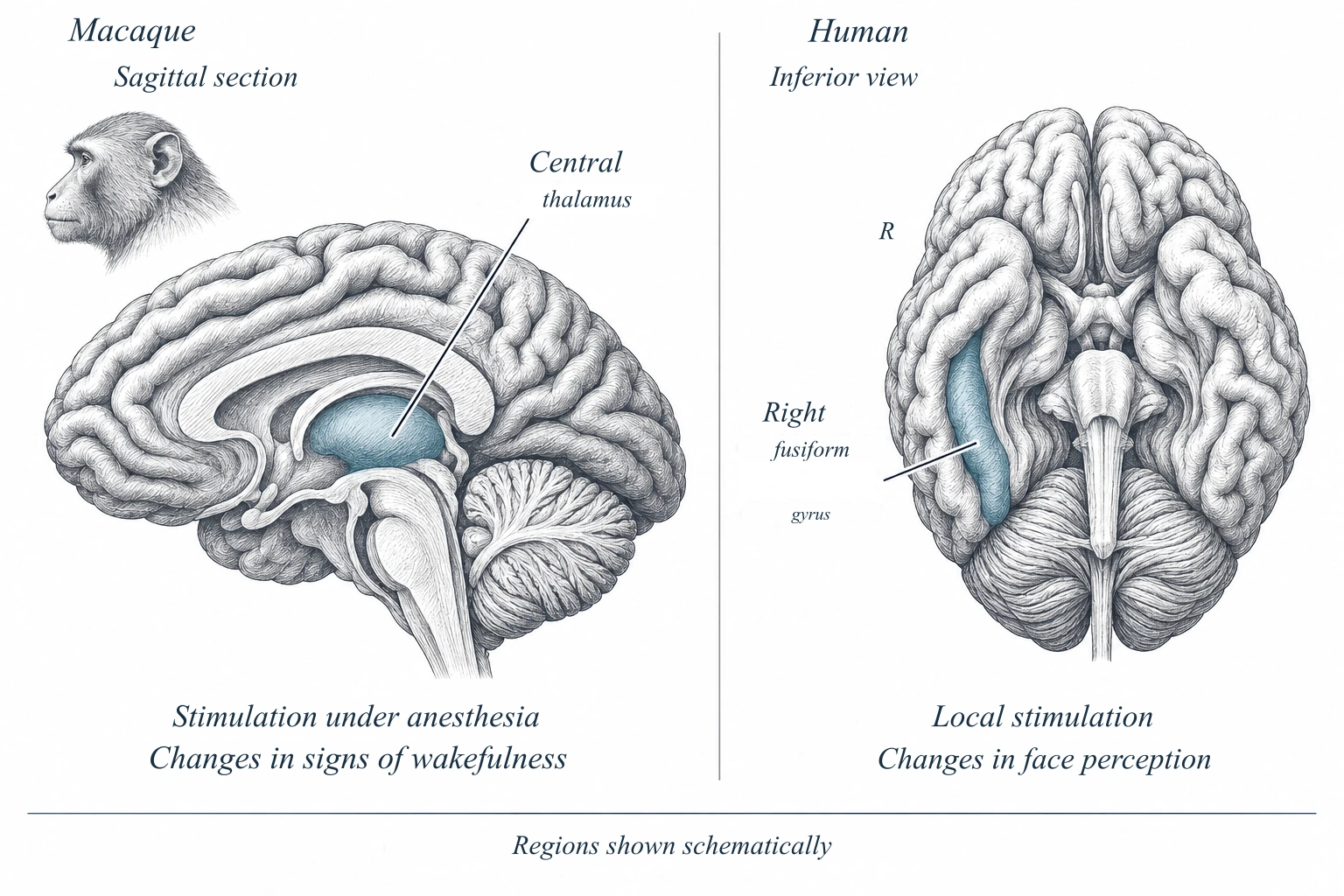
Figure 2. Different interventions affect different observable functions. On the left is an anatomical landmark of the central region of the macaque thalamus: stimulation during anesthesia changed behavioral signs of wakefulness [3]. On the right is a landmark of the human right fusiform gyrus: local stimulation changed the perception of faces [15]. The areas are shown schematically; the drawing is not a map of stimulation points and does not indicate a single center of consciousness.
The interface hypothesis allows that brain damage or stimulation alters the transformation of a more fundamental process. However, such an explanation is not enough without its own forecast. If any outcome is retroactively attributed to interface reconfiguration, the model no longer distinguishes between the expected and the unexpected.
Therefore, neurophysiology must enter into our hypothesis as a set of commitments. It will be necessary to explain why different interventions have different consequences, why certain contents emerge, and why changes in the organism do not appear to be arbitrary switching between countless alien personalities.
Nor should we weaken the alternative. You need to compare your hypothesis with a meaningful neural model that can learn, retain memory, change state and interact with the environment. Defeating the caricature of such a model will not say anything about the nature of consciousness.
What does the word "outside" mean?
The sentence “consciousness is outside the brain” allows for several significantly different readings.
In the first case we are talking about ordinary physical space. There is supposed to be a carrier somewhere outside the body that interacts with it. The hypothesis then faces questions about the spread of the impact, its intensity, delays, and how it can be independently detected. A new field or a new interaction channel cannot be introduced by name alone.
In the second case, we are talking about a quantum description of a composite system. Its general state may contain correlations that cannot be reduced to an independent description of the parts. However, the mathematical division into subsystems does not yet tell where the subject is located. The presence of entanglement also does not provide controlled superluminal communication. A physically valid channel is required to transmit a message. [14]
In the third case, “outside” means ontological primacy. It is assumed that experience or the possibility of experience refers to the fundamental properties of reality. This statement may not at all imply a separate place where a ready-made observer is located.
Such versions cannot be quietly replaced by one another. A spatially external carrier, nonclassical correlations, and the primacy of consciousness make different demands on explanation. If an experiment tests an optical process in a protein, its result cannot be transferred without additional arguments to the existence of a person outside the organism.
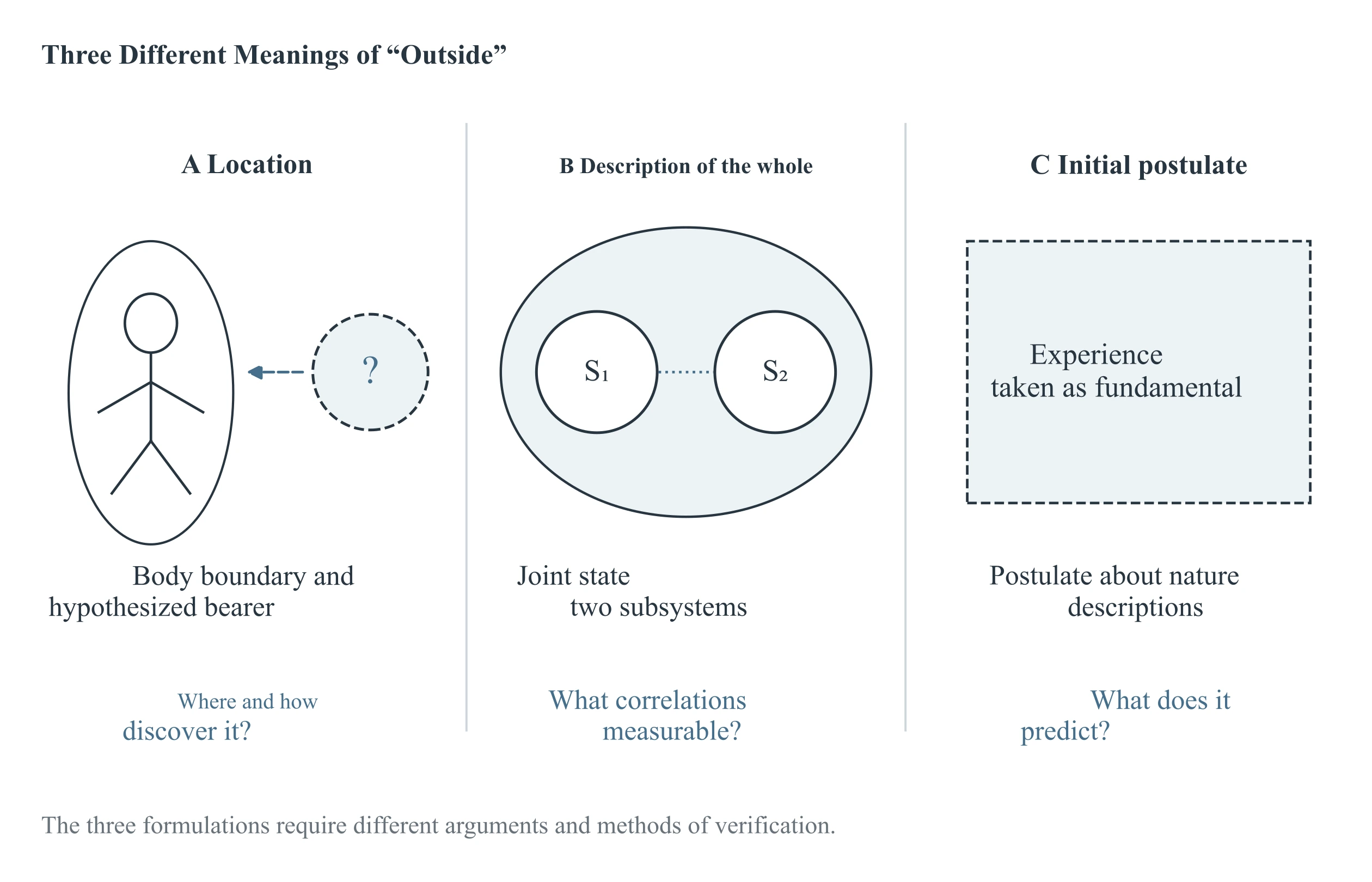
Figure 3. Three different meanings of "out". Spatial arrangement, description of a composite system, and ontological primacy require different arguments and do not automatically confirm each other.
For the book we will choose the most specific route. First, let's look at the physical mechanisms and their connection with brain function. Then we ask whether the data requires a broader system. Only then will we return to the question of the fundamental status of experience.
Why does the word “avatar” require clarification?
The image of an avatar seems clear: there is a user, and there is his representation in another environment. But when applied to a person, this image imperceptibly presupposes the presence of a ready user. He should already have memory, intentions and his own point of view.
This is exactly what we have yet to explain.
If the primary consciousness, even before connecting with the body, has memory and personal history, the hypothesis must explain their origin and method of storage. If it does not have human memory and character, the body participates in the formation of personality much more deeply than the usual image of a controlled figure suggests.
We suggest starting with the second option. Let us assume that there is a more fundamental basis for the experience. A specific subject can arise through its connection with a system that distinguishes between its own state and the world, holds history and directs actions. Then individuality is determined by the organization of interaction.
This is our working hypothesis for the joint formation of personality. It is compatible with the central idea of the book, but it introduces a significant limitation: the existence of a common ground does not necessarily imply the preservation of the individual after the destruction of the organism.
To discuss the preservation of identity, additional conditions will be needed. There must be preserved the differences by which this person is different from the other, the order of his memories and the way in which the experience continues. General information that an organism once existed does not provide these conditions.
In the future we will compare two versions of the interface idea. In one, the personality is entirely defined outside the body, and the organism provides access. In the other, individuality is formed jointly and significantly depends on the organism. They cannot be declared equivalent because they answer questions about development, memory, and brain dysfunction differently.
Why is quantum physics here?
It is possible to formulate a model of an external source without quantum words at all. Therefore, the quantum part must receive independent justification.
It is necessary to determine the specific carrier: for example, certain electronic states or nuclear spins. Then explore the interactions, the retention time of the desired properties and the way of influencing biochemistry. Finally, it is required to show that the phenomenon under consideration is not exhausted by a suitable classical model.
This kind of reasoning is found in existing research programs. Matthew Fisher proposed considering nuclear phosphorus spins and putative calcium phosphate structures as possible elements of quantum processing in the brain. The value of this idea lies, in particular, in the set of specific physical and chemical questions. The sentence itself does not demonstrate a working quantum brain memory. [7, 8]
Stuart Hameroff and Roger Penrose have a different mechanism: the Orch OR theory connects putative quantum processes in microtubules with an objective state reduction. This is a separate program with its own physical postulates. It cannot be considered an established theory of consciousness or a ready confirmation of the brain as a receiver. [4, 5, 6]
In our book, these ideas will be interlocutors. We will look at what they suggest and what results could change their assessment. After this, we will determine which elements can be included in our own model and which conclusions do not follow from them.
Research must have the potential to fail.
Suppose we chose a physical medium and calculated that its connection with the brain should give a certain effect. The experiment found no effect in the range where the method was sufficiently sensitive.
This is a reason to limit or reject the chosen version. If you change the medium, the strength of the connection, and the conditions of manifestation each time after familiarizing yourself with the result, you will never get a negative answer.
Scientific work with consciousness today involves attempts to reconcile such differences in advance. In a Cogitate Consortium study published in 2025, proponents of Integrated Information Theory (IIT) and Global Neural Workspace Theory (GNWT) were involved in formulating predictions prior to testing. The results for 256 participants supported some of the expectations and called into question important predictions of both theories. [1]
This is a useful example of exploratory courage for our book. You can defend your hypothesis while simultaneously defining in advance the circumstances under which you will have to deviate from it.
The first boundary is already clear. We have compelling reasons to study the brain as a causally significant part of human consciousness. The possibility of a more fundamental basis remains a question. To move between them, one will need to discover an additional mechanism and explain its relation to experience.
The next chapter will begin with what is often hidden behind the word “quantum”: what exactly distinguishes a quantum state from the usual description, how it interacts with its environment, and why these differences might matter to a living system.
Chapter 2