Quantum processes in a warm world
A living cell is not like a carefully isolated physical device. Molecules move in it, reactions take place, energy is consumed, and the environment of individual structures changes. At first glance, such an environment seems an unsuitable place for subtle quantum effects. However, the formulation of the question itself needs clarification. Maintaining a certain state over a long time and using a short quantum process are different tasks.
A molecular reaction does not need to maintain the properties required by a large quantum computer. It can use a certain dependence only at one short stage, after which the result is fixed by ordinary chemical dynamics. Therefore, the study of quantum processes in living matter begins with the scale of the problem: what exactly needs to happen, what degrees of freedom are involved and how much time they require.
Not all quantum physics means quantum computing
The chemical bond, absorption spectrum of a molecule and the electronic structure of a substance require a quantum description. In this broad sense, the quantum nature of biology is not an unusual hypothesis. Another statement may turn out to be unusual: for a certain function, a specially preserved coherence, entanglement or spin dynamics is essential, which is not enough to be replaced by a suitable classical model.
This formulation does not require that the entire organism be simultaneously in one controllable quantum state. Different scales may be described in different ways. For one reaction, quantum probabilities of transitions are needed, for the next stage a distribution of concentrations may be sufficient, and the behavior of the organism will require another level of description.
It's like going from a single element to a working device. The physics of the element is important, but explaining the purpose of the device does not arise simply by zooming in on a photograph. It is necessary to show how local changes influence further processes. In biology, such an intermediary could be a chemical product, a change in the shape of a protein, or a change in the rate of a reaction.
Therefore, the expression “quantum effect discovered” leaves the functional question open. The effect can be a necessary link, a side effect of the structure of the molecule, or a phenomenon accessible only under special measurement conditions. To choose between these options requires studying the relationship between the levels.
How spin can change a chemical result
One of the most specific examples is the radical pair mechanism. A radical is a particle with an unpaired electron. If the overall process produces a pair of radicals, the spin states of the two electrons can influence the available pathways for further transformation. The spin here is a quantum property, not the literal spin of a small ball.
In a simplified description, singlet and triplet states of the pair are distinguished. A singlet has a total spin of zero; a triplet combines three states with non-zero total spin. These are the properties of the common quantum state of two electrons. Interactions with surrounding nuclei and the magnetic field can change the ratio of these states over time. If chemical channels differ in their spin dependence, the change in dynamics is reflected in the product yield. This way the magnetic influence gets the path to the chemical result.
Klaus Schulten, Charles Swenberg and Albert Weller back in 1978 proposed a chemical compass mechanism in which sensitivity to the direction of the field is associated with the peculiarities of the spin dynamics of radical pairs. Their work was a physical proposal for a possible mechanism for magnetic sensitivity in living systems. [19]
The significance of this idea lies in the structure of the explanation. The external field does not have to provide all the energy of the subsequent reaction. It can change the relative probability of paths, and the energy comes from another source, such as a previous light excitation. This makes it possible to understand why comparing the energy of a weak effect with the total energy of the system does not always resolve the issue of sensitivity.
However, sensitivity does not arise without conditions. Reaction times, types of interactions, spatial structure of the molecule, and competing processes are important. If the differences disappear before the yield changes, the proposed mechanism does not perform the desired function. Therefore, the word “quantum” should be followed by a description of specific chemical reactions and their rates.
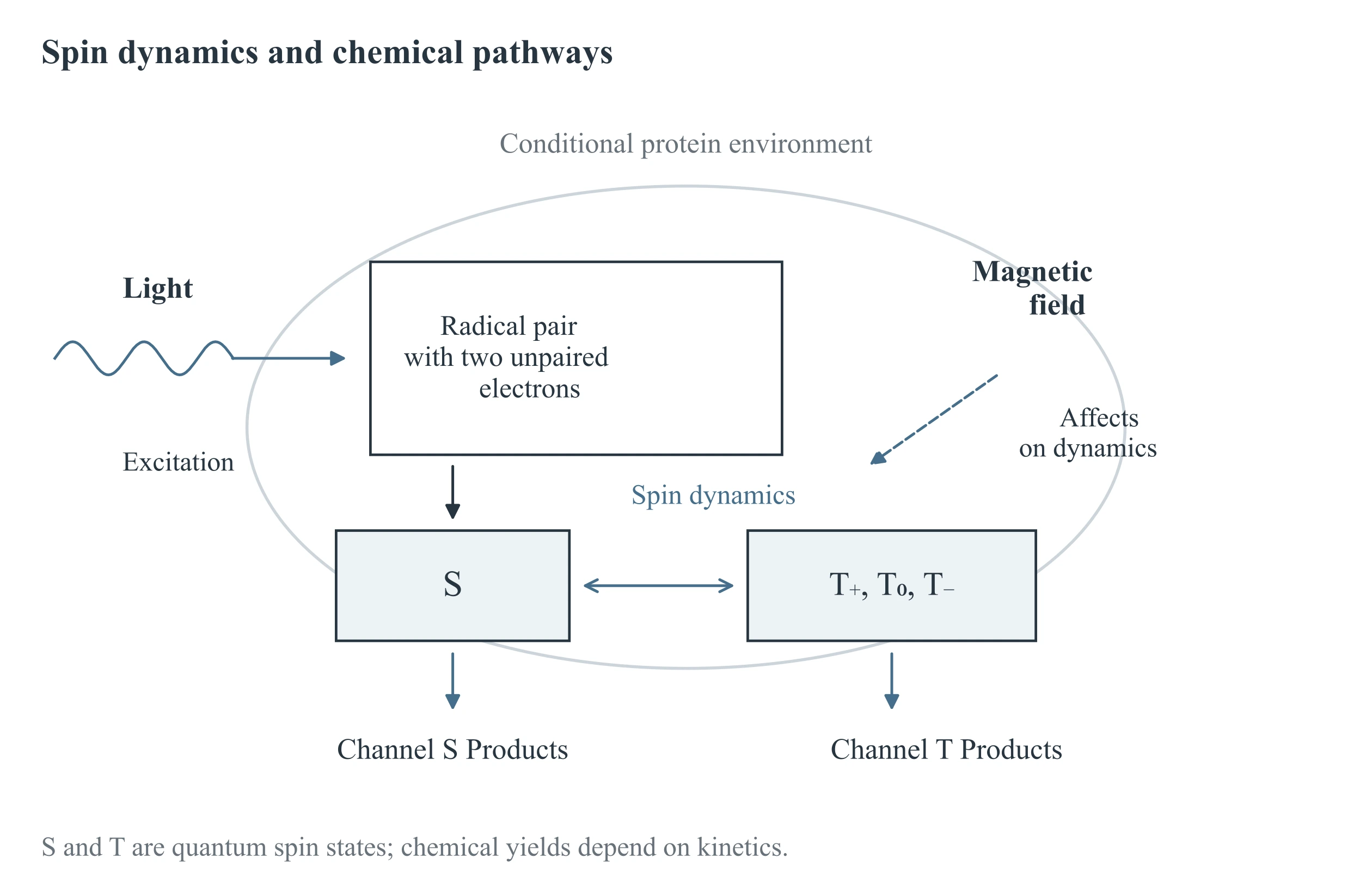
Figure 8. Simplified diagram of the radical-pair mechanism. Changing spin dynamics can change the probabilities of chemical pathways given the right times and interactions.
What has been measured in cryptochrome
A study by Jingjing Xu and colleagues, published in 2021, examined the photochemistry of cryptochrome 4 from the European robin. Experiments with the isolated protein revealed sensitivity to a magnetic field; this sensitivity differed from that of proteins from the other bird species examined. Changes to individual regions of the protein helped investigate the role of successive radical pairs. These results support research into a specific molecular mechanism. They concern measurements outside the whole organism and do not directly record how a bird experiences direction. [9]
The nature of the question is especially important in this story. The researchers isolated the substance, selected the exposure, and measured the dependence of photochemistry on conditions. This allows the proposed mechanism to be compared with other physical explanations for the result.
For a theory of consciousness, such an experiment represents an example of concreteness. If a specific carrier in the brain is suspected, it is useful to ask whether it can be studied independently of the complex behavior first. What quantity is changing? Which influence acts selectively? What chemical explanation options remain? These questions allow us to strengthen the physical link even before discussing subjective experience.
That being said, independent study has a price. By highlighting a structure, the researcher changes its environment. Therefore, laboratory confirmation of a certain property and confirmation of its natural function form different stages. The first is capable of making the second plausible and verifiable, but does not replace it.
The environment both hinders and helps
The environment is often represented only as a source of destruction. For some quantum problems this is a useful first approximation: interactions with the environment result in a loss of available phase relationships. However, the biological mechanism cannot be completely separated from the environment. It receives energy and substances, interacts with neighboring structures and must transmit the result further.
Therefore, for a living system the question is the nature of the connection. Interactions alone destroy the distinction needed by the function. Others create the conditions for a reaction or reinforce its outcome. The same environmental change can be beneficial at one stage and harmful at another. There is no universal conclusion from the word “noise”.
The imaginary molecular machine illustrates this duality well. If you make it completely insensitive to the outside world, the possibility of registering a signal will disappear. If made sensitive to everything, useful distinctions may be lost among random changes. A working design requires selectivity, which is determined by state energy, geometry and modes of interaction.
This reasoning does not guarantee that the necessary selectivity is implemented in the brain. It explains what type of device might be worth checking. Instead of a vague "all noise" defense, one needs to determine which disturbances are significant and why some degrees of freedom may be less sensitive to them than others.
Disequilibrium is also not a ready-made answer. A constant influx of energy can support certain processes, but in itself does not prove the preservation of the necessary coherence. We will have to show where the energy goes, how the state is restored, and whether restoration introduces additional uncertainty.
Let's assume that cooling the sample enhanced the observed effect. This result is compatible with a decrease in some disturbances, but temperature simultaneously changes the rates of chemical reactions and the properties of the medium. Therefore, a temperature comparison alone does not highlight the desired mechanism. For explanation, the set of dependencies expected in advance from the model is important.
A similar difficulty arises when the composition of a substance changes. Replacing an isotope can change not only the spin properties, but also other characteristics of the system. A change in a protein can affect both the putative pathway of excitation transmission and the usual stability of the structure. Therefore, the accuracy of an intervention is determined by its physical consequences, and not by the name of the chosen method.
This makes the investigation slower than simply looking for an unusual signal, but allows explanations to be differentiated. A consistent picture becomes a strong argument: a certain effect changes a certain parameter, the change is reflected in the expected part of the dynamics, and comparable control conditions do not give the same result. This picture still allows for revision, but it connects the hypothesis with the structure of the system much more closely than a single coincidence.
From molecular effect to function
Let the molecular effect exist and reproduce. The next task is to find out whether the body gains access to its result. This requires a path from a small difference in response to a more sustainable change. Without such a pathway, the effect may remain physically interesting and biologically insignificant.
You can mentally trace the chain: the probability of the reaction differs, the amount of the product changes, the state of the sensitive structure changes, then a difference in the cellular response arises. Each transition comes with its own uncertainty. A small effect can increase, average out, or disappear among parallel processes.
Amplification does not mean information appearing out of thin air. It can make a small difference convenient for further use by consuming system energy. But along with the beneficial effect, extraneous disturbances may also increase. Therefore, not only the magnitude of the final answer is important, but also its specificity: does it depend on the property for which the model is proposed?
For consciousness, the chain becomes even longer. After the physical and cellular stages, it is necessary to clarify the relationship of the process to the state or content of experience. Influence on movement, for example, is not the same as influence on experience. Effects on memory can change the story of the past without necessarily changing the experience itself at the time of the event.
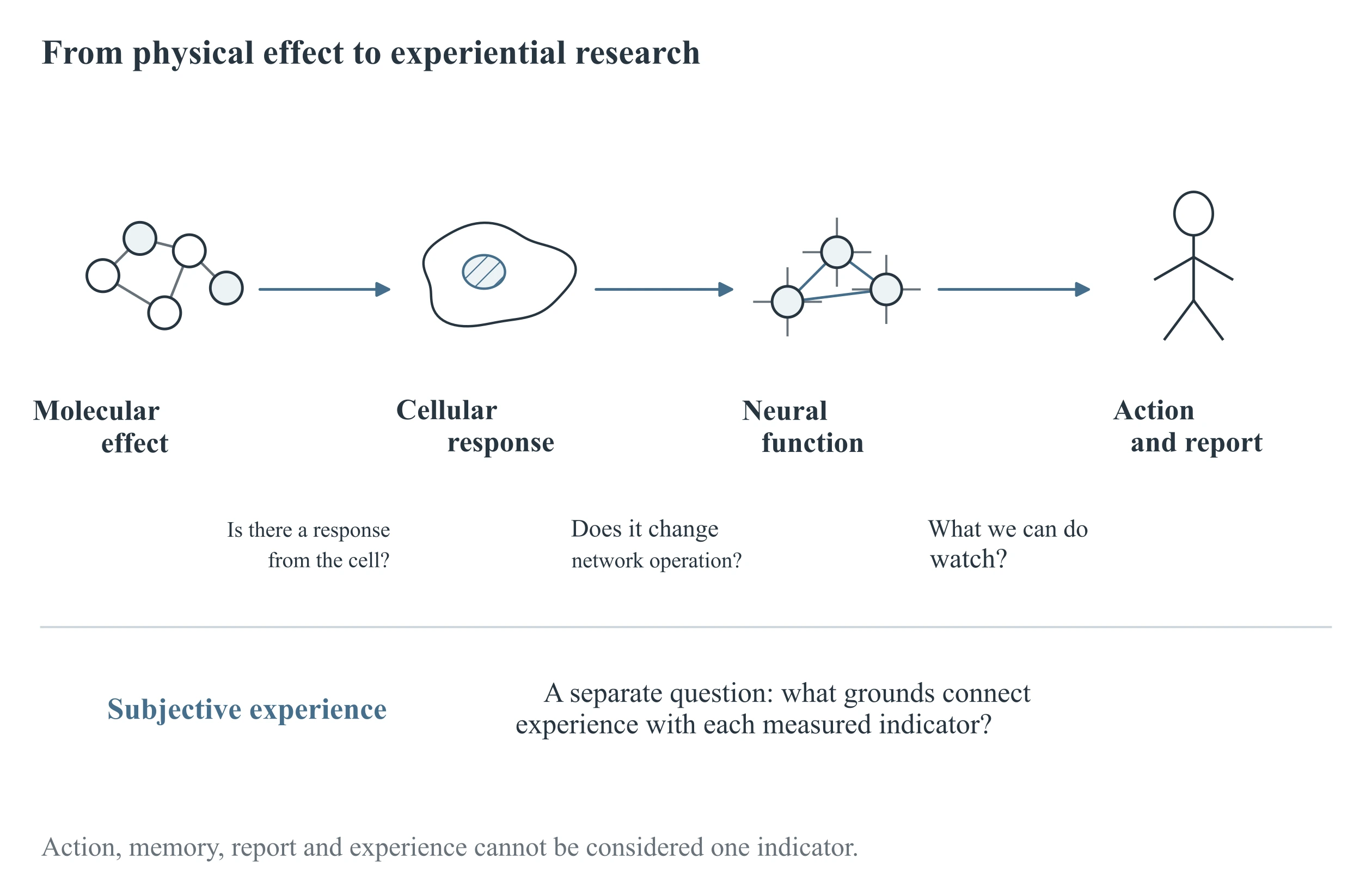
Figure 9. Levels of verification of a possible mechanism. The presence of a molecular effect, its cellular function, and its relation to experience require separate reasons.
This division makes partial success possible. Research may identify a new cellular mechanism, even if its specific connection to consciousness is not confirmed. This will remain a result about living matter. The requirement to immediately explain the origin of subjectivity in its entirety would rather prevent one from noticing its significance.
What quantum resource is really needed?
Different mechanisms have different requirements. For one, the phase in a certain basis is essential. For another - the spin dependence of the reaction. For the third - certain correlations between subsystems. The requirement for the conservation time of one property cannot be transferred to all other quantum mechanisms in living systems.
A short quantum stage can leave a long-term classical trace. In this case, storing the result does not require maintaining the original quantum state throughout the subsequent behavior. And vice versa, if the model assumes direct long-term storage of quantum information, a short initial effect is not enough for it.
This distinction helps to evaluate models of consciousness without extremes. Neither the proof of any molecular quantum effect nor the assessment of the rapid destruction of one selected superposition provides an answer for all possible architectures at once. It is necessary to find out exactly what operation is needed for a given architecture and at what stage it is performed.
It may also be assumed that a useful process involves a sequence of local events, each of which occurs anew. Then the stability of a function is determined by the reproducibility of the process, and not by the eternal preservation of one state. But if the author's model requires the unification of such events into a single subject, this unification must be described additionally. The repetition of a molecular reaction itself does not create an obvious criterion of subjective unity.
What Quantum Biology Gives to the Interface Hypothesis
Quantum biology shows how a seemingly unusual mechanism can be turned into a question about matter, reaction and measurement. It also teaches caution when moving between scales. A property of a molecule, a function of a cell, an animal's behavior, and an experience are not interchangeable results.
In the hypothesis being developed, the proposed interface must have precisely this physical certainty. It is necessary to understand what it receives, what it transforms and what it passes on. If the carrier is spin or electronic states, it will be necessary to study them under real conditions, and not limit ourselves to the name of a class of phenomena.
The receiver metaphor then becomes more meaningful. A possible mechanism may not receive a ready-made stream of consciousness, but may selectively connect certain states of the body with a broader physical system. However, the usefulness of this connection depends on its speed, stability and ability to create discernible consequences.
So the next question concerns time. Even if the desired states are physically permissible, they must retain their essential properties long enough for the intended effect. To appreciate this condition, it is necessary to distinguish between several processes, which in conversation are often combined with the same word “decoherence”.
Chapter 6