Penrose and Hameroff's Proposal
Some theories of consciousness try to find the desired organization within an already accepted physical description. Others suggest that the description itself is still incomplete. Orch OR belongs to the second direction: it connects the question of experience with the question of why quantum alternatives give way to a certain outcome. This connection makes the hypothesis unusually bold and simultaneously creates several independent obligations.
To evaluate this program, it is useful to break it down into its parts. One concerns a fundamental law. The other is a biological carrier. The third links the supposed physical event to the moment of experience. The parts must agree, but none becomes confirmed just because the other can be expressed mathematically.
Three links of one hypothesis
As presented by Stuart Hameroff and Roger Penrose, the supposed quantum processes in microtubules are organized by the biological environment, and their completion is associated with an objective reduction of the quantum state. The word “objective” means that the reduction should occur as a physical event, and not depend on the presence of a person at the device. Biological organization is designed to make such events functionally significant for the neuron and conscious experience. [4]
This description itself does not yet define the necessary observations. Different links should have different characteristics. The composition and physical condition of the carrier are important. For reduction - the law of dynamics and consequences that distinguish it from ordinary interaction with the environment. To connect with consciousness, an explanation of why an event relates to a specific experience rather than simply changing a material system.
Let's imagine a device that contains the necessary protein structures, but does not have the organization of the brain. If the proposed physical process is found in it, this will support the physical part of the model. The question of experience will remain separate. Conversely, the detection of complex neural activity while consciousness is preserved does not automatically indicate what microscopic mechanism makes it possible.
This division is useful for both the supporter and the critic. It does not allow you to declare the entire program confirmed by one effect, but it also does not allow you to reject any research in protein physics due to doubts about the theory of consciousness. The program may fall apart: some ideas will remain important, others will turn out to be superfluous. For a scientific hypothesis, this is a common method of clarification.
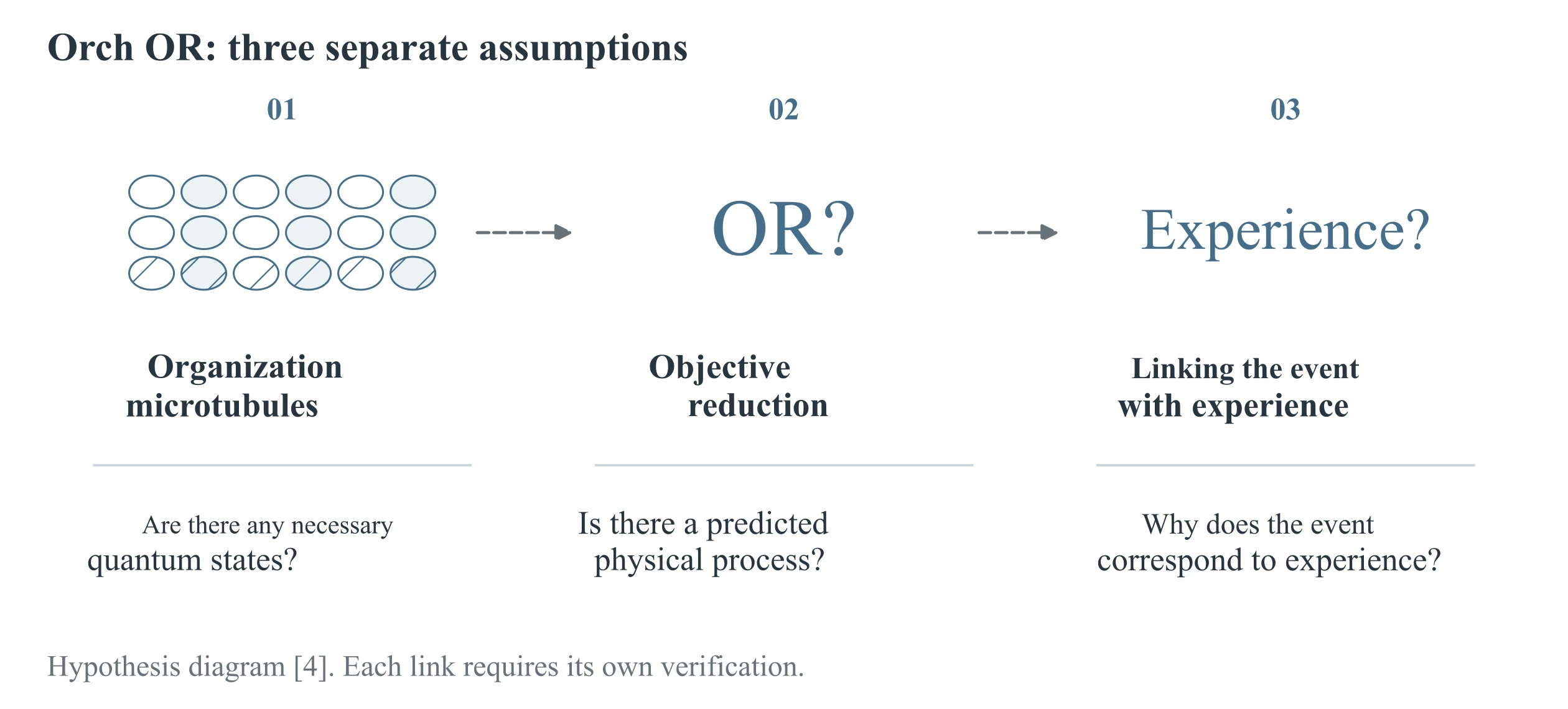
Figure 17. Orch OR connects the biological carrier, the objective reduction hypothesis, and the assumption of connection with experience. Support for one link does not automatically confirm the others.
Time before reduction
In a proposal for a gravitationally coupled objective reduction, the characteristic time is usually estimated by the relation:
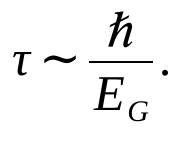
Here τ is the expected characteristic reduction time, ℏ is Planck’s constant divided by 2π, and E_G is the gravitational energy associated with the difference in mass distributions in the alternatives under consideration. This is a heuristic relation within the framework of the corresponding hypothesis; it is not an established universal law of consciousness. [4, 23]
The main difficulty lies in the choice of alternatives. You cannot substitute the mass of the brain into the formula and get the time of thought. It is necessary to describe which mass distributions are involved in the superposition, how different they are, and which scales are significant. Changing these assumptions changes the energy estimate, and with it the expected time.
The dimension of the formula is correct: Planck's constant has the dimension of energy times time. But dimensional consistency is only necessary for physical meaning. Many incorrect models can also be written with correct units. Confidence occurs when independently determined parameters predict an observation that was not used to select them.
The reverse path is especially dangerous: take the desired duration of the experience and then select the mass distribution that gives this duration. Such a calculation shows the possibility of coordination, but does not establish a mechanism. The check should at least partially go in the opposite direction - from the properties of the medium to the time and other consequences of the process.
Even the coincidence of time scales allows for several reasons. The network can set the rhythm that molecular dynamics obeys; a molecular process may limit the network; both processes may depend on a third condition. Therefore, similar periods do not determine the direction of causality. Clarifying this requires intervention or some other way to compare incompatible predictions.
A possible test should also take into account the distribution of times, not just the average. Two models are able to give the same average, differing in scatter, temperature dependence or change in media geometry. These additional characteristics are sometimes more useful in distinguishing patterns than matching the brain's habitual rhythm. They force a physical model to predict an entire pattern, rather than just one convenient number.
So the formula becomes the beginning of the calculation. It defines the relationship between quantities, but leaves the task of determining them independently. Only after this can one decide whether the hypothesized process explains the observed temporal organization or only allows it under specially selected conditions.
What should a biological organization do?
In the word “orchestrated” it is easy to hear the image of an internal conductor. However, the physical model requires other content: a certain organization of interactions, state support, control of transitions and connection with cellular function. Neither of these processes requires ascribing intention to the molecule. It is required to show what features of a living structure change the available dynamics.
A possible mechanism must solve the preparation problem. How does the system get to the desired state? Then the problem of conservation arises: which influences destroy it, and which are compatible with the necessary dynamics? After this, there is the output task: how does the result become significant for other processes of the cell? If the last link is missing, even interesting quantum dynamics can remain functionally isolated.
There is significant tension here. Strong interaction with the cellular environment is convenient for influencing biology, but it can also destroy the properties for which the quantum carrier was introduced. Weak interaction helps isolation, but makes preparation and readout more difficult. The model must find a physically feasible combination, rather than independently selecting the best properties of both limits.
Let's imagine two conditional configurations of the carrier. The first one retains the desired state for a long time, but has almost no effect on the cell. The second effectively triggers a biochemical response, but loses its state too early. The presence of each configuration separately does not prove the existence of a duty cycle. We need a switching mechanism or some other way to link preparation, storage and exit in one system.
Why doesn't the decoherence debate end the question?
Max Tegmark and the authors of the subsequent response - Scott Hagan, Stuart Hameroff and Jacek Tuszynski - obtained different estimates of decoherence under different assumptions about the state and environment. This debate relates to specific physical models. It does not provide a single measured time that can be applied to all possible quantum processes in the brain. [5, 6]
To evaluate Orch OR it is therefore not enough to say “too warm” or, conversely, “the cell protects coherence.” It is necessary to compare exactly those states and times that the selected version uses. If the proposed operation takes significantly longer than the required relationships are maintained, the mechanism does not work in this form. If there is enough time, preparation, reading and functional communication remain.
The conservation of the quantum property makes the proposed mechanism possible, but does not yet confirm the entire theory. A similar distinction exists in engineering: a material can withstand the required temperature, but this does not mean that the engine assembled from it will work. A separate restriction has been lifted; other restrictions have not disappeared.
This approach keeps research from going to extremes. It does not rule out an unusual medium on an overly general assessment and does not declare it successful after one suitable number. For each version, one can create an internally consistent description and then determine which measurement will reduce uncertainty the most. Sometimes the decisive factor will not be a spectacular observation, but an accurate assessment of losses.
Reduction can be sought outside the brain
If objective reduction is a new physical process, its consequences need not manifest themselves only in conscious organisms. This is what makes it possible to test the physical part of the hypothesis, regardless of the difficulties of studying the experience. The altered dynamics may predict additional fluctuations, heating, or radiation, depending on the specific mathematical model.
Sandro Donadi and colleagues explored the implications of the Dieuchy-Penrose model in an underground experiment to search for weak radiation. The resulting restrictions excluded its natural version without a free parameter, considered by the authors. This result significantly limits the specific implementation of gravitational collapse, but does not amount to an experimental refutation of all possible Orch OR variants or any involvement of quantum processes in biology. [23]
The significance of this example is broader than one theory. A claim about the fundamental nature of consciousness may receive a testable part far removed from talk of consciousness. If the proposed law changes the behavior of matter, it must be compared with those experiments where there is no brain. Thus, the hypothesis ceases to use the complexity of a living system as a protection against verification.
The opposite result is also possible: a new reduction law will be established in physics, but the supposed biological mechanism will not be confirmed. Then new knowledge about matter will appear without a ready explanation of the experience. For scientific reasoning, this is a fundamentally acceptable outcome. The study of law and the study of its role in consciousness can move at different speeds.
The event has not yet become an experience
Even if all the physical links work, the issue of compliance remains. Why should a certain reduction event have an internal side? How are events related to the sensation of color and the sensation of pain different? How do multiple events form a coherent stream rather than a series of isolated bursts? The physical formula of time by itself does not answer these questions.
What is needed here is a principle that connects the structure of the process with the structure of experience. It can be proposed as an additional postulate, but then its content must be shown. If a postulate allows any physical result to be arbitrarily correlated with any experience, the predictive power is small. If it sets limits on possible differences in experience, prospects for verification arise.
For the selective interface hypothesis, Orch OR represents a possible interlocutor, but not a ready basis. Objective reduction in microtubules, even if established, does not in itself mean the transfer of personality from an external source. To obtain such a model, additional degrees of freedom, a communication method, and an individualization rule will be required. These elements are not automatically contained in the word “fundamental.”
A strong development of the idea could investigate how the properties of an external bearer constrain the permissible states of an internal mechanism. The external contribution would then need a distinguishable consequence. If the added entity never changes any probability and explains nothing about the structure of experience, its physical role remains undefined. If it does change something, the model must specify where to look for the change.
What remains after verification?
A theory can be useful even if it turns out to be wrong. It forces us to connect the properties of proteins, fundamental dynamics and the problem of subjectivity into one system of obligations. Where previously only the word “secret” existed, specific questions appear. This is a merit of the research program, not evidence of its truth.
The most meaningful strategy is to clarify the links that allow independent verification. The properties of the carrier should be examined separately from the expectation of finding consciousness. The law of reduction is separate from the desire to preserve personality after death. Connection with experience - taking into account the results of neurophysiology, which any competing theory must explain.
This order preserves the boldness of the design. It allows us to assume a change in physics itself and at the same time demands the usual scientific responsibility from the assumption. The question is not whether the idea is unusual enough, but what observations become clearer and what new observations it allows us to expect.
The next proposal takes a different route. Instead of short-lived electronic processes, it focuses on nuclear spins, which may interact more weakly with their surroundings. This change of carrier changes the nature of the difficulties: preserving the state may become easier, but the question of how a protected state participates in the cell’s active chemistry becomes especially pressing.
Chapter 10