What does anesthesia do to the question of consciousness?
The person answers the question, then stops answering, and later starts talking again. There may be a gap in memory between two conversations. This sequence seems like an almost perfect experiment in switching consciousness off. But the seemingly simple picture hides several different processes: a change in experience, loss of connection with the environment, the inability to respond, and impaired memory formation.
This is why anesthesia is so important to the study. It allows you to observe transitions and compare the effects of substances with changes in the brain. At the same time, it forces one to carefully select the measured value. If a theory explains only immobility, it cannot automatically be considered a theory of the disappearance of experience. If it explains memory, it is not a complete explanation of what happened before the response was restored.
Three different disappearances
You can mentally distinguish between three situations. In the first there is no experience. In the second, the experience exists, but does not contain the actual external world. In the third, the outside world is somewhat accessible, but the ability to communicate about it is impaired. Behavior in these situations may be similar. Therefore, the absence of a reaction does not always clearly determine the internal state.
Added to these differences is memory. Even if the experience was present, it might not be preserved in the form of a subsequent story. Conversely, the post-recovery narrative may include events that occurred during the transition between states. The researcher obtains a memory rather than a direct, continuous record of the experience. Timing content becomes a task in itself.
In the study by Sarasso et al, eighteen volunteers were assigned to three anesthesia groups. After ketamine, participants reported vivid dream experiences, whereas after propofol and xenon there were no such reports. The brain's responses to magnetic stimulation also differed: with ketamine, a more complex picture remained, close to wakefulness. [2]
This result is important as a distinction between observed states rather than as a ready-made map of all possible anesthesia experiences. It shows that the same lack of response to external stimuli can be accompanied by different data. For interface theory, the consequence is specific: it is impossible to describe any such transition with a single quantity “connection strength” if different forms of access loss require different mechanisms.
A more meaningful model should distinguish between the channel of external perception, the internal organization of experience and the conditions of subsequent reproduction. Perhaps they depend on the overall process. But this must be shown by explaining the cases of their divergence. Otherwise, the simple word “disconnection” hides precisely those differences that the experiment made available for study.
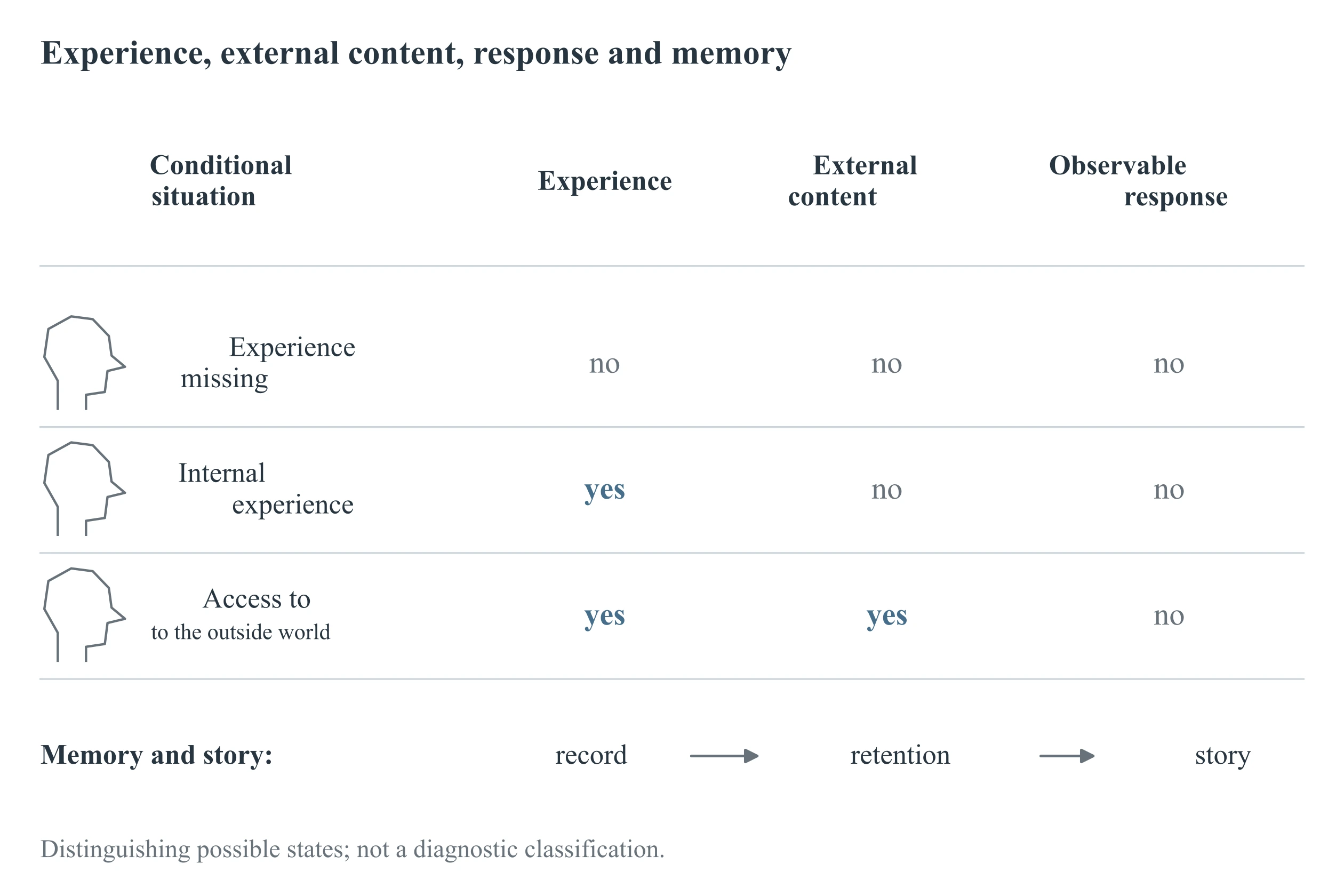
Figure 20. A similar lack of external response may allow for different internal states. Memory and the subsequent story constitute a separate element of observation.
Evidence that comes later
The story of an experience has a special position. It is the most important source of information about the content of experience, but it arises in a system that has already gone through changes in state. Therefore, the researcher must simultaneously take the story seriously and take into account the conditions under which it appeared. Subjective vividness does not replace independent information about time and circumstances.
Suppose a person, after recovery, talks about sound. This sound could relate to the period before the loss of response, to restoration, or to an internally constructed scene. To distinguish between options, an event with a known time and content is required. The very fact of recognition of a sound does not establish the moment of its perception.
Likewise, the absence of a story does not allow one to reconstruct the entire previous story. The memory may not have been formed or may have been inaccessible. This does not mean that any empty interval should be considered a hidden experience. The correct conclusion is that the data constrain many possible explanations, but do not always select one.
For a physical hypothesis, it is especially important to decide in advance which part of this chain it describes. The model can predict the disappearance of available memory while the internal process is preserved. Then it should be checked against the consequences of just such a discrepancy. If it predicts a complete cessation of the process, subsequent evidence and independent indicators will make a different demand.
Validation is stronger when different data sources are consistent. Behavior, physiology, and narrative do not always have to coincide, but theory must explain the pattern of their overlaps and divergences. An arbitrary preference for whichever indicator is more convenient for the current conclusion deprives the experiment of its discriminative power.
Brain response to disturbance
The operation of the system can be studied both under normal conditions and after a short exposure. Perturbation provides a known beginning and allows one to explore how the response spreads and changes. This helps to distinguish states that are externally similar in immobility, but differ in internal organization. This is exactly the approach used in the mentioned magnetic stimulation study. [2]
However, response complexity should not be confused with arbitrary irregularity. Noise can be unpredictable without forming coherent processing. On the other hand, a very regular system can reliably perform a limited function. Connecting with consciousness requires a measure that is sensitive to the organization of interest, and not simply to the amount of fluctuation or the unusualness of the pattern.
Let's mentally compare the three devices. The first responds to the influence with the same short impulse. The second produces random noise. The third gives a varied answer, but related to the impact and internal state. These differences are useful for analyzing dynamics, but do not in themselves determine which device has experience.
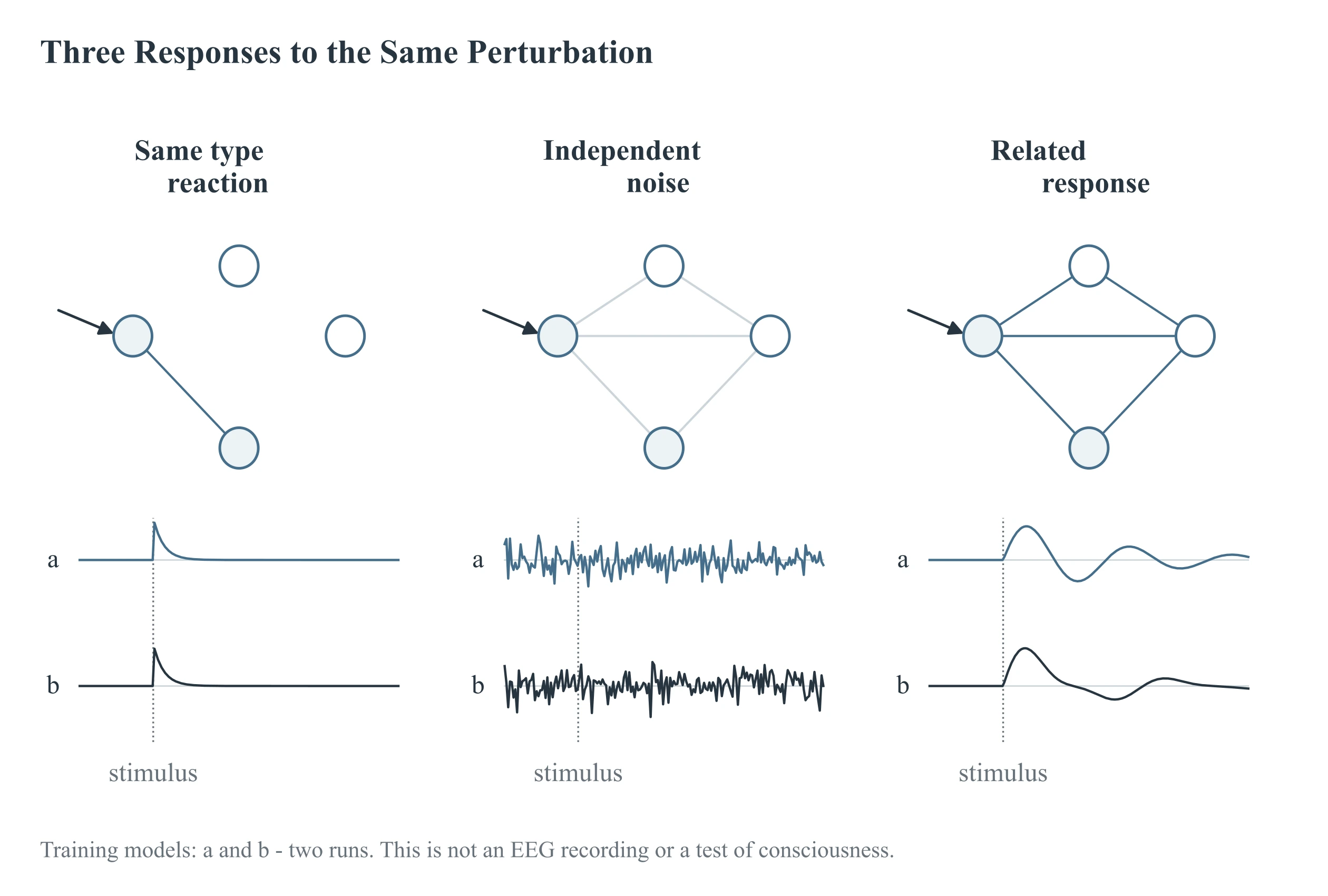
Figure 21. The same type of response, noise and varied associated response reflect different organization of dynamics. In the third example, the two runs differ in the initial state of the device. These teaching examples do not in themselves determine the presence of an experience.
Therefore, a physiological indicator acquires meaning through comparison with independently described states and conditions. It can help assess consciousness where the answer is difficult, without becoming a universal measure of subjectivity for any physical system. Transferring an indicator to a new environment requires a separate verification of its meaning.
Moreover, the condition does not necessarily change in all respects at once. During the transition process, one indicator may recover before another. If we compare only the steady states before and after exposure, an important part of the mechanism will remain invisible. The temporal order of changes can show which link precedes the other and what processes continue after the appearance of the external response. Therefore, the theory must explain the course of the transition, including the sequence of restoration of different functions.
For the quantum hypothesis, this means that a change in the complexity of the brain response may be an expected consequence, but not a direct measurement of the quantum carrier. A causal chain remains between the supposed microscopic process and the observed dynamics. It must be examined if the quantum explanation is to be distinguished from a neural model with a different microscopic basis.
Intervention and return
Of particular value are experiments in which the researcher changes the operation of a particular system and observes a partial restoration of function. In Bastos et al.'s central thalamic stimulation series, two macaques showed signs of wakefulness with continued administration of propofol. At the same time, some characteristics of neural activity changed. [3]
The causal structure is important here. The condition changed after a certain intervention, although the anesthetic continued to act. To explain, it is not enough to say that the molecules of matter simply destroyed consciousness everywhere in the same way. It is necessary to take into account the organization of the network, the possibilities of its activation and what functions have actually been restored.
But the causality of intervention has limits. Turning on one node can affect many others. The return of motor reactions does not allow us to directly read the content of animal experience. Therefore, the precise formulation of the result retains the observational level: signs of wakefulness and neurophysiological changes, rather than full access to the animal's inner world.
The interface hypothesis could incorporate this result by suggesting that a thalamocortical organization is involved in access to the intended carrier. It will then be necessary to explain why this particular organization matters and what additional consequences follow from such an explanation. If any recovery method is called "receiver repair", the hypothesis remains too flexible.
The stronger variant should predict differences between interventions. One change may restore the ability to respond to external stimuli, another may restore the complexity of the brain's response to stimulation, and yet another may restore the ability to retain memories. The relationship between these effects will indicate how many truly independent functions the intended interface includes.
Microtubules in the causal chain
In the work of Han et al, exposure to the microtubule stabilizer epothilone B in rats increased the time to loss of the righting reflex under isoflurane anesthesia. This result correlates interference with the microtubule system with an index of anesthesia sensitivity. The experiment itself did not measure quantum coherence and did not directly determine whether the animal had an experience. [12]
The righting reflex is the ability of an animal to return to its normal position after turning over; In the described experiment, the return of the rat from its back to its paws was assessed. This is a convenient observable indicator, but its change may reflect the work of different parts of the body. To relate the result specifically to quantum dynamics, it is necessary to show its causal role and separate it from other cellular changes. [12]
Suppose the intervention both makes the structure more stable and changes its interaction with light. A change in sensitivity to a substance would be compatible with at least two explanations. What will help you choose between them is not a general reference to microtubules, but a discriminating prediction. For example, which characteristics must change together and which can change independently?
When comparing these experiments, it is necessary to check the intermediate links. An optical effect in an isolated structure and a change in reflex in an animal may belong to the same mechanism, but this connection still needs to be proven. The mere presence of the word “microtubules” in both descriptions does not establish causal continuity.
Further research should connect three levels with measurements: the state of the carrier, its effect on the cell and the state of the organism. If the changes are consistent in timing and effect size, the model is supported. If the chain is broken, it becomes clear where revision is needed.
A Prediction That Distinguishes Explanations
A meaningful forecast concerns not only the direction of the effect. The formulation “a substance will change consciousness” is too broad, if this is already known from pharmacology. The new mechanism must explain additional variation: dependence on a property of the carrier, a characteristic range, a specific temporal order, or a particular combination of observed changes.
For example, in the imaginary model, two impacts change the overall network activity in the same way, but have different effects on the putative quantum carrier. If the model associates a certain aspect of experience with it, it must indicate in advance the difference between the resulting states. Otherwise, the medium does not add observable information to the already existing neural explanation.
The reverse case is also important. Two interventions may produce the same change in a measure of the carrier, yet lead to different behavior because of differences at later stages. The theory must then explain why an equal microscopic effect does not imply an equal state of the organism. A multilevel explanation requires consistency rather than a single universal indicator.
A good model also allows for failure. If the intended carrier changes, but the expected function under suitable conditions remains the same, this limits its role. If a function changes without the expected change in media, the stated need is limited. Such outcomes are useful precisely because they allow one to choose between different causal schemes.
The price of a general explanation
A universal theory of consciousness must explain ordinary wakefulness as well as transitions in which experience, response, and memory diverge. It cannot select only the most mysterious cases. Simple, stable relationships impose demands no less stringent than unusual subjective accounts.
Anesthesia therefore does not provide a single definitive answer, but does provide many limitations. The theory must take into account the diversity of observable conditions, the possibility of causal intervention, and the limitations of measurement methods. For an external medium, this means the need for an accurate model of communication with the organism, and for a purely neural approach, this means the need to explain the internal organization of experience.
The next step is to compare these explanations on general terms. While each program chooses its own successful examples, the argument easily turns into parallel monologues. Scientific meaning appears when competitors indicate in advance where their forecasts really differ and what result will have to be considered inconvenient.
Chapter 12