Part VIII. Authorization, recovery, and learning
Chapters 55–60. How to check the result, correct the failure and remain prepared.
After the first successful actions, a new temptation arises: to call the entire event completed. However, the person may still require assistance, the premises may be suitable for only part of the work, and normal services may remain unavailable. In the last part of the book, each result gets its own question and test.
First, it is necessary to determine what exactly is permitted and on what grounds. Then, prepare a response to the new signal, restore routine services, and test corrections. This ends the individual response and begins the next period of responsibility. Participants should receive a clear record of which tasks are closed, which are ongoing, and who is responsible for them.
55 Authorization for people, facilities, materials, and areas
Navigation: NAV · p. 003 · Contents: OGL · p. 010
What does permission to return to work mean?
authorization is permission to perform a certain action under specified conditions. Can the person return to their job? Is it possible to use the premises again, transfer material or open the area for the chosen activity? In each case, the subject and boundaries of the decision are named. Therefore, medical discharge, cancellation of an individual measure, and closure of an organizational incident may occur at different times.
Before testing, the team determines what result will be sufficient for a decision. Data quality requirements depend on the question they are intended to answer [31]. A negative result is assessed taking into account the suitability of the method, the history of the examination and its limitations. This allows you to understand how much of the rationale it actually supports.
Four separate decisions
Item | Lead responsible | What is the decision based on? |
Man | Treatment team and authorized service as appropriate | Condition, need for assistance, associated risk assessment, operating conditions |
Premises or equipment | Authorized person for authorization with the owner of the facility, technical service and hazard specialist | Work performed, source and residual impact assessment, serviceability of systems, suitability for stated use |
Material | Authorized specialized organization | Identity, history, terms of transfer and limits of acceptable use |
Territory or environment | Competent authority with subject matter experts | Sources and pathways of impact, representativeness of data, purpose of the territory |
Sometimes one trained participant can perform several roles. Even then, he writes down the reasons for each decision separately. The suitability of ventilation requires technical assessment, the patient's condition requires medical assessment. Combining responsibilities does not transform one type of professional conclusion into another.
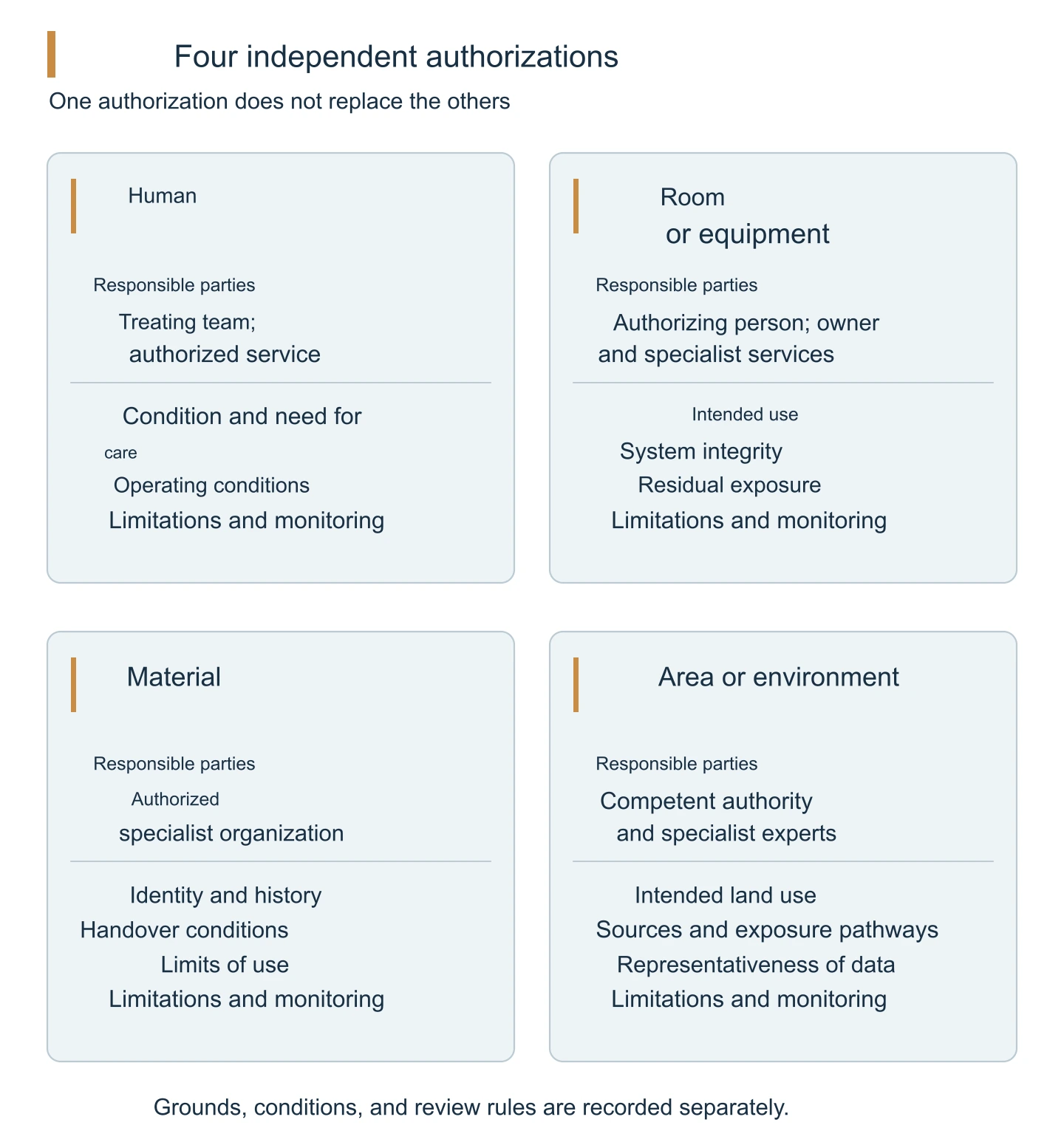
Figure 36. Four independent clearances
The authorization of a person, premises or equipment, material and territory is issued on its own grounds. For each, the responsible person, permitted use, restrictions and revisions are indicated; one decision does not replace the others.
How authorization decisions are made
The task owner describes the action to be resolved and collects the necessary evidence. The check person responsible transmits the results along with restrictions and deviations from the plan. The inspector compares them with pre-established criteria and sorts out contradictions; the degree of its independence must correspond to the significance of the decision. The authorized person then specifies the permitted use, conditions, review period or event, and who is responsible for monitoring.
The result may be authorization within the stated limits, authorization with conditions, retention of the limitation, or recognition of insufficient data. In the latter case, the manager determines the temporary order and method of obtaining the missing information. He simultaneously checks the assistance, the basic needs of the people and the proportionality of the measure. These conditions are part of the ethical rationale for the restrictions [12].
Tutorial R1: How to complete two different checks
At the Sfera station, an independent check clarified the malfunction of the measurement channel. The team returns to the question of the work compartment: can the specified operation be performed there if the systems state is confirmed? The medical officer continues to evaluate the crew member who reported feeling unwell. These questions have different bases and may receive answers at different times.
One suggestion is to remove all associated restrictions after explaining the signal. Another is to save them until the medical evaluation is fully completed. Both proposals link the two objectives too broadly. The commander asks the specialists to indicate what information confirms or limits the proposed work in the compartment. If all the conditions for the specific use of the compartment are confirmed, including the necessary technical conditions and an assessment of the possible impact, the corresponding permit can be issued separately. Medical observation of the person continues for its own reasons.
The clearance record identifies the operation, the test results used, any remaining restrictions, and the person responsible for surveillance. If only the equipment check conditions are confirmed, the entry does not automatically allow the entire scientific program to resume. If there is insufficient information, the manager indicates the permissible temporary activity and the issue that must be resolved next.
Completion is reported to each recipient for their task. The crew receives clear instructions about access and operation. Ground medical team - information about ongoing assistance to the person. The next shift sees which basis has changed and why. In this case, the book does not require a final explanation of all events by one cause: it requires a reasonable conclusion to each decision, preserving the remaining responsibilities.
The same logic works in a hospital or warehouse. The inspected premises may remain unsuitable for previous activities due to lack of water or personnel. Then the permission is limited to secured use. The question “can I open it?” it becomes more precise when it is added: for what work, for whom and under what conditions.
How to report results
The permission message explains what is allowed, from when and under what conditions. It identifies the person responsible for the issues and lists the remaining restrictions. If the decision concerns one area or operation, this should be clear to a person who reads only the message without opening the entire package of documents.
Along with the decision, signs for re-evaluation are transmitted: a new disease, a change in data, a system failure or a detected error. The operations service confirms that it has accepted the observation. P13 · p. 167 issues a specific permit, P14 · p. 168 - subsequent period. Until the person responsible is appointed after opening and has confirmed the task, the transfer remains incomplete.
56 Repeated event after measures are removed
Navigation: NAV · p. 003 · Contents: OGL · p. 010
How to understand the meaning of a new signal
After discovery, a new disease, research result, or technical deviation may appear. The cause may be the same or independent: a preserved source, a new introduction, an unaccounted path of influence, a change in a person’s condition, a method error or an event of a different nature. The team checks the versions against the relevant data. Repetition itself does not explain which previous decision required change.
The duty officer first determines the urgent task: helping a person by P02 · p. 156 or checking the protective function according to P04 · p. 158. The reasons are being clarified in parallel according to P06 · p. 160. The incident number can be clarified later; it should not delay the necessary action. When the cause is unknown, competing infectious and noninfectious explanations remain [2].
Comparison with previous decision
The attendant associates the new signal with the previous event, maintaining its own time and source. The permitting officer raises the rationale: what was permitted, for what use, and with what restrictions. Experts check which initial condition has changed, is no longer met, or has not been sufficiently studied.
The team compares the actual work with the authorization conditions. Have the regime and load changed, have new dependencies appeared? The doctor separately evaluates the patient's condition, new influences, other possible causes and undesirable effects of treatment. The engineer checks the serviceability, maintenance and reliability of the technical signal.
The temporary measure is related to the likely route of harm and the available data. The size of the previous event does not automatically determine the size of the new response. If a manager imposes a broad restriction, he indicates the basis, the provision of people and the nearest revision.
Checking the decision without hiding the error
The discovered error of the previous conclusion is directly reflected in the journal and reported to the participants whose actions depended on it. The old version is retained, and the current decision is corrected. The explanation distinguishes between an error in the initial data, an incorrect application of the method, a violation of the work order, and a change in conditions after a reasoned decision.
In the training example, the signal was repeated after the section was opened. The test showed that the actual load differs from that for which suitability was confirmed. The team clarifies the authorization range and technical conditions. The previous result still makes sense for the tested mode, but does not automatically answer the question about the new one.
In the analysis of R5, some of the city messages turned out to be repeated forwarding. If a similar message appears after updating the summary, it is important for the reviewer to maintain the possibility of two explanations: this is another old record or a new independent observation. The same wording is not enough to make a choice. He clarifies the source and time, and the person's medical need is assessed regardless of which record the call is assigned to.
If it is an old message, the analyst corrects the recordkeeping and provides a link to the original entry. If the observation is new, the team determines whether it changes the rationale for the current measure. This order protects both from re-counting and from missing a new event. In both cases, a record of the check performed is left, which can be understood by the next participant.
When the consequences are significant or the team is too attached to its previous conclusion, an independent reviewer is brought in to review. He needs background data and an opportunity to express disagreement. The appointment of another commission is useful only together with the conditions for such verification.
Closing the repeated review cycle
After re-evaluation, the team writes down the working explanation, modified decisions, and who is responsible for the next tasks. If new information does not change the authorization, it maintains the basis for that conclusion. If the question remains open, indicates what information can change the action and who should receive it.
The detected gap is transferred to the analysis of chapter 58 and checked by studying the chapter 59. The fix must address the cause found. Additional coordination is only meaningful if it helps identify or close the gap and does not unduly delay assistance.
57 Restoring aid, infrastructure and livelihoods
Navigation: NAV · p. 003 · Contents: OGL · p. 010
How to prepare the return of regular services
Routine medical care, water, food, training, transportation, and access to needed support must be maintained during the response. The Health EDRM framework links recovery to the provisioning and resilience of systems [37]. In the author’s model of the book, recovery is assigned a leader, resources, and verifiable results before other areas are completed.
People may still have needs after the administrative incident has ended: continued treatment, assistance with mobility, care, support after losing a job, or fear of returning. The plan also includes those who did not have a confirmed disease, but lost access to a necessary service.
Priority based on need and dependency
The coordinator finds out for whom and what kind of break now creates the greatest harm. The medical service identifies missed care and the need to continue treatment. Engineers check the infrastructure. Social and community services clarify needs for care, housing, communication and access to identified support. From this information, the recovery order is formed.
Before a service opens, staff, supplies, equipment and the route by which people will be able to use it are checked. Provide treatment in case of complications. If the workload increases significantly, the previous assessment of suitability is revised: working with a small group does not yet confirm the ability to serve everyone.
The owner of each task specifies a dependency on another service. For example, a person will be able to get an appointment only after transport is restored; Continued treatment may depend on the supply and storage conditions of the drug. The coordinator links these tasks and checks the transfer between organizations.

Figure 37. Returning services to everyday life
Medical care, food supply, transportation and water supply are shown through accessibility for different people. Recovery requires ongoing services and support for daily tasks; the opening of a building does not in itself confirm that restoration has been completed.
In Figure 37, trace the path of the service to a specific person. The machine must deliver food to the desired address; an open aid station must be accessible to the visitor; a working network - to provide the required object. The image suggests checking the end link. It is there that it often becomes noticeable that the formally completed work has not yet given the expected result.
Medical and social continuation
The duration of observation and the content of rehabilitation are determined according to the needs of the person. WHO considers rehabilitation as part of healthcare; its inclusion in the plan requires an available service and task transfer [34]. This transition is discussed in detail in chapter 30.
The person receives a clear plan for continued assistance: who to contact, how to sign up, what documents are needed, and what to do if things worsen. The team checks to see if he can take advantage of this plan. When faced with obstacles due to distance, language, disability or expense, it identifies the problem and looks for a feasible option within the available system.
Training analysis of R3 and R4: How to check the recovery
In the district hospital from the analysis R3, the load of the new event decreases. The manager can release some of the temporarily allocated resources. Before returning to the previous schedule, the coordinator finds out what routine care has been delayed, which staff are still overworked and who needs continued treatment. The available space in the schedule must meet a specific unmet need.
The two possible orders appear equally complete at the report level. The first returns all units to their previous mode on the selected date. The second compares the priority with actual needs and dependencies. If transportation is not available for some patients, booking an appointment without addressing this issue will not complete their journey. The coordinator links medical and transportation services and obtains confirmation of an available option for those who need help earlier.
In Kedrovoye, the settlement in case study R4, transportation has resumed. This allows you to deliver support, but you still need to confirm the acceptance of the cargo and transfer to people. The local coordinator reviews routine medications and care, and the health worker reviews outstanding care pathways. Weather conditions no longer block the path, but the possible lack of a person to carry the necessary items home remains a challenge in its own right.
To complete the transfer, both teams draw up a short list of remaining commitments. The permanent service accepts each of them along with the resource, contact and revision condition. If there is no recipient, the task remains in current management. The end date of the special regime does not erase it from the log.
The results are checked for separate groups of people. The average availability of a service may appear good until those who need assistance use it. Therefore, the coordinator clarifies whether the help has reached the recipient and what obstacle remains. This question connects restoration to everyday life, not just the execution of a repair or organizational plan.
Metrics and transfer completion
Recovery is measured by access to critical services, remaining needs, resilience of supply, and ability to respond to a new signal. The number of completed jobs is used in conjunction with checking the result for people. The data is divided into the necessary groups so that the overall indicator does not hide those who are still denied access.
The emergency team transfers responsibilities to permanent services with confirmation of resources, responsibilities and review. Unfulfilled obligations remain until they are transferred or completed. Residents are explained what services are available, what else is limited and where to go. Clarity, timeliness and recognition of uncertainty are included in the principles of risk communication [13].
58 Analysis of the incident and verification of corrections
Navigation: NAV · p. 003 · Contents: OGL · p. 010
Purpose of analysis
Analysis helps to understand the course of the event and select corrections. The team determines which decisions helped, where the plan diverged from execution, and what will reduce the likelihood of recurrence. The WHO post-event debriefing guide suggests participatory structured training [17]. The necessary legal investigations, medical examination and technical examination are carried out on their own grounds.
Observations are retained during the response, if this does not interfere with assistance. Performers, managers and host organizations participate in the analysis; involve affected people if necessary. For discussion, information is provided in the amount appropriate to the task. Personal health information is not made public simply because a general meeting is held.
Restoring the painting
The coordinator restores the sequence: message, transmission, decision, action, confirmation and result. Those responsible provide the original records and explain what was known at the time of selection. Information obtained later helps verify the decision. However, they cannot retroactively be made available to the participant from the outset.
When analyzing a deviation, the team finds out whether the required step was foreseen and understood by the person responsible, whether he had enough authority and resources, and whether there was confirmation of completion. If the step is completed, check why it did not produce the expected result. These questions help distinguish between planning failure, lack of preparation, lack of provision, and misattribution of the hazard.
Human action is considered together with working conditions. Liability for willful misconduct remains, but the term “human error” does not explain unavailable communications, incompatible equipment, or unclear authority. The corrective plan must address the identified cause.
Correction Plan
Field | What needs to be explained |
Observed gap | What action, condition or result diverged from expectation? |
Hypothesized cause | Explanation based on records and evidence |
Change | What changes in a process, resource, or authority |
Owner and term | Who enforces it and when? |
Checking the result | What observable action or result will confirm the correction |
Residual constraint | What has not yet been fixed and how it is taken into account |
Training analysis R2: Why the old entry remained valid
Let us return to the handover between Sever and Bereg. The container's location was confirmed; the discrepancy arose from an old copy of the log. It would then be easy to do no more than remind the employee to use current documents. But the review must establish why the working arrangements allowed an old copy to be accepted as current and why the discrepancy went undetected during the handover.
The coordinator arranges the recordings in time and asks both parties to reproduce the path available to them. He distinguishes between the time of actual reception, the time the entry was made and the time when the sender was able to see it. Staff explain which source was considered current. Parsing requires precisely these conditions; The latest corrected version by itself no longer shows the cause of the problem.
The team compares the two fixes. The first thing is to resend the instructions. The second is to clarify the source of the current record, identify the outdated copy and secure the confirmation of receipt with the backup contact. Distribution may help familiarization, but without verification it leaves it unclear whether the next participant will be able to distinguish between the versions. The manager selects a change that addresses the identified gap and assigns a review owner.
In a safe exercise, the participant is given a training message about the transmission and the unavailability of the main source. The observer checks to see if the user has found the latest information, received confirmation via the backup path, and saved any unfinished questions. If a person again stops at the old copy, the correction point remains open. It is closed after demonstrating the desired action under conditions similar to the detected failure.
The final entry distinguishes between an recordkeeping correction and a decision on the suitability of the container. The first relates to the transfer of information. The second remains with the appointed specialist and is based on its own grounds. This way, the analysis improves the process without replacing professional conclusions with a convenient general phrase “the violation has been eliminated.”
From agreement to proof
Once the plan is approved, an independent reviewer or designated quality officer evaluates its implementation. The critical change must be demonstrated under conditions consistent with the identified failure. If equipment is purchased, they also check the possibility of its use: a trained operator, consumables and availability at the right time.
When closing the item, record the proof of the result, the date and the remaining restrictions. If correction is delayed, the manager determines a temporary measure and acceptable activities. Open critical tasks are transferred to new management explicitly, along with their consequences.
The results are sent to chapter 59 for verification by teaching and to chapter 60 for updating instructions. The correction is considered implemented after the work has been changed and the result has been confirmed. The report captures the basis for these changes and helps you check what remains to be done.
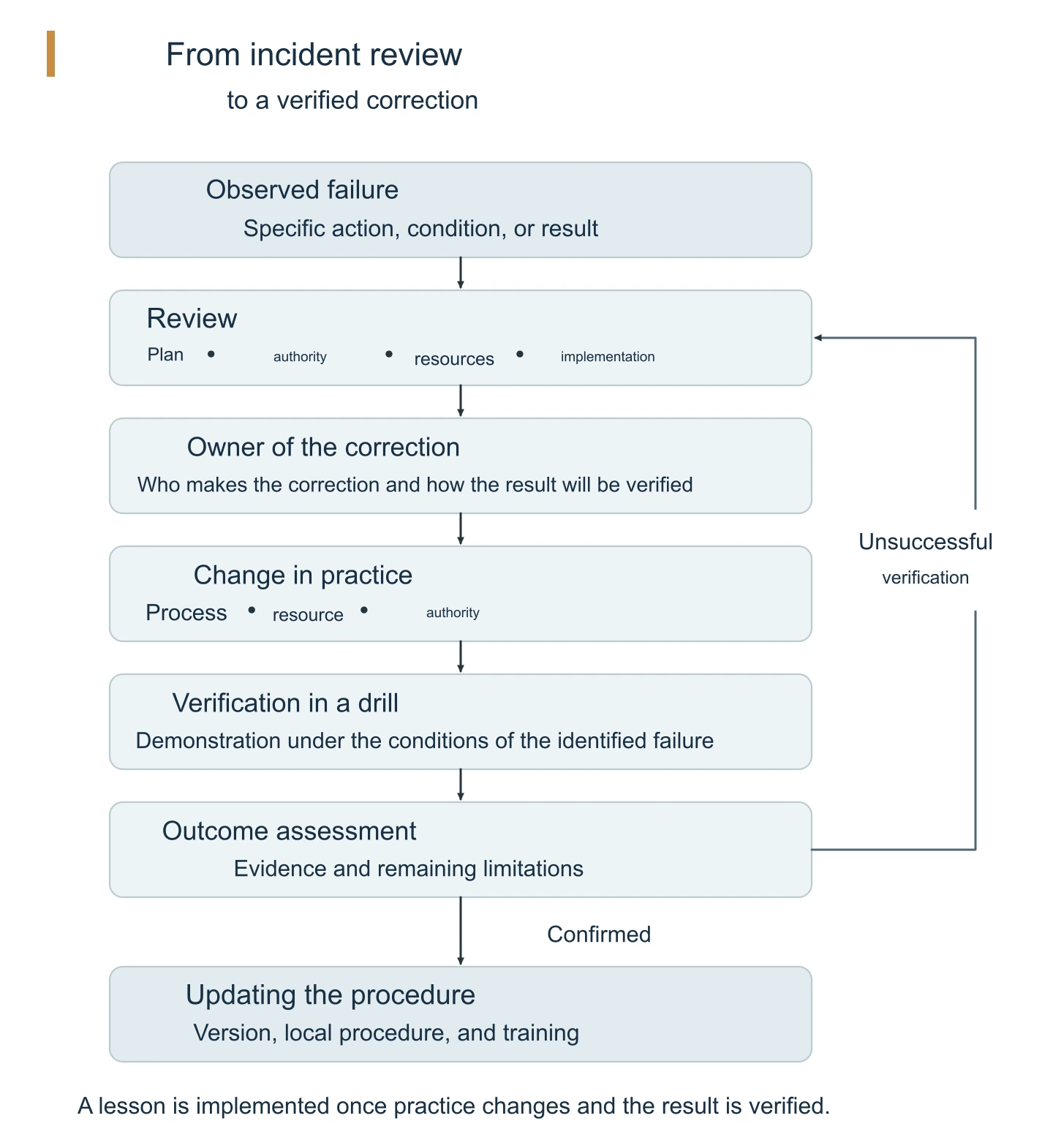
Figure 38. From incident analysis to proven fix
The diagram links the incident review to the owner of the fix, changing the practice, checking the result, and updating the instructions. If the check does not confirm the fix, the issue remains open; The contents combine chapters 58–60.
59 Drills, independent assessment, AI, and automation
Navigation: NAV · p. 003 · Contents: OGL · p. 010
What is tested by teaching?
The exercise shows whether real participants can detect a problem, select a route, complete a task, and transfer responsibility within given constraints. WHO uses simulation exercises to test plans, capabilities and interactions [16]. This book encourages you to test individual cards and the transitions between them using safe learning data, without dangerous material.
The organizer sets the goal and observable criteria. Participants receive initial information, then a new condition: the connection is unavailable, the person's condition has changed, or the receiving service has failed. The observer checks whether participants revised the decision and saved unfinished tasks.
Organization of inspection
The leader ensures a safe training environment and clearly distinguishes between drill messages and real alarms. Observers record actions without prompting and have the right to stop the exercise if there is real danger. Participants use commonly available materials. The person responsible for the plan accepts the results and assigns corrections.
Real constraints are chosen for verification: night shift, replacement of a manager, lack of a digital copy, or shortage of a specific resource. Complexity is added so that the discovered gap can be explained. Failure of all capabilities simultaneously without an available decision says little about which individual barrier needs to be improved.
The observer evaluates action selection, transfer confirmation, retention of assistance, and timely communication of capacity shortages. Urgent tasks take time into account, but check which mandatory actions have been completed during this period. The organization sets goals and indicators for its conditions.
How to check the clarity of the book itself
For a separate exercise, the participant is given a short message from the case R4: there are sick people in the settlement, and the carrier warns about the deterioration of the route. He has access to a book and a local list of contacts. The observer asks to see the first section found and to explain what the participant will do in their role. It is important to hear his own understanding before prompting the card code.
Then they report that the host organization has not yet confirmed readiness. They check whether the participant noticed the incomplete transmission, to whom he sent the question and what he saved in the recording. If he quickly found the page, but understood the sent message as a completed reception, the navigation would only partially work. Corrections may be required by wording, example, or local procedure.
After the exercise, the reader notes unclear words and places where an external explanation was needed. The editor checks them in context and clarifies the text, maintaining accuracy. This analysis allows us to improve the accessibility of the book based on the observable difficulty, and not on the general impression that “everything is written clearly.”
Place of AI
In the proposed system, AI helps to find a section, compare versions, check the completion of the form and prepare a draft message. For the result, the source, time and responsible person are preserved. The user should be able to open the source document and see what information the system is missing.
Clinical treatment orders, permission to reopen a facility, and technical commands require the appropriate authority and procedures. Before using an automatic system in a critical or controlled function, its suitability and approval conditions are checked. The model described here serves as a proposal for local design; the status of a specific instrument must be confirmed separately.
In the tutorial example, the search returns the desired card from the outdated edition. The participant checks the version, opens the valid source and reports a search defect. The reviewer evaluates the entire path to the applicable document, including the opportunity to notice an error, and not just the coincidence of the card name.
Automation with failure monitoring
Before implementing automation, the team describes the input information, permitted actions and application boundaries. It defines how to notice an error and fall back on a network loss, corrupted record, or inconsistent data. An external message may contain extraneous instructions; they should not change the authority of the system and the procedure for approving the decision.
The project provides for a log, access control, revocation of permitted actions, and work according to verified local instructions in case of failure. The independent reviewer uses data appropriate to the task, including cases with missing information. After a version change, the reviewer rechecks the affected features.
The result of the exercise is transferred to the analysis of the chapter 58: what was accomplished, where the gap occurred and how the correction will be confirmed. The capability of the system is assessed by the required function and the established limits of its operation. The use of AI is captured as part of the design of the process, not as proof of readiness.
60 Updating the book and checking local instructions
Navigation: NAV · p. 003 · Contents: OGL · p. 010
How to maintain current instructions
The book helps link actions, decision bases, and work notes. For practical work, the organization prepares local instructions: names those responsible, contacts, resources, equipment, current clinical guidelines and technical procedures. Then it tests whether real people are able to carry out this order in their own conditions.
Local instructions have a date, version number, sources, and history of significant changes. A permanent code links the card to the desired section when pages change. After layout, links and printed numbers are checked.
Who is responsible for the content
The editor is responsible for definitions, structure, and searching. A peer reviewer reviews the factual basis. The owner of the local instruction confirms the performers and resources, the authorized manager confirms the scope and authority. The training officer checks that participants understand the change and can perform the affected activities.
Medical, engineering, scientific and legal issues require appropriate verification. In case of disagreement, write down the subject of the dispute, positions and the basis for the decision made. The editor may make the explanation shorter, but must preserve the conditions on which the conclusion depends and significant ambiguity.
Events to review
The reason for an update may be new guidance, a changed norm, equipment, team composition or partner, as well as an identified failure, an exercise, or data that change the original assumption. The document owner schedules a periodic review based on the scope and rate of change. Sections may require different review frequencies.
When checking a source, the publisher, current version, purpose, and status of the document are determined. The date of the web page is checked against the date of the manual itself. The WHO recommendation, national requirement and COSPAR policy serve different functions. For international interaction, the IHR and local authorities applicable to the state are checked [14].
If a key source is retracted or the basis is refuted, the editor identifies the affected provisions and issues a notice. Users receive an explanation of the practical change: what to do differently now, from when and who is responsible for the transition. The new full version saves this entry in history.
How to get the local version working
Before implementation, those responsible review roles, resources, clarity of transitions, compatibility of technical procedures, and clinical applicability. The teaching shows the execution and transfer of tasks. In the passport, the instructions retain unresolved restrictions. Readiness status refers to verified actions under specified conditions.
In the case study, the receiving medical center has changed. The editor has updated the contact, but the program manager still needs to confirm suitable assistance, transportation and reception procedures. A test call shows the availability of communication. The readiness of a particular route is confirmed by all associated participants.
How to stay consistent with updates
After the changes, the editor goes through the entire path: situation, card, chapter, working form and backlink. He checks the sources and removes obsolete required actions from the live version. Previous editions are archived with a clear indication of their status. Paper kits are updated along with digital kits.
Editorial review confirms the text and navigation in its field. The organization separately records professional verification of local activities, teachings and credentials. Such a record allows the next participant to understand what he can rely on and what issue still needs to be resolved. The book maintains a connection from the first message to the confirmed result of a specific task.
At the beginning of an event, the participant often only has access to a fragment of information. Gradually, it turns into a verifiable story: who observed, what decided, what changed and to whom the task was handed over. The completeness of history does not mean that all unknowns have disappeared. It means that the remaining issues are visible and everyone is assigned responsibility.
Therefore, completing a job always turns to the next person. The patient needs a clear route for further assistance, the operational service needs working conditions, and the researcher needs the boundaries of the conclusion reached. When everyone has received the necessary information and confirmed their task, the achieved result can be saved. On this basis, readiness for a new event is built.