Part IV. Medical care and human recovery
Chapters 21–31. How to choose a clinical route, review decisions, and continue care.
The incident commander and the attending physician have different units of attention. The manager sees the entire event: premises, connections, resources and possible distribution. The doctor is responsible for a specific person at each moment. The overall version of the incident helps to ask questions, but the medical plan must explain this patient's condition and the care he needs. Therefore, this part begins with the division of urgency and possible impact, then moves through the first plan, its revision, and recovery from illness.
For the reader without medical training, this section helps to understand the structure of care, questions to the team and the transfer of responsibility. The professional reader associates the procedure described with the applicable guidelines. In the case study R3, the district hospital admits people after a general event. We will return to it when new data and limitations require us to change the original plan. All circumstances of the case are fictitious; the task of parsing is to make visible the course of choice.
21 Clinical urgency and risk of transmission
Navigation: NAV · p. 003 · Contents: OGL · p. 010
At the first contact, the medical team solves two problems: determines the urgency of care and assesses the possible impact on the person. Urgency addresses the question of “how quickly help is needed,” while impact assessment addresses the question “what conditions are needed to help and prevent further harm.” These tasks are performed in parallel. A serious condition may be due to infection, poisoning, injury, or other cause. A person who may have been exposed may not yet have symptoms. Therefore, the suspected origin of an event does not in itself determine the order of treatment and placement of patients.
Two entries on first contact
The triage staff member records the clinical urgency on the accepted instrument. Separately, a medical or specialized specialist clarifies what is known about the possible exposure. In a small team, one person can perform both functions, but both outputs are needed in the recording. The label "biological risk" is not enough for the next shift: it doesn't tell you how seriously ill the patient is. The “stable condition” label is also incomplete, since it does not indicate anything about the necessary precautions.
Condition | Impact assessment | Organizing the next step |
Immediate assistance needed | There is reasonable suspicion | Urgent care with coordinated protection and suitable accommodation |
Immediate assistance needed | No exposure data available yet | Help continues; circumstances are being clarified in parallel |
No urgent violations identified | Possible contact requires assessment | Individual examination and observation plan |
No urgent violations identified | Signal not confirmed | Explanation of the result and clear conditions for re-applying |
The table shows the author's order of organization of decisions. The medical triage itself is carried out using a suitable approved instrument. For example, IITT, a WHO tool for triaging care in emergency departments, has its own scope. [21]
First decisions and their owners
1. The on-call medical director assigns a team to assess the person without undue expectation. If there is a threat to vital functions, use P02 · p. 156. The record indicates who is already providing care and where the patient is located.
2. The infection control specialist, together with a specialist in the anticipated hazard, selects protective measures based on available information. They also take into account possible chemical or toxic effects. Standard infection control measures are supplemented with those necessary for the suspected mode of transmission. [22, 23]
3. The attending physician determines what information is needed now and what can be clarified after stabilization. He asks the patient or accompanying person clear questions: when the symptoms began, where the person was, what might have affected him, and what help he has already received. If the answer is unknown, write it down.
4. The case coordinator—the staff member who liaises the steps of care—arranges the next step. He records the person in charge, the method of calling when deteriorating, and the receiving team when transferring. If the usual entrance is closed to separate the flows, the person is explained where and how he will receive help.
Pitfalls in separating patient flows
A separate area can reduce contact while making observation more difficult. The manager checks whether the staff will hear the call and can quickly come and provide urgent assistance. Food, toileting and other routine needs are also checked. If a person has difficulty speaking, seeing, hearing or moving, they need an accessible way to get attention. Placement management is only considered to work when the team can actually observe and assist the patient.
In the case study R3, a district hospital accepts people who were in the same place but need different care. One person requires urgent assessment, the other is still stable. The team retains a general question about the cause of the event and makes a separate plan for each patient. Information about the general location helps the investigation; The priority of medical care is determined by the person’s condition.
The time of assessment and the reasons for its revision are recorded immediately. A repeat decision is required if there are new symptoms, changes in contact information, failure of protection, or deterioration in surveillance. In G22 · p. 056 considers the organization of emergency assistance, and G23 · p. 057 - transition from the first examination to the initial treatment plan.
22 Urgent care and medical triage
Navigation: NAV · p. 003 · Contents: OGL · p. 010
A trained medical team begins with a systematic assessment of the person: looking for problems that require immediate intervention and checking the response to help. For the eyewitness, the route remains the same - P02 · p. 156, calling for help and acting within the limits of the skills mastered. The basis for professional training can be the Basic Emergency Care Course (BEC), prepared by WHO and the International Committee of the Red Cross. Practical skills are acquired through training; this chapter explains how to organize their use during an incident. [20]
Organize a place of help
The shift manager names those responsible for triage, clinical work and protection. In a small team, responsibilities can be combined if it is clear who performs each of them. Before starting work, equipment, communications and reserves are checked. It is especially important to distribute attention: the employee collecting information about the source should not unnoticed remain the only one observing a serious patient.
The arriving person must understand where he will be received. When the anticipated exposure requires a different placement, the receiving staff member will arrange the transition and confirm that the patient has reached the team. The instruction “go to the next room” leaves the possibility of losing a person between zones. Accompaniment is especially important for children without an adult, patients with impaired consciousness and people who have difficulty breathing.
Assessment and initial actions
1. A trained triage staff member determines the urgency and guides the patient through the appropriate pathway. WHO IITT provides age-specific instruments; A separate mass triage regime is used when the institution's normal capacity is exceeded. The sheer number of arrivals still requires an assessment of available resources. [21]
2. The clinical team consistently assesses the airway, breathing, circulation, consciousness, and other significant impairments within the scope of their training. When a threat is detected, it provides appropriate assistance and verifies the response. Necessary actions continue while other employees clarify the medical history and its possible cause.
3. The responsible physician decides whether the current level of care is sufficient. If another team's capabilities are required, the physician initiates transfer negotiations while maintaining available support. The request contains clinical need, anticipated risks of exposure, and transportation restrictions.
4. A nurse or other designated staff member observes changes and reports to the doctor. The instruction “observe” reveals: what exactly to check, how to record the result and under what signs to immediately call for help. The frequency of assessment is based on the patient's condition and applicable guidelines.
5. The clinical note taker notes the timing of significant decisions, the interventions performed, and the patient's response. If there is a shortage of personnel, use a short form followed by an addition. Documentation ensures continuity while maintaining the priority of needed care.
Re-sorting and transfer
An urgency category describes the condition at the time of assessment. It may change during a wait, in transit, or after treatment. A staff member is therefore assigned to reassessment in the waiting area, and the patient is given an accessible way to report deterioration. If the person cannot ask for help independently, the team arranges monitoring that accounts for this limitation.
The transmission reports the current state and its changes, possible impacts, completed actions, response to help, and unfinished tasks. The receiving team confirms that they have received the information and accept responsibility. WHO includes clinical documentation and patient referral tools in the Emergency Care Toolkit, a set of emergency care management tools. They can be taken as a basis for the local form. [36]
In the training scenario, two patients received the same primary category, but one began to rapidly deteriorate. The team is reviewing his route regardless of the order of arrival. If security makes observation difficult, the manager changes the organization of observation. The reason for the delay is recorded for later correction, rather than being hidden by a time correction in the log.
After this stage, the person is already assisted, he is monitored by a certain employee, and the next person in charge is known. The initial treatment plan is drawn up according to P05 · p. 159. G23 · p. 057 shows how to relate observed disorders to the choice of further medical route.
23 First hours and choice of syndrome route
Navigation: NAV · p. 003 · Contents: OGL · p. 010
The first hours here refers to the time it takes for the team to create an initial treatment plan after a person has presented. This is not a period of development of an unknown disease. The patient could have been exposed much earlier, and sometimes the moment of contact cannot be determined. Therefore, the record is divided into four events: possible exposure, onset of symptoms, first medical assessment, and significant interventions. Each event has its own source of information and its own accuracy.
The doctor begins by observing the patient. A syndrome is a combination of symptoms that describes a disorder, even if its cause is not yet known. To choose the nearest help, the doctor needs to understand what is happening with breathing, blood circulation, consciousness, water balance and other functions. The general expression “unknown infection” does not provide such a description. The syndromic route allows you to draw up a work plan and subsequently refine it based on new data.
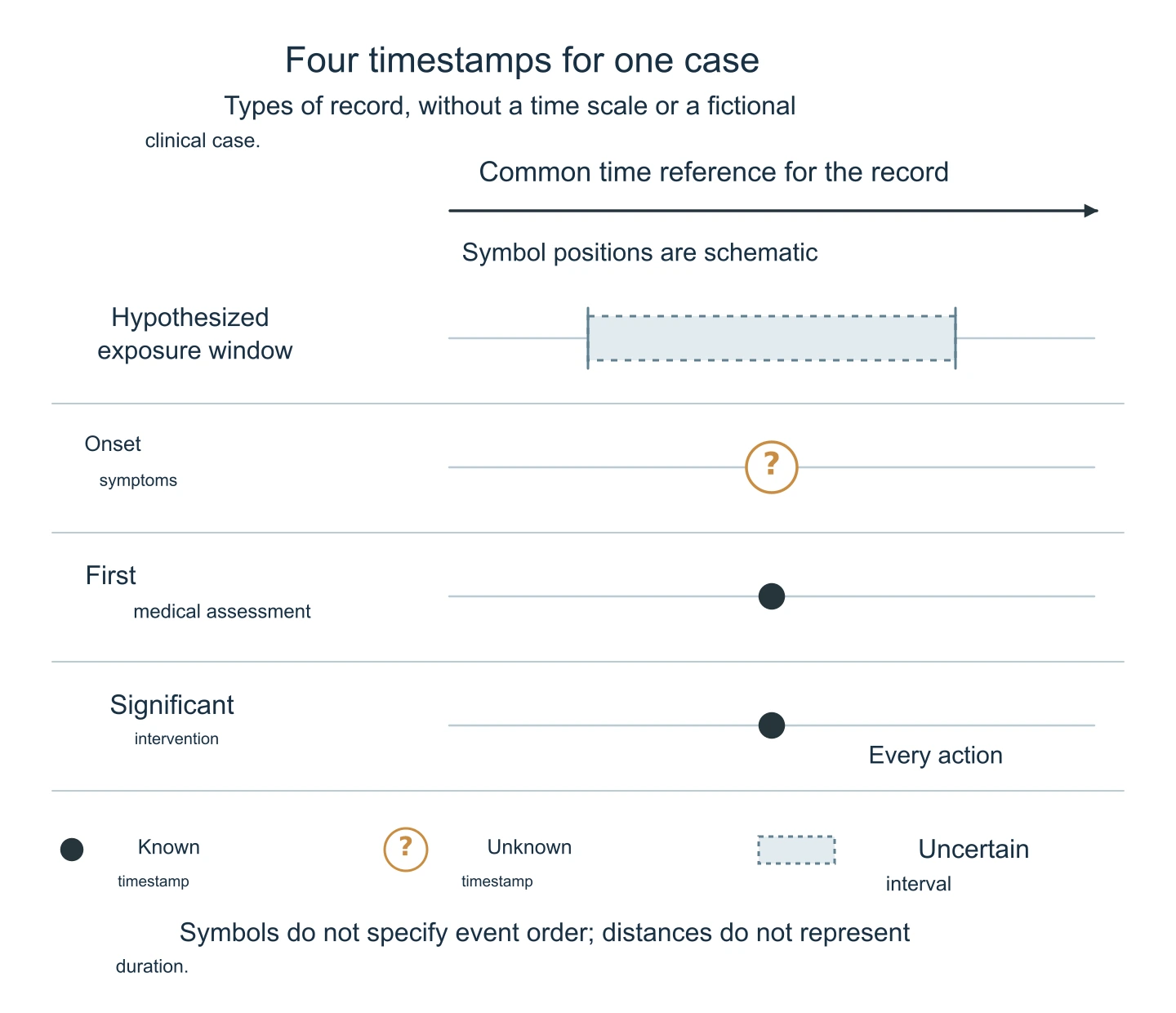
Figure 10. Four timestamps of one case
Types of time records are shown without scale and fictitious chronology of the case. The window of possible exposure, onset of symptoms, first assessment, and significant interventions retain their own sources and degrees of certainty.
Make an initial plan
1. The responsible doctor identifies problems that require help now. For each, he writes down the purpose of the intervention and how the team will evaluate the response. If the condition is unstable, emergency work according to P02 · p. 156 continues while the rest of the plan is formed.
2. The doctor and nurse collect anamnesis - information about what happened to the person before treatment. We need a sequence of symptoms, possible contacts, medications, allergies, concomitant diseases, pregnancy and other significant circumstances. If the stories diverge, both versions are preserved with the sources indicated. The doctor explains why he relies on one of them.
3. The team identifies a small list of causes that need to be checked or taken into account when treating. Possible contact helps formulate the question, but the person may have another disease. If people were in the same environment, along with infection, possible toxic, chemical or other effects of this environment are considered.
4. The doctor, together with a diagnostic specialist, selects studies that can change the immediate decision. They discuss the limitations of the method, the availability of the answer, and how it is communicated. If the right test is not available, the physician will be explicit about how the gap affects care and whether a consultation or patient transfer is needed.
5. The physician selects a guideline appropriate for the identified syndrome and the patient. He checks its current edition and the ability to implement recommendations on the spot. Empirical therapy—treatment until the cause is definitively established—must have a clinical basis and conditions for review. The list of available drugs does not in itself constitute a treatment plan.
Select support level
When choosing an intervention, the doctor simultaneously determines the necessary conditions for its implementation. If certain equipment or constant monitoring is required, the team confirms its availability. When a condition cannot be provided, the physician will agree on an acceptable alternative or transfer. The record includes a decision that can be performed in a given shift, with an assigned person responsible and the ability to check the result.
If sepsis is suspected, the physician refers to the recommendations for the appropriate age group. The Surviving Sepsis Campaign, abbreviated SSC (Surviving Sepsis Campaign) guidelines, 2026, differentiate situations by the severity and likelihood of infection and provide for a review of diagnosis and therapy. A single test does not replace overall clinical assessment. Treatment parameters are selected by a qualified team according to current guidelines. [24, 25]
Make the plan available to the next shift
The handover to the next shift includes the main problems, working explanations, selected guideline, intervention goals, and conditions for carrying them out. The physician states what to monitor and what would require an earlier review. A specific recipient is assigned to pending test results. The immediate next steps are explained to the patient in ordinary language, along with the questions the team cannot yet answer.
In the case of R3, information about a common location prompts the team to look for a common cause. However, patients' initial plans vary in urgency, needed capabilities, and next assessment issues. This distinction continues in the journal: the general investigative record links cases, while the clinical record explains care to a specific individual.
Educational analysis R3: First plan in the face of general uncertainty
People who were in the same place are admitted to the emergency department. One of them needs urgent assessment, the other is still stable. In the first message, the expression “group infection” already appeared, although only a common location was confirmed. If we take this formulation as a ready-made diagnosis, we may mistakenly assign one route to the entire group and miss the differences between people.
The doctor on duty shares the task. For a person whose condition requires urgent assessment, the team will organize the necessary assistance. The stable patient continues to undergo individual examination and clarify the circumstances. Another designated employee gathers information about the overall event and contacts those in charge of the investigation. This distribution is important for a simple reason: the search for a common explanation should not take away the only observer from the patient who needs help now.
The initial choice does not come down to the name of the disease. The team decides which actions are already justified by each person's condition and which require additional information. A common infectious cause remains one of the versions. Possible environmental influences and overlap between different diseases also remain until they can be sufficiently assessed. The clinical note does not require equal certainty on all issues: urgency can be clear when the cause is not yet known.
The physician selects the applicable guideline for the identified disorder and checks whether it is possible to implement it locally. Suppose part of the next decision depends on research that has not yet been obtained. In this case, the plan contains two elements: assistance that continues now, and a specific action after the response is received. The research person responsible knows to whom to convey the result; the physician determines which changes will require reassessment before the test result arrives. These roles do not remain the shared responsibility of “all on duty.”
By the end of the first stage, the team can explain their choice to the next shift. For each patient, the leading problem, current plan, available follow-up, and unresolved issue are identified. In the general record, the version about the connection between the cases remains. This decision allows for subsequent clarification: a new explanation will not require reconstructing the entire event from memory, and a different level of urgency will not be hidden behind the general name of the group.
The next step is advanced when the team is able to complete it, understands the distribution of tasks, and knows when to reassess the patient. The cause of the disease may remain unknown. In G24 · p. 060 a re-assessment of P07 · p. 161 is being considered; a change in prescriptions due to new data accompanies P08 · p. 162.
24 The first days and reassessment of treatment orders
Navigation: NAV · p. 003 · Contents: OGL · p. 010
After the first plan, the team monitors how the person’s condition changes and whether the chosen help helps. The word “days” in the title of the chapter refers to the next period of work, not the allowable interval between inspections. A significant intervention, new finding, patient report, or deterioration may require unscheduled evaluation. A serious condition remains urgent no matter how long a person remains in the hospital.
Compare condition to treatment goals
For each problem, the team records the initial condition, treatment goal, actions taken, observed response, and next question. If the expected response is absent, the physician checks several explanations: whether the cause was understood correctly, whether the intervention was sufficient, whether it was actually delivered, and whether harm occurred. After this review, the physician explains why the treatment order is retained or changed. The record thus makes the decision process visible.
Changes in condition are compared with research and care settings. Improvement after intervention may support the working hypothesis, but causality remains to be assessed. If there is a deterioration, the doctor considers the course of the underlying disease, complication, new exposure, undesirable effect and possible disruptions in care. The choice of next action depends on which explanations are consistent with the available evidence.
Re-evaluation procedure
1. The responsible doctor and nurse compare the current condition with the previous one. New complaints, tolerance, changes in functions and the need for urgent assistance are clarified. Dangerous deterioration immediately returns the patient to P02 · p. 156.
2. The doctor reviews the working explanations and checks whether the ordered results have been obtained. A person is assigned to receive and interpret each important response. If the answer is delayed or lost, the plan remains an open task: who to call, what to clarify and how to act until information is received.
3. The physician, together with the clinical pharmacist, if available, checks the relevance of essential prescriptions. Continuation, modification, narrowing and termination according to indications are considered. In SSC 2026, review of antimicrobial therapy is included in clinical management; the approach depends on the data set. [24, 25]
4. The care coordinator checks to see if the plan is being implemented: if resources and advice are available, and if necessary follow-up is possible. The lack of resource is reported to the doctor so that he can agree on further action. This gap should not remain known only to the employee who encountered it during the shift.
5. The team discusses the plan with the patient and arranges handover to the next shift. If there is a significant change in diagnosis or treatment, P08 · p. 162 is used. The next control is tied to the state and task.
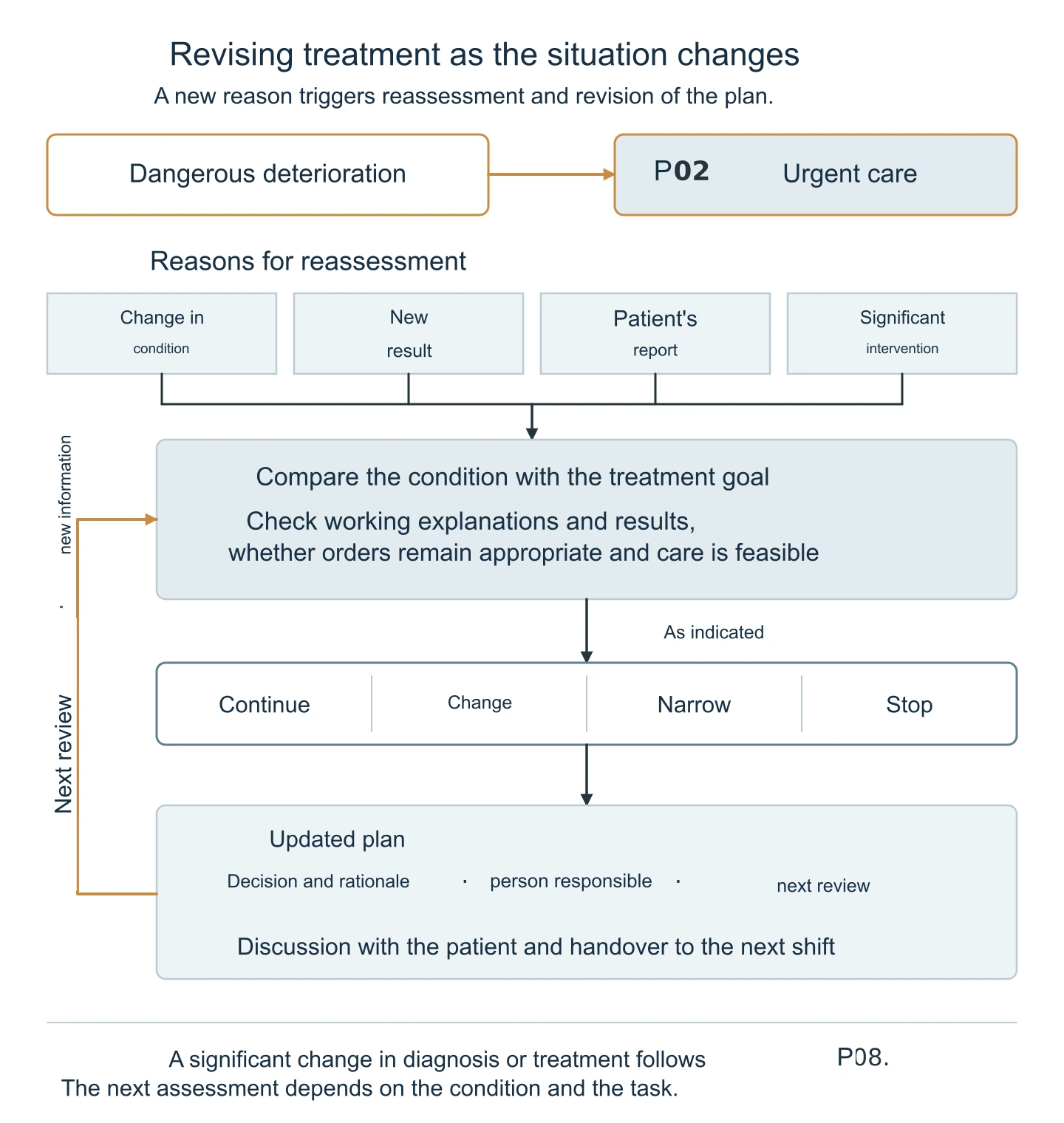
Figure 11. Reviewing treatment as the situation changes
The author's re-evaluation scheme combines the person's condition, new information, treatment orders and the feasibility of the plan. The decision receives a basis, a person responsible and a subsequent review. Dangerous deterioration requires urgent assistance according to P02.
Maintain usual care
An unusual incident does not change chronic illnesses and everyday needs. The doctor checks your permanent medications and explains temporary changes. The nurse monitors nutrition, pain management, hygiene, sleep, and a person's ability to care for themselves. The social service helps to remove practical barriers that prevent you from continuing treatment after hospital.
If the person is separated from loved ones, the team will coordinate contact with their chosen contact and maintain confidentiality. The patient must understand the meaning of the proposed actions and have the opportunity to ask questions. When the explanation remains unclear, the employee repeats it in a different way and checks understanding.
In the case study, the condition has improved, but the institution is preparing a transfer due to a lack of space. The physician separately checks clinical readiness, necessary observation conditions and the readiness of the receiving team. An improvement in the indicator does not confirm all of these conditions at the same time. The transfer is analyzed in G29 · p. 071, further recovery - in G30 · p. 074.
Training review R3: What changes when re-evaluated
By the next assessment, some of the information about the place of stay had been clarified, and the patients’ conditions had changed differently. It is tempting for the team to draw a single conclusion: if one person gets better, the original plan worked for everyone; if the other one got worse, the entire original version was wrong. Both outputs are too wide. The doctor returns to the goals written down for each patient and compares actual changes with them.
First he finds out what the person actually received. The treatment-order sheet shows the team's intent; execution recording and observation show what happened. For example, a delay in an expected study leaves one question open, and staff shortages may change the availability of observation. These circumstances have different consequences. The first requires restoring the response route, the second requires reconsidering the organization of assistance right now.
The team then checks the status explanation. A changed version of a common event may weaken one hypothesis, but does not by itself explain all symptoms. The doctor notes which prescriptions remain valid, which require revision, and for which decision there is still insufficient data. Saving the plan also becomes a meaningful decision: the record shows that it has been checked using new information, and not just rewritten from yesterday.
At the same time, the institution reports a shortage of places and staff. For the administration, the transfer looks like a way to free up resources. For the patient, the question is different: where can the necessary help be provided and what will happen along the way. Therefore, the doctor describes the need, and the coordinator looks for a receiving team capable of filling it. Improvement of condition is taken into account in this decision along with observation and transport conditions.
At the end of the review, the duty officer conveys the changes and their reasons to the next shift. The expected test result retains a named recipient, and the transfer retains a responsible coordinator. If a resource appears or status changes before scheduled monitoring, the team already knows which decision to reopen. The review reduces uncertainty gradually while maintaining continuity of care.
After the review, it should be clear to the next shift what has changed, what decision the doctor made and who will check the result. If the plan remains the same, the recording explains why it is still suitable and what questions remain open.
25 Leading clinical syndromes
Navigation: NAV · p. 003 · Contents: OGL · p. 010
The syndromic route connects the observed disorder with the immediate goal of help. It is needed when the origin of the harm is still being clarified. The doctor continues to look for the cause, since the same manifestations may require different subsequent treatment. This chapter helps the medical specialist choose a direction of work. He takes specific interventions, parameters and contraindications from the guidelines applicable to the patient and condition.
Map of initial tasks
Leading violation | Immediate clinical task | What needs to be clarified in parallel |
Difficulty breathing or signs of respiratory failure | Assessment of airway, oxygenation and need for respiratory support | Infection, toxicity, cardiac, allergic or other cause |
Shock or signs of insufficient blood supply to organs | Circulatory assessment and appropriate hemodynamic support | Probable mechanism, ongoing losses and tolerability of interventions |
Loss of consciousness or seizures | Prevention of immediate injury, assessment of vital signs and urgent cause | Metabolic, toxic, infectious, vascular and other explanations |
Marked fluid loss | Assessing water balance and choosing the appropriate replenishment route | Severity, ability to drink, circulatory status and patient limitations |
Bleeding or other signs of severe systemic damage | Urgent specialist assessment and support appropriate to the patient's condition | Source, consequences, associated disorders and need for transfer |
The table helps determine the initial task. Systematic assessment of acute disorders is taught in the BEC Basic Emergency Care course. Individual syndromes require appropriate additional guidance and training. [20]
Translate the syndrome into a feasible purpose
Breathing. The physician will use clinical judgment and protocol to determine whether oxygen and other supports are needed. The team tests equipment, skills and observation capabilities; if more complex assistance is needed, an appropriate specialist is involved. Personnel protection is coordinated with the infection control service, taking into account the expected exposure. The cause of the breathing difficulty is still being investigated.
Blood circulation. The doctor finds out why the tissues may not be receiving enough blood and chooses support with re-evaluation of the response. Fluids, medications and other interventions have their indications and limitations. In cases of probable sepsis, age-specific recommendations are used. [24, 25] If the condition worsens after the intervention, check the original explanation and the possible harm of the treatment.
Consciousness and convulsions. The team provides the necessary emergency care within its competence, while clarifying potentially reversible causes and the need for a specialized route. The patient's impaired ability to communicate reinforces the importance of observation, companion information, and available medical history. No exposure story is not the same as no impact.
Fluid loss and nutrition. The doctor evaluates the severity of the losses, the ability to safely take fluids, and associated restrictions. The plan indicates the available method of support, monitoring the result and the conditions for changing this method. While the diagnostic search is underway, the team continues to provide nutrition and necessary care.
Mixed states and the danger of a single explanation
A person can have several leading problems at the same time. The clinical manager determines the urgency of each and considers how interventions affect each other. If different specialists are involved, one doctor agrees on the overall plan. This allows you to promptly notice recommendations that require incompatible conditions or additional monitoring.
In the training scenario, a person experiences shortness of breath and confusion after the intended exposure. The team initiates the necessary support, reviews the environment, and considers multiple causes. A research hypothesis about an unusual agent should not supersede the evaluation of available treatment explanations.
For each chosen route, the goal, expected response, risk, execution conditions and the next decision are recorded. Changing the leading syndrome returns the patient to P07 · p. 161; urgent deterioration - by P02 · p. 156. If there is a lack of opportunities, G29 · p. 071 applies.
26 Children, pregnancy and special needs
Navigation: NAV · p. 003 · Contents: OGL · p. 010
Age, pregnancy, comorbidities and communication patterns can change the assessment of the condition, the choice of care and its organization. Therefore, the doctor clarifies what tools and consultations the patient needs. The manager provides access to them. None of these features in itself determines the severity of the disease: the individual assessment is retained.
Patient's age and condition
Children. Age-specific assessment tools, appropriate monitoring parameters and pediatric guidelines are used. Adult schemes are not transferred mechanically. For sepsis there is a separate SSC guideline 2026 for children. [25] Information from parents or other caregivers helps reconstruct the course of the condition, but clinical judgment remains the task of the team. If the child is admitted without an accompanying person, an employee is appointed who is responsible for organizing representation and communication in accordance with local regulations.
Pregnancy and postpartum period. The doctor takes into account the woman’s condition, the characteristics of the period and the need for obstetric or neonatal consultation. The plan of care must address the patient's current threats and the associated needs of the fetus or newborn. Information about a possible threat does not automatically create a reason to stop necessary treatment or undertake irreversible intervention without appropriate clinical judgment.
Old age and chronic diseases. The team finds out how the person lived before the event, what he could usually do on his own, and what medications he took. Then compares this with the current state. This makes it easier to notice a new deterioration and distinguish it from the usual limitation. Age is not a substitute for assessing the need for help and expected benefits.
Features of immunity. The doctor clarifies known diseases and treatments that may change the clinical picture. Together with a specialized specialist, he evaluates whether the usual signs and methods are appropriate for this patient. If there are no typical manifestations, the remaining uncertainty is reflected in the further search and observation plan.
Provide accessible communication
1. The coordinator finds out in what language and in what way the person is comfortable communicating, and whether a translator, accompanying person or technical means is needed. This information is passed on to the next shift along with other conditions of assistance.
2. The team checks that the patient understands the explanation, can express choices, and report deterioration. If a person does not speak, he is offered an accessible method of communication, as much as the urgency allows. After this, they evaluate how he can participate in the decision.
3. The responsible physician will arrange consent and representation in accordance with the state and applicable regulations. Emergency situations have a procedure prescribed by law. Medical care and participation in the study receive separate grounds; consent to one does not imply consent to the other.
4. The nursing service reviews access to toileting, meals, mobility, routine supports and staff call-outs. Placements to prevent transmission must maintain the ability to provide necessary care.

Figure 12. Individual conditions for participation in assistance
Communication, calling and movement tools illustrate possible adaptations and are not a required set. The sheet contains conditional rows. An individual plan takes into account age and condition, pregnancy or postpartum period, initial capabilities, immune system characteristics and method of communication.
Review the plan with the patient
In the case study, a hearing-impaired patient does not respond to instructions from the next room. The employee first checks the method of communication, then conveys the information in an accessible way and makes sure that it is understood. The records reflect the need for such communication. This helps the next shift avoid the mistaken conclusion that the person refused to follow the recommendations. The same question is asked if there is a language barrier, visual impairment or reading difficulty.
In research, the inclusion of special populations requires justification, appropriate consent, and protection of participants. A lack of data must be acknowledged; it neither permits arbitrary experimentation nor justifies automatic exclusion from beneficial care. [26]
Once assessed, the person has the right care settings, the specialists they need, and an accessible way to participate in decisions. The change in state leads to P07 · p. 161. G30 · p. 074 continues this route after the acute stage: transport, communication, medications and assistance with daily living are covered.
27 Transition to targeted treatment
Navigation: NAV · p. 003 · Contents: OGL · p. 010
New information allows the physician to make more accurate treatment choices when it actually changes the understanding of the cause of a disease or the suitability of an intervention. Such information can be a diagnosis, clarification of the mechanism, a response to help, or the result of a specialized study. The doctor evaluates them together. The laboratory message describes the result of the test; the clinical decision explains what this outcome does for a given patient.
Check what exactly has changed
1. The attending physician names the decision that now needs to be made: to continue, change, narrow or stop a particular intervention. He records the new rationale alongside the decision. This makes it clear why an additional result changes the plan or why the plan remains the same for now.
2. The doctor and diagnostic specialist check the reliability of the result, its limitations and suitability for the patient’s condition. The detected factor may cause the disease, accompany it, or have another significance. If the result does not match observations, the team resolves the discrepancy and continues to provide necessary assistance.
3. The subject matter consultant evaluates the applicability of the guidance to the identified situation. Patient characteristics, severity, organ function, drug interactions, previous interventions, and availability of follow-up are taken into account. A known drug with a different indication does not automatically receive proven effectiveness for a new threat.
4. The responsible physician draws up an updated plan and explains the changes to the patient. The team receives a consistent set of treatment orders, expected responses, and reasons for unscheduled revisions. Previous treatment orders that are no longer valid are explicitly canceled in the recording system used.
Tapering and stopping therapy
When there is enough evidence, the doctor can narrow therapy, stop unnecessary interventions, or change the purpose of the intervention. He takes into account changes in condition and the consequences of cancellation. A negative answer to one diagnostic question helps evaluate that question within the method; the decision to discontinue a particular intervention requires an assessment of the entire clinical picture.
SSC 2026 addresses re-evaluation of diagnosis and antimicrobial treatment in the management of sepsis; the choice depends on the specific situation and the quality of available information. [24, 25] In the proposed system, each significant treatment order retained receives a current basis. If the basis remains presumptive, the conditions for its further verification are fixed.
New data may indicate several processes at the same time. Having specified the treatment for one cause, the doctor remains focused on other problems. He coordinates the recommendations of specialists and checks the overall picture, including tolerability and ability to carry out the treatment orders.
If there is no suitable proven remedy
If there is no proven cure for the cause, the team continues to support the impaired function and care. The opportunity to study a new intervention is considered separately. Routine care, a clinical trial, and the exceptional use of an untested drug outside of a trial have different rationales, consents, and oversight. For these issues, WHO publishes guidelines for clinical trials and an ethical framework for the controlled emergency use of unproven clinical interventions (MEURI) for limited exceptional circumstances. [26, 27]
Refusal to participate in a study should not deprive a person of appropriate care. Inclusion in the program does not mean refusal to review the diagnosis, support and treatment of related problems. The status of the evidence, available options, and procedures for reporting adverse events are explained to the participant.
In the case of R3, an additional conclusion is received when the original plan is already in effect. The doctor determines whether the result is relevant to the question asked and whether it is consistent with the condition of each patient. He then retains or changes the treatment orders and communicates the decision to the team. The mere appearance of a file in the system does not trigger equal treatment of the entire group.
Training analysis R3: How to use the new conclusion
Let's imagine the following moment of the same case: the hospital receives an additional diagnostic report. It refers to part of the reasons under consideration and contains a disclaimer on the scope of application. In an information system, the answer is visible to everyone, but different employees are going to use it for different tasks. The doctor wants to clarify the treatment, the coordinator wants to know the terms of the transfer, and the head of the facility wants to change the placement.
The treating physician begins by asking: Does this result change the explanation for this patient's condition enough to reconsider the intervention? The diagnostic specialist explains what the method confirms and what it did not evaluate. The doctor compares the answer with clinical observations. With consistent data, he can clarify the working reason; if there is a discrepancy, he prescribes its analysis, continuing the necessary assistance.
Then the doctor makes a decision on specific prescriptions. For some, the new basis may be significant; for others, the patient’s condition remains decisive. In the updated record, they indicate what was saved, changed and canceled, then these changes are transmitted to the performers. This prevents a situation where a new plan has already been recorded in one system, and the other shift continues the same.
The transfer coordinator and the placement director receive the clinical conclusion to the extent necessary, but each checks their own conditions. One study could answer part of the medical question and leave the environmental question open. Therefore, the overall result is formulated narrowly: what knowledge has appeared and what decision has become possible thanks to it. This is the result that is suitable for further work.
After a change in treatment, a dated plan remains: which guidelines the doctor relies on, under what conditions the intervention is applied, what to observe, and who is responsible for the next step. The change accompanies P08 · p. 162, re-evaluation - P07 · p. 161. In G28 · p. 070 deals with the situation when a new problem appears during treatment.
28 Complications and undesirable effects
Navigation: NAV · p. 003 · Contents: OGL · p. 010
A new disorder during treatment is assessed as a separate task. The doctor checks whether it is related to the underlying disease, another disease, environmental exposure, care, or intervention. At the same time, the team provides the necessary assistance. The original version remains valid only to the extent that it explains new information.
Prepare observation in advance
When starting a significant intervention, the team records the initial state and expected outcome. The doctor determines what needs to be observed for safety; the nurse or other designated staff member confirms that such monitoring is feasible. If an important indicator cannot be obtained, the doctor takes this into account when choosing an intervention, consultation and level of care. The plan should have workable procedures instead of the general phrase “control whenever possible.”
A single reconciled list of prescriptions is maintained for the patient. This includes ongoing medications, self-administered medications, and post-admission changes. When changing institutions, combinations, tolerability and possible duplicates under different names are checked. Significant changes along with their reasons are conveyed to the next shift.
Act upon new violation
1. The observing staff member reports a new symptom, change in function, or suspected error. He indicates the time, previous events and actions already performed. Reporting a possible adverse effect does not require prior proof of causation.
2. The responsible physician assesses the urgency. If there is a threat to life, P02 · p. 156 is switched on. At the same time, the need to continue, suspend, replace or discontinue a specific intervention is considered; this decision takes into account the risk of termination itself.
3. The treatment team works with a specialized consultant to evaluate the timing of events, possible mechanisms, other explanations, and available research. An event occurring after a treatment is prescribed requires assessment, but the order in time does not establish the cause. The unusual nature of the reaction does not in itself exclude it.
4. A clinical pharmacist or designated specialist reviews the drug portion as necessary; Responsible for medical equipment - suitability and operation of the device within the scope of his authority. The team separates the clinical cause from the technical fault, without wasting time arguing about the ownership of the problem.
5. The responsible physician updates the plan and reports the necessary information to the provided security system. The protocol for the study intervention is the same. The patient receives an explanation of known facts, uncertainties, and follow-up. [26]
Prevent harm to the aid organization
With long-term treatment, additional care tasks arise. The team evaluates skin, nutrition, mobility, pain, sleep, orientation, and assistance with normal activities. For preventive interventions, the doctor separately checks the indications and contraindications. Their choice depends on the needs of the person, and not just on his participation in the overall incident.
The team is reviewing the need for devices and restrictions. Separate housing, difficult personnel protection, and communications disruptions can interfere with surveillance, feeding, and communication. The manager appoints an employee who will eliminate a specific obstacle and checks the result. Infection control remains one of the objectives of overall patient safety. [22, 23]
In the teaching example, marked weakness developed during treatment. The team considers the course of the illness, inadequate nutrition, medication effects, and other causes. It checks the care actually received, rather than relying only on the treatment-order sheet. Saying "it is all the unknown agent" does not complete the assessment.
After the debriefing, the physician updates the explanation of the condition, intervention decisions, and follow-up. If an organization error is identified, its correction is assigned to a separate person responsible. Medical information is transmitted via secure channels. For public review, only the data necessary to prevent repetition is used.
29 Medical resource shortages and patient transfer
Navigation: NAV · p. 003 · Contents: OGL · p. 010
A resource shortage is communicated through a task that cannot be completed. For example, an available bed does not solve the problem if there is no trained staff member or required supervision available. Limitations may also include oxygen, equipment, energy, medications, and transportation. The Medical Response Manager maintains an up-to-date understanding of what care each team can provide.
Acknowledge the limitation and request support
1. The attending physician determines which option the patient needs and how urgently. In the request, he describes the clinical need, the potential harm of waiting, and the care the team can continue on site in the meantime.
2. The shift manager checks the possibility of redistributing tasks, consulting and using the prepared reserve. Staff are not empowered to undertake complex interventions simply because of specialist shortages; acceptable actions within the preparation and an alternative route are considered.
3. The resource coordinator contacts the appropriate agencies or higher-level system. He conveys a specific need, a person’s condition and the characteristics of the possible impact. If the agreement is delayed, the capabilities of the receiving party are checked again.
4. Authorized medical management in the event of systemic shortages activates the prescribed order of resource allocation. The reasons must be transparent, clinically and ethically sound, documented and reviewable. Decisions are not made on the basis of social utility, a person's background, or the convenience of his isolation. Ethical allocation issues are addressed in WHO outbreak guidance. [12]
Prepare the transfer
The doctor weighs the benefits of the move against the risk of the journey and determines the necessary support. The coordinator coordinates transport, personnel, resources and the host team. If the possible impact requires additional conditions, specialized services are included in the approval. The decision on the patient is made separately from the decision on the movement of the disputed material.
What is confirmed | Who is responsible | What does the next party get? |
Clinical need and readiness for the chosen route | Sending doctor | Condition, dynamics, assistance and remaining risks |
Path and escort capabilities | Medical Director of Transport | Requirements for observation and action when status changes |
Ready to receive | Designated Host Team | Confirmation of place and time of transfer |
Unfinished tasks | Case coordinator | Expected results and those responsible for communicating them |
The WHO Emergency Care Toolkit contains patient referral, transfer and return tools; they help coordinate information between institutions. [36] The local form must remain available when the primary information system fails.
If the transfer is delayed or impossible
If the receiving party refuses, the coordinator writes down the reason and looks for the next option. The physician reviews available care and frequency of assessment. The manager informs the higher level exactly what resource is needed and why the delay is dangerous. The patient remains on the active task list until the team agrees on a further route.
If connection is lost, a pre-agreed reserve is used. In an autonomous environment, including a remote base or space mission, medical need is weighed against engineering feasibility and predetermined authority. Waiting risk and displacement risk are considered together; There is no universal answer for all circumstances.
In the training scenario, the nearest facility is available but does not have the required supervision. The coordinator looks for a suitable opportunity, and the sending team continues to provide available assistance. Acknowledgment of receipt is verified prior to scheduled dispatch; immediate rescue follows according to a separate prescribed procedure.
Training analysis R3: When there is not enough free space
A place was found in a nearby institution. The coordinator initially perceives the message as a readiness to accept the patient, but a clarifying conversation shows that there is no necessary observation opportunity there on the required shift. Two options arise - continue the agreed assistance on the spot or look for another route. A nearby hospital has the advantage of easy access; its limitation is related to the assistance itself after arrival.
The treating physician describes what capability the patient requires, how its absence affects care, and whether waiting is acceptable under the current plan. The coordinator transmits this request to the agencies, and the shift manager checks the available reserve. The decision is not replaced by a dispute about who is obliged to “take the patient”: the subject of agreement is certain assistance, accompanying conditions and a confirmed recipient.
Until a route is agreed upon, the dispatching team continues to provide available assistance and reassessment. The employee conducting the approval writes down the refusal, its basis and the next option. If the condition changes or a new opportunity arises, the transfer decision is reconsidered. Lack of space on the first call does not become a permanent conclusion that the transfer is impossible.
After approval, the entire transfer is checked: transport, escort, information and actual acceptance of the patient. The team separately evaluates what the departure of employees and the expenditure of resources means for the remaining people. As a result, the issue of one patient does not disappear from monitoring between institutions, and assistance to others remains responsible.
The handover is completed when the receiving team has explicitly accepted the patient and outstanding tasks. The dispatching team then checks the load and supplies for the remaining people. Once resources are restored, it also evaluates the impact of delays that have already occurred.
The resource allocation procedure should allow for immediate decisions without waiting for a lengthy meeting. To do this, the powers of the duty officer, the procedure for consultation and subsequent inspection are determined in advance. A decision made due to a lack of data retains the grounds and conditions for revision. The appearance of a resource or a change in need triggers a new assessment; the initial refusal does not become the patient's permanent status. The manager separately checks whether language, digital or transport barriers impede access to the review.
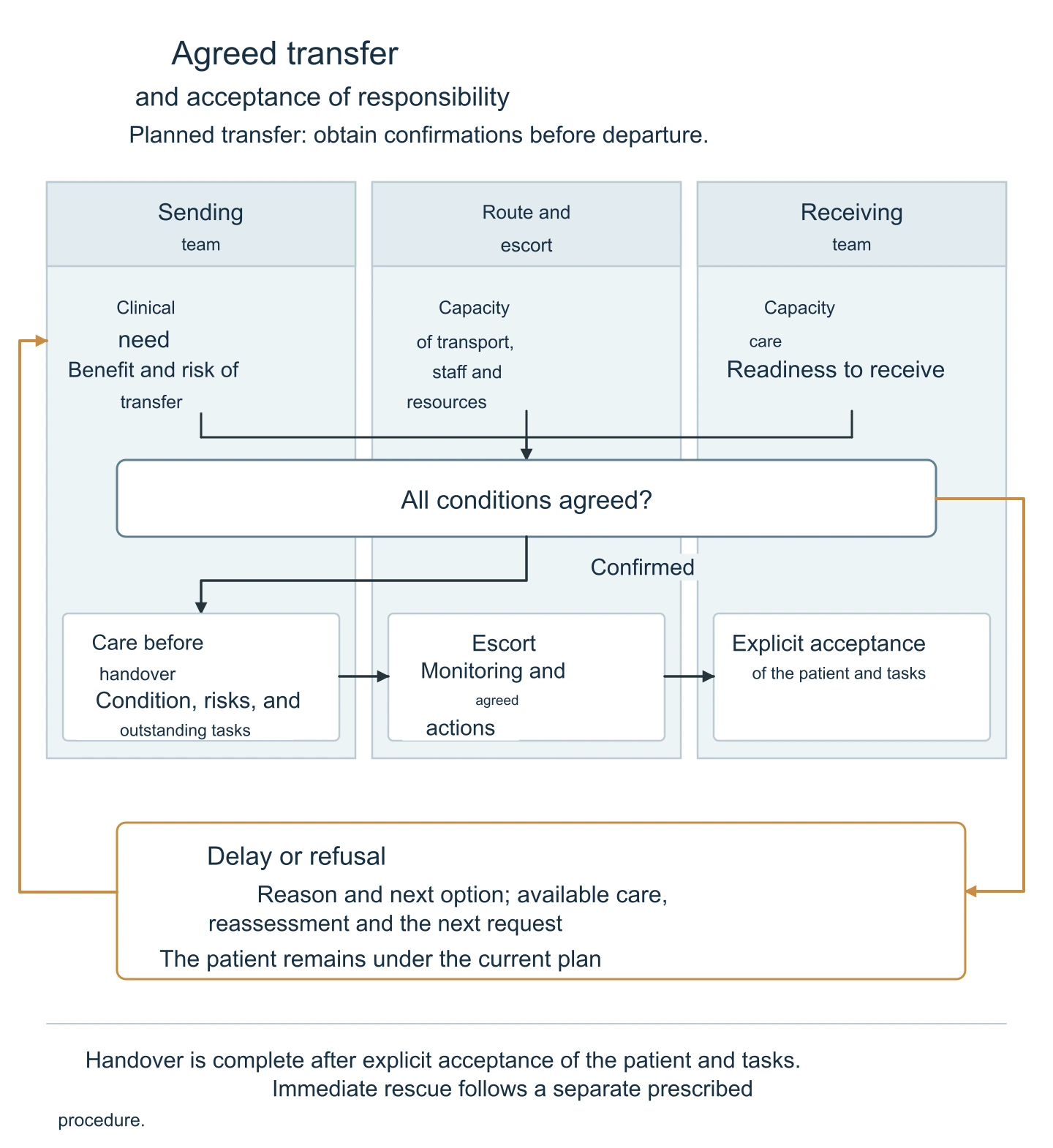
Figure 13. Agreed transfer and acceptance of responsibility
The scheme refers to an agreed planned transfer. Ongoing care and responsibility remain until confirmed acceptance of the patient and pending tasks; the delay requires a new decision. Direct rescue has a separate prescribed procedure.
30 Recovery and long-term follow-up
Navigation: NAV · p. 003 · Contents: OGL · p. 010
After the acute stage, the person gradually moves on to other care tasks. He may be clinically stable and still require support with activities of daily living. Readiness for discharge and reasons for discontinuing precautions are also assessed separately. Follow-up must have a clear purpose, responsible agency, and review conditions. If the cause of the disease remains unknown, the team explains which decisions this limits and which can already be made.
Determine needs before handover
Before handover, the care team discusses the patient's ongoing symptoms and what has become difficult to do. This may concern movement, self-care, communication, memory and attention, emotional state, study or work. Recovery goals are compared to the person's previous life and their own priorities.
WHO considers the availability of quality rehabilitation as a task for the healthcare system. [34] In the proposed pathway, needs assessment begins as soon as the condition allows and continues after discharge. It does not come down to prescribing the same physical activity to all victims. The program is selected based on condition, tolerability and available evidence; new deterioration requires clinical reassessment.
Prepare a plan for further assistance
1. The attending physician writes a final note. It separately indicates established and suspected, complications, assistance provided, current prescriptions, limitations and unfinished studies. If the answer comes later, it is already known who will receive it and contact the patient.
2. The follow-up specialist accepts the tasks and agrees on an available method of re-evaluation. Its duration depends on the condition and the issue of observation. When there is no applicable biological deadline, the team explicitly explains what the next revision is based on.
3. The rehabilitation team works with the patient to formulate achievable goals and appropriate actions. The plan specifies the resources needed, how tolerability will be assessed, and indications when a load or other component should be reconsidered. Having a diagnosis does not replace a functional assessment.
4. The social coordinator checks the possibility of fulfilling the plan: medications, food, housing, transport, communications, assistance at home. The inability to independently attend an appointment requires a decision by the organization of care, and not a record of the patient’s hypothesized dishonesty.
5. The relevant transmission risk service separately formalizes the measures to be maintained and the conditions for changing them. The clinical statement alone does not confirm the safety of the premises, materials or all contacts. The further route is connected with P14 · p. 168.
Observation with a specific purpose
Each direction of observation answers a specific question: how the function is restored, whether a complication appeared later, how the treatment is tolerated, whether it is necessary to change living conditions. The results are compared with the initial state and the agreed goal. If observation no longer influences assistance, its scope is reviewed. A new question receives a person responsible and a further route.
Observation may reveal general patterns in the consequences of an incident, but clinical care and research data collection have different foundations. The purpose of using the information, access to it, and applicable consent procedures are explained. Refusal to participate in a study should not deprive a person of available medical support.
In the case study, a person is discharged after stabilization, but is unable to perform previous daily activities. The team will organize assistance and functional assessment, even if some of the control tests are normal. The opposite situation is also possible: a person feels better, but an unresolved clinical issue remains. The scope of follow-up is determined by this question, not by the general label “recovered.”
When completing a specific observation, the specialist explains the result and signs that require contact again. The person remains in clear contact. In case of a new acute deterioration, P02 · p. 156 applies; other changes are considered in an agreed upon clinical re-evaluation manner.
For remote monitoring, two things are tested: whether the method is suitable for the medical issue and whether the person can use it. The team will agree in advance on the reserve in case of loss of communication and the reason for an in-person inspection. If the patient does not respond, the coordinator follows the agreed communication procedure while maintaining confidentiality. What cannot be assessed remotely remains unassessed in the record and is taken into account in the next decision.

Figure 14. Return to everyday life
Daily activities, rest, nutrition, socializing, and work or school help describe individual recovery goals. The areas shown do not form a required sequence of stages; the scope of observation is determined by the specific issue.
31 Support for seriously ill patients, families and staff
Navigation: NAV · p. 003 · Contents: OGL · p. 010
Relief of suffering, care and support for decisions are needed throughout the course of the disease. These challenges persist in the face of uncertainty, prolonged separate placement, and the absence of a proven remedy against the cause. WHO includes palliative care and symptom relief in response to humanitarian emergencies. [35] Such assistance is determined by the needs of the person and can be combined with treatment aimed at recovery.
Ease current suffering
The responsible physician evaluates pain, difficulty breathing, anxiety, and other distressing symptoms, choosing appropriate care based on the condition and applicable guidelines. The nurse monitors effect and tolerability, supports care, and communicates ongoing needs. Specific prescriptions require clinical indications; the assumption of an unusual agent does not override the usual assessment of benefit and risk.
The team asks what is most important to the person right now: getting relief from a symptom, talking to loved ones, getting enough sleep, getting a clear explanation, or maintaining a practice that is meaningful to them. The answer helps you choose a specific action. Another specialist or assistant is involved with the consent of the patient and taking into account the necessary protection conditions.

Figure 15. Care and connection remain part of care
Care, comfort, and connection with the chosen loved one remain part of the care. The method of communication and the conditions of presence are coordinated with the person and the necessary protection.
Discuss the goals and limitations of assistance
1. The treating physician explains the known condition, possible options, and significant uncertainty. For important decisions, time is allocated, the necessary specialists are involved, and understanding is checked. The forecast does not appear to be more accurate than the data allows.
2. The team ascertains the patient's preferences and available previously expressed decisions within the framework of applicable law. If a person is unable to participate, the established order of representation is used. Failure to respond does not automatically translate into consent to the experimental intervention.
3. The responsible clinical manager agrees on treatment goals and how they will be reviewed. Decisions to limit certain interventions have a specific medical and legal basis. They do not mean stopping care, symptom relief, and respectful treatment.
4. The communication coordinator maintains contact with the patient’s chosen loved ones within an acceptable amount of confidentiality. If in-person attendance is limited, an accessible alternative will be organized. The family knows who is reporting information and when to expect the next update.
Support loved ones during a difficult outcome
Severe impairment or death is reported by a trained staff member. He speaks clearly, leaves time for questions, and honestly explains what is known about the cause. Loved ones are told the next steps, the support available, and who is responsible. The handling of bodies and personal belongings is organized by competent services in accordance with identified hazards and local regulations.
In a training scenario, a family receives different explanations from several professionals. The clinical supervisor agrees on the factual summary and appoints a point of contact. Differences in expert opinion may remain, but they should be explained as differences of opinion rather than giving conflicting commands to the family.
Keep the team healthy
The manager organizes shifts, rest, conditions of protection and the opportunity to seek help in case of physical or emotional exhaustion. An employee must be able to communicate that they can no longer safely perform a task. Mutual support within a team is helpful, but adequate composition and access to professional support remain the responsibility of the organization.
After difficult decisions, an analysis is carried out taking into account the information available at the time and real limitations. Its purpose is to identify correctable causes and support further work. Medical and personal information is protected; public discussion should not become a search for blame based on an incomplete picture.
At the end of the medical journey, each person is left with the help and care they need, agreed goals and a clear connection with the team. The end of the emergency regime does not eliminate ongoing needs. The next part of the book addresses the overall event: how to set its boundaries, test explanations, and choose an informed response.