Part V. Investigation and counteraction
Chapters 32–42. How to move from a signal to a reasonable conclusion, elimination of the source and a medical remedy.
Clinical work answers the question of how to help a person now. The investigation gradually reveals what the cases have in common, what impact is possible and what conclusions are reliable enough for general measures. These areas exchange information while maintaining their own tasks. The patient's improvement does not in itself explain the origin of the event; a finding does not automatically select treatment.
This part traces the path from the description of observations to the decision to eliminate the consequences and the development of a medical product. The team first formulates a question, then checks the applicability of the data, compares explanations, and selects an action. Extensive cases show how an erroneous note, dependent reports, or inappropriate research can change the entire course of reasoning. Technical procedures are performed by specialized organizations; here the logic of setting and checking their tasks is discussed.
32 Case definition and exposure description
Navigation: NAV · p. 003 · Contents: OGL · p. 010
What exactly is being investigated
The investigation begins with a general description of what the team is looking for. Such a description is called a case definition: from it, different employees should recognize events that require recording and analysis. The name of the agent may not yet be known. The definition will be refined as information becomes available. WHO envisages such a review; if the cause is unknown, toxicological, environmental and other explanations remain under consideration. [2]
Message, possible exposure, disease and identified cause are different information. Multiple messages may refer to the same person. Exposure may not result in symptoms, and similar symptoms may have different causes. Therefore, the categories “suspicious”, “probable” and “confirmed” are opened for a given event. They describe the basis for inclusion in the investigation. The urgency of helping a person is still assessed separately according to P02 · p. 156.
The operational definition specifies who or what is observed, what manifestations are considered, in what place and period. If the proposed cause is immediately made a requirement for inclusion, the team may miss cases that disprove it. Too broad criteria, on the contrary, will combine disparate messages. The investigation director explains what searches the current version is suitable for and what it might miss.
Record generation procedure
1. The epidemiological director, together with the clinician and relevant specialists, makes the initial determination. The team receives the criteria for inclusion, exclusion, and deferral, the start date of the version, and the name of the person responsible for updating it.
2. The Registrar assigns a case ID and checks for possible duplicates. Personal information is stored with appropriate access; operational summaries use only the necessary data. Result: One case does not become multiple events when transferred between institutions.
3. A trained interviewer will clarify the sequence of symptoms and possible exposures. He separately records the time of the event itself, the time of the message, and the person's confidence in the memory. The answers “not asked”, “unknown” and “person denies” retain different meanings.
4. The clinical and diagnostic supervisors complete the record with findings, noting the status of each finding. New information does not erase the original record: a history of changes is preserved, allowing you to reconstruct the progress of the investigation.
5. The investigation director regularly checks to see who the current case definition may have missed. When the criteria change, the director determines which previous entries should be revised and notifies all participating teams.
The WHO form T1, which is designed to investigate outbreaks of unknown cause and known diseases in unusual circumstances, can be adapted for the original record. It involves the joint work of different specialists. When customizing, keep the purpose of the questions and explain what each field means. [43]
How to describe impact
When describing the possible impact, the team specifies the source, route, period, location, and protection in place. If the period is unknown, it is not replaced by the time of registration of the accident. The interview is conducted calmly: the person may not remember events accurately, and this should be reflected in the recording. The completeness of the story does not become a condition for access to treatment.
Case study, fictitious situation. Following the incident, weakness was reported in the work building. The first version covers only shift employees. Then it becomes known about a sick visitor. The team expands the criteria and re-considers visitor requests, maintaining the previous version to properly understand early statistics. This is a basis for reconsidering coverage, not proof of a specific pathogen.
After changing the criteria, the number of registered cases may increase due to the registration procedure itself. The summary therefore notes changes in definition, availability of care and testing. The team passes the agreed upon definition, comparable records, and open questions to the next stage. G33 · p. 081 explains how to turn these questions into a diagnostic query; The general route of investigation is given in P06 · p. 160.
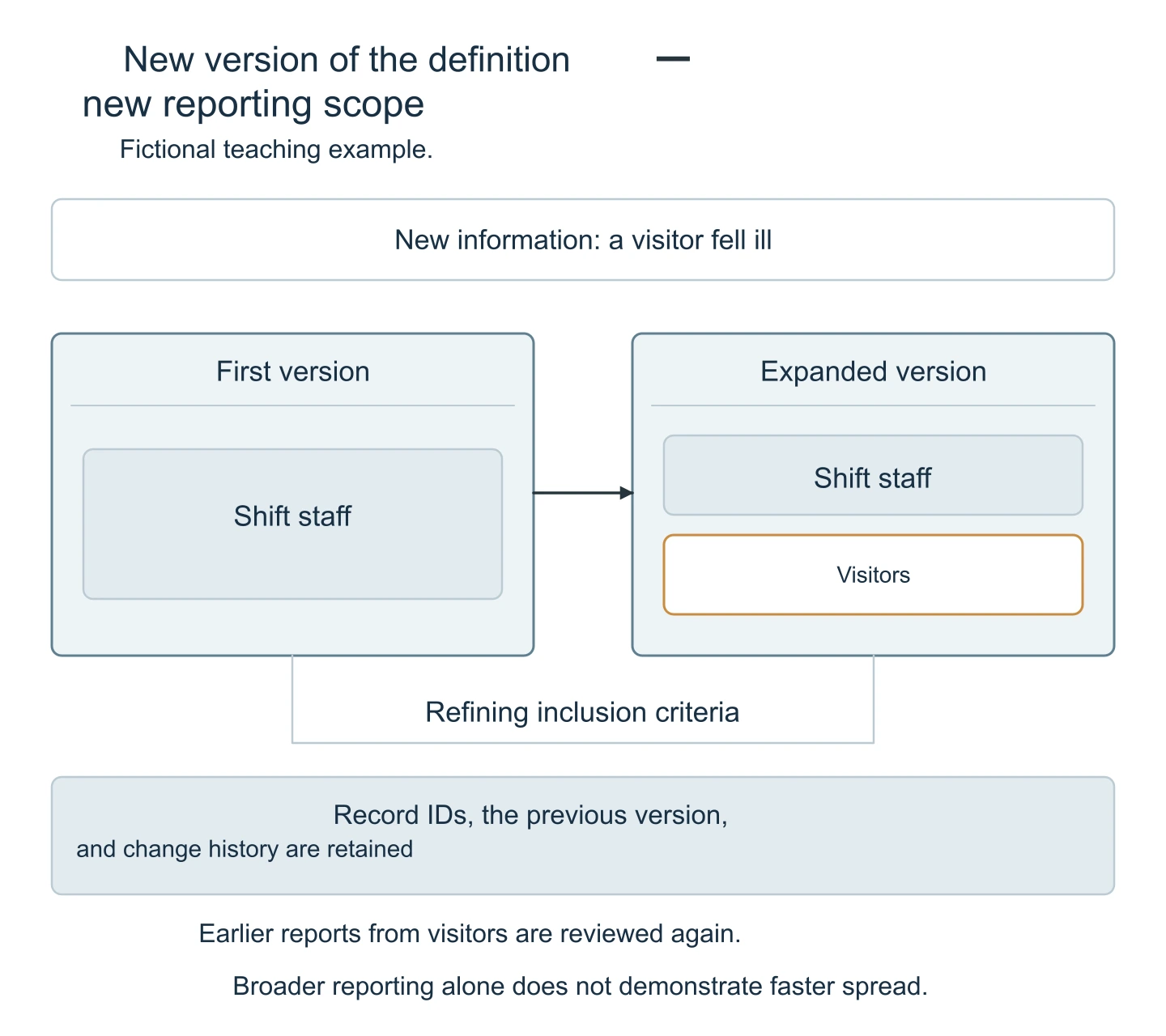
Figure 16. New version of the definition - new recordkeeping coverage
Case Study, Fictional Situation: The scope of the case definition is expanded from shift employees to employees and visitors. Early recordings retain the version; a change in registration does not in itself prove an increase in diffusion.
33 Diagnostic question and suitability of the method
Navigation: NAV · p. 003 · Contents: OGL · p. 010
First decision, then research
Before the study, the leader names the decision for which an answer is needed. This could be a change in treatment, clarification of possible exposure, revision of a protective measure, or assessment of the suitability of a facility. One result can help in one task and be insufficient for another. A method based on a known factor also has limits: these are checked before using the answer to estimate the unknown hazard.
The reliability of a laboratory result depends on the entire effort: training of staff, documentation, execution of procedures, and communication of findings. The WHO laboratory quality guidelines consider these elements as one system. The specific requirements that apply are determined by the institution's standards and procedures. [44]
In the proposed system, a diagnostic request is a short agreement between the decision maker and the performer. They agree on the question, the limitations of the answer, and the recipient in advance. This convention helps avoid a technically correct answer that cannot be applied to the current problem. While the team is waiting for the study, the necessary help on P05 · p. 159 continues.
Six request checks
1. The customer describes an observation, a working explanation, and a decision that may change. The request to “check everything” is replaced by a question with a clear purpose.
2. The laboratory manager checks whether the available methods are suitable for the subject and whether the institution has the necessary authority. If there is a lack of capacity, they will agree to contact another competent organization. An unavailable method remains an explicitly stated knowledge gap.
3. The quality specialist checks information about the received object, its identification and transmission history. He notes circumstances that may make the conclusion unreliable. The material handling itself is carried out according to the approved procedures of the relevant institution.
4. The clinical or subject matter expert discusses in advance what a supportive response, an opposing response, and an indeterminate result would mean. For each option, he names an action or issue for further consideration.
5. The customer and the laboratory manager agree on the deadline, transmission channel and reserve in case of delay. If the result significantly changes assistance or protection, the authorized recipient confirms that the message has been accepted.
6. The decision owner records how the response is used. If the plan survived, he explains why. Even after a patient has been transferred or a shift has ended, the late result must have a specific destination.
Limits of diagnostic conclusion
The conclusion should make it clear what was sought, how appropriate the method was to the question, and what limits the conclusion. The absence of a signal may mean that the factor being sought is missing or that the chosen approach does not answer a significant part of the question. The person responsible helps to distinguish between these situations. Further testing is ordered for the sake of a new decision, so the very fact of uncertainty does not require endless repetition of one study.
Three connections need to be separately assessed: whether the measurement is correct, whether it relates to the patient's condition, and whether it helps select an action. Even a reliably measured indicator may poorly explain a specific disease. The priority of additional research depends on whether it is likely to change a significant decision and whether the cost, delay and risk are justified. [1, 19]
Case study, fictitious situation. The team receives a negative response from a study targeting a limited list of known causes. The clinician maintains necessary support and elaborates on other explanations. The security manager reviews his measure based on individual source data. One response is not used as automatic permission to simultaneously discharge the patient and open the facility.
Tutorial R3: Diagnostic query as agreement
The hospital in case R3 requests an additional test. The initial wording is broad: "Rule out an unknown threat." The person performing the test cannot give a meaningful answer because neither the suspected cause nor the decision depending on the result has been specified. The leads discuss what must be learned for the next clinical step and narrow the question to an area in which the available method is genuinely informative.
Before executing a request, three possible responses are considered. If the data supports a particular version, the doctor will check its relevance to the patient's condition and review the associated prescriptions. If the data weaken the account within the capabilities of the method, attention will shift to other explanations. A vague answer will leave the question open; the team will then evaluate whether another available source of information will help. Neither option means stopping needed assistance during the discussion.
Then it turns out that the answer can come after an agreed transfer. If you specify only the department as the recipient, there is a risk: the result will be seen by an employee who is no longer responsible for the patient. The coordinator records the specific recipient and the order of transfer to the new team. If there is a delay, the doctor knows which issue remains unresolved and takes this into account in the plan.
The agreement turns out to be useful even after receiving the result. The executor communicates the restrictions, the doctor records the impact on treatment, and the person responsible for the transfer confirms that the information has been received. If the plan survived, the recording shows why. Such research can be useful even without an immediate change in treatment orders: it can justify maintaining the plan or eliminate unnecessary action if it answers the question posed.
This analysis shows the criteria for a good request. Its quality is determined by whether both parties can name the question, the limits of the answer, and the next action. The wording “extended examination carried out” without these connections communicates the amount of work, but leaves the next shift without an explanation for the decision.
Once agreed, the team has a clear request, method limitations, and a confirmed response route. If the question has changed, the request is updated. New clinical information is assessed according to P08 · p. 162; G35 · p. 086 helps sort out conflicting results.
34 Composition, biological activity and causation
Navigation: NAV · p. 003 · Contents: OGL · p. 010
Separating statements
Having received the message “threat detected,” the manager first clarifies what exactly has been detected. This may be an unusual structure, a recognized component, an observed activity, or an association with harm. These statements require different reasons. The name of the finding is useful for communication when all participants have the same understanding of the conclusion behind it.
The analysis describes the composition and structure within its capabilities. This information helps guide subsequent questions, but does not alone establish the ability to cause infection. The activity report reveals three things: what exactly was observed, how reliable it was, and what alternatives were tested. For a hypothetical extraterrestrial system, it is first discussed whether familiar concepts apply to it.
The book suggests dividing the conclusion into several statements. Everyone can have their own level of confidence. For example, the composition of a single component can be described reliably while its relationship to disease remains unknown. This allows you to use the acquired knowledge for a limited decision and see where further verification is needed.
Statement | What needs to be justified | What should not be automatically |
Material present | Reliability of detection and attribution of the result to the object | That it causes observable disease |
There is some activity | Meaning of observation and excluded alternatives | That activity is dangerous for humans |
Factor associated with harm | The totality of clinical and other relevant data | That it is transmitted between people |
Transfer possible | Suitable information about the route and circumstances | That every contact leads to illness |
The measure reduces the danger | Result in specific conditions | That fitness extends to any environment |
How is the assessment organized?
1. The diagnostic director writes what directly follows from the study. He preserves the limitations of the method and the quality of the original information.
2. The clinician compares the finding with the manifestations of the disease, their sequence and other possible causes. If the data do not agree, it directly indicates a discrepancy.
3. The epidemiologist compares the distribution of cases and possible exposures. Information about people without the disease and about different conditions is useful for assessment. He also checks to see if the conclusion is skewed by who was included in the comparison.
4. The environmental expert works with the engineer to verify that the proposed mechanism is appropriate for the design of the systems and the circumstances of the event. Common infrastructure can link multiple cases, even when transmission between individuals is not established.
5. The investigation director consolidates the findings and lists significant discrepancies. The management summary includes statements for which a basis can be given. For open questions, the following check is assigned.
Interdisciplinarity is especially important when the etiology is unknown: WHO recommends keeping hypotheses flexible and taking into account the context of the event. [2] In the book, this recommendation is developed into a rule for separately recording the composition, the proposed mechanism of harm and the causal inference.
Checking the causal version
A working explanation must fit observations and stand up to comparison with plausible alternatives. The team compares the possible impact with the timing of the harm and takes into account the uncertainty of dates. Multiple consistent sources strengthen the conclusion as long as they do not repeat the same error. Retellings of the same original record in different reports remain the same basis.
Case study, fictitious situation. An unusual analytical signal was detected in the building and breathing complaints were recorded. The team simultaneously stores versions of the infectious process, the overall harmful effect, and the independent coincidence. Until a causal role is established, treatment is determined by the condition of the individuals and engineering measures by an assessment of plausible pathways of exposure.
Continuation of the analysis of R5: What is needed to check the cause
In chapter 4, the study city team found out that some of the messages were forwarding one story. A separate question now needs to be tested: can a common supply system explain the independent observations that have survived? The origin of the messages has been clarified, but the cause of the illness is still unknown.
The head of the investigation formulates what connection the version about water suggests. The engineer checks the facts related to the system, and the medical team checks the circumstances and conditions of people. The information is then compared by location, time and nature of possible impact. The important question is whether the proposed connection is consistent with observations, including those that so far contradict it.
The team has two temptations: accept the popular explanation before checking, or discard it completely after discovering forwarding. Both decisions would rely on information flow properties. The manager saves the version as being reviewed, identifies any missing information, and continues to compare it with other explanations. The lack of a ready answer does not prevent us from helping people and checking the necessary protective measures.
A useful result of this stage is a clarified question and coordinated work of specialists. The log shows which observations are truly independent, which causal relationship is being tested, and who should provide the following information. If they change the assessment of the source or area of impact, the team will reconsider the specific measure and explain to people the basis for the change.
After parsing, the team receives a map of statements: what the data supports and where the gaps remain. Suspected laboratory or extraterrestrial origin is recorded separately from the mechanism of harm and treatment choices. G35 · p. 086 continues to check the findings, and G36 · p. 088 translates information about the source into the task of eliminating it.
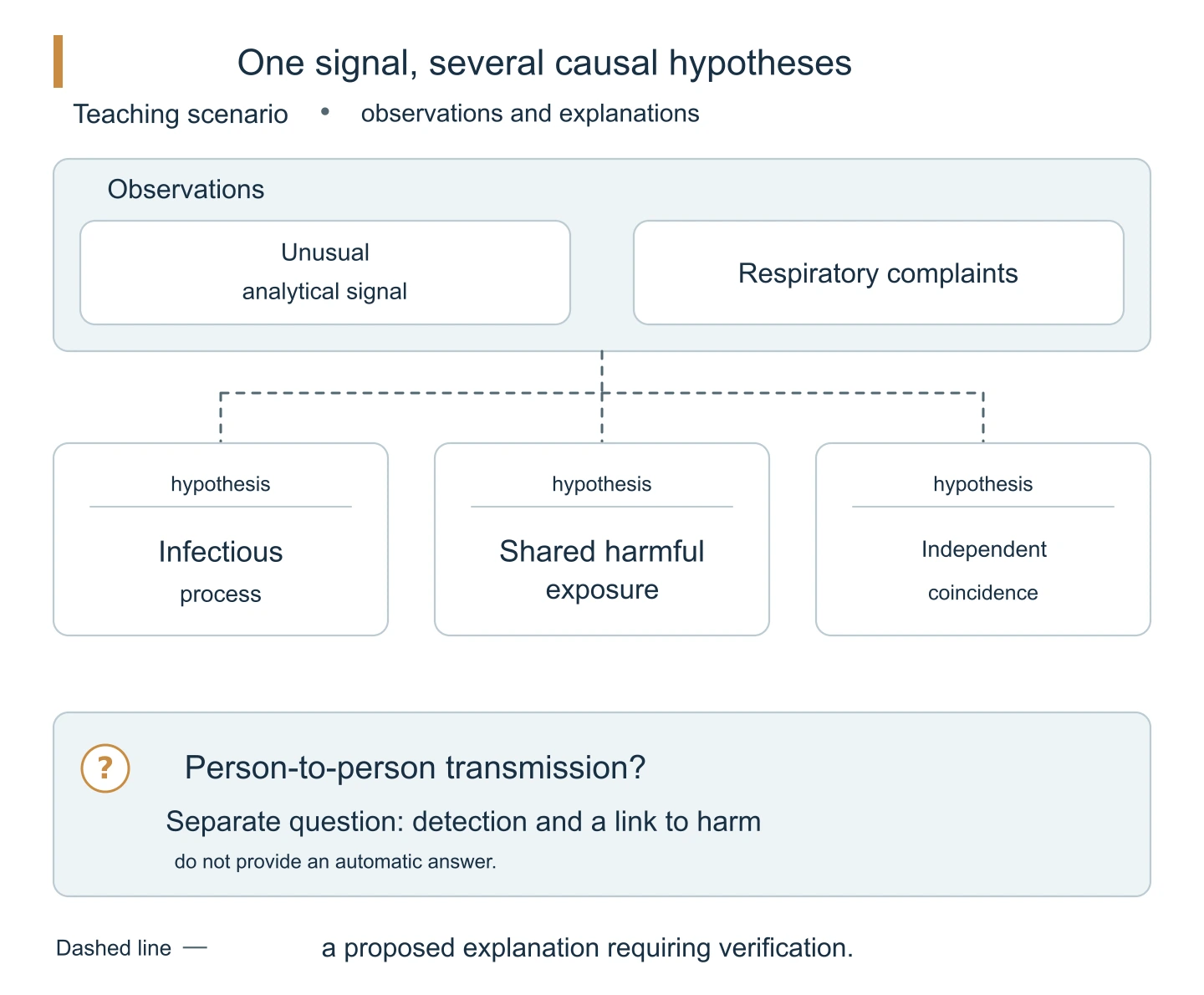
Figure 17. One signal, several causal versions
The case study retains several explanations for the unusual analytical signal and breathing complaints. Causality and the possibility of transmission between people are independent issues; The dotted line indicates the version that requires verification.
35 Confirming the conclusion and working with contradictions
Navigation: NAV · p. 003 · Contents: OGL · p. 010
Controversy as a reason to test the model
If two results disagree, the team first figures out what the difference is. There may be errors, differences in the capabilities of the methods, changes in the event over time, or heterogeneity of observations. An inconvenient answer is saved for analysis. The discrepancy itself does not decide which conclusion is correct and which part of the investigation needs to be reconsidered.
The leader assigns a debriefing, in which participants separate observations from explanations. First, they check whether the information relates to the same question, object and period. Quality and possible reasons for differences are then considered. Laboratory quality system documents help to reconstruct the origin of results and changes made. [44]
A review is considered independent only if it cannot repeat the same key error. Two performers can use one source, different programs can use one incorrect entry. Therefore, general dependencies are recorded next to the results, and matching conclusions are evaluated taking them into account.
Parse sequence
1. The data owner retains the original versions, time of receipt, and subsequent revisions. A controversial result receives the status “requires clarification”; it does not disappear from the log after more convenient output appears.
2. Subject matter experts check the comparability of issues, objects and conditions. Result: a description of what exactly the discrepancy is and what differences may be natural.
3. The quality team determines whether there are grounds to doubt the reliability of the information. If a defect is likely to affect other findings, the affected decisions and their owners are identified.
4. An independent expert or other competent group, when necessary and available, evaluates the key finding without the obligation to confirm the original version. The scope of the review is related to the consequences of the decision.
5. The investigation director selects a further question capable of distinguishing between explanations. The study is clarified or suspended if its continuation is unsafe or the result remains uninterpretable.
6. The response leader and clinical team review the affected actions. Assistance continues, and temporary measures receive clear reasons and a deadline for next consideration.
Dealing with Negative and Uncertain Results
Negative and indeterminate results report different things. The former may weaken a particular hypothesis if the study was suitable to test it. The second means that there is not enough data for the intended conclusion. The summary keeps these statuses separate and explains what issue they address.
The decision to perform additional verification takes into account the consequences of an error, the expected information content, and the cost of delay. When there is an immediate threat to life, the clinician follows the applicable medical route. In the event of a disputed authorization, the competent authority shall consider sufficient alternative measures. The inability to achieve absolute certainty does not provide an independent basis for an indefinite limitation. [12, 19]
Case study, fictitious situation. The two services report opposing findings about the premises. The analysis shows that the first assessed the suitability of short-term technical access, and the second assessed the possibility of permanent work. Initially, the apparent contradiction is associated with different tasks. The summary is corrected and the permission is formulated for a specific use.
Educational analysis R2: Where the contradiction arose
The Sever organization recorded the dispatch of a closed container, but there is no confirmation of receipt in the copy of the Bereg organization's log available to the sender. Various explanations are possible: the cargo is still on the way, the reception has not been completed, or the recording has not reached the required participant. While the location and responsibility are unknown, the problem concerns transmission control. The disruption of the shell and the impact on humans due to this discrepancy have not been established.
The designated employee contacts the recipient through the established channel. The Bereg confirms the actual location of the container and the person responsible. The versions of the records are then compared. It turns out that the sender was displaying an old copy of the log. The first contradiction is resolved: the confirmed reception and location were not visible in the used version of the data.
After this, a separate decision remains regarding further use. The condition of the container and applicable conditions are assessed by a designated competent person. Correcting the log does not automatically grant such clearance. Two clear lines appear in the log: the location question is closed by the recipient’s confirmation; the question of further use has been transferred to the specified specialist.
To prevent recurrence, the team checks how participants know they are reading a live post and what happens if they lose connection. The fix is complete when the transmission check produces the correct result. In G47 · p. 119 this case is considered from the perspective of a laboratory organization, and in G58 · p. 147 - as a patch verification task.
When a significant finding is corrected, the person responsible notifies the people who have already made decisions based on it. The public notice explains the new basis and maintains confidentiality. After analysis, the current version, canceled conclusions, open questions and those responsible for the consequences are known. Clinical decisions are reviewed according to P08 · p. 162, approval conditions - according to P13 · p. 167.
36 Source, route of exposure and purpose of elimination
Navigation: NAV · p. 003 · Contents: OGL · p. 010
Which chain needs to be interrupted?
To eliminate a threat, the team determines what supports the possible impact. The source may be material, damaged equipment, or an ongoing process. The exposure pathway links the source to the person or environment. Once the supply stops, contamination may remain. Therefore, the tasks are divided and a testable result is selected for each. Compromised protection may require action before diseases appear.
While the cause is unknown, several explanations are stored on the working card. For each, known connections, assumptions, and information that could change the decision are noted. The risk assessment is associated with a specific activity, possible exposures and consequences, then updated with new data. This approach is included in the WHO risk assessment guidelines. [19] The origin of the material and liability issues are considered separately from identifying the source of exposure.

Figure 18. Source, path and residual trace
Conventional section of the supply unit, its connection with the premises and areas requiring inspection. The branched amber marks on the table and floor are artistic marks: their shape does not determine the nature of the material and does not confirm a biological cause. Discontinuation and assessment of residual impact require separate decisions.
Sequence of problem statement
1. The incident manager names the result of the work: what impact needs to be stopped and what function needs to be restored while still helping people. He appoints a person responsible and a time for review. Instead of the goal of “making everything safe,” the team describes the conditions for a specific object and its use.
2. The investigation manager, engineer, and environmental specialist map the sources and paths. It marks the boundaries of systems, connections, sequence of events and confidence in information. Unsurveyed areas remain designated as unknown. For the issues on which the intervention depends, responsible staff are assigned.
3. The engineer checks which functions depend on the affected node. Stopping it could change ventilation, water supply, communications or access to help. The engineer suggests a permissible shutdown, replacement of a function, or limited continuation of work. In the space environment, this consideration is included in the decision to maintain life support.
4. The medical director describes what exposure must be stopped to protect patients and staff, which groups require special routing, and what deterioration is likely to occur if delayed. Assistance to the victims continues as the investigation continues. Treatment of a specific individual is not dependent on the final identification of the environmental source.
5. The work manager compares options based on the expected effect, the ability to verify the result, the risk of transfer and available resources. He considers the consequences of both interventions and expectations. The selected plan indicates the boundaries of the work, requirements for the contractor, handling of generated waste and stopping conditions.
6. The Incident Commander approves the purpose and limitations. The person responsible for quality checks that the completion of the work can be confirmed by information independent of the contractor’s promise. If there is insufficient data, a limited reversible decision with a specified verification period is allowed; it cannot be described as final liquidation.
What is considered failure?
The plan is revised if exposure continues, another source is found, work interferes with a vital function, or the result cannot be verified. Before repeating the action, the team finds out the reason for the failure. By stopping a dangerous operation, it continues the necessary assistance and maintains available protective measures.
The review separately addresses four questions: whether supply has ceased, whether distribution has been limited, whether the remaining risk is consistent with the agreed use, and whether the necessary systems are in place. Each answer has its basis. Different specialists may be responsible for different results, but a common log links their decisions.
Case study, fictitious situation. The settlement replaced the damaged part of the supply system, but the unusual complaints continued. Repeated replacement does not eliminate the problem if the supply is higher up the system. The manager returns to the source map, checks the boundaries of the original version, and keeps alternative supplies within the approved plan.
By the end of this work, the purpose of the remediation, known and suspected connections, responsibilities and reasons for the revision have been agreed upon. In G37· p. 090 team selects the recovery method according to P09 · p. 163. If doubt concerns the very connection of the finding with the harm, return to G34 · p. 083.
37 Selecting and verifying environmental remediation
Navigation: NAV · p. 003 · Contents: OGL · p. 010
Suitability of the method for a specific object
The recovery method is chosen based on the environment, the expected mechanism of harm, and the future use of the object. A result obtained on a different material or under different conditions requires verification of applicability. WHO considers decontamination and waste in relation to risk assessment and working conditions. [1] For a hypothetical extraterrestrial nature, the applicability of terrestrial concepts remains a separate issue.
The plan specifically addresses cessation of supply, removal of hazardous material, reduction of hazardous activity, and return to desired function. Sometimes the justifiable outcome is replacing a component, temporary restriction, or changing the purpose of an object. In this case, the team explains the consequences and assigns a further decision.
How the recovery plan is approved
1. The owner of the object describes how it is going to be used and what functions are needed for this. Medical premises, technical compartments and residential buildings may require different access conditions. The owner communicates infrastructure limitations, availability of reserves, and impact of shutdown. On this basis, the problem from G36 · p. 088 is refined.
2. A specialized specialist presents options and reasons for their applicability. For each, he notes confirmed, suspected, and conditions of possible unsuitability. Technical regimes are taken from approved professional procedures for a given object and hazard. If the evidence is insufficient, this gap remains part of the decision.
3. The engineer and medical director assess the possible harm of the work: damage to materials, equipment failure, impact on personnel, interruption of care. They check the subsequent maintenance of the systems and the route of the resulting materials. The variant that creates a new uncontrollable hazard is returned for processing.
4. The person responsible for quality, before starting work, determines what information and independent assessment will confirm the result. A separate performance report and a statement on the suitability of the environment will be required. The criteria are agreed upon in advance; Test limitations and their consequences are recorded in the plan.
5. The Incident Commander weighs options and approves the actor, resources, boundaries, suspension conditions, and how to change the plan. The presence of equipment does not in itself confirm the qualifications of the person responsible. The approval must take into account the authority to carry out the work and further disposal of the facility.
Execution and acceptance
Before starting, the work manager checks the readiness of people, communications, significant dependencies and reserves. If the condition is not met, he moves the beginning or changes the agreed volume. The record remains of who authorized the work and on what grounds.
During the work, the contractor records significant deviations, damage, unintended distribution of material and loss of control over the boundaries of the operation. In the event of such an event, he informs the manager and acts according to the prescribed stopping procedure. Unauthorized replacement of a method is not masked by the entry “equivalent procedure”. Renewal requires consideration of the cause and updating of the plan.
Acceptance compares the completed task with the state of the environment and the operation of systems. For each condition, appropriate reasons are used: appearance, hazard assessment results and equipment serviceability answer different questions. A significant discrepancy is recorded along with the person responsible and the deadline for the decision.
Case study, fictitious situation. After work in the compartment, the expected effect according to the agreed indicator was shown, but the tightness of an important unit was lost. The compartment is not accepted for previous use: an engineering malfunction creates its own risk. The decision may involve replacement of the assembly and a new limited clearance after inspection.
Tutorial: How to Compare Recovery Options
Assume that within case study R5 the team is considering returning one affected facility back to service. This is a conditional branch of analysis, and not a message about confirmed pollution of the city. The required function for the room is named and a list of conditions is defined that must be confirmed by specialists. Options are now being discussed: continue the temporary restriction while ensuring replacement of the service, restore the facility to its original operation, or allow a more limited use after appropriate review.
Each option has its own price. Continued restriction requires sustainable replacement of the service. Full recovery may require resources and time that are not currently available. Restricted use is only useful if it does not rely on untested areas and the team is able to enforce its conditions. The comparison is built around a specific function and impact, and not around the desire to declare the work completed as soon as possible.
The engineer checks technical dependencies; the medical director describes the consequences of interruption of care; the restoration specialist justifies the applicability of the options. The person responsible for quality determines what information will allow the result of each of them to be accepted. The manager compares these conclusions and writes down the selected scope along with the terms of the revision.
If the data supports only part of the conditions, the permissible next step may also be limited. The document indicates who is allowed to work and why, what function is currently provided differently, and what is required to expand access. This is superficially less definitive than saying “the object has been restored,” but it does give performers clear boundaries.
After execution, the result of the operation and the readiness of the systems are checked separately. Failure to comply with one mandatory condition returns the affected portion of the decision for review. Previously confirmed information is saved with an indication of the area to which it relates. This way acceptance shows what has actually been achieved and what work remains.
After the work, the contractor’s report, deviations, conclusion on functions and data for authorization were collected. The decision on the return of people is made by the authorized head of G38 · p. 093 and P13 · p. 167. The contractor's certificate of completion of the operation is included in this package, retaining its specific purpose.
38 Data quality and authorization decision
Navigation: NAV · p. 003 · Contents: OGL · p. 010
Approval relates to specific use
authorization describes who, where, why and under what conditions can enter or return. Brief technical work and permanent residence require different reasons. A single site scan also does not automatically cover related premises and networks. Therefore, the intended use is determined before assessing the adequacy of the data.
EPA links data quality planning for pollution remediation to the decisions that data should support. [31] The book adopts the following principle: first, the decision and key uncertainty are formulated, then the necessary package of confirmations is determined. A single number of negative results for all objects is not established.
Contents of the decision package
The decision involves collecting information about the hazard, source elimination, environmental conditions, system health, and health monitoring. Each section indicates the origin of the data, the restrictions and the authorization condition that they support. Then they check the completeness of the decision questions: the volume of the report does not compensate for the absence of the required section or period.
Testable Question | What should a decision maker see? |
Has the approved intervention been completed? | Completed actions, deviations, unresolved comments |
Has the intended impact ceased? | Consistent data with designated limits |
Is the infrastructure suitable? | Confirmation of functions for selected use |
Are the conditions sufficiently covered? | Explanation of assessment boundaries and outstanding situations |
Can deterioration be detected? | Work observation, message recipients, actions |
Sequence of consideration
1. The owner of the clearance decision specifies the facility, intended users, and operating conditions. Together with the medical and engineering managers, he sets criteria that correspond to the consequences of an error. Requirements introduced after receiving the results are separately explained and go through the same approval process.
2. The quality officer checks the origin, completeness and relevance of the data, as well as significant discrepancies. He maintains the distinction between no information, a negative response, and an inappropriate method. The corrected conclusion is linked to the previous version so that the decision change can be restored.
3. An independent subject matter reviewer evaluates whether the information supports the requested clearance. Independence means the ability to challenge a conclusion without being held accountable for the success of the work performed. If resources are limited, determine and document an available method for such verification; its limitations are communicated to the decision owner.
4. Medical and engineering managers verify the ability to detect deterioration after authorization and change conditions in a timely manner. Favorable statistics on non-working help-seeking are not considered reliable observations. Special consideration is given to users for whom the consequences of residual exposure may be particularly severe.
5. The authorized principal authorizes the use, permits it with conditions, or defers it. He signs the basis and appoints someone responsible for the remaining risks. If deferred, indicates the specific gap, the method for eliminating it, the executor and the date of revision.
Limited Return Conditions
The facility can be opened in stages when the boundaries of each stage are clear, the necessary services are available, and the team is able to notice the deterioration and respond. The decision specifies the duration, permitted use, operations not yet available, and how to report problems. Changing these conditions requires a new assessment.
Case study, fictitious situation. The city has completed work on one building, but the connection to the overall supply system remains unclear. The building report does not confirm the suitability of the entire network and does not in itself authorize the use of the building depending on its condition. The authorized manager will only consider a limited permit after the supply has been demonstrated to be suitable for that use or the permitted activity has been demonstrated to be independent from the untested network. The rest of the uncertainty gets a separate task and owner.
Users receive a clear clearance document: which version is valid, what is allowed, and when revision is required. The impossible condition is corrected before the people return. For approval, P13 · p. 167 is used, for analyzing discrepancies - G35 · p. 086, to continue elimination - P09 · p. 163.
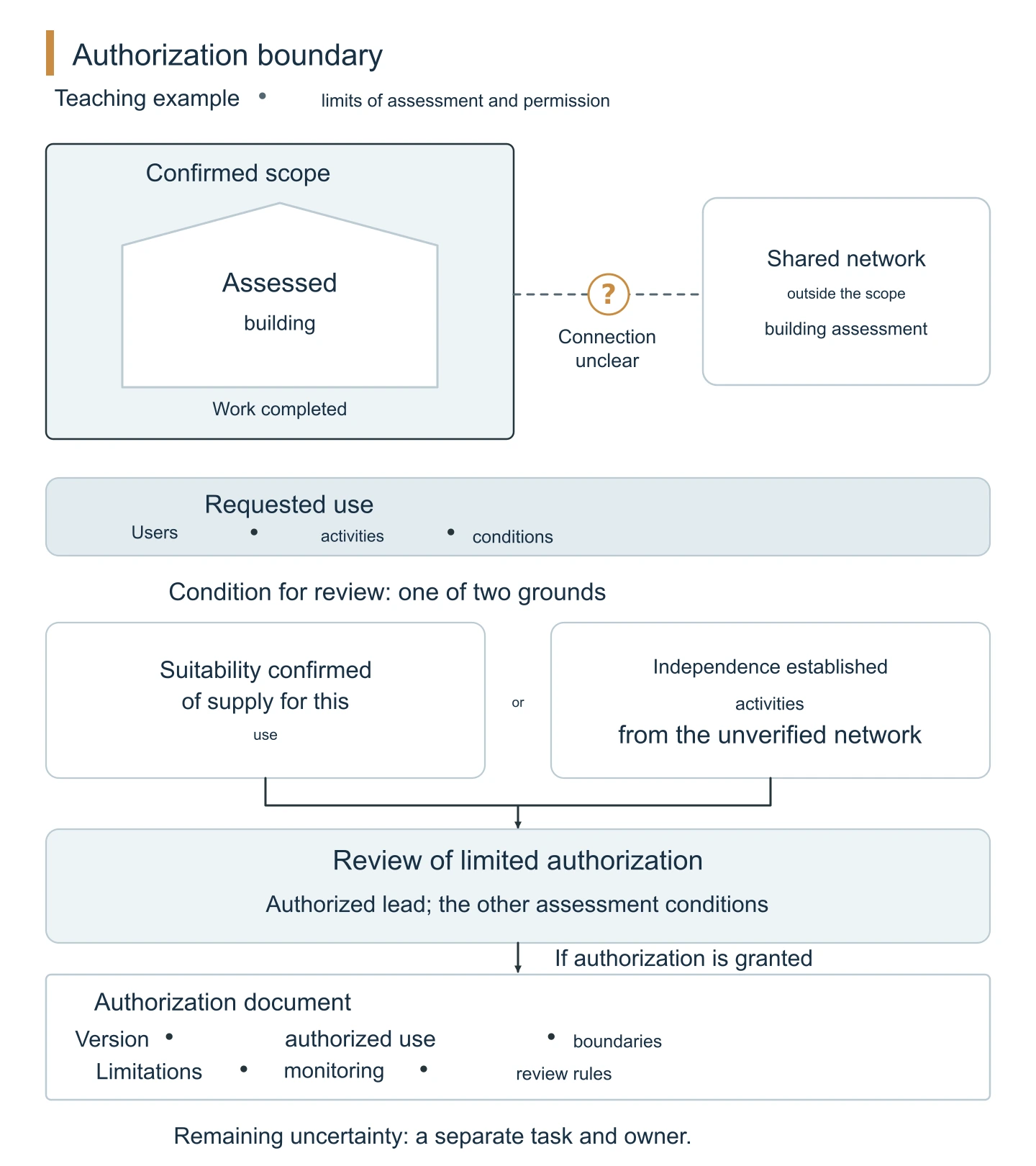
Figure 19. authorization limit
In the training example, the building inspection does not automatically cover the associated network. Limited authorization depends on the declared use and the demonstrated suitability of the supply or the reasonable independence of the activity from the untested network.
39 The profile of the required medical countermeasure
Navigation: NAV · p. 003 · Contents: OGL · p. 010
From patient need to development challenge
Development begins with a need for help. The team finds out what decision the doctor cannot yet make or what result remains unattainable for the person. Prevention of the disease, recognition of the condition, reduction of severity, treatment of the complication, or restoration of function may be required. If the nature of the event is unknown, the defense mechanism remains to be elucidated. The name of the intended agent does not in itself determine the future product.
The target product profile describes what and for whom the product is needed, what properties it should have, at least in a minimally acceptable form, and what properties are desirable. This is the approach taken by WHO. [29] In the book, the profile links the clinical service, the researchers and the application organization: they agree on the required benefits, limitations and reasons for reconsidering the target.
How to create a profile
1. The medical director formulates an unmet need. He indicates who needs help, at what stage of the condition, what decision is currently available and what it does not achieve. The needs of people with severe illness and people with possible exposure without illness are recorded separately: they may require different products.
2. Clinicians work with representatives of affected groups to select meaningful outcomes. If a laboratory value is used instead of a human result, the team will justify the relationship between the two. For a diagnostic tool, actions after a positive, negative and uncertain answer are described in advance. They also check whether this next step is available to the patient.
3. The clinical director describes the site of application, available personnel, support, required response times and resources. Requirements are tested in real care conditions. The proven effect in a specialized center still requires assessment of applicability to a settlement where observation and delivery are arranged differently.
4. The person responsible for quality and supply determines the requirements for quality, transportation, storage, employee training and supply recordkeeping. He checks consumables and outage actions. Capabilities that have not yet been confirmed by the supplier are designated as unresolved requirements.
5. The development manager separates the minimum, without which the tool does not solve the problem, and the desired improvements. Each requirement has a basis and a method of evaluation. If the minimum is not reached, the team changes the intended use or terminates the direction. The reduced requirement is presented as a new decision with an explanation of the consequences for patients.
6. The authorized medical body approves the profile and update procedure. Researchers receive one working version. New information about a disease, available care, or conditions of use may require a different purpose; changes are not hidden inside the list of candidates.
Product inside the help route
The profile shows the place of the product in the aid: who chooses the application, what is tested, to whom the result is conveyed and who observes the consequences. The decision for the individual patient remains a clinical one. Available information and gaps are clearly noted for different groups of people. These gaps are addressed in research design and application settings.
Case study, fictitious situation. The lander requires a means to promptly determine the need to change the medical route. The candidate gives an accurate answer only after being delivered to a distant center. Its scientific value may remain, but it does not satisfy the original operational needs of the crew. They revise the profile or look for another way to support the decision.
Training analysis R3: First determine the desired decision
The hospital in case R3 is discussing the future development program. The first sentence sounds like the name of the product: “We need a new rapid test.” The clinical team asks the following question: What decision would such a test improve? Possible tasks vary - to clarify a specific reason, support the choice of further assistance, or resolve a route issue. Until the task is chosen, the word “fast” has no clear practical meaning.
The team describes the current challenge: the physician needs to obtain a decision-appropriate answer in the conditions of a given institution. After this, it is clarified who will use the product, what supervision remains necessary and what will follow the different results. If a positive answer leads to an unavailable next step, the profile must take this deficiency into account. Otherwise, a technically successful product will leave the original medical problem unsolved.
Then the required and desirable properties are separated. In the educational model, it becomes mandatory to have an answer that can be applied to the chosen question and a feasible route after it. More convenient organization of work may be a desirable improvement. Specific indicators of accuracy, time and quality are determined by specialists for a given task; they receive a basis and a method of assessment. They are not assigned arbitrary round numbers for the sake of a complete table appearance.
A comparison with a remote community shows why one profile does not always fit all locations. In the hospital there is only one method of transmitting and discussing the result; in the settlement there may be other restrictions on communication, transportation and observation. Developers can choose different uses or explicitly limit the first use. These decisions are saved in the profile version to prevent the team from later expanding the product promise unnoticed.
At the end of the discussion, the program can be evaluated meaningfully: does the candidate meet the selected need and what properties still require verification? If the need itself has changed, the profile is revised before comparing directions. Already received data is saved, but future expenses are correlated with the new goal.
If the team demonstrates a technical achievement but cannot identify an improved patient or physician decision, it returns to the original need. The received data is saved. After this check, the profile has an owner, version, success criteria and failure conditions. G40 · p. 098 considers the selection of candidates, and P10 · p. 164 links the stages of medical development.

Figure 20. The exact answer is too far
Fictional case study: The crew requires a timely decision, but the diagnostic candidate's response is only available at a remote center. Scientific rigor and suitability for the current care pathway are assessed separately; The distance is shown conditionally.
40 Candidates and limits on extending results
Navigation: NAV · p. 003 · Contents: OGL · p. 010
What is known about the candidate
A candidate is a tool or application that the team proposes to study. This could be an existing product, a new development, or a new application of a known product. A scientific hypothesis explains the interest in the referral, and the benefit to the patient for a new disease requires a separate assessment. Knowing about similar pathogens helps you select the right questions—this is the meaning of research priority, including the WHO approach to pathogen prioritization. [28]
For the candidate, the intended action, results of relevant studies, safety, quality and feasibility are separately described. The FDA reviews drug development through research, preclinical and clinical evaluation, regulatory review, and follow-up. [33] This description applies to the US system; powers in another jurisdiction are determined by its own authorities.
Order of comparison of directions
1. The program director matches the candidate with the profile from G39· p. 095. He indicates what need the direction can fill and what result will allow it to be verified. A candidate without a clear purpose returns to posing the question, even if its mechanism looks interesting.
2. The scientific team explains how the available data relate to the target disease and care setting. It lists significant differences between the system studied and future patients and evaluates how each difference might change the conclusion.
3. The Quality Assurance Officer reviews the provenance of the data, the completeness of the reports, the reliability of the methods, and the independence of the evidence. Multiple publications about the same sample are considered related information. Unavailable essential data remains a limitation of the decision.
4. Clinical and regulatory experts are assessing the basis for the next authorized step. They compare expected benefits, potential harms, available alternatives, and what question the study will answer. The status of the investigational product is reported separately from the status of the usual care product.
5. The program director and independent reviewers compare several areas, taking into account limited resources. Priority is given to the question that can improve the medical decision at an acceptable risk. Popularity, origin of funding and funds already spent are not independent proof of prospects.
6. The person responsible for the direction sets the next result to be checked and the stopping conditions. Reasons for discontinuation may include unacceptable benefit-risk ratio, insufficient quality, loss of ability to answer a question, or inadequacy of need. When changing direction, negative results and explanations for the choice are retained.
How not to overestimate intermediate success
Changes in the measured signal, biological indicator and human condition - different results. When an indicator is used instead of a clinical outcome, the relationship between them is substantiated. The remaining uncertainty is clearly communicated to clinicians, participants and the public. To compare directions, both favorable and unfavorable observations are saved.
Case study, fictitious situation. The drug under study changes a parameter associated with a perceived threat, but data on well-being, complications and safety are insufficient. The team maintains candidate status, clarifies the clinical question, and considers the appropriate next step. The announcement of a cure would be broader than the available evidence.
Case study: How to choose your next question about a candidate
After agreeing on the profile, the program receives two conditional offers. The first describes the indicator being measured better, but there remains a large gap between it and the benefit for the patient. For the second, there is less information, but a clear question about the clinically significant result is formulated. These are fictitious referrals without drug names or purported agents; they are needed to analyze research choices.
Having more measurements does not automatically solve the comparison. The quality officer will find out where the information came from and what the limitations of both proposals are. The clinical team matches them with the profile. Regulatory and ethical experts evaluate which next step is acceptable and capable of providing a useful answer at an acceptable risk. At this stage, the team selects a research question while maintaining a distinction from treatment intent.
In the first direction, the next work may be devoted to checking whether the indicator relates to the desired result. If such a relationship cannot be assessed in the proposed way, additional measurements of the same type will not fill the main gap. The second area may lack initial safety or quality data. Then interest in the clinical task also does not allow the transition further. Each sentence has its own continuation condition.
The decision is written down so that another group can check it: what intended use is being considered, what is known, what is missing, and what outcome would change the status. If there is a lack of resources, the manager chooses a direction with an explanation of the alternatives and the cost of delay. Funds already spent are included in the program history, but do not replace the assessment of the next step.
Stopping the direction should also provide knowledge. The team saves the base and its associated data so that it does not later start the same path under a different name. This outcome is especially important in a long-term program: it allows decisions to be changed without losing accumulated experience and without declaring each intermediate effect as a found treatment.
Vaccines also require a separate assessment of safety, efficacy and quality; the procedure for their development and consideration is not limited to determining the composition of the threat. [30] Extraterrestrial origin does not allow us to promise in advance the applicability of vaccination or the timing of receipt of the product. Planning is based on achievable milestones and review conditions.
After the comparison, the program has the questions selected, a record of each candidate's reasons, and reasons for rejecting other options. The next stage involving people is considered in G41 · p. 101. While development continues, medical assistance and source elimination are carried out along their own routes.
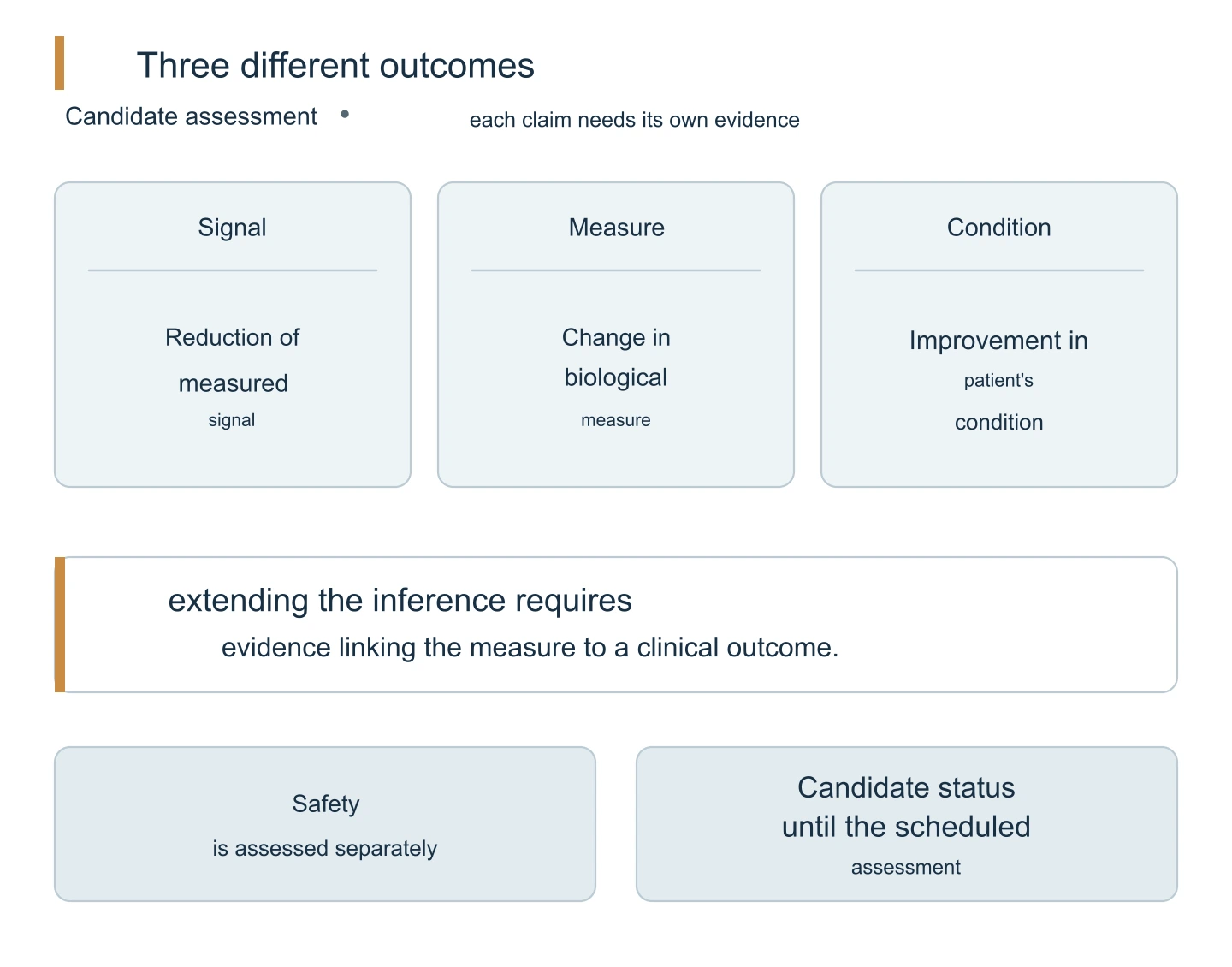
Figure 21. Three different results
The measured signal, the biological parameter and the patient's condition describe different results. Transferring a conclusion requires justification; safety is assessed separately. Until the required verification, the drug under investigation retains its candidate status.
41 Clinical research, ethics and independent oversight
Navigation: NAV · p. 003 · Contents: OGL · p. 010
What question does the research need to answer?
A study involving human subjects must address a significant medical question. Its design should allow obtaining data suitable for a decision at an acceptable risk. In an emergency situation, information content is especially important. A study whose design does not produce an interpretable answer wastes resources and exposes participants to risk without sufficient scientific benefit. WHO guidance 2024 links research quality to scientific validity, ethics and usefulness of the result. [26]
Before starting, the protocol defines participants, comparators, significant outcomes, safety assessment, analysis, and handling of incomplete data. Each change receives a reason, date and approval. If the research involves adaptation during the work, its conditions are described in advance. This makes it possible to differentiate an intended change from a lucky choice after reviewing the data.
Launch and execution sequence
1. The principal investigator formulates a question and checks to see if the team can answer it. To do this, the investigator evaluates the availability of participants, resources, observation and comparison. If obtaining a meaningful result is unlikely, the design of the study is first changed.
2. The sponsor and quality manager ensure data processing, site preparation, product accounting and distribution of responsibilities. Significant conflicts of interest are identified before the start and taken into account when organizing supervision. The procedure for disclosing results should also preserve information that is inconvenient for the financing party.
3. An independent ethical committee and a competent regulator will carry out the required review. Their functions differ: ethical approval does not replace the necessary permission, and permission does not replace the researcher's responsibility for the participant. The expedited procedure preserves the meaningful review of significant risks and consent. [12]
4. The team explains to the participant the purpose, uncertainty, possible benefits and harms, alternatives and the right to terminate participation. The explanation is given in accessible language and understanding is checked, taking into account the possible pressure of dependence. If routine consent cannot be obtained, apply the applicable requirements and approved protocol.
5. The clinical team and independent review body consider safety and continuation of work within the scope of their authority. The treating specialist is responsible for direct care. Significant harm, serious loss of quality, or failure to obtain a response triggers the prescribed consideration of modification, suspension, or termination of the study.
6. The sponsor's designated registration and reporting representative ensures that the intervention trial is pre-publicly registered before the first participant is recruited, then keeps the record current and discloses the results as appropriate. Applicable national requirements are checked separately. [46] WHO standards view registration of interventional studies as a scientific and ethical responsibility. [45] Reporting negative and indeterminate results allows other programs to take into account what they have already learned.
Access to untested intervention
When discussing the study, the usual care available is explained to the person separately. It remains valid even if you refuse to participate. Prior to inclusion, follow-up and possible access to beneficial interventions are discussed, identifying only those commitments that the organization is able to meet.
MEURI is the WHO ethical framework for the controlled use of unregistered or investigational interventions outside a clinical trial in specified emergency circumstances. [27] Its use requires valid authority, justification, consent, monitoring and transmission of relevant data. The frame does not provide legal permission by itself; the possibility of proper research is considered separately.
Case study, fictitious situation. At a remote clinic, they suggest including only patients who can easily return for examination. Such an arrangement may exclude the most vulnerable people and distort the applicability of the result. Before launch, the team reviews surveillance support and is honest about remaining limitations.
Case Study R3: Exploring Inside a Working Hospital
Suppose a research proposal has been prepared for the hospital in case R3, which still needs to undergo the necessary reviews. The team wants to know whether the intervention being studied improves a specific significant outcome in a designated group. Before enrolling the first participant, it checks to see if the answer can be obtained in the facility setting while continuing routine care and required follow-up.
The first limitation is related to the composition of the participants. If only those who can easily return for screening are included, the data may be poorly representative of people who have difficulties with transport or care. Instead of implicit simplification, the team considers support for follow-up and honestly describes the remaining limitations of applicability. If essential conditions cannot be ensured, the project is revised before recruitment begins.
The second limitation concerns the total load. Research observation requires people and time. The department manager evaluates how these responsibilities combine with care for non-program patients. The sponsor and investigator will agree on the resources needed. Formal site consent does not confirm that all conditions will be available to each shift.
The third task is to talk with a person. They explain what help is available regardless of participation, what the research question is, and what is not yet known. Checking for understanding allows you to notice if a person considers participation to be a guarantee of recovery or a condition for maintaining routine care. The clarification becomes part of the inclusion decision, rather than a signature after a choice the team has already made.
During the study, a new adverse signal undergoes a prescribed safety assessment. The treatment team continues direct care while designated oversight participants consider program implications. Changes or termination of the study are recorded with reasons and further observation. The final report retains negative and uncertain results: they also answer the question for which people were asked to participate.
Before work begins, there must be an agreed protocol, necessary reviews, clear consent procedures, oversight and reporting. After completing the study, the team evaluates the answer received. The decision to implement broadly will require the next step described in G42 · p. 104 and P10 · p. 164.
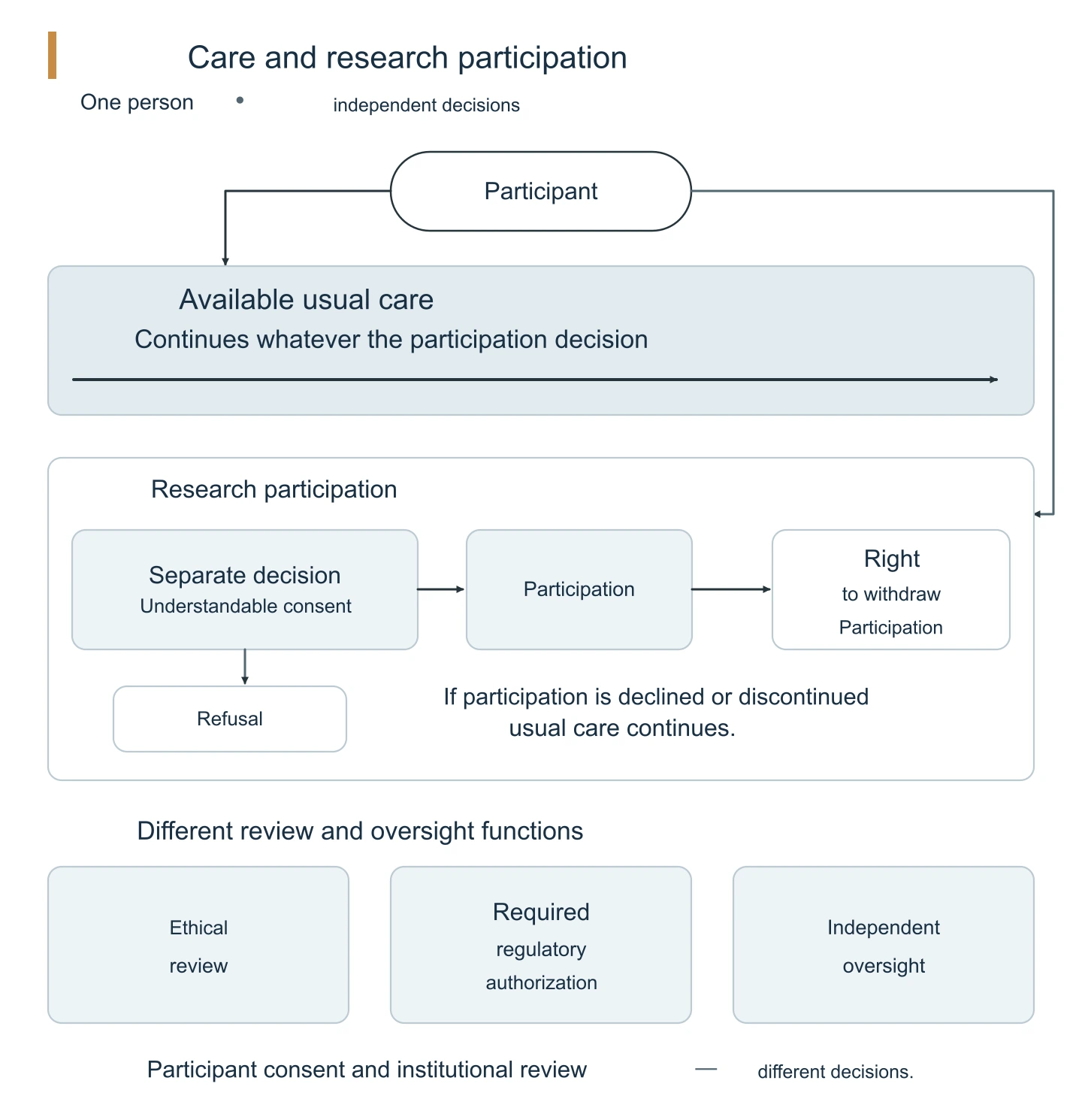
Figure 22. Help and participation in the study
Routine care and research participation have different rationales. Refusal or termination of participation does not interrupt available care; consent, independent oversight, ethical review, and required approvals remain independent.
42 Authorization of use, quality, and monitoring
Navigation: NAV · p. 003 · Contents: OGL · p. 010
Four stand-alone decisions
Scientific assessment of benefit, approval of use, clinical recommendation and product delivery are linked, but each decision has its own reasons and responsibilities. Before practical use, they find out which product is allowed, to whom, for what and under what conditions. The decision of one jurisdiction is considered within the limits of its powers.
The WHO emergency listing process evaluates certain products based on quality, safety, effectiveness and emergency need. The decision has conditions and subsequent obligations. [32] When planning use, check the current status of the product, the limitations of that status, and the requirements of the applicable jurisdiction.
Sequence of introduction into practice
1. The Regulatory Affairs Officer writes a record of the product's status: manufacturer, intended use, application groups, source of decision, restrictions, and current revision. Research use, normal authorized use and special regimes are indicated separately. The status is checked against the current decision, and not just against the old publication.
2. The body that approves the clinical guidelines determines the product's place among the available treatments. It evaluates whether the evidence relates to local patients, resources and pathways. The recommendations disclose the choice, necessary checks, monitoring and reasons for revision. For another group of patients, the applicability is reconsidered.
3. The person responsible for purchasing and quality confirms the origin and identity of the supply, required documents, handling conditions and traceability. He provides the ability to associate usage with a specific supply and perform a restriction or recall. If there is doubt about the quality, the controversial product is separated from those available for use according to the established procedure, preserving the medical route of patients.
4. The medical director reviews the facility's readiness: staff training, resources, and communicating problems to patients and recipients. If the necessary condition is not present, it is provided or another valid route is chosen. This turns having a supply into doable help.
5. The treating specialist compares the authorized prescription with the patient's condition and writes down the essential reasons for the choice. He explains the expected benefits, risks and monitoring. A change in status may require a new custom decision, even if the overall status of the product remains the same.
6. The safety watchdog and regulator receive and evaluate messages, compare them with other data and, if necessary, change the conditions of use. The FDA includes post-market surveillance of a drug product as part of its life cycle evaluation process. [33] The specific responsibilities of participants are determined by the applicable system.
Safety signal and decision change
An adverse event following use requires evaluation. The team considers the disease, other interventions, product quality, and similar messages. The order itself in time does not yet establish the cause, but assistance to the victim continues until the analysis is completed. Precautions and status changes are recorded along with reasons and responsibilities.
The restriction is communicated to purchasing, warehouse, clinical teams and affected patients to the extent necessary. The person in charge acknowledges receipt, arranges alternative assistance and verifies compliance. This feedback shows whether the update has reached the point where decisions were made.
Case study, fictitious situation. The product is approved for one group of patients with available observation. Another site does not have such surveillance, although it has the same supply. The manager first provides the required conditions or transfer to a suitable service. The same product name does not eliminate the difference in terms.
Educational analysis R3: From permission to real help
Consider a conditional continuation of the program: a certain product has received approval for a designated group and under specified conditions. This tutorial thread does not assume that a remedy has actually been found for event R3. It shows the next organizational transition. The hospital receives the supply, but must still check its readiness for use.
The person responsible for quality confirms the supply information, the medical director confirms the training of employees and the necessary resources. It turns out that some of the required supervision is not available on all shifts. Until this issue is addressed, the product cannot be considered equally accessible to every eligible patient. The manager provides the condition or agrees on another acceptable route.
Later, clarification of application restrictions is received. It must change specific work activities: order verification, stock release, patient explanation, and follow-up. The coordinator confirms receipt with those affected by the change. If someone continues to use the old version, the team fixes that particular transmission gap.
Thus, the implementation ends not with the date of receipt of the boxes, but with a working route with responsibility, quality and feedback. Even after this, the issues of the source of the event, the environment and the recovery of people are assessed separately. This keeps medical development connected to the rest of the book's objectives.
After the introduction of the product, a clinical route is in place, the quality of supplies is confirmed and feedback is organized. The development of a drug or vaccine solves a specific medical problem. Investigation of the source, restoration of the environment and surveillance of people continue until their own tasks are completed. The following parts examine this general order in the context of a space mission and terrestrial locations.
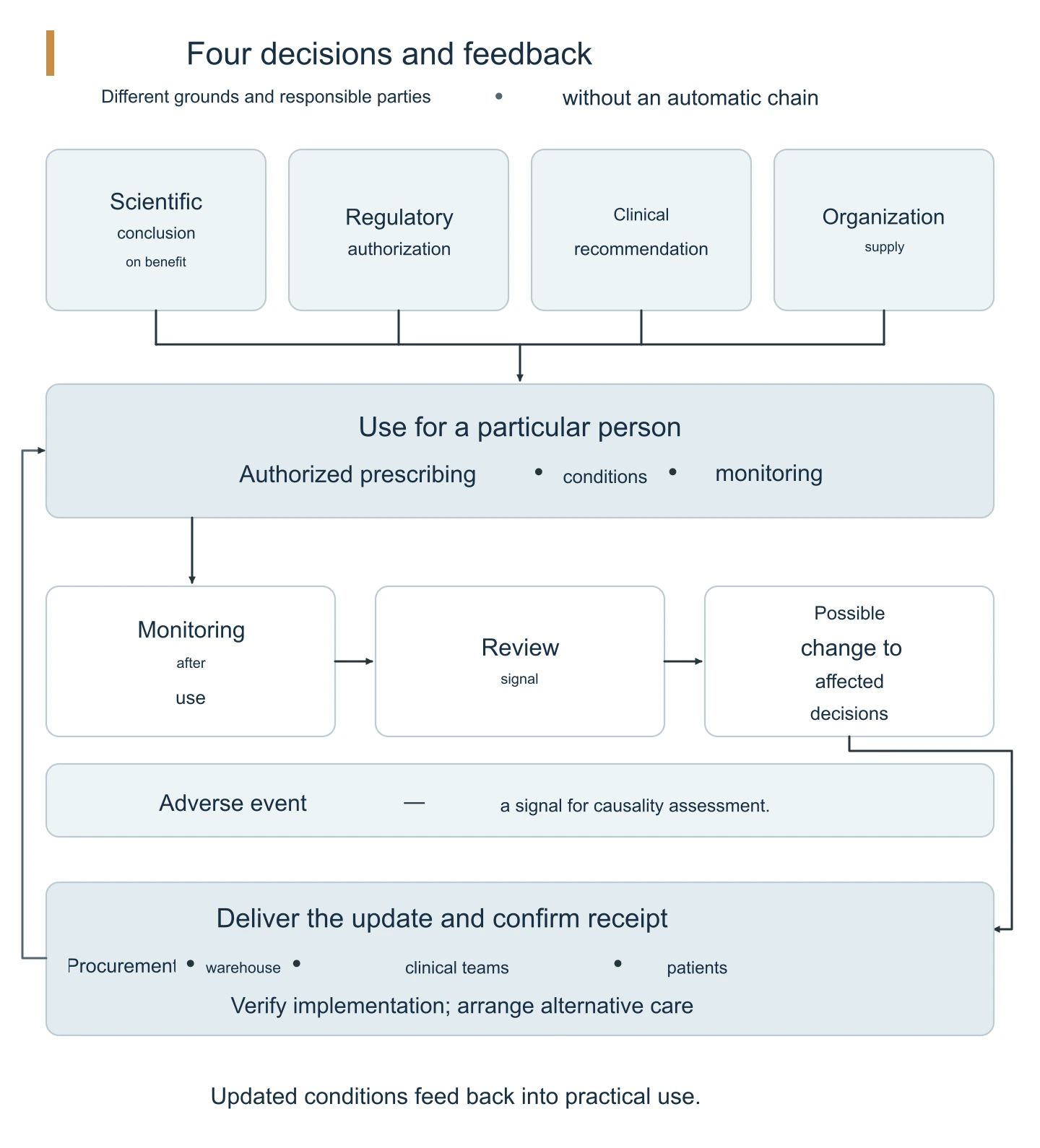
Figure 23. Four decisions and feedback
Scientific conclusion, approval, clinical recommendation and supply are not substitutes for each other. A safety signal may change the affected decision; the update should reach performers and patients with confirmation of receipt.