Part I: Preparedness and Management
Chapters 1–6. How to detect an event, find instructions and ensure accountability.
An unknown event rarely begins with a clear name. First, someone notices an anomaly, gets a strange result, or asks for help. The first chapters explain how to turn this message into concerted action. This requires a clear destination, a division of tasks and a record so that the next shift can continue working.
It is convenient to read this part sequentially. First, let's look at the choice of the first action, then the preparation of people and means, verification of the message and transfer of responsibility. At the end it will become clear what to save in the journal. Cards in the CARDS section · p. 154 allow you to quickly return to these actions during an event.
1 Starting with the situation
Navigation: NAV · p. 003 · Contents: OGL · p. 010
First decision with incomplete information
Start with what can be described now. “The person became ill,” “the protective system stopped confirming its mode,” and “an unusual result was obtained” lead to different first actions. To select them, it is not necessary to know the origin of the proposed agent. The navigator helps the reader find a task within the limits of his training and transfer the remaining questions to those who know how to work with them.
The person's condition determines the urgency of help. Unusual properties of an object require a separate specialist assessment. Both tasks can occur simultaneously: the doctor organizes assistance while the researcher determines the properties of the material. The discovery of new material does not in itself give the researcher the authority to prescribe treatment. U0 · p. 169 helps coordinate parallel work.
How to use
1. An eyewitness reports what happened, where and when. He distinguishes between what he has seen himself and what he has learned from others. The receiving party needs a clear description; a diagnosis from an eyewitness is not required.
2. The duty officer or medical specialist selects urgent action. If the person feels worse, open P02 · p. 156; with possible exposure without symptoms - P03 · p. 157; in case of violation of protection - P04 · p. 158. When several tasks arise, the cards are used in parallel.
3. The appointed manager clarifies the conditions of the location: availability of communication and assistance, the state of vital systems, dependence on external services. The head of the desired location helps check these restrictions.
4. The person responsible for each task checks his authority and means. If it is impossible to perform the action, he names what exactly is missing and sends a request via P11 · p. 165 or P12 · p. 166.
5. The recipient confirms that they have accepted the task and understand what they are responsible for. The transfer ends after this response. One sent message is not enough to complete the transfer.
During an incident, a person performs emergency actions for which he is trained. Detailed explanations are studied in advance: they help to understand why the card is designed this way and what changes will require a different route. This understanding is tested in the exercise.
When the route needs to be changed
The card selection describes the current task and is subject to change. The observed person developed symptoms, a necessary resource ran out, a contradictory result came - each of these events requires checking the previous plan. When handed over, the next card, the person responsible and the expected answer are directly named.
Result of correct entry
The first pass through the book should end with a clear distribution of work. The director, the medical officer in charge, the current restrictions and the next review have been named. Unresolved issues remain in the journal. If there is no ready-made example, start with P01 · p. 155 and describe the unknown in your own words. To organize a response, an honest description of the situation is sufficient.
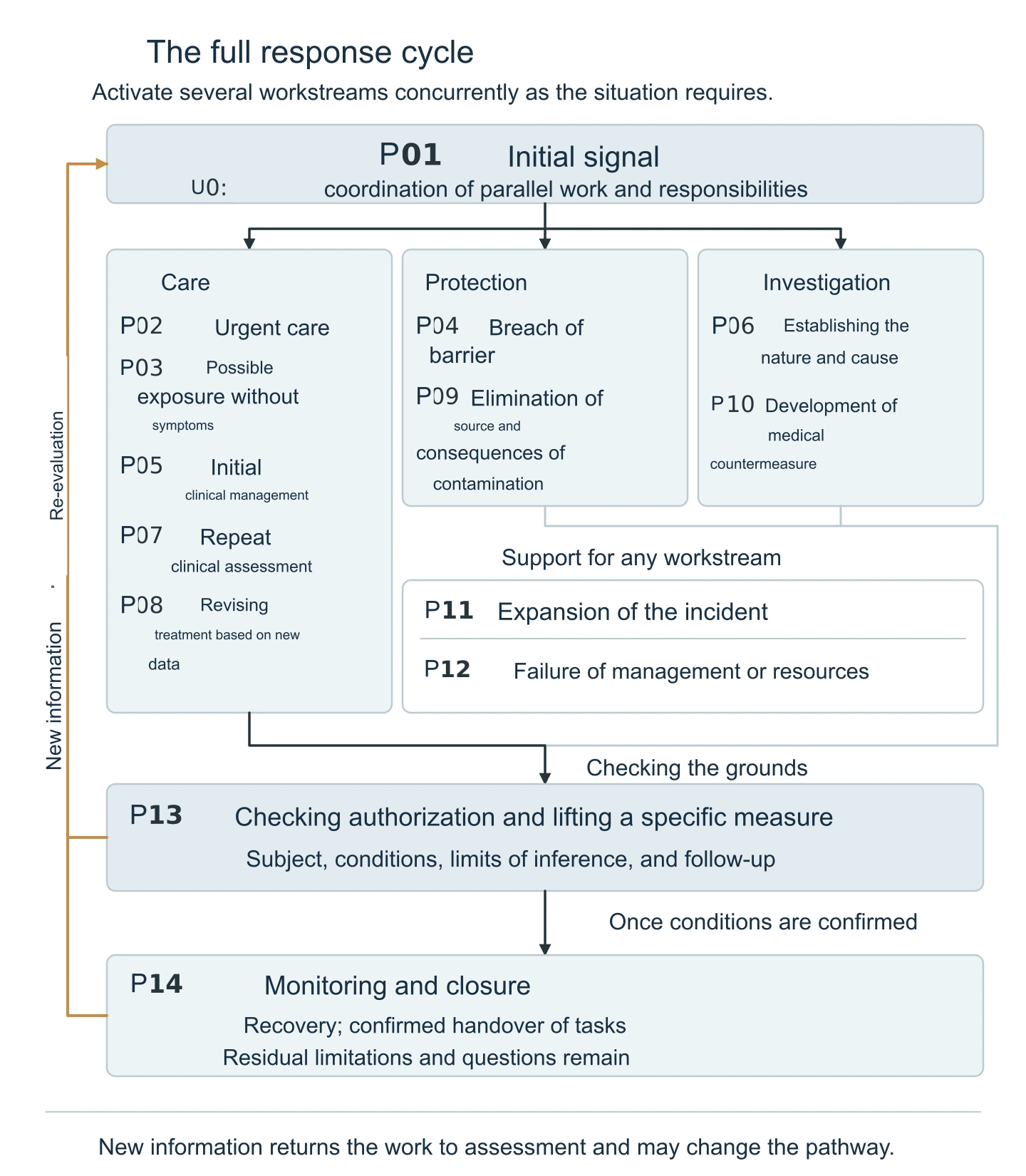
Figure 01. Full response cycle
The author's scheme connects the first signal with the parallel tasks of assistance, protection and investigation. Source elimination, authorization, and restoration have their own effects; new data returns to the appropriate estimate.
Educational analysis R1. There are six people at the Sfera station. It has a living module and a separate work compartment. An unusual monitoring signal appears in the work compartment. One crew member later reports feeling unwell. So far there are two known observations; the connection between them remains to be clarified.
The team is tempted to immediately choose one explanation: either the device detected a general threat, or the alarm was false. But no explanation has yet been confirmed. If you direct all your attention to the device, you can delay helping the person. If we immediately accept a common cause, different problems will begin to depend on an assumption that has not yet been tested.
The manager divides the work. The medical officer assesses the person’s condition and the assistance needed. The engineer checks what exactly the system shows and how reliable its information is. Participants report results to one coordinator, but do not wait for each other where waiting interferes with their own urgent task.
The first entry therefore contains two separate questions: “What is the person’s condition and what help is needed?” and “What does the signal in the work compartment mean?” In the line about the connection of events it is “not established”. This record allows you to continue working even if the answer in one direction arrives before the other.
The workaround is specific to a specific problem. The manager indicates who checks the working compartment mode, what actions of the crew are currently allowed according to station procedures, and when the situation needs to be re-evaluated. The medical plan has its own executor and grounds for revision. No decision is silently extended to the entire crew and all systems.
After this first step, the cause of the event is still unknown. However, the team is already helping the person, checking technical information and understanding who will collect the next report. In chapter 9 we will return to the case when the engineer receives the first data about a malfunction. This result will change part of the picture, but will require careful determination of which one.
2 Indexes by location, role, syndrome and failed function
Navigation: NAV · p. 003 · Contents: OGL · p. 010
Four independent search methods
There are four ways to search for the section you need. The situation prompts the first action. The location shows the limitations of the environment. A role helps you separate your responsibilities from those of others. The failed function indicates what needs to be restored: communication, energy, helping people, or reliable monitoring of the defense system.
Most often, two pointers are needed at once. The hospital may experience a mass influx of patients, loss of water, or suspected spread of disease. The word “hospital” alone is not enough to select an action. The search by role is also structured: medical triage, intensive care and laboratory diagnostics require different training, although doctors can participate in them.
How to combine pointers
Original question | First choice | Next clarification |
What happens to a person | P02 · p. 156 or P05 · p. 159 | |
What no longer protects | Function and dependencies according to G14 · p. 040–G18 · p. 047 | |
How to understand the research result | Question and limits of conclusion according to G33 · p. 081–G35 · p. 086 | |
How to eliminate the source | Purpose of work and approval according to G36 · p. 088–G38 · p. 093 | |
Is it possible to resume activities? | Separate decisions on G55 · p. 140 |
In medical sections, the search begins with the observed syndrome - a combination of signs that helps to choose the direction of assessment. For example, the words “respiratory disturbances” and “changes in consciousness” indicate a problem, but do not yet explain its cause. The applicability of a particular guideline will be determined by a healthcare professional. The initial systematic assessment is supported by the Basic Emergency Care (BEC) curriculum; An appropriate version of the Interagency Integrated Triage Tool (IITT) is available for emergency department triage. [20, 21]
Responsibilities of the Local Editor
In the local version, the card code is saved even if its page has changed. The editor checks the links, and the head of the corresponding direction checks the content of the transition: who to transfer the task to and what information he needs. Future users then try to find the desired action. The review includes the night shift, temporary employee and person without access to the network.
It is useful to check also the erroneous first choice. The participant receives an incomplete message and then a new circumstance. The organizer checks to see if he noticed the change, found the required section and submitted the task. A quick page search makes sense if the action found matches the reader's background and credentials.
Access without network
The paper kit must be suitable for working without the Internet. It includes a situational navigator, active cards, local contacts and a backup method of communication. The detailed e-book is also saved locally. Each working copy indicates the version and date of review; the outdated printout is clearly marked.
Use internal links to jump to the desired section. The organization reviews navigation after changes affecting work procedures and responsibilities. This way the book remains accessible both during regular reading and during an urgent search.
3 Organizational readiness and offline access
Navigation: NAV · p. 003 · Contents: OGL · p. 010
Preparation is checked by action
Organizational readiness can be seen in action. People know their tasks, tools are operational, external partners are willing to accept calls, and limitations are discovered before an incident occurs. The WHO Framework for Health Risk Management in Emergency and Disasters (Health EDRM) links prevention, preparation, response and recovery into the overall work of health and other stakeholders. Below, this approach is applied to checking a specific object. [37]
Start with what the organization is obliged to preserve: assistance to people, communications, water, energy, conditions for safe stay, recordkeeping of people and necessary supplies. For each function, name the person responsible, the resource, and the reserve. Then the person in charge checks whether the current shift can use the reserve in the event of the failure for which the facility is being prepared.
Sequence of preparation
1. The site manager defines the plan's objectives and his or her legal authority. He coordinates with external services what work the object performs itself and what it delegates to them.
2. Area managers describe possible events and consequences of failures. Include a situation with an unknown cause so that the preparation also covers an event without a familiar name.
3. The supply service compares the need with what can actually be obtained. It checks delivery times, equipment compatibility, supplies, and availability of people to maintain.
4. Medical and engineering managers coordinate work under restrictions. Before the site closes, they are figuring out how assistance and service will continue and how people will be able to get out in another emergency.
5. The communications officer checks the main and backup channels. The check ends with a confirmed response from the external recipient.
6. The organizer conducts the exercise without hazardous material. Detected gaps are recorded; each gap is assigned a responsible person and a deadline for correction. [16]
The reserve must be independent
The reserve may have the same vulnerabilities as the main system. Two programs on the same server will disappear along with the server. Two shifts will not replace each other if both depend on a single employee with the right key. The function passport needs to show what will remain available after the selected failure and who will be able to use it.
Let's imagine a scenario: the network is unavailable, although all electronic contacts usually work. The team looks for a valid number in the local copy, uses another channel and receives a response. If contact cannot be reached, a gap in preparation has been identified. It is corrected until the next inspection; the serviceability of the main channel on a normal day does not eliminate this gap.
Acceptance of readiness and revision
Having accepted readiness, the manager reviews the results of the review along with the remaining restrictions. For each critical deficiency, he approves a temporary decision, the work allowed before correction and the condition for stopping it. These restrictions must be visible next to the plan approval mark.
The plan is returned for review when infrastructure, personnel, external partners, clinical guideline, or failure records change. At the same time, people’s everyday needs during restrictions are also checked: medicines, food, communication with loved ones, clear language of messages and access to routine emergency care.
4 First signal and message check
Navigation: NAV · p. 003 · Contents: OGL · p. 010
The signal has a source and degree of confirmation
The first message may come from an eyewitness, an instrument, a hospital, a laboratory, or an external organization. The receiver finds out what can be checked in it. The authority of the sender helps establish contact, but does not confirm his assumption. Conversely, a serious observation remains important even if the report has not yet been formalized.
The times of event, detection and transmission are recorded separately; there may be a significant gap between them. If the exact moment is unknown, indicate the known interval. A fictitious precise marker will later distort the chronology and create connections between events that were not actually established.
Minimum set of information
The receiver finds out what was observed and where, who needs help now, whether the immediate danger continues and what has already been done. The eyewitness is not required to name the agent. The manager on duty acknowledges receipt and schedules a check. In the event of an urgent medical need, P02 · p. 156 is switched on at the same time.
The journal distinguishes between observation, retelling and explanation. “Three employees reported nausea” – a record of the information received. “A new virus infected the department” is an explanation that still requires evidence of the nature of the event and transmission. Unknown information is indicated separately. Such accuracy helps to connect the right specialists, while maintaining the ability to change the original version.
Check without delaying the help you need
1. The verifier contacts the primary source or independent witness. He clarifies the description and notes errors that could arise during the retelling.
2. The subject matter expert compares the message with the normal state of the object and considers other explanations. Changing the instrument readings still requires finding out what has changed and why.
3. The manager selects temporary measures, explains their basis and orders a review. He checks whether they reduce plausible harm and allow assistance to continue.
4. The person in charge of the log records the questions, performers, and expected responses. If there is no answer yet, the question remains open.
5. The information officer communicates what is known, what activities are in progress, and when an update will occur. The Crisis and Emergency Risk Communication (CERC) Guidelines outline principles for clear reporting and correction of information. [13]
False alarm and good faith reporting
If the signal is disproved, the manager writes down the reason and ends tasks that are no longer needed. Helping a person or repairing a separately detected fault can continue. The corrected message is received by the same groups that received the original message. A malfunction or erroneous procedure still has its own person responsible for correction.
Educational analysis R5. In the city there are reports of illness among residents of two areas. An explanation is spreading online: the cause was water. At the first stage, the municipal team has reports of people and an unconfirmed version of the route of exposure. This information is recorded separately.
It would be possible to count all the transfers and immediately build a distribution map. However, then one message posted multiple times in different groups will turn into many cases. Therefore, the reviewer looks for primary reports and notes which stories relate to the same observation. Help for people is organized according to their condition while this check is ongoing.
New information is emerging: in one area, some of the messages actually go back to one source. The other retains independent observations. Now one can neither count the initial number of reports as the number of cases, nor declare the entire event a rumor. The team refines the picture separately for each area and retains the question of the cause.
The public message is also changing. The person in charge explains what has been updated in the records, what observations continue to be verified, and what services are performing the work. He does not attribute a causal role to water without justification, nor does it promise the absence of a threat simply because repetitions are found. When prescribing specific measures, the supply of hospitals and residential buildings is taken into account separately.
It is useful to keep both versions of the summary in the log and the reason for the correction: the number of independent messages has changed, not the status of each previously mentioned person. This part will be needed by the investigation in chapter 32 and the city team in chapter 52. It will also make it possible to explain to residents why the updated picture is different from the first, without hiding the fact of the change.
When reliable information contradicts the original version, the review team changes the explanation and maintains the basis for the change. Local policies should allow suspicions to be reported in good faith. Consideration of possible violation of the rules is carried out separately: otherwise people may choose to remain silent precisely when early communication is most needed.
5 Authority, deputies and transfer of control
Navigation: NAV · p. 003 · Contents: OGL · p. 010
A task must have a specific owner
The overall leader coordinates goals, people, and resources within his or her authority. The medical director organizes assistance, the engineer is responsible for the acceptable technical conditions, and the laboratory director is responsible for the safety and quality of his work. Experts discuss the decision together, but after the discussion it should be clear who made it and who will check its implementation.
The Incident Command System (ICS) distinguishes command, operations, planning and supply. The WHO Emergency Response Framework (ERF) describes the response organization of the World Health Organization itself. Here both models help to consider the structure of the team; The powers of a particular organization are determined by the applicable rules. [8, 9]
How to assign responsibility
The manager assigns responsibility for assistance, engineering systems, investigation, supply, information and work safety. For each function, he defines a deputy and the condition under which he assumes responsibility. In a small facility, one person can lead multiple directions if they can handle the workload and can get the necessary review of important decisions.
Before considering a task accepted, four things need to be checked: the person responsible understands the assignment, has the training, has the means, and knows the order of the report. If something is missing, he names a specific need. The manager considers it before the formal consent of the overloaded employee becomes the only basis to consider the work organized.
A short response from the person responsible helps to understand the order. He names the expected result, his immediate action and the obstacle, if it is already known. The manager can immediately detect different understandings: one participant is only going to send a request, the other expects confirmed help from him. By agreeing on the result, they receive a common completion criterion.
If responsibilities are combined in a small team, this is noted in the record. Then you can see which tasks are competing for one person’s time and who to transfer them to when overloaded. Discussion of workload becomes part of choosing a feasible plan.
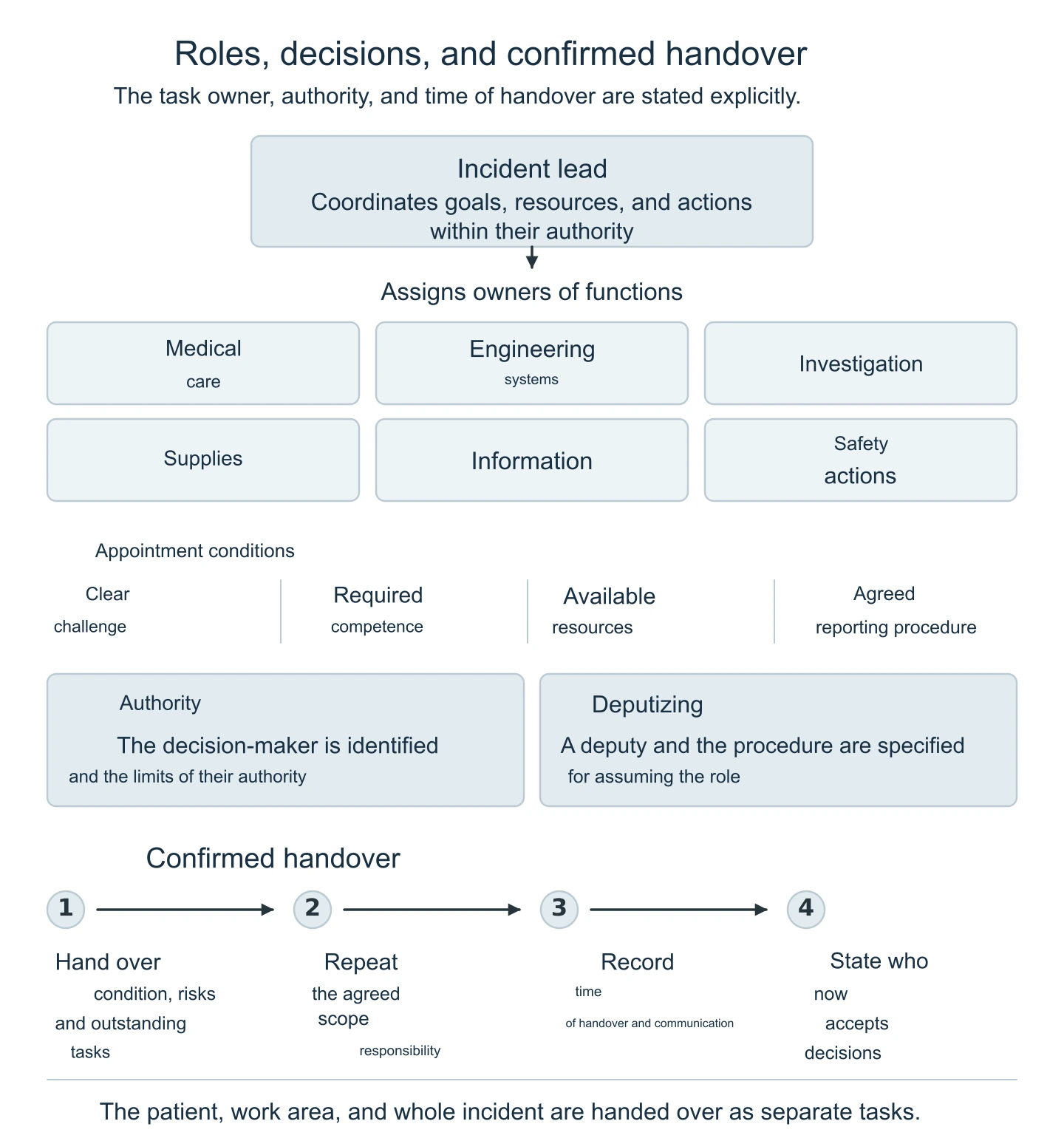
Figure 02. Roles, decisions and confirmed handover
Roles are defined by tasks and authority. A surrogate, available resources, and confirmed acceptance of responsibility are required for a valid transfer; a formal appointment is not enough.
Confirmed transfer
1. The transmitter describes the state of people and systems, the work performed, remaining risks and immediate decisions.
2. The recipient confirms in his own words what he is responsible for and what tasks have not yet been completed. Both parties check access to documents, communications and funds.
3. Both parties record the moment of transfer and how to contact if circumstances change.
4. The manager informs the performers who now makes decisions on the transferred tasks.
Each handover has a specific subject. The hospital admits a patient; the material is received by the specialized organization; management of the event passes to a designated person. The transmission of a general summary does not increase the authority of the recipient. Therefore, the record directly states what was transferred and what responsibilities remained with the former party.
Case Study R2: Transfer between Organizations
The organization Sever sent a sealed container to the organization Bereg. The sender has a dispatch record but no confirmation of receipt. The container's actual location and the person responsible for it remain unknown. No damage to the casing or exposure of people has been reported.
The first choice concerns the organization of the search. You can wait for the usual automatic notification, considering the transportation completed according to the sender’s record. You can immediately declare the container lost. Both formulations go further than known data. The manager records the confirmation gap and assigns an employee who will contact the recipient through the established channel.
The task for this employee should be verifiable: obtain the actual location, the name of the accepting person responsible and a description of unfinished actions. A request to “deal with the container” would leave the outcome to the discretion of the person responsible. While there is no response, the sender remains able to maintain contact and provides information for verification.
Bereg confirms the container's location and names the receiving employee. The question of location is now resolved. At this stage, however, the records still need to be compared to establish why the confirmation was not visible. A separately appointed specialist assesses the container's condition and whether further use is permissible, within that specialist's authority.
Thus, several different results appear: the location is confirmed, responsibility is accepted, the reason for the discrepancy in the documents is still being clarified. In the general summary they are not combined with the word “closed”. If a new anomaly is subsequently discovered, the team can determine which decision is affected.
In chapter 6 we will continue this case from the point of view of records. A written handover is useful precisely because it allows the other shift to see the boundaries of the completed decision. The completed sample transfer in the appendix shows how to keep these differences in a concise form.
Order conflict
In case of conflicting orders, the executor reports the conflict to a predetermined level of approval. An immediate threat to life and a dangerous operation are considered according to the facility's emergency procedures. Both orders and the final decision are stored in the journal so that subsequent analysis is based on the actual sequence of events.
In a training situation, the shift manager is unavailable, and life support resources are reduced. The appointed deputy acts within the limits of pre-delegated powers: includes an autonomous procedure according to P12 · p. 166, suspends non-essential work and requests support. The inability to obtain a manager's response remains a noted limitation.
The effectiveness of management is visible in the urgent question: who makes the decision, who will replace him in his absence, and who will confirm execution. This sequence is checked during training and during shift handover. In order for the next team to understand the basis for decisions already made, it will need a journal, the subject of the next chapter.
6 Decision log and version control
Navigation: NAV · p. 003 · Contents: OGL · p. 010
What should the journal save?
The journal stores information available at the time of decision, action and its result. During an emergency, a short note is sufficient. Later additions provide the author and time so as not to attribute to the team knowledge acquired subsequently.
For a decision, record the number, time, factual basis, significant unknowns, action, responsible person, date or event of review and result. If there is a deviation from the plan, the reason is indicated. Corrections maintain access to the original content.
recordkeeping units
Patients, facilities, and organizations receive individual records with numbers and explicit connections. The coincidence of a surname or room does not replace verification of the identity of the information. Reconciliation reveals both duplicates of one case and omissions: both errors distort the picture.
Record | Content owner | What is confirmed |
Medical decision | Responsible doctor | Reason, purpose, observation |
Changing Engineering Mode | Authorized Engineer | Configuration Validity and Validation |
Transfer of responsibility | Sending and receiving sides | Acceptance of the task and the moment of transition |
Change in overall rating | Head of Investigation | New information and impact on output |
Instruction version and data version
The new patient is registered in the current register. A change in case definition, triage order, or authority requires revision of the working document. The summary separately identifies the protocol version, operational case definition, and data update time.
The editor maintains a list of current documents. Line managers confirm content changes, and the person responsible for distribution confirms receiving the new version at work sites. The owner and date of verification of the paper copy helps to select a valid printout when the network is lost.
Continuation of analysis of R2: Two versions of the recording
Comparing the documents from Sever and Bereg reveals that the sender was looking at an old copy of the log. The current record already confirms receipt. This explains the discrepancy between the reports while preserving the actual chronology of events.
The person in charge saves the old entry, adds a confirmation, and notes the time the version error was discovered. Now both the moment of transfer of the container and the moment of its confirmation to the sender are visible. Subtly replacing the line would hide the reason for the scan being started.
The entry indicates the copy used, the confirmation received, its sender and open tasks. The phrase “everything is fixed” does not indicate whether the conditions for further use of the container have been assessed. Therefore, correction of recordkeeping and conclusion on suitability receive separate lines and responsible persons.
The employee finds out who still has the old copy and confirms receipt of the latest information. The reason for issuing an outdated record is analyzed separately. In chapter 58, checking the next transmission will show whether the fix worked.
Access and data minimization
Medical data are shared only with those who need them to provide care or carry out authorized work; the general summary contains the minimum necessary information. Before publication, check whether a combination of indirect identifiers could identify a particular person. The organization establishes the legal basis for access and the retention periods within its own jurisdiction.
In another training situation, shifts count cases using different definitions. The investigation director retains both versions, explains the differences, and compares notes. Otherwise, changing the recordkeeping may create a false impression that the event has changed.
The log should allow you to reconstruct the decision. A new required field is added if it supports a specific help, control, or verification task. Subsequent analysis and verification of corrections is described in G58 · p. 147.[17]