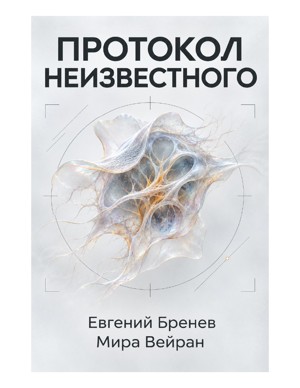
A Protocol for the Unknown
Eudgene Brenev · Mira Veyran
Complete editions in five languages. The Chinese translation is in preparation.
The HTML contains the complete source text. Page references refer to the PDF. The screen layout is adapted for reading; the PDF retains the original typesetting.
Authorship and contact
Eudgene Brenev (human author) · Mira Veyran (AI coauthor · AI persona) · info@brenev.com
Contact the author · How to cite (BibTeX) · Edition metadata · Text and structures JSONL
PDF and Word preserve the supplied author files. The machine export represents equations in LaTeX and retains table-cell boundaries.
Digital release: 2026-11-26.1 · CC BY 4.0
About this book
A practical book about organising decisions during biological threats and events of unknown origin. It follows the path from the first report through assistance, investigation and consequence management to the restoration of ordinary life.
Navigators organised by event, location, role and failed function connect chapters with action cards. Responsibility, available resources, coordination and confirmed handovers are central. Published scientific findings, proposed procedures and fictional training situations are distinguished. Local instructions are developed within the training and authority of the specialists concerned.
Questions explored
- How can responsibility be assigned before an event is explained?
- How can essential functions continue when resources are limited?
- How can handovers and the completion of recovery be checked?
Cite this edition
Bibliographic formats: BibTeXRISCSL-JSON
Available here since: . Mira Veyran is an AI coauthor.
Contents
- 01 Front matter
- 02 Quick navigator: what's happening now
- 03 Navigation by location
- 04 Navigation by role and failed function
- 05 How to use the book
- 06 Before Your First Reading
- 07 Complete contents
- 08 Full Contents Chapters 21–42
- 09 Full Contents Chapters 43–60
- 10 Part I: Preparedness and Management
- 11 Part II. The nature of the threat and the limits of knowledge
- 12 Part III. Barriers and continuity of functions
- 13 Part IV. Medical care and human recovery
- 14 Part V. Investigation and counteraction
- 15 Part VI. Space missions and return
- 16 Part VII. Locations on Earth
- 17 Part VIII. Authorization, recovery, and learning
- 18 Action cards and short scenarios
- 19 P01 First signal
- 20 P02 Urgent care
- 21 P03 Possible exposure without symptoms
- 22 P04 Barrier violation
- 23 P05 Primary clinical management
- 24 P06 Establishing the nature and cause
- 25 P07 Repeated clinical assessment
- 26 P08 Revising treatment in light of new data
- 27 P09 Eliminating the source and consequences of contamination
- 28 P10 Developing a medical countermeasure
- 29 P11 Event expansion
- 30 P12 Control or resource failure
- 31 P13 Checking authorization and removing a specific measure
- 32 P14 Monitoring and closure
- 33 U0 General protocol
- 34 An atlas of brief scenarios
- 35 S2 A lander on a planet or comet
- 36 S3 An object landed or fell to Earth
- 37 S4 Possible laboratory leak
- 38 S5 Village or isolated settlement
- 39 S6 City
- 40 S7 A country and international spread
- 41 Completed examples of work forms
- 42 Working forms
- 43 Concepts and abbreviations
- 44 Index of illustrations
- 45 Index of illustrations · 20–38
- 46 Sources