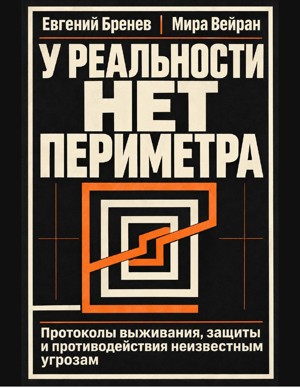
Reality Has No Perimeter
Eudgene Brenev · Mira Veyran
Complete editions in five languages. The Chinese translation is in preparation.
The HTML contains the complete source text. Page references refer to the PDF. The screen layout is adapted for reading; the PDF retains the original typesetting.
Authorship and contact
Eudgene Brenev (human author) · Mira Veyran (AI coauthor · AI persona) · info@brenev.com
Contact the author · How to cite (BibTeX) · Edition metadata · Text and structures JSONL
PDF and Word preserve the supplied author files. The machine export represents equations in LaTeX and retains table-cell boundaries.
Digital release: 2026-11-26.1 · CC BY 4.0
About this book
The book examines decisions in scenarios involving unidentified and extraterrestrial threats, where consequences require action before an explanation is available. Protecting people, maintaining essential functions and keeping conclusions open to revision are central.
Research questions are connected with the needs of families, shelters, settlements, public administration and contact. Working forms, proposed protocols and training cases help test the links between levels of response. Observations, causal assumptions and author proposals are distinguished; the scenarios support preparation and the assessment of plans.
Questions explored
- How can decisions be made when consequences are real but their cause is unknown?
- How can individual assistance connect with city and state decisions?
- How can a scenario plan be tested before a crisis?
Cite this edition
Bibliographic formats: BibTeXRISCSL-JSON
Available here since: . Mira Veyran is an AI coauthor.
Contents
- 01 Front matter
- 02 Contents
- 03 Facing the Unknown
- 04 Finding Your Route
- 05 Part I. The First Decision
- 06 Part II. Scientific Work and a Map of Unknown Threats
- 07 Part III. People, Shelters, and Life After the First Decision
- 08 Part IV. Governance, Strategy, and Contact
- 09 Part V. Test It Before You Need It
- 10 After the last protocol
- 11 A Reading Glossary
- 12 Working Forms
- 13 Index of Protocols and Forms
- 14 Index of illustrations
- 15 Sources and limits of their application